

Quick Brief
- Cisco unveiled Silicon One G300 at Amsterdam’s Cisco Live EMEA 2026 before 21,000 attendees
- G300 chip delivers 102.4Tbps programmable switching with 33% improved network utilization
- IDC forecasts global AI opportunity at $23.3 trillion by 2030, positioning Cisco as critical infrastructure provider
- New innovations include quantum-ready capabilities, enhanced AI Defense, and liquid-cooled systems with nearly 70% energy efficiency gains
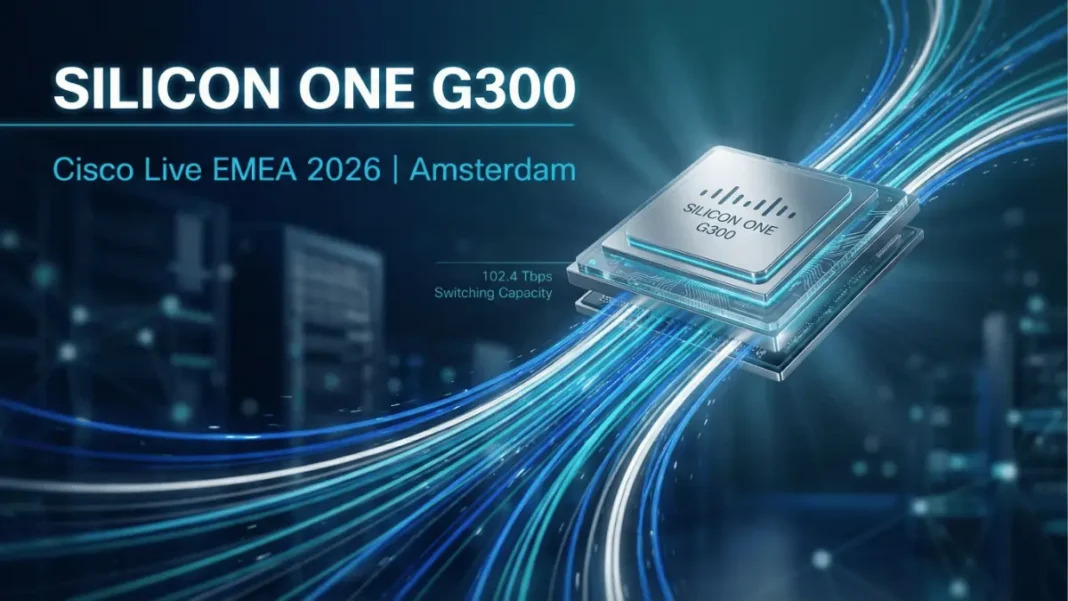
Cisco positioned itself as the definitive AI infrastructure company at Cisco Live EMEA 2026 in Amsterdam, where 21,000 customers, partners, and tech analysts witnessed the launch of Silicon One G300, a 102.4Tbps switching chip purpose-built for gigawatt-scale AI clusters. Gordon Thomson, Cisco’s EMEA president, framed the moment bluntly: “This is a defining moment for all of us,” referencing the seismic shift artificial intelligence is driving across enterprise technology. The announcements underscore Cisco’s aggressive play for a market IDC values at $23.3 trillion by 2030.
Silicon One G300 Targets AI Cluster Scalability
The Silicon One G300 represents Cisco’s most ambitious silicon advancement yet, delivering 102.4Tbps of full-duplex switching capacity through 512 SerDes lanes supporting up to 1.6Tbps Ethernet. Jeetu Patel, Cisco’s chief product officer, emphasized the chip’s programmability: “It enables infield upgrades without silicon spins, which means it’s fully programmable”. This flexibility allows data center operators to adapt network capabilities post-deployment without hardware replacement, a critical advantage as AI workloads evolve rapidly.
The G300 powers both Nexus 9000 series and Cisco 8000 series systems, available in air-cooled and liquid-cooled configurations. Cisco claims liquid-cooled models achieve nearly 70% improved energy efficiency compared to previous generations. The chip incorporates Intelligent Collective Networking, delivering 33% higher network utilization and 28% faster job completion times versus non-optimized traffic patterns.
What makes Silicon One G300 unique for AI workloads?
The G300 features a fully shared on-die packet buffer allowing any port to consume entire memory capacity. This architecture reduces packet loss and minimizes priority flow control events, maximizing RDMA and RoCE v2 protocol performance under varying traffic conditions. Hardware-based link monitoring automatically rebalances traffic under link failures, sustaining optimized utilization in large-scale networks.
Dual-Chip Strategy: Scale-Out Meets Scale-Across
Cisco’s Silicon One portfolio now addresses two distinct AI infrastructure challenges through complementary silicon. The G300 handles “scale-out” within single data centers, while the P200 chip announced last fall enables “scale-across” by connecting multiple data centers into unified AI clusters.
The P200 delivers 51.2Tbps throughput while processing 20 billion packets per second with 65% lower power consumption than prior generations. Its deep buffering capability prevents disruption when large packets traverse between data centers essential for distributed training workloads spanning geographic regions. Together, the G300 and P200 provide infrastructure flexibility from hyperscalers to sovereign private deployments.
Integrated Platform Advantage: Silicon to Security
Patel highlighted Cisco’s vertical integration as a “massive differentiator” in AI infrastructure competition. The company controls the full stack: silicon fabrication, system design, software development, security platforms, and observability tools all engineered to function as “one cohesive unit”.
This integration manifests in the Hybrid Mesh Firewall architecture, which fuses Cisco Secure Firewall with cloud protection products. Security enforcement extends from top-rack switches to server agents, with policy management spanning third-party products. Patel explained the rationale: “AI demands that security stays close to the workload”. The approach addresses the “no AI without trust” mandate Thomson emphasized, noting AI adoption requires starting with “safety and security”.
How does Cisco integrate security into AI networking?
Cisco embeds security directly into network silicon, enabling real-time protection without impacting AI workload performance. The Hybrid Mesh Firewall ties physical and virtual firewalls to Secure Workload and Hypershield, pushing unified policy across hybrid environments from branch to cloud. This “security fused into the fabric” model allows enforcement at the switch, server, or kernel-adjacent agent level.
Real Madrid Case Study: Infrastructure at Stadium Scale
Enrique Uriel, CIO of Real Madrid, validated Cisco’s end-to-end value proposition from the conference stage. Real Madrid has been a Cisco customer since 2000 and extended its partnership last year, deploying latest-generation networking, Wi-Fi, and security across the 83,000-seat Santiago Bernabéu Stadium. Uriel stated Cisco is “the only company that can deliver end-to-end a value chain that is seamless and providing robustness, reliability, scalability, and a present and a future”.
The stadium transformation demonstrates AI infrastructure principles applied to venue operations: high-density connectivity, real-time security monitoring, and scalable capacity management across massive concurrent user loads.
Agentic AI Transforms Operations and Customer Experience
Cisco introduced expanded AgenticOps capabilities centered on Cisco IQ, an agentic AI solution powering all Cisco services. Adele Trombetta, SVP for customer experience EMEA, described Cisco IQ as embedding “AI directly into your operation” with a focus on prevention over remediation: “We don’t just fix problems. We prevent them“.
The company previewed Cisco Cloud Control, a 2026 release consolidating management for Nexus One, Security Cloud Control, Intersight, Meraki Dashboard, and Splunk into a single interface. Patel characterized this as “completely reimagined and simplified agentic ops for managing your entire infrastructure estate”. The unified control plane reflects Cisco’s platform strategy reducing operational complexity while increasing visibility across hybrid environments.
What is Cisco IQ and how does it improve operations?
Cisco IQ is an agentic AI system that provides personalized, conversational interactions to resolve infrastructure issues faster and with less manual effort. It combines agentic AI automation with human expertise, creating what Trombetta calls “a fantastic ecosystem” working alongside customer teams and partners. The system emphasizes proactive issue prevention through predictive analytics embedded in operations workflows.
Quantum-Ready and Advanced Optics Announcements
Beyond silicon, Cisco Live EMEA 2026 introduced quantum-ready capabilities and advanced optics systems. The quantum-ready networking addresses future cryptographic vulnerabilities as quantum computing advances toward practical deployment. The advanced optics innovations pair with G300 and P200 chips to optimize end-to-end performance.
Energy Efficiency and Liquid Cooling Adoption
Liquid-cooled G300 systems address the thermal and power density challenges AI clusters create. Data centers running thousands of GPUs and high-throughput switches generate heat loads air cooling cannot economically manage at scale. Cisco’s nearly 70% energy efficiency improvement claim for liquid-cooled G300 systems reflects both chip-level optimization and thermal management innovation.
Energy efficiency directly impacts AI infrastructure economics. IDC’s $23.3 trillion AI opportunity projection reflects the massive scale of transformation across industries. Cisco’s ability to deliver 102.4Tbps switching with liquid cooling at data center scale positions the G300 for hyperscale AI deployments.
Platform Strategy and 2026 Roadmap
Patel closed Cisco Live EMEA 2026 keynotes emphasizing platform consolidation: “This is going to be an amazing year. I’m so excited about what we have to offer”. The roadmap centers on Cisco Cloud Control as the unifying interface for infrastructure management, security policy, and observability.
Cisco’s platform vision addresses the operational complexity AI introduces multiple clouds, hybrid deployments, distributed workloads, and security enforcement at unprecedented scale. By integrating Splunk’s observability and analytics with Cisco’s networking and security portfolio, the company offers correlated insights across the infrastructure stack.
Thomson’s closing remarks reinforced confidence in Cisco’s market position: “I’m confident that there’s no one better than Cisco to deliver the outcomes you need in the future”. The Silicon One G300, backed by integrated security, agentic operations, and unified management, represents Cisco’s technical answer to that claim.

Frequently Asked Questions (FAQs)
When was Cisco Silicon One G300 announced?
Cisco announced Silicon One G300 on February 10, 2026, at Cisco Live EMEA in Amsterdam before 21,000 customers, partners, and tech analysts. The chip targets AI data center deployments with 102.4Tbps switching capacity and programmable architecture for post-deployment upgrades.
What is the switching capacity of Silicon One G300?
Silicon One G300 delivers 102.4Tbps full-duplex switching through 512 SerDes lanes supporting up to 1.6Tbps Ethernet. It enables 64x 1600 Gigabit Ethernet ports with deterministic, low-latency performance optimized for RDMA and RoCE v2 protocols in AI clusters.
How much is the global AI infrastructure market worth?
IDC estimates the global AI opportunity at $23.3 trillion by 2030. Cisco positions itself as a critical infrastructure provider targeting this market through Silicon One chips and integrated platform strategy.
What systems use Silicon One G300?
Silicon One G300 powers Cisco Nexus 9000 series and Cisco 8000 series systems. Both platforms offer air-cooled and liquid-cooled configurations, with liquid-cooled models achieving nearly 70% improved energy efficiency compared to previous generations.
What is Cisco’s Hybrid Mesh Firewall?
Hybrid Mesh Firewall combines physical and virtual Cisco Secure Firewalls with cloud protection products, Secure Workload, and Hypershield. It extends security policy management to third-party products, enforcing protection from branch networks to cloud environments with unified control.
How does G300 improve AI job completion times?
G300’s Intelligent Collective Networking delivers 33% increased network utilization and 28% faster AI job completion times versus non-optimized traffic. The fully shared on-die packet buffer minimizes packet loss and priority flow control events, sustaining high throughput under varying traffic conditions.
What is Cisco Cloud Control?
Cisco Cloud Control is a 2026 release providing unified management for Nexus One, Security Cloud Control, Intersight, Meraki Dashboard, and Splunk. It offers “completely reimagined and simplified agentic ops” through a single interface for managing entire infrastructure estates.
How does Silicon One G300 compare to P200?
G300 delivers 102.4Tbps for “scale-out” within single data centers, while P200 provides 51.2Tbps for “scale-across” connecting multiple data centers. P200 features deep buffering for large packets traversing geographic distances and processes 20 billion packets per second, complementing G300’s intra-cluster switching for distributed AI workloads.

