

Key Takeaways
- Claude Opus 4.6 launched in Notion on February 9, 2026 with autonomous task execution
- Adaptive thinking adjusts reasoning depth automatically across four effort levels
- Context compaction enables conversations exceeding 200K tokens without limit errors
- Agent teams coordinate multiple AI workers on complex projects simultaneously
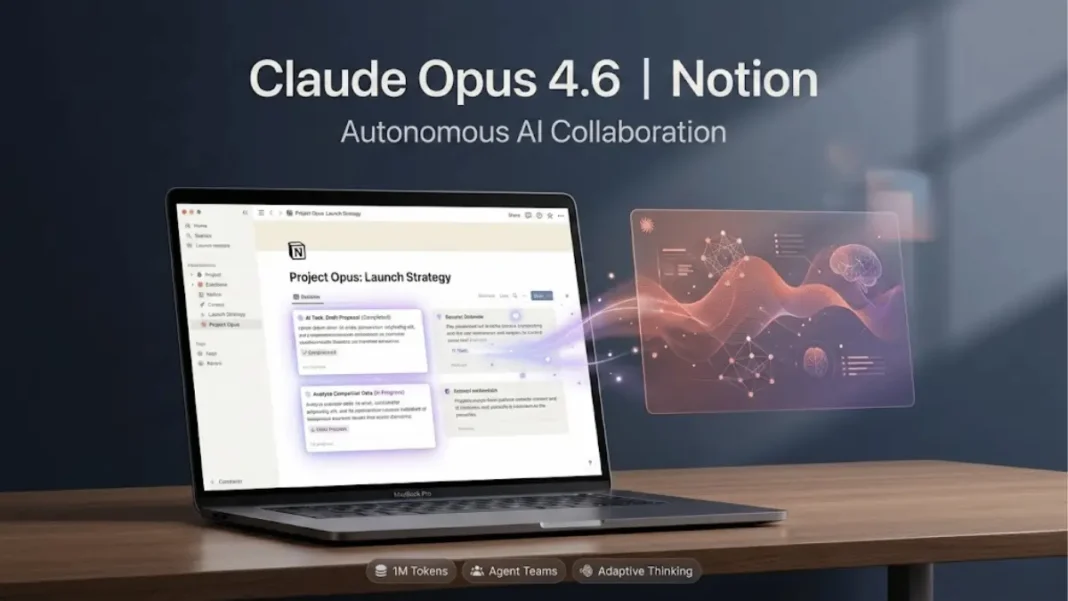
Notion deployed Claude Opus 4.6 on February 9, 2026 Anthropic’s most capable AI model to date. This integration transforms how Notion users approach complex workflows, shifting from basic assistance to autonomous collaboration. According to Notion’s announcement, the model operates “less like a tool and more like a capable collaborator” that breaks ambitious tasks into concrete steps and executes them independently.
What Makes Claude Opus 4.6 Different
Autonomous Task Execution Without Hand-Holding
Claude Opus 4.6 operates as a persistent collaborator rather than a reactive assistant. When assigned multi-step projects like building database structures, drafting reports, or organizing research the model plans independently, executes sub-tasks, and delivers polished results. The architecture enables sustained focus across extended sessions without drift.
Microsoft Azure testing confirms the model handles “complex, multi-tool workflows with less oversight,” essential for teams scaling AI operations. This capability stems from improved instruction-following and context retention across extended sessions.
Adaptive Thinking Balances Speed and Intelligence
Previous Anthropic models offered binary extended thinking controls. Claude Opus 4.6 introduces adaptive thinking the AI autonomously determines when deep reasoning benefits the task. Simple queries receive instant responses; complex challenges trigger extended analysis without manual toggling.
Developers control four effort levels via API: low, medium, high (default), and max. Customer service teams use low effort for speed; financial analysts deploy max effort for accuracy-critical work. This granular control optimizes the intelligence-cost-speed triangle based on task requirements.
Context Compaction Eliminates Token Limits
Long-running agentic tasks traditionally crash when conversations approach context window limits. Claude Opus 4.6’s context compaction (beta) automatically summarizes older conversation segments when approaching configurable thresholds, preserving continuity beyond 200K tokens.
The model supports up to 1 million tokens in beta, with premium pricing beyond 200K. For Notion users managing multi-day projects with accumulated context, this prevents workflow interruptions from “context exceeded” errors.
Agent Teams Parallelize Complex Projects
Claude Opus 4.6 proactively creates sub-agents to distribute workload. When facing tasks requiring parallel execution like analyzing datasets while drafting documentation the model spins up specialized agent teams without user intervention. Each sub-agent operates with independent context windows while coordinating through shared task lists.
Anthropic demonstrated this capability by building a C compiler with 16 coordinated agents, producing 100,000 lines of Rust code that successfully compiled the Linux 6.9 kernel. Microsoft Foundry deployments leverage this across “legacy systems, document processing, and operational tools”.

How Notion Users Benefit
Coding and Database Development
Claude Opus 4.6 demonstrates state-of-the-art coding performance across languages. Notion users building Formulas, API integrations, or custom database views receive syntactically accurate code with context-aware suggestions. The model “plans more carefully, sustains agentic tasks for longer, and operates interfaces more reliably” than predecessors.
Knowledge Work and Documentation
The AI handles research-heavy tasks requiring synthesis across multiple sources. When compiling reports, it retrieves data from linked Notion pages, cross-references information, and structures outputs according to specified formats. Testing shows the model explores details and creates structures beyond initial specifications.
Workflow Automation
Notion’s recent Workflow Blocks update pairs with Claude Opus 4.6 for embedded AI assistance. Instead of chat interfaces, the AI operates within automation sequences triggering actions, populating fields, and routing tasks based on content analysis. This “assistive intelligence” approach suits power users managing complex project pipelines.
Technical Specifications
| Feature | Claude Opus 4.6 | Previous Models |
|---|---|---|
| Context Window | 1M tokens (beta) | 200K tokens standard |
| Output Tokens | 128K maximum | 64K maximum |
| Reasoning Control | 4 effort levels + adaptive | Binary on/off |
| Context Management | Auto-compaction | Manual limit handling |
| Agent Capabilities | Multi-agent coordination | Single-thread execution |
| Release Date | February 5, 2026 |
Comparison With Competing Models
Claude Opus 4.6 arrived on February 5, 2026 amid steady improvements across AI tools. ChatGPT improved reliability and instruction-following during the same period. However, Anthropic’s model distinguishes itself through sustained agentic performance maintaining task focus across hours without drift.
Perplexity Pages and Canva AI focused on specialized use cases (research structuring, brand-tone consistency) rather than general-purpose autonomy. Claude’s 1M token context window exceeds standard implementations, critical for enterprise knowledge work.
Pricing and Availability
Notion integrated Claude Opus 4.6 starting February 9, 2026 for all users. The model operates as Notion’s default AI option. Anthropic charges premium rates beyond 200K tokens when using the 1M context window. US-only inference carries an additional 1.1x pricing multiplier.
Enterprise Notion accounts gain additional controls including workspace-level AI tool permissions. These governance features address security requirements for organizations deploying AI at scale.
Limitations to Consider
While Claude Opus 4.6 demonstrates advanced reasoning, it maintains Anthropic’s conservative output tendency. Users seeking creative or speculative content may find responses measured compared to models optimized for generative tasks.
The adaptive thinking system requires testing to identify optimal effort levels for specific workflows. Teams should benchmark performance across low, medium, high, and max settings to balance cost and output quality.
Context compaction remains in beta edge cases may produce unexpected summarization behaviors during extended sessions. Monitoring conversation continuity helps identify when manual context pruning improves results.
What This Means for Productivity
Claude Opus 4.6’s integration marks a shift from AI-assisted to AI-autonomous work. Notion users can delegate entire project components not just sentence generation or data lookup to an AI that sustains focus, self-corrects, and delivers publication-ready outputs.
Organizations gain measurable efficiency through reduced oversight requirements. The model’s reliability in “high-stakes reasoning” scenarios enables deployment across security workflows, financial analysis, and operational decision-making previously requiring human validation.
For individual users, the practical impact appears in reduced context-switching. Instead of prompting AI, reviewing output, correcting errors, and re-prompting, users work with a model that maintains multi-session continuity and executes complex tasks end-to-end.

Frequently Asked Questions (FAQs)
What is Claude Opus 4.6 in Notion?
Claude Opus 4.6 is Anthropic’s most advanced AI model, integrated into Notion on February 9, 2026. It autonomously executes complex tasks by breaking them into steps, planning workflows, and producing polished results without constant supervision.
How does adaptive thinking work in Claude Opus 4.6?
Adaptive thinking allows Claude to automatically determine when deep reasoning is required. Simple questions receive fast responses; complex challenges trigger extended analysis. Developers can set four effort levels (low, medium, high, max) to control intelligence-speed-cost balance.
What is context compaction in Claude Opus 4.6?
Context compaction automatically summarizes older conversation segments when approaching token limits. This enables Claude to handle tasks exceeding 200K tokens without errors. The feature supports conversations up to 1 million tokens in beta.
How do agent teams work in Claude Opus 4.6?
Agent teams allow Claude to create multiple sub-agents with independent context windows. A lead session coordinates overall projects while agents work on different components simultaneously through shared task lists. Anthropic tested this by building a C compiler with 16 agents.
When did Notion add Claude Opus 4.6?
Notion integrated Claude Opus 4.6 on February 9, 2026, four days after Anthropic’s official release on February 5. The model is available to all Notion users as the default AI option.
Can Claude Opus 4.6 handle coding tasks in Notion?
Yes. Claude Opus 4.6 demonstrates state-of-the-art coding performance across programming languages. It generates syntactically accurate code for Notion Formulas, API integrations, and database queries with minimal errors.
How much does Claude Opus 4.6 cost in Notion?
Notion includes Claude Opus 4.6 access in standard plans. Anthropic charges premium rates when conversations exceed 200K tokens using the 1M token context window. US-only inference carries a 1.1x pricing multiplier.
What are agent teams in Claude Opus 4.6?
Agent teams allow Claude to create multiple sub-agents that work on different task components simultaneously. The primary model coordinates these agents through shared task lists. Anthropic demonstrated this by building a 100,000-line C compiler with 16 agents.
Is Claude Opus 4.6 better than ChatGPT for Notion users?
Claude Opus 4.6 excels at sustained agentic tasks requiring multi-step execution and long context retention. ChatGPT improved instruction-following in early 2026 but focuses on conversational reliability rather than autonomous project completion.
Does Claude Opus 4.6 work offline in Notion?
No. Claude Opus 4.6 requires internet connectivity as it processes requests through Anthropic’s API. All AI features in Notion operate online.
Can I switch between AI models in Notion?
Yes. Notion allows users to select between available AI models. Claude Opus 4.6 serves as the default option after February 9, 2026, but model selection remains accessible.
What is the context window limit for Claude Opus 4.6?
Claude Opus 4.6 supports up to 1 million tokens in beta, with standard usage at 200K tokens. Context compaction extends conversations beyond these limits by auto-summarizing older content.

