

Quick Brief
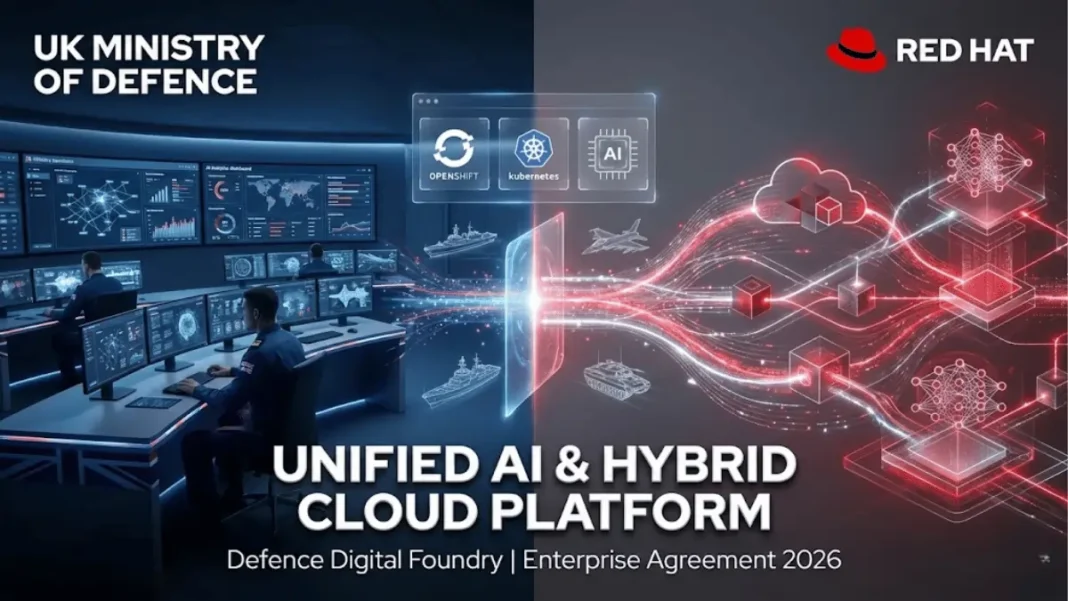
- UK MOD signs enterprise agreement with Red Hat to standardize hybrid cloud and AI deployment across Royal Navy, British Army, and Royal Air Force
- Defence Digital Foundry gains centralized access to Red Hat Enterprise Linux, OpenShift Platform Plus, Ansible Automation Platform, and Red Hat AI
- Agreement enables AI model deployment from data centers to tactical edge with consistent security footprint across defence operations
- Computacenter partners to onboard MOD teams and approved third-party providers starting February 2026
The UK Ministry of Defence has restructured its digital infrastructure with a new Red Hat partnership announced February 11, 2026. The enterprise agreement provides Defence Digital Foundry with unified access to Red Hat’s hybrid cloud and AI platforms across all service branches. This marks a shift from fragmented pilots to a standardized platform engineering approach that enables rapid AI deployment at military scale.
Defence Digital Foundry: The Hub Behind UK Military Modernization
Defence Digital Foundry operates as the central software delivery organization for the UK Ministry of Defence, supporting the Royal Navy, British Army, Royal Air Force, Space Command, and Cyber & Specialist Operations Command. Part of Defence Digital which operates with an annual budget exceeding £2 billion and a team of 2,500 colleagues the Foundry focuses specifically on building user-facing digital services and enabling platforms for defence operations.
The organization’s mission centers on providing strategic advantage through rapid software delivery based on agile practices and data exploitation. Operating within Defence Digital, the Foundry pioneers methods to harness artificial intelligence and emerging technologies for battlespace outcomes. The new Red Hat agreement standardizes this infrastructure, eliminating technology silos that previously slowed innovation across different military branches.

Red Hat Technologies Deployed Across MOD Operations
The enterprise agreement provides MOD teams and approved third-party suppliers with centralized access to five core Red Hat platforms. Red Hat Enterprise Linux serves as the foundational operating system for defence applications. Red Hat OpenShift Platform Plus delivers the hybrid cloud application platform powered by Kubernetes, enabling deployment from on-premise data centers to cloud environments and tactical edge locations.
Red Hat Ansible Automation Platform unifies previously disconnected automation efforts across MOD teams for IT operations, configuration management, and security orchestration. Red Hat AI accelerates development and deployment of artificial intelligence solutions with optimized inference capabilities. Red Hat OpenShift Virtualization provides a migration path for existing virtual machines while managing containerized workloads side-by-side.
Computacenter supports the ongoing onboarding process, ensuring MOD users can access Red Hat Services including technical experts, hands-on training, and dedicated consulting time.
AI Deployment From Data Center to Tactical Edge
What is the UK MOD’s AI deployment strategy?
The UK Ministry of Defence is implementing a unified AI platform that enables algorithm development once and deployment anywhere whether on-premise, in the cloud, or on disconnected field devices. Red Hat AI addresses the “inference gap” between data science teams and operational infrastructure by providing a consistent MLOps environment.
The agreement breaks down data silos and accelerates AI model deployment from centralized data centers to the tactical edge. This standardization allows developers to choose appropriate AI models and hardware accelerators for specific mission requirements without vendor lock-in. The platform supports optimized inference, ensuring AI models run efficiently on restricted hardware footprints typical in military field environments.
Defence Digital Foundry will now provide a consistent MLOps environment to all service branches, replacing fragmented AI pilots with enterprise-scale deployment capabilities. According to Mivy James, CTO at the UK Ministry of Defence, “Easing access to Red Hat platforms becomes all the more important for the UK Ministry of Defence in the era of AI, where rapid adoption, replicating good practice, and the ability to scale are critical to strategic advantage“.
Hybrid Cloud Flexibility for Military Operations
The enterprise agreement delivers hybrid cloud capabilities that allow MOD personnel to build applications and deploy them on premise, in any cloud, or at the edge. This flexibility proves essential for defence operations that span fixed installations, mobile command centers, and disconnected tactical environments.
Red Hat OpenShift enables agile practices including microservices architecture, DevSecOps integration, and secure-by-design principles across MOD domains. Teams gain scalable access from prototype development to operational deployment, supporting faster time-to-market for new applications and software updates. The platform abstracts cloud complexity, allowing teams to move workloads between environments while maintaining consistent developer experience.
Cybersecurity and Trusted Software Supply Chain
How does the Red Hat agreement improve MOD cybersecurity?
The partnership establishes a consistent security footprint across all MOD operations through standardized Red Hat platforms. DevSecOps practices integrate security gates directly into the software supply chain, maintaining trusted software pedigree when incorporating code from approved third-party providers.
Simplified lifecycle management of applications and trusted software supply chain reduces fragmentation created by technology silos. Collaboration and sharing of best practices across teams provides upskilling opportunities while reducing duplication. The standardized platform enables faster innovation with approved third-party providers able to align deliverables with MOD’s security requirements.
Red Hat Ansible Automation Platform enforces governance as AI models are retrained and redeployed. Configuration management, security orchestration, and service provisioning remain compliant with defence standards through automated enforcement mechanisms. This approach maintains cybersecurity posture while operating at military scale across diverse environments.
Legacy System Migration and Virtualization Strategy
Red Hat OpenShift Virtualization addresses a major challenge in defence modernization: coexistence of legacy virtualized workloads with modern containerized AI applications. The platform provides a migration path for existing systems, allowing MOD to manage traditional virtual machines alongside new neural networks on the same control plane.
This capability reduces operational complexity by eliminating the need to maintain separate infrastructure for legacy and modern applications. MOD gains flexibility to manage both workload types side-by-side during the transition period. The migration approach supports gradual modernization rather than requiring disruptive wholesale replacement of working systems.
Enterprise-Wide Automation and Efficiency Gains
The Red Hat Ansible Automation Platform provides a unified approach for MOD teams to reduce manual tasks, increase efficiency, and drive repeatability at scale. This consolidation moves beyond fragmented automation efforts that previously existed across different military branches and departments.
Automation extends across IT operations, configuration management, security orchestration, and service provisioning. Teams achieve consistency in processes while reducing human error in repetitive tasks. The platform enables rapid scaling of best practices across the organization once patterns are established and validated.
According to Joanna Hodgson, Regional Manager for UK and Ireland at Red Hat, “Red Hat offers flexibility and scalability to deploy any application or any AI model on their choice of hardware whether on premise, in any cloud, or at the edge helping the UK Ministry of Defence to harness the latest technologies, including AI“.
Developer Productivity and Modern Application Development
Red Hat OpenShift delivers a hybrid cloud application platform powered by Kubernetes, enabling modern development practices across MOD domains. Developers gain increased productivity with consistent tooling and workflows regardless of deployment target. The scalable access model supports teams from initial prototype through operational deployment without infrastructure changes.
Agile practices including microservices architecture and DevSecOps integration accelerate software update cycles. Teams deliver new capabilities faster while maintaining security and reliability standards required for defence operations. The common platform reduces learning curves as personnel move between projects or transfer between service branches.
Strategic Implications for UK Defence Capabilities
Why is platform standardization critical for military AI adoption?
Standardizing on Red Hat infrastructure decouples AI capabilities from underlying hardware, enabling algorithm portability across diverse military environments. This platform engineering approach addresses bottlenecks in enterprise AI deployment that have hindered previous defence modernization efforts.
The agreement enables MOD to unify disparate AI efforts and reduce duplication across large government IT programs. Success in defence environments depends on the ability to reliably deliver, update, and govern models at scale. The unified platform transforms AI maturity from isolated experiments to operational deployment capabilities across all service branches.
Mivy James emphasized the strategic importance: “Red Hat is helping Defence Digital Foundry build our unified, modern digital backbone to keep the UK Ministry of Defence agile and innovative. With this enterprise agreement, people up and down the country working for the UK Ministry of Defence can more easily and reliably access tools and collaborate using common Red Hat-based platforms“.
Ecosystem Engagement and Third-Party Collaboration
The enterprise agreement extends beyond internal MOD teams to include approved third-party providers working on MOD technology programmes and capabilities. This ecosystem engagement enables faster innovation by standardizing the technology foundation that suppliers build upon.
Approved providers can now align their deliverables with MOD’s Red Hat environment, reducing integration friction and accelerating deployment timelines. The common platform facilitates collaboration between internal teams and external partners on the same infrastructure. This approach builds a broader defence technology ecosystem around standardized open source foundations.
Defence Digital Structure and Digital Services
Defence Digital Foundry operates within the broader Defence Digital organization, which serves as the primary hub for digital services across the Ministry of Defence. The Foundry maintains dedicated sub-organizations including Software Products teams that build and support digital products and services, Digital Integration Services that support programmes with specialist capabilities, and Technology and Futures teams that explore emerging technologies.
The organization connects closely with the Defence Artificial Intelligence Centre (DAIC), which focuses on accelerating AI adoption across defence. This integration ensures AI capabilities developed through the Red Hat partnership align with broader MOD digital transformation initiatives. The Foundry’s structure enables rapid delivery of software solutions while maintaining security and compliance standards required for defence operations.
Implementation Timeline and Deployment Progress
The agreement was announced February 11, 2026, with onboarding activities underway. Computacenter leads the implementation process, managing access provisioning for MOD teams and approved third-party providers. MOD users gain access to Red Hat Services including technical account management, hands-on training sessions, and dedicated consulting time to accelerate adoption.
This support structure aims to get teams operational quickly and ease integration of Red Hat offerings into existing programmes. The enterprise agreement structure allows organic growth as additional teams and projects onboard to the standardized platform over time.

Frequently Asked Questions (FAQs)
What is Defence Digital Foundry?
Defence Digital Foundry is the UK Ministry of Defence’s central software delivery organization that provides digital services, enabling platforms, and tools for all service branches. Operating within Defence Digital, it builds user-facing applications and common platforms for the Royal Navy, British Army, Royal Air Force, and other defence commands.
Which Red Hat technologies are included in the MOD agreement?
The enterprise agreement covers Red Hat Enterprise Linux, Red Hat OpenShift Platform Plus, Red Hat Ansible Automation Platform, Red Hat AI, and Red Hat OpenShift Virtualization. MOD teams and approved suppliers gain centralized access to all platforms with full support services.
How does Red Hat AI benefit military operations?
Red Hat AI enables development of algorithms once and deployment anywhere from data centers to tactical edge locations. The platform provides optimized inference for restricted hardware environments, supports any AI model on any accelerator, and creates a consistent MLOps environment across all service branches.
What role does Computacenter play in this partnership?
Computacenter supports ongoing onboarding and access provisioning for the enterprise agreement. The company manages deployment logistics, ensuring MOD teams and approved third-party providers can access Red Hat platforms and services.
How does this agreement improve UK defence cybersecurity?
The standardized Red Hat platform establishes a consistent security footprint across all MOD operations. DevSecOps practices integrate security gates into the software supply chain, while automated governance ensures compliance with defence standards as applications and AI models are deployed.
Can legacy systems coexist with new AI applications?
Yes. Red Hat OpenShift Virtualization provides a migration path for existing virtual machines while managing containerized AI workloads side-by-side. This reduces operational complexity and allows gradual modernization without disruptive wholesale replacement.
What is the strategic advantage of platform standardization?
Standardizing on Red Hat infrastructure decouples capabilities from specific hardware, enabling portability across military environments. It reduces duplication, accelerates best practice sharing, and transforms AI from isolated pilots to enterprise-scale deployment across all service branches.
Which military branches will use this platform?
The Red Hat platform will serve the Royal Navy, British Army, Royal Air Force, Space Command, and Cyber & Specialist Operations Command through Defence Digital Foundry’s centralized software delivery organization.

