

Quick Brief
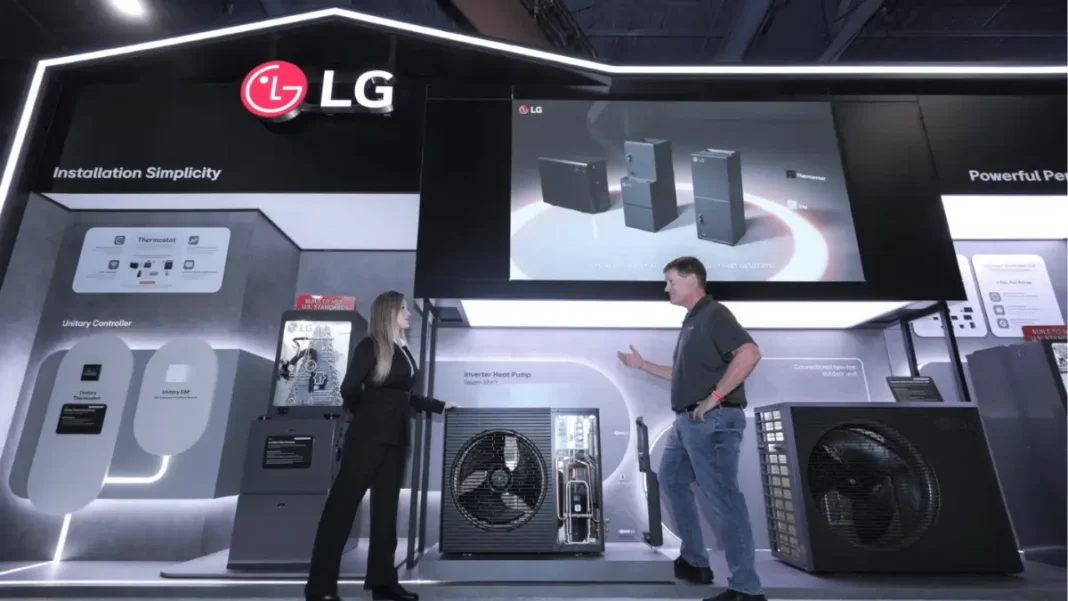
- LG’s AHR Expo 2026 booth spans residential, commercial and industrial HVAC, including AI data center liquid cooling.
- New inverter rooftop units maintain heating performance down to –5°C without backup heaters.
- Modular inverter scroll heat pump chillers scale from 30RT to 540RT with IPLV up to 21.2 Btu/Wh.
- CoreTech components scroll compressors, EC motors, fans, drives are tuned for 2029 U.S. DOE standards.
LG is using AHR Expo 2026 in Las Vegas to position itself as a full‑stack HVAC vendor, from residential unitary systems to AI data center liquid cooling. For mobile readers, what matters is not booth spectacle but how these systems might change operating costs, compliance and risk in the next five to ten years. This guide breaks down LG’s lineup into decisions you can actually use whether you manage a U.S. strip mall, design Indian data halls, or simply track where HVAC hardware is heading.
Why LG’s AHR Expo 2026 lineup matters now
AHR Expo 2026 runs from February 2 to 4 at the Las Vegas Convention Center and remains the largest dedicated HVAC/R event globally, with thousands of professionals and hundreds of new product launches. LG is using this platform to show a portfolio that explicitly targets decarbonization, chilled‑water adoption in North America and the cooling load spike from AI workloads. A similar narrative appears in Daikin’s AHR announcements, which emphasize low‑GWP refrigerants, cold‑climate heat pumps and hyperscale data center chillers.
What is AHR Expo 2026?
AHR Expo 2026 is a three-day international HVAC/R trade show at the Las Vegas Convention Center, running February 2–4. It brings together over a thousand manufacturers and suppliers who launch new heating, cooling, ventilation and refrigeration technologies, with an explicit focus on efficiency, decarbonization and smart controls.
For LG, the latent user trigger here is simple: “Will this help me survive stricter U.S. DOE rules and higher energy prices without ripping out entire systems twice?” The company’s messaging leans hard on integrated solutions systems plus components rather than single hero products.
Inside LG’s residential unitary HVAC and water heating lineup
On the residential side, LG is debuting an integrated unitary HVAC lineup designed for North American single‑family homes, including regions with high ceilings and ducted distribution. The outdoor inverter heat pump units keep a compact sub‑39.3‑inch height and use a single‑fan, all‑black grille design, making them easier to place visually and mechanically. Multi‑position air handling units support vertical, horizontal and downflow mounting to match varied floor plans without redesigning ductwork.
To mitigate refrigerant risk, LG’s A‑coils embed R32 leak detection sensors, while gas furnaces support dual‑fuel operation for cold‑climate backup. A dedicated thermostat talks directly to the inverter and connects over Wi‑Fi to LG ThinQ, which can simplify zoning and demand‑response setups by reducing extra control wiring. On water heating, LG pairs inverter heat pump water heaters with condensing tankless gas models that use dual stainless heat exchangers and electric units with upgraded insulation for better heat retention.
What is LG’s residential unitary HVAC lineup at AHR Expo 2026?
LG’s residential unitary lineup at AHR Expo 2026 combines compact inverter heat pump outdoor units, multi‑position air handlers and dual‑fuel gas furnaces. The systems add R32 refrigerant leak detection, Wi‑Fi‑enabled thermostat control and extended water heater options, aiming to cover diverse U.S. housing types and climate zones.
For U.S. installers, that means less custom engineering per house type and a clearer path to R32‑based systems that still respect homeowner comfort expectations. For Indian readers watching from afar, the key takeaway is the direction of travel: high‑efficiency inverter heat pumps with app‑centric control and leak‑sensing will likely cascade into global portfolios over the next product cycles.
Inverter rooftop units, Multi V i and ACP i: LG’s commercial play
LG’s new inverter rooftop units (RTUs), manufactured for the U.S. market, maintain heating performance down to –5°C (23°F) without auxiliary heaters, which directly targets shoulder‑season gas consumption. They connect to building automation systems and prioritize service access, so technicians spend less time fighting panels just to reach boards and fans.
The commercial story extends into variable refrigerant flow with the AI‑powered Multi V i system, which combines high‑efficiency inverter compressors with AI‑driven control to adjust capacity and airflow in real time. LG is also introducing ACP i, a building control platform that centralizes monitoring, flags anomalies early and offers data‑based optimization recommendations, effectively turning disparate units into a coordinated fleet.
What is LG’s inverter rooftop unit?
LG’s inverter rooftop unit is a commercial HVAC system designed for North American buildings that maintains stable heating down to –5°C without backup heaters. It supports building automation integration, improved component access for service and inverter‑driven efficiency aimed at upcoming efficiency and refrigerant regulations.
For facility managers, the pattern is clear: LG wants to compete directly with Daikin’s NEXIO rooftop line and other intelligent RTUs by offering comparable inverters plus tighter integration with its own controls and components.
AI data center cooling and modular chillers
On the heavy commercial and industrial side, LG is anchoring its AHR presence around modular inverter scroll heat pump chillers and liquid cooling for AI data centers. The modular chiller design uses 30RT building blocks that can scale to 60, 90 and up to 540RT (six units) on a shared power and piping connection, controlled through a touchscreen HMI. LG states an Integrated Part Load Value (IPLV) of 21.2 Btu/Wh for a 30RT module tested under ANSI/AHRI 551/591, which is squarely in high‑efficiency territory.
For AI data halls, LG is showing oil‑free inverter centrifugal chillers alongside a coolant distribution unit (CDU) and cold plate solution. The CDU regulates coolant temperature and flow and uses slide‑rail pump access plus quick‑release filters to simplify maintenance, while cold plates sit directly on high‑TDP chips to cut air‑side cooling inefficiencies.
How is LG cooling AI data centers?
LG cools AI data centers with liquid cooling systems that pair oil‑free centrifugal chillers, coolant distribution units and cold plates mounted on high‑power chips. This design reduces space use, raises energy efficiency versus air cooling and supports higher rack densities typical of AI workloads.
Daikin is attacking the same problem from another angle with its Magnitude WME‑C Quad Chiller and AWM air‑cooled chiller, both tuned for hyperscale data centers with low‑GWP refrigerants and magnetic‑bearing compressors. For engineers, this competition is useful: it signals that liquid and high‑efficiency chilled‑water solutions are no longer fringe but the new baseline for mission‑critical cooling.
CoreTech components and rooftop unit kits
Beyond finished systems, LG is pitching itself as a “total component solution” provider for rooftop units, bundling large scroll compressors, EC motors, EC fans and drives as an integrated kit. Scroll compressors span roughly 6 to 27.5 RT and are designed to hit upcoming U.S. DOE standards that emphasize real‑world partial‑load efficiency rather than peak nameplate capacity.
LG’s proprietary core technologies BHA Series DualJet for reciprocating compressors, TriVane for rotary compressors and CurvedSpoke for BLDC motors are meant to shrink footprints while boosting energy density and reliability. The pitch is that by sourcing from one vertically integrated vendor, OEMs and large contractors can simplify compatibility, maintenance and long‑term support.
What HVAC core components is LG highlighting at AHR Expo 2026?
LG is highlighting scroll compressors up to about 27.5 RT, EC motors, EC fans and drives tailored for commercial rooftop units. These CoreTech components incorporate proprietary designs such as DualJet, TriVane and CurvedSpoke to increase partial‑load efficiency and align with stricter U.S. DOE standards expected from 2029.
LG vs Daikin vs Carrier at AHR 2026
| Brand / focus area | Data center & mission‑critical | Rooftop / light commercial | Refrigerant & efficiency angle |
|---|---|---|---|
| LG | Oil‑free centrifugal chillers plus CDU and cold plates for AI data centers. | New inverter RTUs for U.S. market, scalable scroll heat pump chillers up to 540RT. | Emphasis on inverter efficiency, R32 in residential and commercial solutions, high IPLV claims. |
| Daikin | Magnitude WME‑C Quad Chiller and AWM air‑cooled chiller focused on hyperscale, high‑ambient operation. | NEXIO MAX inverter rooftops with cloud‑connected HERO services for light commercial buildings. | Strong push on low‑GWP R‑32 and R‑515B with DOE “Cold Climate Heat Pump Challenge” alignment. |
| Carrier | Positions itself around intelligent, connected HVAC equipment and lifecycle services across buildings and data centers. | Promotes advanced controls and integrated management solutions for commercial installations at AHR Expo. | Frames story around energy efficiency and smarter controls; specific refrigerant platforms not highlighted in expo teaser. |
For an engineer or facility owner, this table makes the trade‑off tangible: LG leans on vertical integration and liquid cooling, Daikin on chiller R&D scale, and Carrier on controls and lifecycle services.
Limitations and considerations
LG’s AHR lineup is still largely announcement‑stage; detailed field performance data and independent benchmarks are limited today. Integration also cuts two ways: a single‑vendor stack can simplify projects but may lock you into specific components, service contracts or control platforms over a decade‑long lifecycle.
Frequently Asked Questions (FAQs)
What is LG showcasing at AHR Expo 2026?
LG is showcasing a broad HVAC portfolio covering residential unitary systems, commercial inverter rooftop units, Multi V i VRF systems, modular inverter scroll heat pump chillers and liquid cooling solutions for AI data centers, alongside CoreTech components such as scroll compressors, EC fans and EC motors.
How efficient is LG’s modular inverter scroll heat pump chiller?
LG cites an Integrated Part Load Value of 21.2 Btu/Wh for a 30RT module tested under ANSI/AHRI Standard 551/591 conditions. The modular design allows configurations from 30RT to 540RT while maintaining single power and piping connections to simplify installation and scaling.
How does LG’s CDU and cold plate solution work in AI data centers?
LG’s CDU (coolant distribution unit) circulates coolant through cold plates attached directly to high‑power chips, managing temperature and flow for each loop. Compared with air cooling, this approach reduces installation space and improves energy efficiency, supporting higher rack density and stable AI operation.
What makes LG’s new inverter rooftop unit different?
LG’s inverter rooftop unit is built for the U.S. market, maintaining heating performance down to –5°C without auxiliary heaters and integrating with building automation systems. It also prioritizes component accessibility to shorten service times and minimize downtime in commercial buildings.
Why is LG emphasizing CoreTech components and “total component solutions”?
By providing scroll compressors, EC motors, EC fans and drives as a single integrated package, LG aims to simplify system design and maintenance for rooftop manufacturers and large contractors. This model helps align entire systems with upcoming 2029 U.S. DOE efficiency and refrigerant transition standards.
Is AHR Expo 2026 relevant if I’m based in India?
Yes, because AHR Expo signals where global HVAC technology is heading toward inverter‑driven systems, low‑GWP refrigerants and liquid‑cooled data centers. These platform decisions often inform later product waves in Asia, including India, especially for multinational brands like LG and Daikin.

