

Quick Brief
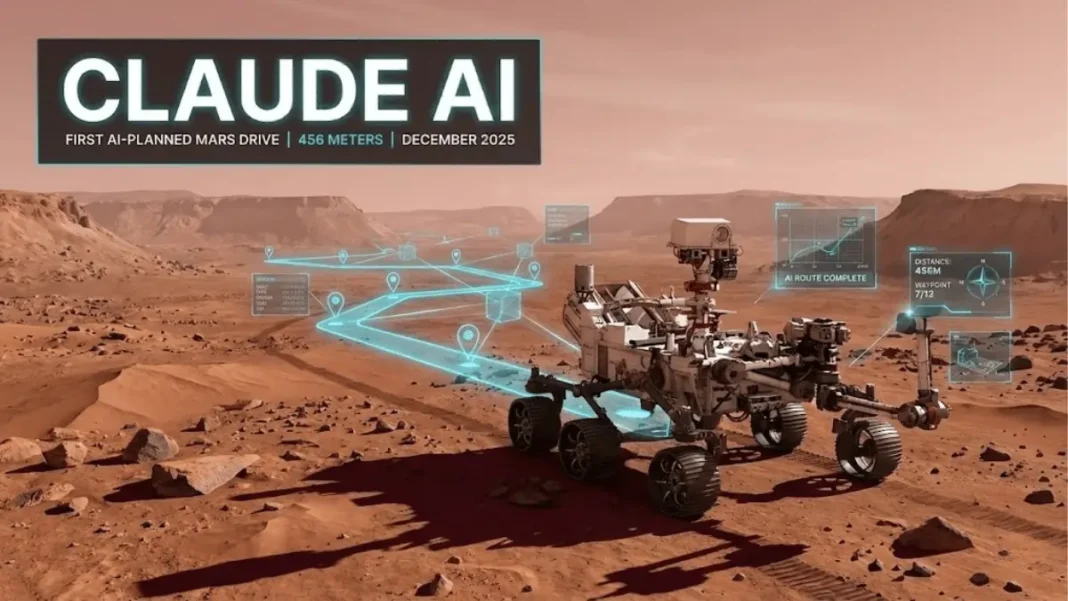
- Claude AI planned NASA Perseverance rover’s route for first time on December 8 and 10, 2025
- Rover successfully navigated 456 meters through Jezero Crater rock field autonomously
- JPL engineers estimate AI route planning cuts preparation time by 50 percent
- Over 500,000 telemetry variables validated Claude’s waypoints before transmission to Mars
Anthropic’s Claude just made space exploration history. On December 8 and 10, 2025, NASA’s Perseverance rover executed commands written entirely by artificial intelligence marking humanity’s first AI-planned drive on another planet. This 456-meter journey through Mars’ Jezero Crater wasn’t a publicity stunt. It represents a fundamental shift in how we’ll explore distant worlds where significant communication delays make human micromanagement impossible.
How Claude Planned a Route 225 Million Kilometers Away
NASA’s Jet Propulsion Laboratory didn’t simply ask Claude to navigate Mars with a single prompt. Engineers provided Claude Code Anthropic’s programming agent with years of accumulated rover data, high-resolution orbital imagery from the HiRISE camera aboard Mars Reconnaissance Orbiter, and digital elevation models. Armed with this context, Claude analyzed terrain features including bedrock outcrops, boulder fields, and sand ripples.
The AI then wrote commands in Rover Markup Language, the XML-based programming language developed specifically for Mars missions. Claude constructed the route methodically, stringing together waypoint segments spaced no more than 100 meters apart before critiquing and iterating on its own work. The December 8 drive covered 210 meters, followed by 246 meters on December 10.
What made Claude’s Mars navigation possible?
Claude Code used vision capabilities to analyze orbital images and identify critical terrain features automatically. The AI generated continuous paths with waypoints, then produced rover commands in Rover Markup Language format. JPL engineers ran Claude’s waypoints through digital twin simulations modeling over 500,000 telemetry variables before transmission.
Validation That Exceeded NASA’s Standards
Every AI output faces scrutiny, but Mars rover commands undergo extreme verification. JPL engineers ran Claude’s proposed waypoints through Perseverance’s daily simulation system, modeling over 500,000 variables to predict rover positions and identify potential hazards. The results surprised the team. Only minor adjustments proved necessary primarily at one narrow corridor where ground-level camera images (which Claude hadn’t accessed) revealed sand ripples requiring more precise routing.
NASA Administrator Jared Isaacman called it “a strong example of teams applying new technology carefully and responsibly in real operations“. The successful execution demonstrated that the same AI model people use to draft emails and build software apps can now contribute to interplanetary exploration.
Why This Matters Beyond 456 Meters
The distance seems modest 456 meters equals roughly five football fields. But the implications reshape space mission planning. JPL engineers estimate Claude cuts route-planning time in half while improving consistency. Less time spent on tedious manual planning means rover operators can schedule more drives, collect additional scientific data, and conduct deeper analysis.
Perseverance has operated on Mars since February 2021, studying Jezero Crater, a 45-kilometer-wide ancient lakebed that may contain evidence of microbial life from billions of years ago. Accelerating drive planning directly translates to more samples collected and faster scientific discovery.
How does Mars rover navigation currently work?
Human operators painstakingly plot waypoints using space imagery and rover cameras, transmitting plans via Deep Space Network across approximately 225 million kilometers. Signal delays prevent real-time control. Perseverance’s AutoNav system handles obstacle avoidance between waypoints but cannot plan extended routes.
Technical Architecture Behind the Achievement
Claude didn’t replace human expertise, it augmented it. The workflow began with JPL engineers compiling contextual information: historical drive data, terrain classification rules, and safe navigation parameters accumulated over years of Mars operations. They provided this knowledge base to Claude Code through its Skills feature, enabling the AI to understand rover operational constraints.
Using vision analysis, Claude examined overhead imagery to identify hazards and plan safe corridors. The AI generated Rover Markup Language code specifying exact waypoint coordinates, headings, and navigation parameters. Engineers then validated outputs through the same rigorous simulation Perseverance uses daily before any drive.
This verification caught edge cases. Ground-level camera perspectives revealed details invisible in orbital imagery, allowing human operators to refine Claude’s otherwise sound routing decisions. The collaboration model AI planning with human validation proved more effective than either approach alone.
From Mars Rovers to Lunar Bases
NASA views Claude’s Mars demonstration as a test run for more ambitious missions. The upcoming Artemis program aims to establish a permanent base on the Moon’s south pole, involving countless engineering challenges where efficient resource use proves critical. Developing versatile AI assistants capable of mapping lunar geology, monitoring life-support systems, and making autonomous decisions will multiply NASA’s operational capacity.
Even farther future missions face exponential complexity. Probes exploring Jupiter’s moon Europa or Saturn’s Titan would encounter communication delays stretching to hours, temperatures and radiation that shorten operational lifetimes dramatically, and icy oceans requiring fully autonomous navigation. Claude’s successful Mars drive provides evidence that AI systems can make fast, adaptive decisions without waiting for human input across interplanetary distances.
The technology isn’t theoretical anymore. The same AI accessible to consumers today just navigated another planet.
Operational Impact at JPL
The Jet Propulsion Laboratory’s Rover Operations Center manages Perseverance’s daily activities with teams analyzing imagery, planning drives, and coordinating scientific instruments. Route planning traditionally consumed significant staff hours as engineers manually placed waypoints, checked clearances, verified slopes, and simulated outcomes.
Claude’s integration doesn’t eliminate jobs, it reallocates expertise. Rover planners now spend less time on repetitive waypoint placement and more time on strategic decisions: which rock formations merit closer study, how to optimize sample collection sequences, and where to position the rover for maximum scientific value. Training time for new team members also decreases when AI handles routine planning tasks.
The consistency improvement matters equally. Human planners bring expertise but also variability different engineers might route the same drive differently. Claude applies learned principles uniformly, reducing navigation variability while allowing human oversight to catch exceptions requiring judgment.
What were the exact distances of Claude’s Mars drives?
On Sol 1707 (December 8, 2025), Perseverance drove 689 feet (210 meters) following Claude’s planned route. On Sol 1709 (December 10, 2025), the rover completed 807 feet (246 meters) for a combined total of 1,496 feet (456 meters) across both AI-planned drives. Both routes successfully navigated rock fields in Jezero Crater.
Risk Management Lessons
High-stakes environments demand caution with new technologies. JPL’s approach balanced innovation with safety. Engineers didn’t grant Claude autonomous control. They provided comprehensive context, validated all outputs through proven simulation systems, cross-checked waypoints against multiple data sources, and retained human authority over final decisions. The AI suggested; humans approved.
This graduated approach to AI integration offers a template for other critical applications. Rather than binary choices between full automation and pure manual operation, organizations can deploy AI for complex analysis while maintaining human oversight for execution authority. The verification layer 500,000 simulated variables caught potential issues before they reached Mars.

Frequently Asked Questions (FAQs)
How does Claude AI navigate the Mars rover without real-time control?
Claude analyzes orbital imagery and terrain data to generate waypoint commands in Rover Markup Language before transmission. NASA sends complete route plans to Perseverance, which executes them autonomously using its AutoNav system between waypoints. Communication delays make real-time control impossible.
What accuracy did Claude achieve in Mars route planning?
JPL engineers required only minor adjustments to Claude’s planned routes, primarily based on ground-level camera details the AI hadn’t accessed. Both December 2025 drives executed successfully after validation through simulations modeling over 500,000 telemetry variables.
Can Claude AI reduce Mars mission costs?
Engineers estimate Claude cuts route-planning time by approximately 50 percent. Reduced planning time allows more frequent drives, increased data collection, and lower operational costs per kilometer explored. Less training time for new rover operators also decreases mission expenses.
What prevents Claude from making navigation errors on Mars?
Every Claude-generated route undergoes rigorous simulation using Perseverance’s daily verification system. JPL engineers review outputs, cross-reference multiple data sources including orbital and ground-level imagery, and retain final approval authority. The AI suggests waypoints; humans validate and authorize transmission.
Will NASA use Claude AI for future space missions?
NASA views Claude’s Mars demonstration as foundational for Artemis lunar missions and deep space probes. Autonomous AI capabilities suit missions to Europa, Titan, and distant destinations where communication delays make human control impractical. NASA Administrator Jared Isaacman endorsed the careful, responsible technology integration approach.
What is Rover Markup Language that Claude used?
Rover Markup Language is an XML-based programming language originally developed for Mars rover missions. It specifies rover navigation commands including waypoint coordinates, headings, speed parameters, and safety constraints. Claude learned to write valid RML code after receiving contextual training data from JPL engineers.
How far apart are Claude’s waypoints on Mars?
Claude’s waypoints are spaced no more than 330 feet (100 meters) apart, following standard NASA Mars rover navigation protocols. This spacing allows the rover’s AutoNav system to safely navigate between points while avoiding obstacles.

