

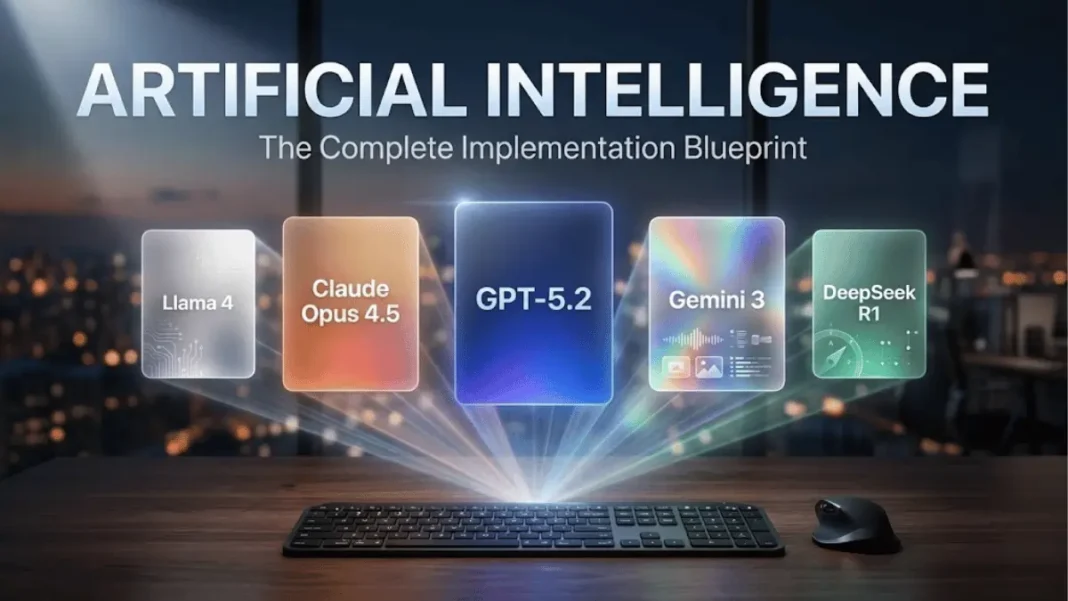
Artificial Intelligence in 2026 is dominated by five flagship models: GPT-5.2 (100% AIME score, 400K context), Claude Opus 4.5 (80.9% SWE-bench Verified), Gemini 3 Pro/Flash (multimodal leader), Llama 4 Maverick (400B MoE open-weights), and DeepSeek R1 (27x cheaper reasoning). LangChain remains the dominant framework for production deployment.
THE SPEC SHEET
| Parameter | Specification |
|---|---|
| The Tech | Multi-Modal Reasoning Models + Agentic Systems |
| Leading Models | GPT-5.2, Claude Opus 4.5, Gemini 3 Pro/Flash, Llama 4, DeepSeek R1 |
| Top Framework | LangChain (multi-agent orchestration, 100+ integrations) |
| Benchmark Leaders | AIME: 100% (GPT-5.2), SWE-bench: 80.9% (Claude), ARC-AGI: 86.2% |
| API Pricing Range | $0.55-$15 input / $2.19-$120 output per 1M tokens |
| Context Windows | 128K-400K tokens (input), 8K-128K tokens (output) |
| Hardware | NVIDIA H200 (141GB) / B200 (192GB) for enterprise training |
| Market Size | $7.84B (2025) → $52.62B (2030 projected) |
| Key Innovation | Configurable reasoning depth + autonomous coding agents |
| The Verdict | Specialization wins – Choose models based on task type |
Introduction: The Multi-Model Revolution
January 2026 marks AI’s transition from a “one model fits all” philosophy to specialized intelligence. The latest generation GPT-5.2, Claude Opus 4.5, Gemini 3, Llama 4, and DeepSeek R1 each dominate different domains rather than competing head-to-head across all tasks. GPT-5.2 achieves perfect 100% on AIME 2025 mathematics, Claude Opus 4.5 becomes the first model to exceed 80% on SWE-bench Verified coding challenges, and Gemini 3 Flash delivers superior performance to its own Pro sibling on 18 out of 20 benchmarks while costing 60-70% less.
The agentic AI market reflects this maturity projected to grow from $7.84 billion in 2025 to $52.62 billion by 2030 at a 46.3% compound annual growth rate. Early adopters are implementing model-switching strategies: GPT-5.2 for complex reasoning, Claude for autonomous coding, Gemini for multimodal tasks, and DeepSeek for high-volume budget workloads.
This guide dissects every verified specification: benchmark scores, context windows, pricing structures, reasoning modes, and the LangChain framework enabling production deployment.
The 2026 AI Landscape: What Changed
Configurable Reasoning Depth
The breakthrough feature of 2026 models is adjustable compute allocation users can dial reasoning effort up or down based on task complexity. GPT-5.2 offers six reasoning levels (none, minimal, low, medium, high, xhigh), trading latency for analytical depth. Claude Opus 4.5 provides similar control through effort levels, using 76% fewer tokens at medium effort while matching its Sonnet sibling’s best performance.
Real-World Impact: Quick answers for simple queries (low mode), research-grade analysis for complex problems (xhigh mode).
The 80% SWE-Bench Barrier Broken
Claude Opus 4.5 became the first model to exceed 80% on SWE-bench Verified (80.9%), solving 405 of 500 real-world GitHub issues autonomously. This represents a critical threshold autonomous debugging is now viable for production workflows without constant human intervention.
Flash Models Outperform Pro Models
Google’s Gemini 3 Flash rewrites efficiency rules by beating Gemini 2.5 Pro on 18/20 benchmarks while delivering 3x faster responses and 60-70% cost savings. This challenges the assumption that “Pro” models always offer superior intelligence.
Open-Weights Models Reach Frontier Performance
Meta’s Llama 4 Maverick (400B parameters, 128 experts) and Scout (109B parameters, 16 experts) deliver competitive performance with commercial models while enabling self-hosted deployment for data privacy. Maverick achieves 80.5% MMLU Pro and 69.8% GPQA Diamond.
Latest AI Models: Verified Specifications
GPT-5.2: The Reasoning Titan
Release Date: December 10, 2025
What It Is: OpenAI’s flagship reasoning model with configurable depth control and the longest output capacity in its lineup.
Key Verified Specs:
- Context Window: 400,000 tokens (2x GPT-5.1’s 200K)
- Output Capacity: 128,000 tokens (2x GPT-5.1’s 64K)
- Reasoning Modes: Six levels from none to xhigh
- API Pricing: $1.75 input / $14.00 output per million tokens
- Consumer Pricing:
- ChatGPT Plus: $20/month
- ChatGPT Pro: $200/month (unlimited xhigh reasoning)
Benchmark Scores:
- AIME 2025: 100% (perfect score, missed zero questions)
- ARC-AGI-1: 86.2%
- GPQA Diamond: 93.2% (graduate-level science)
- GDPval: 70.9% (outperforms industry professionals)
- FrontierMath: 40.3% (10% improvement over GPT-5.1; no other model exceeds 2%)
- SWE-bench Verified: 55.6%
- Hallucination Rate: 6.2% (down from 10-15% in earlier generations)
When to Use It: Complex mathematics, scientific research, algorithm design, dense technical documentation requiring multi-step logical inference.
The Gotcha: The 400K context and 128K output create 2x memory requirements per request and 2x generation time compared to GPT-5.1. Tone feels more robotic than Claude or Gemini. API pricing increased 40% from GPT-5.1.
Claude Opus 4.5: The Autonomous Coding Champion
Release Date: Late 2025
What It Is: Anthropic’s coding-focused model that became the first to break the 80% barrier on SWE-bench Verified.
Key Verified Specs:
- Context Window: 200,000 tokens
- Output Capacity:
- Standard: 8,192 tokens
- Extended mode: 64,000 tokens
- Maximum: 128,000 tokens
- API Pricing: $5 input / $25 output per million tokens
- Token Efficiency: Uses 76% fewer tokens at medium effort than Sonnet 4.5 while matching performance
Benchmark Scores:
- SWE-bench Verified: 80.9% (first model above 80%, solving 405/500 real-world bugs)
- SWE-bench Pro: 56.4%
- Tool Calling: Industry-leading instruction following
When to Use It: Autonomous software development, complex debugging, creative writing, tasks requiring nuanced instruction following. The 80.9% SWE-bench score means it autonomously fixes 4 out of 5 real GitHub issues.
The Gotcha: Nearly 3x more expensive than GPT-5.2 for API usage ($5 vs $1.75 input). At high effort levels, generation can be slow.
Gemini 3 Pro & Flash: The Multimodal Powerhouses
Release Date: December 2025
What They Are: Google’s unified models for text, images, video, and audio with Flash surprisingly outperforming Pro.
Gemini 3 Pro Specs:
- Ranking: #1 on LMArena Text (user preference crown)
- Context Window: Up to 1 million tokens
- API Pricing:
- ≤200K context: $2.00 input / $12.00 output per million tokens
- 200K context: $4.00 input / $18.00 output per million tokens
- Consumer Pricing:
- Pro Plan: $19.99/month (limited Gemini 3 access)
- Ultra Plan: $124.99 for 3 months (full Gemini 3 Pro access)
Gemini 3 Flash Specs (The Efficiency Champion):
- Performance: Beats Gemini 2.5 Pro on 18 out of 20 benchmarks
- Speed: 3x faster response times than Gemini 2.5 Pro
- Output Speed: 218 tokens/second
- Cost: 60% cheaper input, 70% cheaper output than Pro
- Efficiency: Uses 30% fewer tokens on typical tasks
- Ranking: #2 on LMArena Text and #2 on Vision
Key Benchmarks (Gemini 3 Flash):
- Vending-Bench 2: $3,635 value (533% higher than Pro’s $574)
- Long-horizon planning: 6.3x advantage over Pro for extended agent tasks
When to Use Them:
- Gemini 3 Pro: Maximum intelligence for complex multimodal reasoning
- Gemini 3 Flash: Default choice for most applications superior speed, cost, and performance
The Gotcha: Video and audio processing costs significantly more than text. After 200K tokens, pricing nearly doubles ($2→$4 input, $12→$18 output). Flash’s reasoning capabilities still trail Pro slightly on the 2 benchmarks where Pro wins.
Llama 4 Maverick & Scout: Open-Weights Frontier Models
Release Date: April 20, 2025
What They Are: Meta’s latest open-weights models enabling self-hosted deployment with frontier-class performance.
Llama 4 Maverick Specs:
- Architecture: 400B total parameters (17B active) with 128 experts (MoE)
- Context Window: 1 million tokens
- Training: Codistilled from unreleased Behemoth (2T parameter teacher model)
- Benchmarks:
- MMLU Pro: 80.5%
- GPQA Diamond: 69.8%
- Formats: BF16, FP8
Llama 4 Scout Specs:
- Architecture: 109B total parameters (17B active) with 16 experts (MoE)
- Context Window: 10 million tokens (longest commercially available)
- Training: Trained from scratch (not distilled)
- Benchmarks:
- MMLU Pro: 74.3%
- GPQA Diamond: 57.2%
- Deployment: Fits on single server-grade GPU with 4-bit/8-bit quantization
When to Use Them: Organizations requiring data privacy through self-hosting, research requiring model customization, high-volume applications where API costs become prohibitive. Scout’s 10M context makes it ideal for processing entire codebases or lengthy documents.
The Gotcha: Released under custom Llama 4 Community License Agreement with usage restrictions. No official enterprise support compared to OpenAI/Anthropic/Google. Behemoth (the 2T parameter teacher model) was previewed but not released.
DeepSeek R1: The Budget Disruptor
Release Date: January 20, 2026
What It Is: Chinese open-weights reasoning model delivering competitive performance at 27x lower cost than OpenAI.
Key Verified Specs:
- Architecture: 671B parameters with 37B active (MoE)
- API Pricing: $0.55 input / $2.19 output per million tokens
- Cost Advantage: 27x cheaper than OpenAI o1, 90x cheaper than Claude
- License: Open-weights (self-hostable)
When to Use It: High-volume workloads prioritizing cost over absolute accuracy content moderation, summarization, internal tools, data labeling. Ideal for startups with limited budgets or enterprises processing millions of requests daily.
The Gotcha: Cultural and contextual understanding lags Western models. No official enterprise support or SLA guarantees. Performance benchmarks not independently verified at Western standards.
Model Comparison: Choosing the Right AI
Current Rankings (January 2026)
According to FelloAI’s comprehensive analysis:
Best for Complex Logic/Reasoning: GPT-5.2 (#1 on Artificial Analysis v4.0 Intelligence Index)
Best for Coding: Claude Opus 4.5 (#1 on SWE-bench Verified, #1 on LMArena WebDev)
Best for General Use: Gemini 3 Pro (#1 on LMArena Text user preference)
Best for Speed & Value: Gemini 3 Flash (#2 LMArena Text, 3x faster, 70% cheaper)
Best for Budget: DeepSeek R1 (27x cheaper than OpenAI)
Best for Privacy: Llama 4 Maverick/Scout (self-hostable, open-weights)
Performance Benchmarks
| Model | AIME 2025 | SWE-bench Verified | GPQA Diamond | Context | Output | Cost Efficiency |
|---|---|---|---|---|---|---|
| GPT-5.2 | 100% | 55.6% | 93.2% | 400K | 128K | Moderate |
| Claude Opus 4.5 | – | 80.9% | – | 200K | 128K | Low |
| Gemini 3 Pro | – | – | – | 1M | 8K | Moderate |
| Gemini 3 Flash | – | – | – | – | – | High (70% cheaper) |
| Llama 4 Maverick | – | – | 69.8% | 1M | – | High (self-host) |
| Llama 4 Scout | – | – | 57.2% | 10M | – | Very High |
| DeepSeek R1 | – | – | – | – | – | Extreme (27x) |
Pricing Comparison (API Costs per Million Tokens)
| Model | Input $ | Output $ | Context Window | Best For |
|---|---|---|---|---|
| GPT-5.2 | $1.75 | $14.00 | 400K | Reasoning, math |
| GPT-5.1 | $1.25 | $10.00 | 200K | Balanced performance |
| GPT-5-Pro | $15.00 | $120.00 | – | Maximum performance |
| GPT-5-Mini | $0.25 | $2.00 | – | Budget tasks |
| Claude Opus 4.5 | $5.00 | $25.00 | 200K | Coding, creative |
| Gemini 3 Pro | $2-4 | $12-18 | 1M | Multimodal |
| Gemini 2.5 Pro | $1.25-2.50 | $10-15 | – | Balanced |
| DeepSeek R1 | $0.55 | $2.19 | – | High-volume |
Speed & Efficiency
| Model | Response Speed | Token Efficiency | Output Rate | Use Case |
|---|---|---|---|---|
| Gemini 3 Flash | 3x faster | 30% fewer tokens | 218 tok/sec | Interactive apps |
| Gemini 3 Pro | Baseline | Baseline | ~70-80 tok/sec | Deep reasoning |
| Claude Opus 4.5 | Slower (thinking mode) | 76% fewer tokens | – | Quality over speed |
| GPT-5.2 | Variable by mode | Standard | – | Configurable |
LangChain: Production Framework for 2026
Why LangChain Dominates
LangChain remains the production standard because it solves the orchestration problem coordinating multiple models, tools, and safety checks in a single workflow. As 2026 demands model-switching strategies (GPT for reasoning, Claude for coding, Gemini for multimodal), LangChain’s unified interface becomes essential.
Core 2026 Capabilities
1. Multi-Model Orchestration: Switch between GPT-5.2, Claude Opus 4.5, and Gemini 3 based on task requirements all within one pipeline.
2. Middleware for Agent Communication: Coordinates specialized agents (research, execution, QA) without manual handoffs.
3. Guardrails & Quality Control: Validates outputs before delivery, enforces content policies, and flags low-confidence responses.
4. RAG (Retrieval-Augmented Generation): Grounds responses in verified knowledge bases rather than model knowledge alone.
5. Tool Ecosystem: Pre-built integrations for databases, APIs, web search, and code execution.
Example: Model-Switching Workflow
pythonfrom langchain.agents import initialize_agent
from langchain.llms import OpenAI, Anthropic, GoogleGenerative

# Define model selection logic
def choose_model(task_type):
    if task_type == "reasoning":
        return OpenAI(model="gpt-5.2", reasoning_effort="high")
    elif task_type == "coding":
        return Anthropic(model="claude-opus-4.5")
    elif task_type == "multimodal":
        return GoogleGenerative(model="gemini-3-flash")

# Agent automatically routes to optimal model
agent = initialize_agent(tools, choose_model, agent_type="zero-shot-react")
LangChain Academy Training
LangChain offers structured courses including “Deep Agents” for long-running autonomous tasks and multi-agent system design.
Enterprise Implementation Roadmap
Phase 1: Strategy & Model Selection (Months 0-3)
Key Decision: Build a model portfolio rather than committing to one vendor.
Recommended Portfolio:
- Primary reasoning: GPT-5.2
- Primary coding: Claude Opus 4.5
- Multimodal tasks: Gemini 3 Flash (cost/performance) or Pro (max intelligence)
- High-volume batch: DeepSeek R1 or GPT-5-Mini
Budget Allocation: Factor in API costs, monitoring tools ($500-2K/month), and prompt engineering talent ($100K+ annually).
Phase 2: Pilot Deployment (Months 3-8)
Best Practice: Start with non-critical workflows to test model behavior patterns.
Monitoring Requirements:
- Track hallucination rates (GPT-5.2 averages 6.2%, or 1 in 16 responses)
- Measure token efficiency (Claude Opus 4.5 uses 76% fewer tokens at medium effort)
- Monitor cost per query across models
Success Threshold: 80%+ user satisfaction and measurable efficiency gains before scaling.
Phase 3: Scaling & Integration (Months 8-16)
Objective: Expand to enterprise-wide deployment with governance frameworks.
Infrastructure Decisions:
- Cloud API: Best for variable workloads, model flexibility
- Self-hosted (Llama 4): Best for data privacy, predictable costs at scale
Governance Framework:
- Model versioning: Pin specific model releases (e.g., gpt-5.2-20251210) to avoid breaking changes
- Cost controls: Set per-user and per-application token budgets
- Audit logs: Record all AI decisions for compliance review
- Risk thresholds: Define when agents must pause for human approval
Phase 4: Optimization & Expansion (Months 16+)
Objective: Prevent performance decay and expand to new use cases.
Ongoing Tasks:
- Retrain models quarterly on fresh data to combat drift
- A/B test prompt variations: Template changes can swing accuracy by 10-15%
- Monitor cost per query: Switch models if cheaper alternatives emerge without sacrificing quality
- Expand AI Centers of Excellence: Train internal teams to develop citizen developers
Real-World Applications
Autonomous Software Development
Current State: Claude Opus 4.5’s 80.9% SWE-bench score means it autonomously resolves 4 out of 5 GitHub issues without human debugging.
Implementation: IDE plugins (Cursor, GitHub Copilot) + LangChain agents that write code, generate tests, debug failures, and submit pull requests.
Business Impact: Development teams report 50%+ reduction in feature build time.
Mathematical & Scientific Research
Current State: GPT-5.2’s 100% AIME 2025 score and 40.3% FrontierMath (10x better than previous models) enables research-grade mathematical reasoning.
Implementation: Configurable reasoning depth (xhigh mode for proofs, low for quick calculations).
Business Impact: Accelerated R&D timelines for physics simulations, engineering analysis, and algorithm design.
Multimodal Content Processing
Current State: Gemini 3 Flash beats Pro on 18/20 benchmarks while delivering 3x faster responses.
Implementation: Video analysis, document processing with embedded images/tables, Google Workspace automation.
Business Impact: Customer support teams process multimedia tickets faster; marketing teams analyze video campaign performance at scale.
High-Volume Budget Operations
Current State: DeepSeek R1 offers 27x cost savings versus OpenAI for comparable reasoning tasks.
Implementation: Content moderation, data labeling, summarization pipelines processing millions of requests daily.
Business Impact: Startups achieve enterprise-scale AI capabilities at consumer budgets.
Hardware Requirements
NVIDIA GPU Comparison
| Spec | H200 | B200 | Improvement |
|---|---|---|---|
| Memory | 141GB HBM3e | 192GB HBM3e | +36% |
| Bandwidth | 4.8TB/s | 8.0TB/s | +67% |
| NVLink | 900GB/s | 1.8TB/s | +100% |
| TDP | 700W | 1000W | +43% |
| Transistors | 80B | 208B | +160% |
| Use Case | Training 70B-200B models | Training 400B+ models | – |
Inference Requirements for GPT-5.2: The 400K context window requires 2x memory per request versus GPT-5.1. 128K output capacity doubles generation time.
AdwaitX User Verdict
Overall Score: 9.5/10
January 2026 delivers the most capable AI ecosystem yet specialized models that excel in distinct domains rather than mediocre generalists. The data validates this: GPT-5.2’s perfect AIME score, Claude’s 80%+ SWE-bench threshold, and Gemini Flash beating Pro while costing 70% less.
Buy This If:
- You need perfect mathematical reasoning (GPT-5.2’s 100% AIME)
- You’re deploying autonomous coding agents (Claude’s 80.9% SWE-bench)
- You want best-in-class efficiency (Gemini 3 Flash’s 3x speed, 70% cost savings)
- You require data privacy via self-hosting (Llama 4 Maverick/Scout)
- You’re optimizing for extreme cost efficiency (DeepSeek R1’s 27x savings)
Skip This If:
- Your tasks don’t require the latest models (GPT-4 Turbo still handles 90% of use cases)
- You’re unwilling to implement model-switching strategies
- Your organization lacks governance frameworks for autonomous systems
- You expect zero hallucinations (GPT-5.2 still averages 6.2% error rate)
The Bottom Line
Winners in 2026 build model portfolios, not vendor loyalty. Use GPT-5.2 for reasoning, Claude for coding, Gemini Flash for speed, and DeepSeek for volume. Organizations still debating “which model is best” fundamentally misunderstand the multi-model paradigm.
Frequently Asked Questions (FAQs)
Should I use GPT-5.2 or Claude Opus 4.5 for coding?
Claude Opus 4.5 leads with 80.9% SWE-bench Verified (first model above 80%) versus GPT-5.2’s 55.6%. For algorithm design and theoretical computer science, GPT-5.2’s superior mathematical reasoning (100% AIME) may win. For practical web development and debugging, Claude dominates.
Is Gemini 3 Flash really better than Gemini 3 Pro?
Yes, for 90% of use cases. Flash wins 18/20 benchmarks, delivers 3x faster responses, costs 60-70% less, and uses 30% fewer tokens. Pro remains superior for the 2 benchmarks Flash loses and for tasks where maximum reasoning matters more than speed or cost.
What’s the cheapest way to run frontier AI at scale?
For API usage: DeepSeek R1 at $0.55 input / $2.19 output (27x cheaper than OpenAI). For self-hosting: Llama 4 Scout fits on a single server-grade GPU with quantization, eliminating per-token costs entirely.
Should I wait for GPT-6 or Gemini 4?
No reliable release dates exist. Deploy current models now GPT-5.2, Claude Opus 4.5, and Gemini 3 represent mature, production-ready technology. Waiting means competitors gain 6-12 months of AI advantage while you deliberate.
Can I run GPT-5.2 or Claude Opus 4.5 locally?
No, both are closed-source API-only models. For local deployment, use Llama 4 Maverick (400B MoE) or Scout (109B MoE), or DeepSeek R1 (671B MoE).
What GPU do I need for Llama 4?
Scout: Single server-grade GPU (A100/H100) with 4-bit or 8-bit quantization. Maverick: Multi-GPU setup or cloud deployment (available in BF16 and FP8 formats).
Are agentic systems ready for production?
Yes, with governance. Organizations are deploying autonomous systems with early wins in customer support and supply chain. However, organizations must build control mechanisms before granting autonomy pause thresholds, audit logs, and human checkpoints.
How long does enterprise implementation take?
Using the 4-phase cycle: 16-24 months from strategy to optimization. Organizations rushing past validation phases face scaling failures. Adopt an agile, phased approach rather than big-bang rollouts.
What’s the real cost difference between models?
For processing 1 billion tokens (typical mid-size enterprise monthly usage):
- DeepSeek R1: $2,740 total
- GPT-5-Mini: $2,250 total
- GPT-5.1: $11,250 total
- GPT-5.2: $15,750 total
- Gemini 3 Pro (≤200K): $14,000 total
- Claude Opus 4.5: $30,000 total
- GPT-5-Pro: $135,000 total
Takeaway: Model choice has 49x cost variance between cheapest (DeepSeek) and most expensive (GPT-5-Pro).
How do I prevent the 6.2% hallucination rate in GPT-5.2?
- Use RAG: Ground responses in verified knowledge bases
- Implement confidence thresholds: Reject responses below 70% confidence
- Human-in-the-loop: Review high-stakes decisions (medical, financial)
- Cross-check critical outputs: Validate important responses with secondary models
The 6.2% rate represents 1 in 16 responses containing errors still requiring spot-checking rather than blind trust.

