

Quick Brief
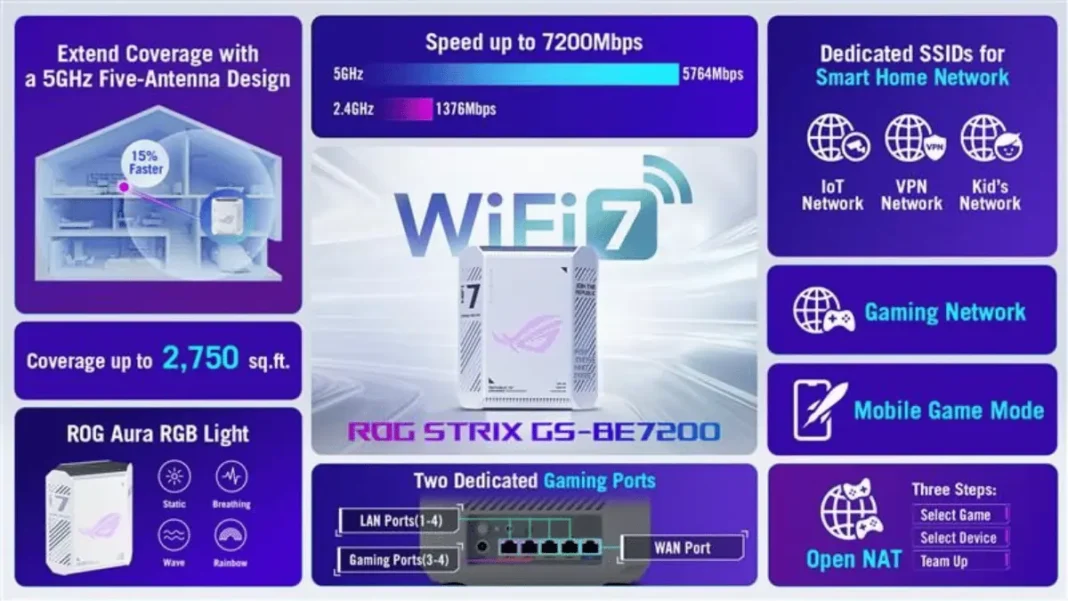
- The Launch: ASUS Republic of Gamers deployed the ROG Strix GS-BE7200 dual-band WiFi 7 gaming router on January 21, 2026, delivering 7200Mbps throughput with Multi-Link Operation and 4K-QAM modulation.
- The Innovation: Six internal antennas featuring 5T5R architecture deliver 15% better long-range throughput versus standard 4T4R designs, targeting multi-room gaming environments.
- The Market Context: WiFi 7 router market reached $2.7 billion valuation in 2025, projected to hit $9.3 billion by 2033 with 26.5% CAGR according to HTF Market Insights.
- Availability: ASUS has not disclosed pricing or specific availability timeline for the GS-BE7200 as of January 2026.
ASUS Republic of Gamers announced the ROG Strix GS-BE7200 on January 21, 2026, introducing a dual-band WiFi 7 gaming router engineered with 5T5R antenna architecture for competitive gaming environments. The GS-BE7200 leverages 802.11be standard with Multi-Link Operation, 160MHz channels, and 4096-QAM to deliver 7200Mbps aggregate throughput across congested network conditions.
The router targets professional gamers and tech infrastructure managers demanding sub-10ms latency across distances exceeding 50 feet. ASUS deployed the GS-BE7200 as WiFi 7 adoption accelerates, with the global router market expanding at 26.5% annually through 2033 according to HTF Market Insights.
The 5T5R Antenna Architecture
The GS-BE7200 implements six internal antennas configured as 5-transmit, 5-receive (5T5R) on the 5GHz band, breaking from conventional 4T4R designs. This architecture increases spatial streams and beamforming precision, yielding 15% throughput improvement at long distances in ASUS internal testing.
The router allocates 5764Mbps to 5GHz with 160MHz channel bandwidth and 1376Mbps to 2.4GHz band using 4096-QAM modulation. Multi-Link Operation enables simultaneous data transmission across both bands, reducing latency variability during peak traffic periods.
Physical specifications include 1GB DDR4 RAM, 128MB flash storage, and MediaTek chipset (MT7987A/MT7992AV/MT7975N/MT7979N plus MXL86252C) handling packet processing. Five 2.5-Gigabit Ethernet ports one WAN and four LAN support wired connections for latency-sensitive devices without bottlenecking fiber internet above 1Gbps.

AdwaitX Analysis: Gaming Network Differentiation Strategy
ASUS integrated ROG Gaming Network software layer to automate Quality of Service for gaming packets, eliminating manual port forwarding configuration. Two dedicated gaming ports receive hardware-level priority, ensuring PlayStation 5, Xbox Series X, or gaming PCs maintain consistent sub-20ms ping during household bandwidth congestion.
The GS-BE7200 supports up to 30 simultaneous VPN clients with WireGuard, OpenVPN, and IPSec protocols critical for remote workers requiring corporate network access without router-level performance degradation. Smart Home Master segments IoT devices, kids’ networks, and VPN tunnels into isolated VLANs, addressing enterprise security requirements in residential deployments.
WiFi 7 AiMesh compatibility enables mesh network expansion using existing ASUS routers, reducing total infrastructure cost for homes exceeding 3,000 square feet. ASUS Network Security bundles AiProtection and Safe Browsing, leveraging Trend Micro threat intelligence to block malicious connections at router level.
Technical Specifications Comparison
| Specification | ROG Strix GS-BE7200 | Standard WiFi 7 Router |
|---|---|---|
| WiFi Standard | 802.11be (WiFi 7) | 802.11be |
| Throughput | 7200Mbps (1376 + 5764) | 5400-9600Mbps |
| 5GHz Antenna Config | 5T5R | 4T4R |
| Range Improvement | +15% vs 4T4R | Baseline |
| 2.5G Ports | 5 (1 WAN + 4 LAN) | 1-2 typical |
| Gaming Ports | 2 dedicated | 0-1 typical |
| VPN Clients | 30 simultaneous | 5-10 typical |
| Memory | 1GB DDR4 | 512MB-1GB |
| Flash Storage | 128MB | 128MB-256MB |
| Dimensions | 182×80×207mm | Varies |
| Weight | 750g | Varies |
Infrastructure Implications for Enterprise Gaming
The GS-BE7200 enters a WiFi 7 market where dual-band routers now compete across budget to premium segments. ASUS differentiates through 5T5R antenna count rather than tri-band 6GHz support, reducing silicon costs while maintaining long-range performance claims.
Enterprise esports facilities and gaming cafes represent secondary markets, where 30-VPN-client capacity and hardware gaming ports justify commercial deployment over consumer routers. ASUS has not disclosed pricing, though the GS-BE7200 will compete against established WiFi 7 models from TP-Link, Netgear, and other manufacturers.
The router’s dual-band configuration omits WiFi 7’s optional 320MHz channel support and 6GHz spectrum access, focusing on 160MHz channels across 2.4GHz and 5GHz bands. Industry analysts project WiFi 7 penetration will reach 35% of router shipments by 2027 as chipset costs decline and ISP fiber upgrades exceed 2Gbps.
Deployment Roadmap and Regulatory Considerations
ASUS confirmed availability through retail partners in Q1 2026, with initial distribution focused on North America and Asia-Pacific regions. The router supports region-specific 5GHz and 2.4GHz frequency regulations, requiring firmware variants for FCC (US), CE (EU), and other jurisdictions.
WiFi 7’s 320MHz channel option remains unavailable in GS-BE7200’s dual-band configuration, as the router operates exclusively on 2.4GHz and 5GHz bands with maximum 160MHz channel width. According to HTF Market Insights, the WiFi 7 router market will expand from $2.7 billion in 2025 to $9.3 billion by 2033.
ASUS has not disclosed manufacturing volumes or sales targets for the GS-BE7200 lineup. The router measures 182mm (W) × 80mm (D) × 207mm (H) and weighs 750 grams.

Frequently Asked Questions (FAQs)
What is the speed of ASUS ROG Strix GS-BE7200 WiFi 7 router?
The GS-BE7200 delivers 7200Mbps aggregate throughput: 5764Mbps on 5GHz and 1376Mbps on 2.4GHz using 4096-QAM modulation and 160MHz channels.
How does 5T5R antenna improve WiFi performance?
5T5R adds one extra transmit/receive antenna versus standard 4T4R, increasing spatial streams and beamforming accuracy for 15% better long-range throughput.
What is Multi-Link Operation in WiFi 7?
MLO transmits data simultaneously across 2.4GHz and 5GHz bands, reducing latency and improving reliability by avoiding single-band congestion bottlenecks.
Does ROG Strix GS-BE7200 support VPN clients?
Yes, it supports 30 simultaneous VPN clients with WireGuard, OpenVPN, and IPSec protocols for secure remote access without performance loss.
What ports does the GS-BE7200 router have?
Five 2.5-Gigabit Ethernet ports total: one WAN for internet connection and four LAN ports, including two dedicated gaming ports with hardware priority.

