

Quick Brief
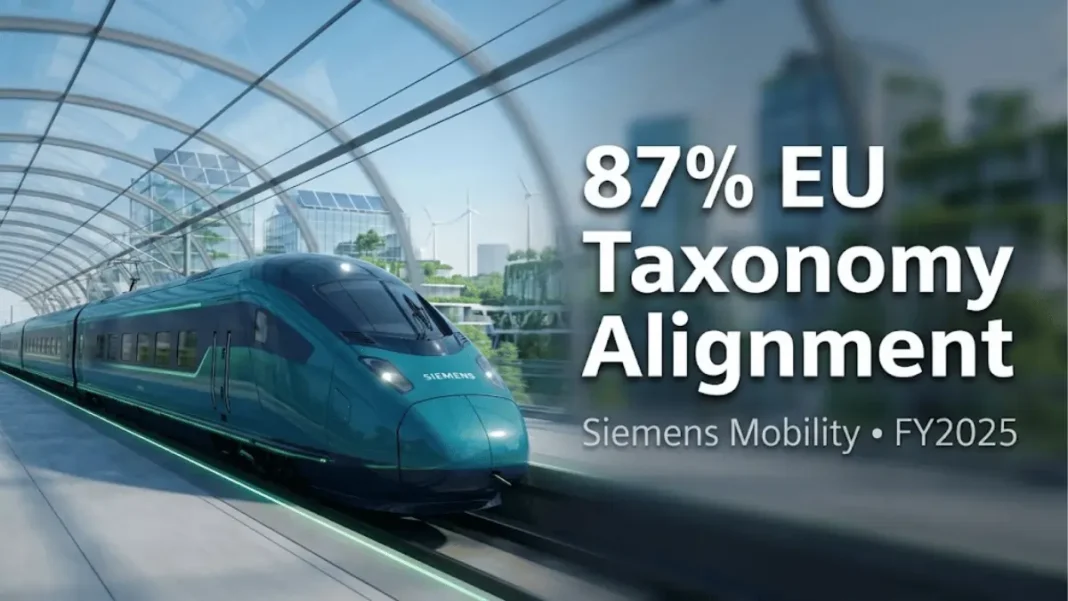
- The Achievement: Siemens Mobility reached 87% EU Taxonomy alignment for fiscal year 2025, marking its strongest sustainability performance since reporting requirements began
- The Scale: The alignment applies to revenue of €12.4 billion, with 100% of the company’s portfolio classified as Taxonomy-eligible
- The Context: This represents a one-percentage-point improvement over the 86% alignment achieved in fiscal 2024, despite more stringent regulatory requirements
Siemens Mobility announced on January 15, 2026, that 87 percent of its fiscal year 2025 revenue now aligns with EU Taxonomy sustainability criteria, the company’s highest score since mandatory reporting commenced. The German transport technology leader posted total revenue of €12.4 billion for the fiscal year ending September 30, 2025, with operations spanning 43,400 employees worldwide.
Fiscal 2025 Sustainability Metrics
Siemens Mobility achieved 100 percent Taxonomy eligibility across its entire technology portfolio, spanning rolling stock, rail automation, electrification systems, software solutions, and turnkey infrastructure projects. The 87 percent alignment figure indicates that nearly all eligible activities meet the EU’s rigorous environmental and social requirements, including substantial contribution to climate objectives and Do No Significant Harm (DNSH) criteria.
The company’s performance surpasses its fiscal 2024 result of 86 percent alignment, demonstrating sustained progress despite evolving regulatory standards. This positions Siemens Mobility substantially above the parent company Siemens AG, which reported 52 percent EU Taxonomy alignment across its broader industrial portfolio.

Impact on Sustainable Mobility Investment
The record alignment score provides institutional investors with verified data for ESG-driven capital allocation decisions. EU Taxonomy compliance has become a critical benchmark for pension funds, sovereign wealth entities, and asset managers required to direct capital toward sustainable economic activities under European regulations.
Siemens Mobility’s portfolio directly contributes to climate change mitigation through technologies that reduce transportation sector emissions—a priority area under the EU’s climate objectives. The company’s rail solutions enable operators to replace diesel-powered systems with electric and battery-hybrid alternatives, supporting the EU Green Deal’s 2050 climate neutrality target.
Andreas Mehlhorn, Head of Sustainability at Siemens Mobility, confirmed the company will maintain its trajectory toward higher alignment rates while expanding its climate-focused technology offerings.
EU Taxonomy Framework Overview
| Component | Siemens Mobility FY25 | Industry Context |
|---|---|---|
| Revenue Alignment | 87% | Top tier among rail technology providers |
| Eligibility Rate | 100% | Entire portfolio qualifies for assessment |
| Total Revenue | €12.4 billion | Up from €11.4 billion in FY24 |
| Climate Contribution | 100% of aligned activities | Focused on mitigation objectives |
The EU Taxonomy operates through a two-step assessment process: eligibility determines if activities fall within the framework’s scope, while alignment verifies compliance with technical screening criteria, DNSH requirements, and minimum social safeguards. Companies subject to Corporate Sustainability Reporting Directive (CSRD) requirements must disclose Taxonomy alignment across revenue, capital expenditure (CapEx), and operational expenditure (OpEx) metrics.
Regulatory Changes Under 2026 Simplification Act
The European Commission’s Simplification Delegated Act, effective January 28, 2026, introduces materiality thresholds that allow companies to exclude immaterial activities from detailed assessments. Financial undertakings receive a temporary reporting opt-out from 2026 to 2028, though non-financial companies like Siemens Mobility face unchanged disclosure obligations.
Updated reporting templates require adjustments to data collection systems and internal controls, particularly for multi-business conglomerates. Refinements to DNSH criteria under pollution prevention objectives may affect alignment calculations for manufacturing activities beginning with 2026 fiscal year disclosures.
Siemens Mobility’s early achievement of high alignment positions the company favorably under the revised framework, reducing compliance risk as regulatory interpretations evolve.
Strategic Outlook for Sustainable Rail Technology
Siemens Mobility’s technology roadmap focuses on electrification infrastructure, digital rail management systems, and zero-emission rolling stock to maintain Taxonomy alignment above 85 percent through 2030. The company’s bi-mode battery train technology, operational in the UK market, targets diesel train elimination with projected carbon savings of 12 million tonnes over 35 years.
Capital expenditure priorities include renewable energy integration at manufacturing facilities, circular economy initiatives for component recycling, and expansion of charging infrastructure for electric rail fleets. The UK subsidiary reduced operational emissions by 36 percent in fiscal 2024 through solar installations, electric vehicle fleet conversion, and Hydrotreated Vegetable Oil (HVO) fuel adoption.
The parent company Siemens AG committed to net-zero operations by 2030, with Siemens Mobility serving as a lead division for climate performance benchmarks. AdwaitX analysis indicates the rail sector’s Taxonomy alignment will become a competitive differentiator for public infrastructure contracts as governments prioritize climate criteria in procurement decisions.

Frequently Asked Questions (FAQs)
What is EU Taxonomy alignment?
EU Taxonomy alignment measures the percentage of a company’s revenue, capital expenditure, or operating expenses from activities that substantially contribute to environmental objectives while meeting Do No Significant Harm criteria and minimum social safeguards.
How does Siemens Mobility’s 87% compare to industry peers?
The 87% alignment rate represents top-tier performance in the rail technology sector, significantly above the 52% alignment achieved by parent company Siemens AG across its broader industrial portfolio.
Why does 100% eligibility not equal 100% alignment?
Eligibility indicates activities fall within the EU Taxonomy scope, while alignment requires meeting stricter technical criteria, environmental safeguards, and social standards that not all eligible activities satisfy.
When does Siemens Mobility’s fiscal year end?
Siemens Mobility operates on a fiscal year ending September 30, meaning fiscal year 2025 concluded on September 30, 2025.

