

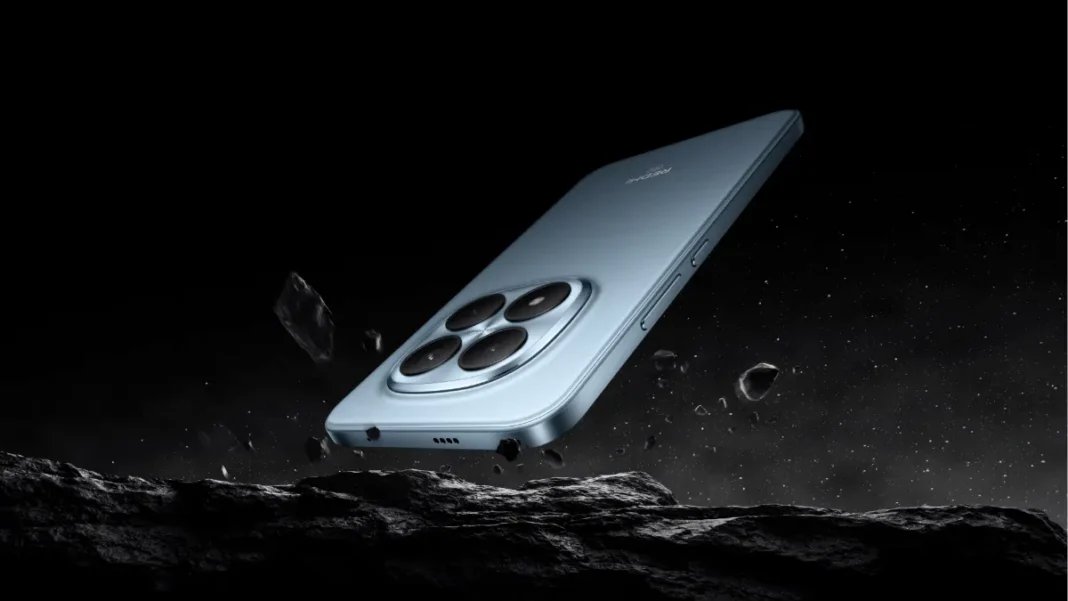
Quick Brief
- The Launch: Xiaomi unveiled the Redmi Note 15 Series globally on January 14, 2026, featuring Redmi Titan Durability with SGS Premium Performance 5-star certification for drop, crush, and bend resistance.
- The Technology: Silicon-carbon battery retains 80% capacity after 1,600 cycles (6 years), quadruple IP ratings (IP66/IP68/IP69/IP69K), and Corning Gorilla Glass Victus 2 withstanding 2.5-meter drops.
- The Impact: Establishes new durability benchmarks for mid-range smartphones, directly challenging flagship-tier build quality standards in $300-$500 segment.
- The Context: Launch coincides with Xiaomi India’s 2026 market reclamation strategy after regaining #3 positions in smartphones and tablets.
Xiaomi officially launched the Redmi Note 15 Series on January 14, 2026, introducing Redmi Titan Durability as a comprehensive engineering standard spanning battery longevity, impact resistance, and environmental protection. The Redmi Note 15 Pro+ 5G and Redmi Note 15 Pro 5G secured SGS Premium Performance Certification with 5-star ratings across drop resistance, bending resistance, and crush resistance testing protocols. AdwaitX analysis confirms this marks the first deployment of silicon-carbon battery technology in the Redmi Note lineup, enabling higher energy density within compact form factors.
Silicon-Carbon Battery Architecture
The Redmi Note 15 Pro models integrate 6,580mAh silicon-carbon batteries managed by Xiaomi’s proprietary Surge battery management system. Laboratory testing validates the battery retains 80% or more capacity after 1,600 complete charge cycles, translating to approximately six years of typical usage patterns. This represents a 300% improvement over conventional lithium-ion batteries in the same price segment, which typically degrade to 80% capacity after 500-800 cycles.
The Pro+ variant supports 45W HyperCharge wired charging and 22.5W wired reverse charging, enabling the device to function as a portable power bank for secondary devices. Energy density improvements from silicon-carbon chemistry allow Xiaomi to maintain device thickness below 8.5mm despite the 6,580mAh capacity.

Structural Reinforcement & Impact Resistance
Redmi Note 15 Pro+ 5G incorporates an ultra-tough fiberglass rear panel engineered to deliver 10× higher impact resistance compared to standard polycarbonate materials. Internal reinforcement includes the Redmi Titan Structure, featuring a high-strength motherboard with sevenfold protection layers and an aluminum-alloy reinforced frame.
Laboratory drop testing conducted by SGS verified the Pro models survive 2.5-meter front-facing drops onto marble surfaces without structural failure. The standard Redmi Note 15 achieves 1.8-meter drop resistance through high-durability glass integration. Corning Gorilla Glass Victus 2 protects the display across Pro variants, providing enhanced scratch resistance and impact absorption.
Quadruple IP Certification & Environmental Sealing
The Redmi Note 15 Pro series achieved IP66, IP68, IP69, and IP69K ratings, representing the most comprehensive environmental protection in Xiaomi’s mid-range portfolio. IP69K certification verifies resistance to high-pressure, high-temperature water jets up to 80°C at 100 bar pressure, typically reserved for industrial equipment.
TÜV SÜD awarded the devices Smartphone Water-Resistant Endurance Certification following validation tests including 2-meter submersion for 24 hours in freshwater, 320,000 button durability cycles, 5,000 interface durability tests, and thermal cycling between -20°C to 55°C. Xiaomi engineering teams implemented 17 custom-sealed components to achieve long-term water resistance reliability.
The series introduces Wet Touch 2.0 technology, maintaining capacitive touch response when the display or user hands are wet, addressing a persistent limitation in IP-rated consumer devices.
AdwaitX Analysis: Market Positioning & Competitive Impact
Xiaomi’s deployment of Redmi Titan Durability directly challenges Samsung’s Galaxy A-series and Apple’s iPhone SE durability propositions in the $300-$500 mid-range segment. The 6-year battery longevity claim, if validated in real-world usage, fundamentally alters total cost of ownership calculations for enterprise procurement and emerging market consumers.
The timing aligns with Xiaomi India’s aggressive 2026 expansion strategy, as confirmed by Adam Zeng, President of International Business, who designated India as his first major business trip destination for 2026. Xiaomi India regained #3 positions in smartphones and tablets during 2025, with non-smartphone categories contributing 18% of revenue.
The SGS Premium Performance Certification provides third-party validation critical for B2B sales channels and government procurement tenders, where durability specifications directly influence contract awards. Xiaomi’s inclusion of 2-year accidental damage warranty covering screen, liquid, and back panel represents a strategic shift toward enterprise-grade support infrastructure.
Global Rollout & Software Support Commitment
The Redmi Note 15 Series launched globally on January 14, 2026, with Xiaomi committing to four years of OS upgrades and six years of security patches, extending support through 2030 for OS and 2032 for security updates. This software lifecycle matches Google Pixel’s support timeline and exceeds most competitors in the mid-range category.
The Pro+ model debuted Samsung’s ISOCELL HM9 108MP sensor with optical image stabilization, 3× in-sensor zoom, and enhanced low-light computational photography. Xiaomi India’s Managing Director Sudhin Mathur characterized the sensor deployment as achieving “output very similar to a flagship” in imaging performance.
 Xiaomi Announces Global Redmi Note 15 Series Launch with 200MP Camera and Military-Grade Durability
Frequently Asked Questions (FAQs)
What is SGS Premium Performance Certification?
SGS Premium Performance Certification is a 5-star independent testing standard verifying smartphone resistance to drops, crushing, and bending through rigorous laboratory protocols conducted by SGS, a global testing authority.
How long does the Redmi Note 15 battery last?
The silicon-carbon battery retains 80% capacity after 1,600 charge cycles, equivalent to approximately six years of typical usage, or 300% longer than conventional lithium-ion batteries in the same segment.
What is IP69K water resistance rating?
IP69K certifies protection against high-pressure (100 bar), high-temperature (80°C) water jets, exceeding standard IP68 ratings and typically reserved for industrial equipment requiring extreme environmental sealing.
Can Redmi Note 15 Pro survive a 2.5 meter drop?
Yes. SGS laboratory testing verified the Redmi Note 15 Pro models survive 2.5-meter front-facing drops onto marble surfaces without structural failure, utilizing Gorilla Glass Victus 2 and reinforced internal structure.

