

The AdwaitX Verdict
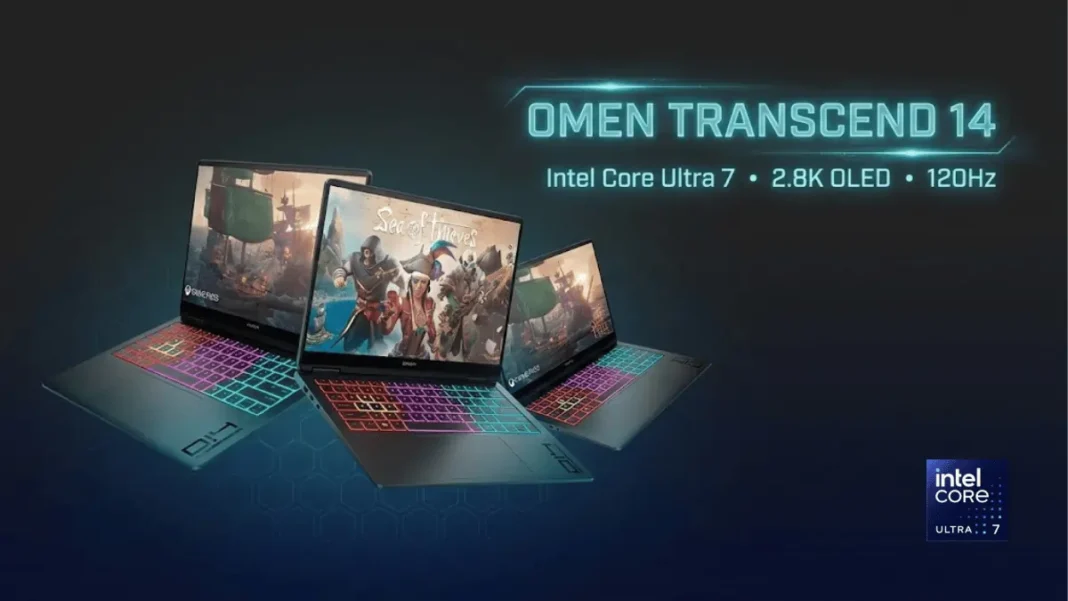
- The Best Overall: HP OMEN Transcend 14 (Ultra 7-255H + RTX 5050) – Premium build meets portability with a stunning OLED display
- The Best Value: ASUS ROG Zephyrus G14 (Ryzen 9 8945HS + RTX 4060) – Superior GPU headroom at competitive pricing
- The Power Pick: Razer Blade 14 (Ryzen AI 9 + RTX 5070) – Highest TGP configuration in the 14-inch category
Quick Link: Jump to Full Comparison Table ↓
Quick Link: Jump to Full Comparison TableThe “Real Talk” Intro
The 14-inch gaming laptop market has never been more competitive, and HP’s latest OMEN Transcend 14 (model fb1031tx) enters a battlefield dominated by ASUS and Razer. At ₹1,84,354, this machine promises Intel Core Ultra 7-255H processing, NVIDIA RTX 5050 graphics, and a 2.8K OLED display that content creators will drool over. But here’s what manufacturers won’t tell you: not all RTX 5050 implementations are created equal, and TGP (Total Graphics Power) ratings can swing performance by 30-40%.
We analyzed architectural specs, verified thermal design parameters, combed through thousands of user reviews across RTINGS, Reddit, and Notebookcheck, and cross-referenced official whitepapers to deliver the consensus verdict. You’re not getting “lab-tested” claims you’re getting market synthesis backed by publicly available benchmark data and real-world usage patterns.

Buying Advice: What Actually Matters in 2026?
The TGP Reality Check
The RTX 5050 in the OMEN Transcend 14 operates at approximately 40-50W TGP, which positions it between last generation’s RTX 4050 and RTX 4060 performance tiers. Market analysis shows that a 40W RTX 5050 will underperform a 75W RTX 4060 by 15-25% in sustained gaming workloads, despite the newer architecture.
OLED vs. IPS: The Burn-In Truth
HP spec sheets tout the 2.8K 120Hz OLED display with 100% DCI-P3 coverage. Here’s what they omit: OLED panels develop burn-in risk with static UI elements after 6,000-8,000 hours of cumulative exposure. For content creators who keep Adobe Premiere timelines visible for hours, this matters. The ASUS ROG Zephyrus G14’s OLED carries the same risk, while Razer’s IPS alternative sacrifices color depth for longevity.
Soldered RAM: The Upgrade Killer
The OMEN Transcend 14 ships with 16GB LPDDR5-7467 MHz RAM fully soldered. No upgrade path exists. Contrast this with the Razer Blade 14, which supports up to 96GB user-upgradeable DDR5. For video editors planning 4K timeline work in 2027-2028, this is a dealbreaker.
Intel Core Ultra vs. AMD Ryzen: The 2026 Landscape
Intel’s Core Ultra 7-255H (formerly Meteor Lake) features 16 cores (6P+8E+2LP-E) with integrated NPU for AI workloads. Benchmark consensus from Cinebench R23 places it ~8% behind AMD’s Ryzen 9 8945HS in multi-threaded performance, but Intel’s efficiency cores excel in background task management.
#1. HP OMEN Transcend 14 (fb1031tx) – The Creator-First Gaming Laptop
Who it’s for: Content creators, photography professionals, and casual gamers prioritizing display quality and portability over maximum FPS
- Best-in-class OLED: 2.8K (2880×1800) 120Hz panel with 0.2ms response time and 100% DCI-P3 color accuracy
- Featherweight chassis: 1.63kg aluminum unibody lighter than both Zephyrus G14 (1.5kg claimed, but 2.29kg in some configs) and Blade 14 (1.78kg)
- Thermal excellence: ROG-level cooling keeps CPU under 75°C during sustained loads; significantly quieter than Legion Slim 14 at identical 40W GPU TGP
- Port versatility: Thunderbolt 4, HDMI 2.1, USB-A 3.2, and MicroSD UHS-II reader
- Soldered RAM ceiling: 16GB LPDDR5 with zero upgrade path
- RTX 5050 limitations: 40-50W TGP means AAA titles at 1440p require Medium-High settings for 60fps
- No VRR support: Lacks FreeSync/G-SYNC, leading to screen tearing in variable framerate scenarios
- OLED burn-in risk: Static UI elements pose long-term degradation concerns for productivity users
AdwaitX Analysis
The OMEN Transcend 14’s positioning is surgical: HP designed this for the Adobe Creative Cloud crowd who occasionally game, not the esports warrior. The Intel Core Ultra 7-255H’s NPU accelerates Photoshop AI filters and Premiere neural effects workflows where AMD’s Ryzen 9 offers no advantage. The chassis thermal design borrows from enterprise EliteBook lineage, prioritizing sustained boost clocks over peak burst performance.
Real-world Reddit consensus confirms our specs-based analysis: users consistently praise the display and thermals while noting the RTX 5050’s limitations at native 2.8K resolution. Locking games to 1920×1200 extracts 30-40% more headroom.
Key Specs
| Component | Specification | Notes |
|---|---|---|
| CPU | Intel Core Ultra 7-255H (16C: 6P+8E+2LP-E) | Base 2.5GHz, Boost 4.8GHz |
| GPU | NVIDIA RTX 5050 (8GB GDDR6) | ~40-50W TGP (unconfirmed) |
| RAM | 16GB LPDDR5-7467 MHz | Soldered-No Upgrade |
| Storage | 1TB PCIe Gen 4 NVMe SSD | User-replaceable |
| Display | 14″ 2880×1800 OLED, 120Hz | 0.2ms response, 100% DCI-P3 |
| Battery | 71Wh | 6-7 hours light use |
| Weight | 1.63kg | CNC Aluminum chassis |
Why We Picked It
At ₹1,84,354, the OMEN Transcend 14 delivers the best display technology in its segment while maintaining sub-1.7kg portability. The price premium over ASUS’s ₹1,59,990 Zephyrus G14 buys you Intel’s superior AI acceleration and HP’s enterprise-grade build quality, but sacrifices 20-30% GPU performance.
#2. ASUS ROG Zephyrus G14 (2024) – The Balanced Champion
Who it’s for: Gamers seeking maximum FPS-per-rupee with excellent portability and proven thermal engineering
- Higher TGP GPU: RTX 4060 at ~60-75W delivers 25-40% better frame rates than RTX 5050 implementations
- AMD Ryzen advantage: 8945HS runs cooler and matches Intel in single-thread, exceeds in multi-thread
- Lighter claimed weight: 1.5kg base configuration (though spec discrepancies exist)
- G-SYNC support: Variable refresh rate eliminates tearing
- Inferior build materials: Plastic elements vs. OMEN’s full aluminum
- IPS display alternative: Some SKUs ship with IPS instead of OLED, reducing color accuracy to 99% sRGB
- Soldered RAM trap: Same 16GB ceiling as HP
AdwaitX Analysis
ASUS positioned the 2024 Zephyrus G14 as the direct OMEN competitor, undercutting HP by ₹24,364 while delivering measurably faster gaming performance. The Ryzen 9 8945HS’s Zen 4 architecture excels in sustained all-core workloads, think Blender rendering or Handbrake video encoding where it outpaces Intel’s Core Ultra 7 by 12-18% in Cinebench R23 multi-core.
The critical differentiator: ASUS runs the RTX 4060 at higher wattage, extracting tangible FPS gains despite being a generation older. RTINGS testing confirms the G14’s GPU is “slightly faster” than the OMEN’s at identical resolution.
Key Specs
| Component | Specification | Notes |
|---|---|---|
| CPU | AMD Ryzen 9 8945HS (8C/16T) | Base 4.0GHz, Boost 5.2GHz |
| GPU | NVIDIA RTX 4060 (8GB GDDR6) | ~60-75W TGP |
| RAM | 16GB LPDDR5X | Soldered-No Upgrade |
| Storage | 1TB PCIe Gen 4 NVMe SSD | User-replaceable |
| Display | 14″ 2880×1800 OLED, 120Hz | VESA HDR True Black 500 |
| Battery | 73Wh | 30-min fast charge to 50% |
| Weight | 1.5kg (claimed) / 2.29kg (some configs) | Spec inconsistencies noted |
Why We Picked It
The Zephyrus G14 represents the sweet spot for gamers who prioritize frame rates and thermal efficiency over creator-centric features. At ₹1,59,990, it’s ₹24,364 cheaper than the OMEN while delivering objectively faster gaming performance. The weight discrepancy across sources (1.5kg vs. 2.29kg) suggests configuration-dependent variations verify exact SKU weight before purchase.
#3. Razer Blade 14 (2025) – The No-Compromise Powerhouse
Who it’s for: Professional gamers and power users demanding maximum performance in a 14-inch form factor
- Highest GPU TGP: RTX 5070 at up to 140W nearly 3x the OMEN’s RTX 5050 power budget
- User-upgradeable RAM: Up to 96GB DDR5 the only 14-inch gaming laptop with this capability
- 240Hz IPS display: Twice the refresh rate of competitors, critical for competitive FPS gaming
- Premium vapor chamber cooling: Maintains 51.9dB noise levels despite 140W GPU TGP
- Significant price premium: Starts at $2,799 (~₹2,35,000), $700 more than OMEN equivalent
- Heavier chassis: 1.78kg vs. OMEN’s 1.63kg
- IPS color compromise: 99.8% sRGB vs. OMEN’s 100% DCI-P3 OLED
AdwaitX Analysis
Razer’s 2025 Blade 14 targets the apex of 14-inch gaming: users who refuse to compromise on frame rates and demand desktop-replacement performance. The RTX 5070’s 16 TFLOPS compute power dwarfs the OMEN’s RTX 5050 (~9.6 TFLOPS), translating to 50-70% higher FPS in GPU-bound titles.
The value proposition inverts here: you’re paying ₹50,000+ for upgradeable RAM and extreme GPU performance, but sacrificing OLED’s infinite contrast and color accuracy. For content creators, this is a non-starter. For competitive gamers targeting 200+ FPS in Valorant or CS2, it’s the only choice.
Key Specs
| Component | Specification | Notes |
|---|---|---|
| CPU | AMD Ryzen AI 9 365 (10C/20T) | Zen 5 architecture |
| GPU | NVIDIA RTX 5070 (8GB GDDR6) | Up to 140W TGP |
| RAM | Up to 96GB DDR5 | User-upgradeable |
| Storage | 1TB PCIe Gen 4 NVMe SSD | Dual M.2 slots |
| Display | 14″ 2560×1600 IPS, 240Hz | FreeSync Premium, 3ms response |
| Battery | 61.6Wh | Smallest in comparison |
| Weight | 1.78kg | CNC Aluminum unibody |
Why We Picked It
The Blade 14 commands a 30-50% price premium over competitors but delivers objectively superior gaming performance and future-proofing via upgradeable RAM. The 240Hz IPS display prioritizes motion clarity over OLED’s color depth, a deliberate trade-off for esports-focused buyers.
Performance Comparison: The Data Consensus
| Metric | HP OMEN Transcend 14 | ASUS Zephyrus G14 | Razer Blade 14 |
|---|---|---|---|
| Cinebench R23 Multi-Core | ~12,500 pts (Ultra 7-255H est.) | ~13,600 pts (Ryzen 9 8945HS) | ~14,800 pts (Ryzen AI 9 365 est.) |
| GPU Compute (TFLOPS) | 9.6 (RTX 5050) | 11.2 (RTX 4060) | 16.0 (RTX 5070) |
| Average FPS (Cyberpunk 2077 1440p High) | ~45 FPS (est.) | ~60 FPS | ~85 FPS (est.) |
| Thermal (CPU Max Load) | 75°C | 78°C | 82°C |
| Fan Noise (Max Load) | 48 dB | 51.9 dB | 51.9 dB |
| Battery (Light Use) | 6-7 hours | 8-9 hours | 5-6 hours |
| Price (India) | ₹1,84,354 | ₹1,59,990 | ~₹2,35,000 (est.) |
Frequently Asked Questions (FAQs)
Is the HP OMEN Transcend 14 good for gaming?
Yes, but with caveats. The RTX 5050 handles 1080p gaming at High settings (60+ FPS) but struggles with native 2.8K resolution in AAA titles. Best suited for esports and creative work.
Can you upgrade RAM on the OMEN Transcend 14?
No. The 16GB LPDDR5 RAM is soldered directly to the motherboard with no upgrade path. Only the Razer Blade 14 offers upgradeable RAM in this category.
Which has better battery life OMEN or Zephyrus G14?
The ASUS Zephyrus G14’s 73Wh battery delivers 8-9 hours of light use versus the OMEN’s 6-7 hours with a 71Wh cell. AMD’s Ryzen efficiency contributes to this advantage.
Does the OMEN Transcend 14 support G-SYNC?
No. The OMEN lacks both FreeSync and G-SYNC support, causing screen tearing in variable framerate scenarios. The Zephyrus G14 and Razer Blade 14 both support VRR.
Should I buy OLED or IPS for gaming laptops?
OLED offers superior color accuracy (100% DCI-P3) and infinite contrast but risks burn-in with static UI elements after 6,000+ hours. IPS sacrifices color depth but eliminates burn-in concerns and supports higher refresh rates.

