

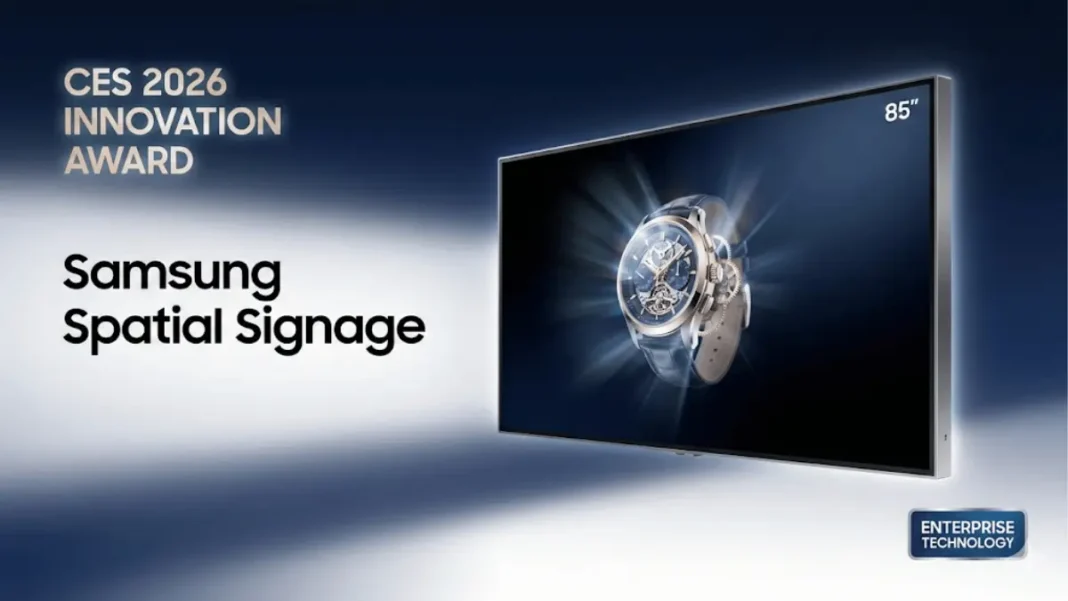
Samsung Electronics announced that its Spatial Signage display has won a CES Innovation Award 2026, marking the company’s first-ever recognition in the Enterprise Technology category. The 85-inch glasses-free 3D display, first unveiled at IFA 2025, is now making its commercial display debut at CES 2026 in Las Vegas from January 5-7.
What’s New
Samsung Spatial Signage uses proprietary 3D Plate technology to deliver immersive three-dimensional visuals without requiring special glasses or headsets. The display converts standard 2D content into multidimensional experiences, creating depth and realism for retail and commercial environments.
The system features an ultra-slim 2.1-inch profile with a nearly bezel-less 85-inch frame, allowing seamless installation in design-conscious spaces ranging from luxury retail stores to stadiums. Samsung VXT is built directly into the display, enabling businesses to remotely deploy and manage content across multiple screens without additional hardware.
Samsung maintains its position as the #1 global digital signage provider for 16 consecutive years.
Why It Matters
Glasses-free 3D displays represent a significant shift in how retailers capture shopper attention in physical stores. Industry research indicates that holographic 3D screens increase shopper attention by up to 2,000% compared to traditional 2D displays, with message retention improving by 300%.
The Enterprise Technology award validates Samsung’s move beyond consumer electronics into commercial signage solutions. For retailers competing with mobile devices for customer attention, Spatial Signage offers a deployment-ready alternative to complex AR or VR systems.

Technical Specifications
Key features include:
- Display Size: 85 inches diagonal
- Profile Depth: 2.1 inches (ultra-slim)
- Technology: Patented 3D Plate technology
- Content Compatibility: Converts existing 2D content to 3D
- Management: Built-in Samsung VXT CMS
- Installation: Lightweight, flat-panel design
Market Impact
Retailers and advertisers are increasingly adopting glasses-free 3D displays for digital signage to create interactive customer experiences. The technology eliminates hardware barriers with no glasses, headsets, or additional equipment required making it practical for high-traffic commercial environments.
Samsung VXT’s remote content management allows businesses to update promotional offers, merchandise displays, and campaigns across locations from a single platform. This reduces operational complexity for multi-location retailers.
What’s Next
Samsung is showcasing Spatial Signage at The Wynn Las Vegas through January 7, 2026. Pricing and broader commercial availability have not been announced. Additional technical specifications and deployment timelines are expected following the CES exhibition.
The display targets big-box chains, luxury retailers, entertainment venues, museums, and live event spaces. Samsung has not disclosed whether smaller display sizes will be developed.

Featured Snippet Boxes
What is Samsung Spatial Signage?
Samsung Spatial Signage is an 85-inch commercial display that delivers glasses-free 3D visuals using patented 3D Plate technology. It converts standard 2D content into immersive three-dimensional experiences for retail and enterprise environments without requiring special eyewear.
Does Samsung Spatial Signage require 3D glasses?
No. Spatial Signage uses Samsung’s 3D Plate technology to create depth perception and spatial effects without glasses, headsets, or any viewer-worn equipment. The system is designed for immediate engagement in high-traffic commercial spaces.
When will Samsung Spatial Signage be available?
Samsung has not announced commercial availability or pricing. The display is being showcased at CES 2026 from January 5-7 at The Wynn Las Vegas. Deployment timelines for retail and enterprise customers are expected to be revealed after CES.
What is Samsung VXT?
Samsung VXT is a cloud-based content management system built into Spatial Signage. It allows businesses to remotely create, schedule, and deploy digital signage content across multiple displays from any device. Users can manage playlists, upload media, and control screens without on-site hardware.

