

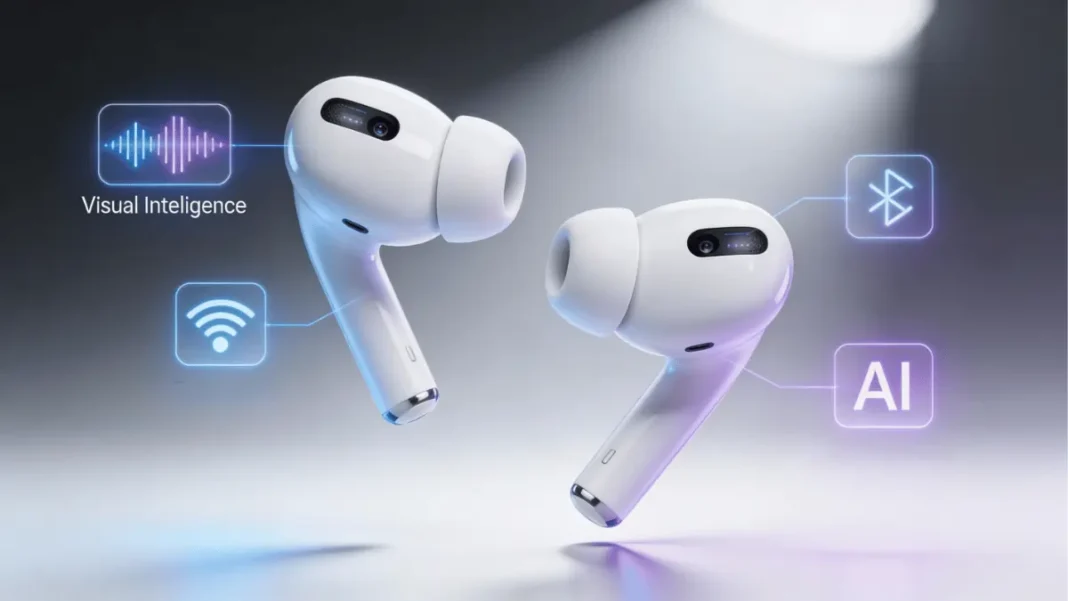
Apple is developing a premium variant of the recently launched AirPods Pro 3 that will feature infrared cameras designed to enable AI-powered Visual Intelligence capabilities. The camera-equipped model is expected to arrive in late 2026, just months after the standard AirPods Pro 3 debuted in September 2025, and will be priced above the current $249 retail price.
What’s New in Camera-Equipped AirPods Pro 3
The infrared cameras will work similarly to the Face ID module in iPhones, detecting environmental changes to enable Visual Intelligence features through Apple Intelligence. Bloomberg’s Mark Gurman reports that the cameras will allow users to invoke Visual Intelligence capabilities without pulling out their iPhones, enabling the earbuds to understand surroundings and provide contextual information.
Key hardware upgrades include:
- Infrared camera modules that capture environmental data for AI processing
- New H3 chip to power enhanced features with reduced latency and improved audio quality
- Hand gesture controls that could potentially replace current pressure-sensitive stem buttons
- Enhanced spatial audio integration with Apple Vision Pro headset
Analyst Ming-Chi Kuo first predicted in June 2024 that Apple would begin mass production of camera-equipped AirPods by 2026, with Foxconn serving as the supplier for infrared camera modules with an initial annual capacity of 18-20 million units.
Why Apple’s Two-Tier AirPods Strategy Matters
The camera-equipped variant mirrors Apple’s existing strategy with the AirPods 4, which launched in two versions with and without Active Noise Cancellation at different price points. This approach allows Apple to serve both mainstream consumers and early adopters willing to pay premium prices for cutting-edge features.
The standard AirPods Pro 3, which launched September 19, 2025, already includes significant upgrades such as heart rate monitoring during workouts, Live Translation powered by Apple Intelligence, twice the Active Noise Cancellation of the previous generation, and extended battery life of up to eight hours. However, those models use the same H2 chip as the 2022 AirPods Pro 2, making the camera-equipped version a more substantial hardware upgrade.
The premium variant’s infrared cameras could enable depth mapping capabilities and work seamlessly with Vision Pro to enhance spatial audio experiences. When a user turns their head while watching content, the cameras could adjust sound positioning to amplify audio from that direction.

Visual Intelligence Capabilities and Use Cases
Visual Intelligence represents Apple’s approach to bringing context-aware AI features to wearables without requiring users to constantly reach for their iPhones. The infrared cameras would enable features like Visual Look Up, which currently identifies objects, landmarks, and scenes through the iPhone camera.
Potential applications include:
- Location determination by analyzing nearby signs and landmarks
- Navigation assistance through real-time environmental scanning
- Object and scene identification via Siri voice commands
- Contextual reminders based on visual cues and location data
Chinese leaker Instant Digital suggests that in-air gesture controls could transform how users interact with AirPods, eliminating the need for physical buttons entirely. This would align with Apple’s broader push toward more intuitive, hands-free device control across its ecosystem.
What’s Next for AirPods Pro Development
The camera-equipped AirPods Pro 3 is expected to enter mass production sometime in 2026, though Apple has not officially confirmed the timeline. The H3 chip development is reportedly focused on improving ANC performance, reducing audio latency, and providing the computational power necessary for real-time AI processing.
Apple’s silicon team is working to ensure the H3 chip delivers “much better” Active Noise Cancellation than the current H2-powered models, which already provide twice the noise cancellation of the original AirPods Pro. The enhanced processing capability will be essential for handling complex AI algorithms while maintaining battery efficiency.
While pricing hasn’t been officially announced, industry sources indicate the camera variant will command a premium over the standard $249 model. The exact release date remains uncertain, with estimates ranging from mid to late 2026 depending on production timelines and component availability.

Featured Snippet Boxes
When will the camera-equipped AirPods Pro 3 be available?
The camera-equipped variant is expected to launch in late 2026, following mass production that begins sometime during the year. The standard AirPods Pro 3 without cameras launched September 19, 2025, and is currently available for $249.
What will the infrared cameras in AirPods Pro 3 actually do?
The IR cameras will enable Visual Intelligence features through Apple Intelligence, allowing the earbuds to understand your surroundings, identify objects and locations, provide navigation assistance, and support in-air gesture controls. They’ll work similarly to Face ID sensors, detecting environmental changes for enhanced spatial audio and AI-powered features.
How much will the camera-equipped AirPods Pro 3 cost?
While Apple hasn’t announced official pricing, sources indicate the camera variant will be priced above the standard AirPods Pro 3’s $249 retail price. This follows Apple’s two-tier strategy used with AirPods 4, which offers models with and without Active Noise Cancellation at different price points.
Will the camera AirPods work with Vision Pro?
Yes, the infrared cameras are specifically designed to enhance spatial audio experiences when paired with Apple Vision Pro. When you turn your head while wearing both devices, the cameras can adjust sound positioning to amplify audio from that direction, creating a more immersive spatial computing experience.

