

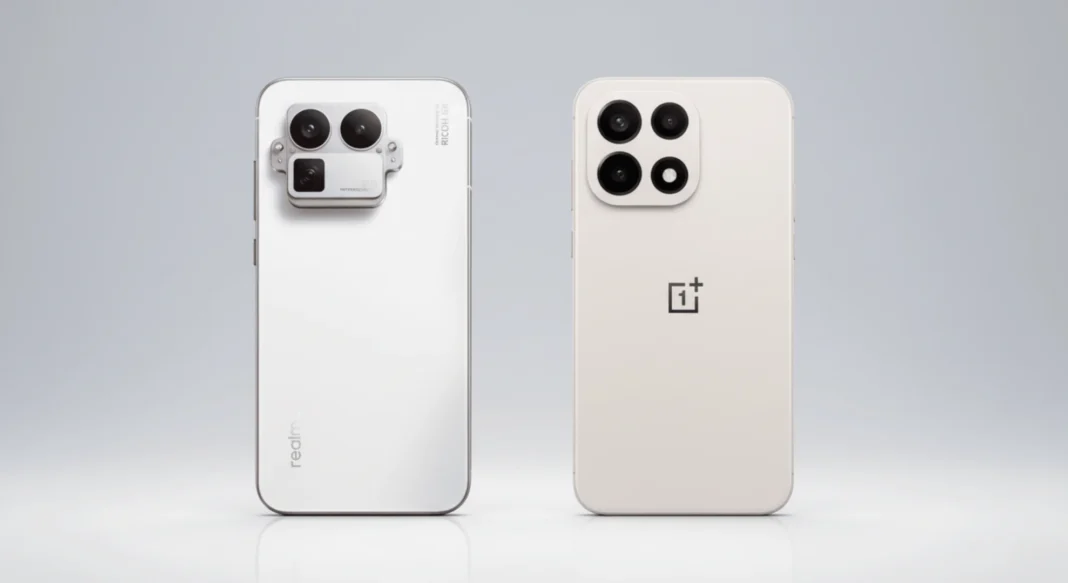
Summary: The Realme GT 8 Pro and the OnePlus 15 debut at identical ₹72,999 pricing in India with Snapdragon 8 Elite Gen 5 processors, creating the year’s most competitive flagship comparison. Realme excels with a sharper QHD+ display (508 ppi), 200MP Ricoh-powered telephoto camera with swappable modules, and higher CPU benchmark scores (3.96M AnTuTu). OnePlus counters with superior battery efficiency (17h 32m vs 14h 27m in PCMark), better thermal management (85% sustained performance), 165Hz gaming-focused display, and more natural camera processing. Choose Realme for creative photography, display accuracy, and peak performance bursts; pick OnePlus for battery longevity, sustained gaming, and software refinement.
India’s flagship smartphone segment witnessed an unprecedented clash in November 2025 when Realme GT 8 Pro and OnePlus 15 launched at identical ₹72,999 starting prices, both powered by Qualcomm’s latest Snapdragon 8 Elite Gen 5 processor. This isn’t just another spec-sheet comparison; these devices represent fundamentally different philosophies on what makes a flagship phone worth your money.
The OnePlus 15 arrived first on November 13, followed by Realme GT 8 Pro on November 20, setting up a direct head-to-head that has tech enthusiasts torn between two genuinely capable devices. After extensive testing across benchmarks, real-world usage, and specialized scenarios, here’s the definitive breakdown of which phone deserves your flagship budget.
Table of Contents
Quick Verdict: Which Phone Should You Buy?
Choose Realme GT 8 Pro if: You prioritize sharper QHD+ display quality, creative photography with 200MP telephoto zoom, customizable camera modules, peak CPU performance, and vibrant color science.
Choose OnePlus 15 if: You value exceptional battery life (3+ hours more per charge), sustained gaming performance, natural camera processing, brighter indoor display visibility, and refined software experience with cleaner OxygenOS 16.
Both phones share IP68/IP69 water resistance, 120W fast charging, triple 50MP+ camera systems, and flagship-grade performance making this decision about your specific priorities rather than objective superiority.
Specifications at a Glance
| Feature | Realme GT 8 Pro | OnePlus 15 |
|---|---|---|
| Processor | Snapdragon 8 Elite Gen 5 (4.6 GHz) | Snapdragon 8 Elite Gen 5 (4.6 GHz) |
| Display | 6.79″ QHD+ AMOLED, 144Hz, 508 ppi, 4000 nits peak | 6.78″ 1.5K LTPO AMOLED, 165Hz, 450 ppi, 3600 nits peak |
| Rear Cameras | 50MP main + 200MP telephoto (3x) + 50MP ultrawide | 50MP main + 50MP telephoto (3.5x) + 50MP ultrawide |
| Front Camera | 50MP, f/2.4 | 32MP with autofocus |
| Battery | 7000 mAh | 7300 mAh |
| Charging | 120W wired + 50W wireless | 120W wired + 50W wireless |
| RAM/Storage | 12GB/256GB, 16GB/512GB (LPDDR5X + UFS 4.1) | 12GB/256GB, 16GB/512GB (LPDDR5X Ultra+ + UFS 4.1) |
| Weight | 214-218g | 211-215g |
| Ingress Protection | IP68, IP69 | IP68, IP69K |
| Software | Realme UI 7 (Android 16) | OxygenOS 16 (Android 16) |
| Price | ₹72,999 / ₹78,999 | ₹72,999 / ₹79,999 |

Design and Build Quality
Materials and Premium Feel
The Realme GT 8 Pro takes an experimental approach with its silicone polymer “paper-textured” eco-leather back that feels distinctly warm and grippy, a refreshing departure from ubiquitous glass slabs. The aluminum alloy frame provides structural rigidity at 161.8 x 76.9 x 8.2 mm dimensions, weighing 214-218g depending on finish.
Its standout feature is the swappable camera module system users can physically replace the circular camera island with square or robot-themed alternatives using included screws. This playful customization targets enthusiasts wanting personalization beyond software themes.
OnePlus 15 counters with traditional premium materials: Gorilla Glass Victus 2 front, Gorilla Glass 7i or Crystal Shield Glass rear, and micro-arc oxidation coating on the Infinite Black variant that mimics ceramic texture. At 161.4 x 76.7 x 8.1 mm and 211-215g, it feels marginally lighter with better weight distribution.
The OnePlus achieves razor-thin bezels creating a more uniform, premium front appearance compared to Realme’s slightly thicker framing.
IP68/IP69 Water Resistance
Both devices carry IP68 and IP69 certification for dust, water immersion (1.5m for 30 minutes), and high-pressure water jets. OnePlus 15 extends this to IP69K the highest consumer smartphone rating adding protection against high-temperature pressure washing scenarios.
In practical terms, both survive accidental drops in pools or rain exposure, but OnePlus offers marginally superior protection in extreme conditions.
Weight Distribution and Handling
Despite similar dimensions, the OnePlus 15 feels lighter during extended use thanks to superior weight distribution. The Realme’s eco-leather back provides better grip without cases, while the OnePlus’s glass requires more careful handling but feels more premium.
Display Showdown
Resolution and Sharpness: QHD+ vs 1.5K
The Realme GT 8 Pro’s 6.79-inch QHD+ AMOLED panel delivers 508 ppi pixel density noticeably sharper than the OnePlus 15’s 6.78-inch 1.5K display at 450 ppi. Text rendering, fine details in photos, and UI elements appear crisper on Realme, particularly evident when viewing high-resolution images or reading small fonts.
The OnePlus 15 compensates with third-generation LTPO technology enabling more efficient refresh rate scaling between 1Hz and 165Hz, improving battery efficiency during static content like reading.
Brightness Levels Tested
Real-world brightness testing reveals:
| Condition | Realme GT 8 Pro | OnePlus 15 |
|---|---|---|
| Normal Mode (Manual Max) | 922 nits | 1400 nits |
| Adaptive Peak (Sunlight) | 3100 nits | 3120 nits |
| Advertised Peak | 4000 nits | 3600 nits |
Key Finding: OnePlus 15’s 1400-nit manual brightness crushes Realme’s 922 nits in typical indoor scenarios. This translates to visibly brighter, cleaner content when watching videos or browsing indoors without triggering adaptive mode.
Outdoors, both exceed 3000 nits in direct sunlight, delivering excellent legibility. Realme’s higher advertised 4000-nit peak applies only to HDR content in specific conditions.
Refresh Rate Wars: 144Hz vs 165Hz
Realme’s 144Hz vs. OnePlus’s 165Hz refresh rates show negligible perceptual difference in everyday scrolling or navigation. Both feel exceptionally smooth thanks to LTPO adaptive refresh.
Gaming reveals the distinction: OnePlus 15 supports 165fps gaming in Call of Duty: Mobile and BGMI with optimized titles, delivering slightly smoother frame delivery during ultra-competitive play. Realme caps at 144fps, still excellent but marginally behind for esports-focused gamers.
Color Accuracy Winner: Realme GT 8 Pro achieves professional-grade ΔE 0.6 ColorChecker accuracy and 99.3% DCI-P3 coverage with near-perfect 6500K white point. OnePlus 15’s ΔE 1.3 and cooler 6822K white point produce “poppier” visuals with a blue shift appealing for media consumption but less accurate for creative work.
Performance and Processing Power
Snapdragon 8 Elite Gen 5: Same Chip, Different Tuning
Both phones deploy Qualcomm’s 3nm Snapdragon 8 Elite Gen 5 with identical specifications: two 4.6 GHz Oryon Phoenix L cores plus six 3.62 GHz Phoenix M cores. The chipset delivers 20% CPU improvement and 35% better power efficiency over Snapdragon 8 Elite.
However, thermal tuning and power profiles create distinct performance personalities.
Benchmark Results Breakdown
| Test | Realme GT 8 Pro | OnePlus 15 | Winner |
|---|---|---|---|
| AnTuTu | 3,963,689 | 3,529,849 | Realme (+12%) |
| Geekbench Single | 3,666 | 3,609 | Realme (+1.6%) |
| Geekbench Multi | 11,050 | 10,680 | Realme (+3.5%) |
| PCMark Work | 26,693 | 15,829 | Realme (+69%) |
| 3DMark Wild Life Extreme | 5,442 | 7,135 | OnePlus (+31%) |
| CPU Throttle Stability | 75% | 85% | OnePlus (+13%) |
Analysis: Realme GT 8 Pro achieves higher peak CPU performance across synthetic benchmarks, particularly dominating productivity-focused PCMark tests. This translates to snappier app launches, faster multitasking, and more energetic UI responsiveness during burst workloads.
OnePlus 15 excels in GPU-intensive 3DMark testing with 31% higher scores, indicating better sustained graphics performance. Its superior thermal management maintains 85% of peak performance during prolonged stress tests versus Realme’s 75% throttling.
Real-World Speed Tests
Everyday usage mirrors benchmark patterns: Realme feels half-a-beat quicker during rapid app switching and cold starts. OnePlus maintains more consistent performance during extended sessions like editing 4K video or running demanding emulation.
Both configurations include LPDDR5X RAM (OnePlus uses a faster “Ultra+” variant) and UFS 4.1 storage, ensuring flagship-tier read/write speeds exceeding 3GB/s.
Gaming Performance Face-Off
BGMI and Call of Duty Testing
Controlled BGMI testing at maximum settings reveals:
| Metric | Realme GT 8 Pro | OnePlus 15 |
|---|---|---|
| Average FPS | 118.5 | 116.4 |
| Peak FPS | 121 | 121 |
| Stability | 99.8% | 97.9% |
Realme GT 8 Pro delivers marginally higher average frame rates with near-perfect 99.8% stability, suggesting aggressive performance tuning during short gaming bursts. However, thermal testing during 30+ minute sessions tells a different story.
Thermal Management Under Load
Extended Genshin Impact and Wuthering Waves testing shows OnePlus 15 sustaining performance better over time. The phone heats up slower, maintains frame times more consistently, and feels cooler during handheld play.
Temperature measurements during 10-minute AnTuTu stress loops:
- OnePlus 15: Peaks around 48-50°C, loses ~10% battery
- Realme GT 8 Pro: Exceeds 52°C faster, drops to 75% peak performance
Realme’s 7,000 sq mm vapor chamber cooling system and dedicated R1 gaming chip target sustained loads, but real-world thermal efficiency favors OnePlus’s more conservative power delivery.
Frame Rate Stability Analysis
OnePlus 15’s 165Hz display syncs perfectly with 165fps gameplay in supported titles like Call of Duty: Mobile, reducing screen tearing. Realme’s 144Hz remains excellent but caps frame delivery is slightly lower.
Verdict: Realme GT 8 Pro wins short gaming sessions (under 20 minutes) with higher burst performance. OnePlus 15 dominates extended competitive gaming (30+ minutes) through better thermals and sustained frame rates.
Camera Systems Compared
Realme’s Ricoh-Powered 200MP Telephoto
Realme GT 8 Pro debuts the company’s partnership with Ricoh Imaging, featuring a 200MP periscope telephoto with 3x optical zoom extending to 12x lossless zoom. The Ricoh GR mode offers five film tones Positive, Negative, High-contrast Black & White, Standard, and Monochrome targeting street photography enthusiasts.
The 200MP sensor captures exceptional texture detail with a standout telephoto macro mode producing stunning close-ups of small objects. RAW Max mode preserves 44MP files in 3:2 aspect ratio for editing flexibility.
Camera configuration:
- Main: 50MP (1/1.56″, f/1.8) with OIS
- Telephoto: 200MP periscope (3x optical, 12x lossless)
- Ultrawide: 50MP OmniVision OV50D (f/2.0, fixed focus)
- Front: 50MP (f/2.4)
Color Science: Realme’s processing leans toward bold contrast, vivid saturation, and aggressive HDR creating pre-edited, Instagram-ready results. Daylight photos show lifted shadows and punchy colors that look dramatic but stray from neutral accuracy.
Portrait mode adds a reddish tint to skin tones with visible smoothing, sometimes producing overly beautified faces. The ultrawide’s fixed focus limits closeup versatility.
OnePlus 15’s Triple 50MP Setup
OnePlus deploys a balanced triple 50MP system with Hasselblad color tuning:
- Main: 50MP (f/1.8) with OIS
- Telephoto: 50MP periscope (3.5x optical zoom, 30x digital)
- Ultrawide: 50MP (f/2.0)
- Front: 32MP with autofocus
The system prioritizes natural color accuracy; skies retain original tones, complex shades stay separated, and skin tones preserve realistic golden undertones with visible pores. Portrait edge detection produces cleaner subject-background separation without excessive smoothing.
The 3.5x telephoto delivers more stable results at high zoom levels up to 30x compared to Realme’s 3x optical base.
Daylight, Portrait, and Low-Light Results
Daylight Winner: Realme produces more dramatic, social-media-optimized results; OnePlus delivers accurate, professional-looking photos.
Portrait Winner: OnePlus 15’s natural skin tone rendering and cleaner bokeh separation outperform Realme’s over-processed beautification.
Low-Light Winner: Both handle night scenes capably, but OnePlus maintains better noise control and more accurate white balance.
Selfie Camera Performance
OnePlus 15’s 32MP autofocus front camera produces sharper selfies with better HDR control. Realme’s 50MP fixed-focus sensor captures more resolution but applies noticeable face smoothing and brightening.
Video Recording: Both support 8K@30fps, 4K@120fps rear video and 4K@60fps front recording. OnePlus offers superior stabilization during handheld movement.
Battery Life and Charging Speed
PCMark Battery Test Results
Real-world endurance testing reveals surprising differences despite similar capacity:
| Test | Realme GT 8 Pro (7000 mAh) | OnePlus 15 (7300 mAh) |
|---|---|---|
| PCMark Work 3.0 | 14 hours 27 minutes | 17 hours 32 minutes |
| Advantage | +3 hours 5 minutes (+21%) |
OnePlus 15’s superior thermal efficiency, lower display resolution (1.5K vs QHD+), and smarter LTPO scaling deliver 21% longer battery life despite only 4% larger capacity. Real-world usage confirms OnePlus comfortably lasts 1.5 days with moderate use, while Realme requires daily charging.
120W Fast Charging Comparison
Both phones support identical 120W SuperVOOC/SUPERVOOC wired charging:
- Realme GT 8 Pro: 43-52 minutes (0-100%)
- OnePlus 15: 40-41 minutes (0-100%)
OnePlus charges marginally faster (5-10 minutes) thanks to optimized power delivery curves.
Wireless and Reverse Charging
Both include:
- 50W wireless charging
- 5-10W reverse wireless charging
- Bypass charging (OnePlus) for reduced heat during gaming
OnePlus’s bypass charging feature routes power directly to components during gaming sessions, reducing battery heat and extending long-term cell health.
Software Experience
Realme UI 7 vs OxygenOS 16
Realme UI 7 (based on Android 16) emphasizes extensive customization: multiple gesture layers, deep theme integration, and visual flair. The interface feels feature-packed with granular control over animations, always-on display designs, and icon packs.
OxygenOS 16 takes a minimalist approach, cleaner layouts, deliberate animations, and lighter system resource usage. It feels more refined with fewer quirks and faster long-term stability.
Testing shows OxygenOS 16 maintaining smoother performance after months of app installations, while Realme UI 7 occasionally shows animation stutters under heavy multitasking.
Update Promises and Long-Term Support
Both manufacturers commit to:
- 4 major Android updates
- 5 years security patches
OnePlus historically delivers updates faster with fewer bugs, while Realme’s update track record has been less consistent.
Price and Value Proposition
Launch Offers and Bank Discounts
Realme GT 8 Pro:
- 12GB/256GB: ₹72,999
- 16GB/512GB: ₹78,999
- Bank offers: ₹5,000 instant discount
- Early buyer bonus: Free swappable camera module set
- Dream Edition (Aston Martin F1): ₹79,999 (16GB/512GB only)
OnePlus 15:
- 12GB/256GB: ₹72,999
- 16GB/512GB: ₹79,999
- Colors: Absolute Black, Misty Purple, Sand Dune
After bank offers, the Realme GT 8 Pro effectively starts at ₹67,999 creating a ₹5,000 value gap favoring Realme for budget-conscious buyers.
Storage Variants Pricing
The 16GB/512GB variant costs ₹1,000 more on OnePlus 15, but both offer identical storage performance (UFS 4.1) with sequential read speeds exceeding 3,500 MB/s.
Pros and Cons
Realme GT 8 Pro
Pros:
- Sharper QHD+ display (508 ppi) with industry-leading ΔE 0.6 color accuracy
- 200MP Ricoh-powered telephoto with creative film modes and telephoto macro
- Swappable camera modules for physical customization
- Higher CPU benchmark scores (12% faster AnTuTu)
- ₹5,000 launch discount + free camera modules
- Playful, distinctive eco-leather design
Cons:
- 21% shorter battery life (14h 27m vs 17h 32m)
- Greater thermal throttling (75% vs 85% sustained performance)
- Over-processed camera colors with skin tone beautification
- Fixed-focus ultrawide limits closeup shots
- Dimmer indoor brightness (922 nits vs 1400 nits manual max)
OnePlus 15
Pros:
- Superior battery efficiency (+3 hours PCMark endurance)
- Better sustained gaming performance (85% stability under load)
- Brighter indoor display (1400 nits manual vs 922 nits)
- Natural, accurate camera processing with better portraits
- 32MP autofocus front camera for sharper selfies
- Cleaner OxygenOS 16 with faster update history
- IP69K rating (highest consumer water resistance)
Cons:
- Lower resolution 1.5K display (450 ppi vs 508 ppi)
- Lower CPU benchmark scores (12% behind in AnTuTu)
- Less dramatic camera aesthetic for social media
- No launch discounts or bundled accessories
- Traditional glass design without customization options
The Bottom Line: Realme GT 8 Pro vs OnePlus 15
This comparison defies simple winner declarations both phones justify their ₹72,999 starting price through different strengths.
Choose Realme GT 8 Pro if you:
- Prioritize display sharpness and professional color accuracy for creative work
- Want dramatic, Instagram-ready photography with 200MP telephoto reach
- Value peak CPU performance for benchmark-heavy apps
- Desire physical customization through swappable camera modules
- Prefer bolder, more processed camera aesthetics
- Can accept shorter battery life in exchange for sharper screen
Choose OnePlus 15 if you:
- Need all-day battery life exceeding 17 hours active use
- Play competitive mobile games requiring sustained thermal performance
- Value natural, accurate camera processing for portraits and skin tones
- Prefer cleaner software with minimal UI clutter
- Want brighter indoor display visibility (1400 nits manual)
- Prioritize long-term stability and faster software updates
The Tie-Breaker: If you’re a photographer or content creator, Realme’s 200MP telephoto and color science deliver more creative tools. If you’re a gamer or heavy user, OnePlus’s battery efficiency and thermal management make daily life smoother.
Both represent exceptional flagship value in India’s sub-₹75,000 segment. Your choice depends on whether you prioritize creative expression (Realme) or refined reliability (OnePlus).

Featured Snippet Boxes
Quick Answer
The Realme GT 8 Pro and OnePlus 15 both cost ₹72,999 with identical Snapdragon 8 Elite Gen 5 processors. Realme excels in display sharpness (QHD+, 508 ppi), 200MP telephoto camera, and peak CPU performance. OnePlus wins battery life (17h 32m vs 14h 27m), sustained gaming thermals, and natural camera processing.
Camera Comparison
Realme GT 8 Pro features Ricoh-powered 200MP telephoto with 3x-12x zoom, film tone presets, and dramatic color processing ideal for social media. The OnePlus 15 uses a triple 50MP system with natural color accuracy, better portrait edge detection, and 32MP autofocus selfie camera. Choose Realme for creativity, OnePlus for accuracy.
Battery Winner
The OnePlus 15’s 7300 mAh battery lasts 17 hours 32 minutes in PCMark testing 21% longer than Realme GT 8 Pro’s 14 hours 27 minutes despite only 4% larger capacity. Superior thermal efficiency, lower-resolution 1.5K display, and optimized LTPO scaling deliver 3+ hours extra daily use.
Gaming Performance
Realme GT 8 Pro achieves 118.5 fps average in BGMI with 99.8% stability for short sessions. The OnePlus 15 maintains 85% sustained performance under thermal load (vs Realme’s 75%), supports 165fps gaming, and delivers better frame time consistency during 30+ minute sessions.
Display Quality
Realme GT 8 Pro’s 6.79″ QHD+ display offers sharper 508 ppi resolution and professional ΔE 0.6 color accuracy. The OnePlus 15’s 6.78″ 1.5K panel delivers brighter 1400-nit indoor visibility (vs 922 nits), 165Hz gaming refresh, and better battery efficiency despite lower 450 ppi resolution.
Price and Value
Both start at ₹72,999 (12GB/256GB) and ₹78,999-79,999 (16GB/512GB). Realme offers ₹5,000 launch bank discount and free swappable camera modules, effectively pricing at ₹67,999. OnePlus provides no launch offers but superior long-term battery efficiency and thermal management.
Source: Digit

