

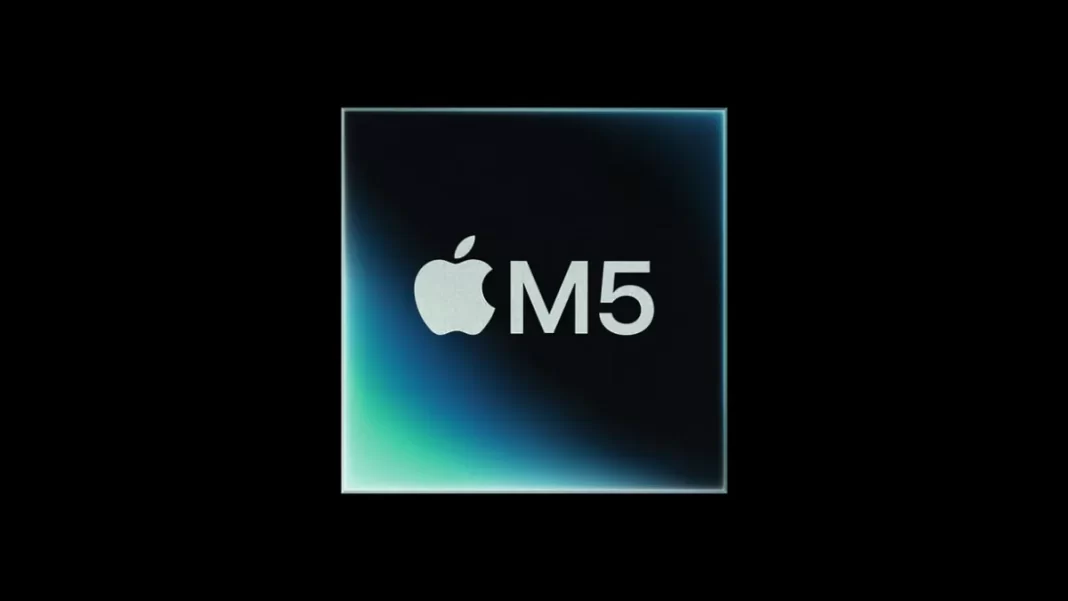
Apple’s M5 is a third-gen 3 nm chip with a 10-core CPU, a new 10-core GPU that adds a Neural Accelerator to each core, a faster 16-core Neural Engine, and 153 GB/s unified memory bandwidth. Apple claims up to 3.5x faster on-device AI and up to 1.6x faster graphics versus M4, depending on the task. It ships in the 14-inch MacBook Pro, iPad Pro, and Vision Pro starting October 22, 2025.
What is Apple’s M5 chip?
M5 is the next Apple Silicon generation focused on on-device AI. It keeps Apple’s CPU+GPU+Neural Engine design, but adds per-core Neural Accelerators inside the GPU, so AI workloads can spread across the graphics cores without always bouncing back to the dedicated NPU. The result is much higher peak AI compute from the GPU, plus faster graphics and a modest CPU uplift.
Key specs (base M5):
- CPU: up to 10 cores (4 performance, 6 efficiency), with Apple calling its performance core the world’s fastest.
- GPU: 10 cores, next-gen architecture, third-gen ray tracing, Neural Accelerator per core.
- Neural Engine: 16 cores, faster and more efficient for Apple Intelligence and Core ML tasks.
- Memory: unified memory bandwidth up to 153 GB/s.
- Process: third-generation 3 nm.
What’s new vs M4?
- AI performance: Apple cites over 4x peak GPU compute for AI vs M4, and device-level claims of up to 3.5x faster AI performance for tasks like diffusion image generation, local LLMs, and AI video tools.
- Graphics: up to 30% faster graphics and up to 45% uplift in ray-traced apps, plus smoother gameplay through improved dynamic caching.
- CPU: up to 15–20% multithreaded uplift vs M4, depending on the workload.
- Memory: bandwidth rises from 120 GB/s (M4) to 153 GB/s (M5), which helps larger models and heavier textures.
Which devices are getting M5, and when?
- 14-inch MacBook Pro: same chassis, 24-hour battery estimate, faster SSD, up to 4 TB storage. Pre-orders live now, on sale October 22, 2025.
- iPad Pro (11-inch and 13-inch): big AI uplift, Wi-Fi 7 via the new N1 wireless chip, and C1X modem on cellular models for faster mobile data. Same date.
- Apple Vision Pro: M5 boosts pixel rendering by ~10%, enables up to 120 Hz, and extends battery by ~30 minutes to 2.5 hours.
Specs at a glance
| Spec | M5 | M4 (base) |
|---|---|---|
| Process | 3 nm (third-gen) | 3 nm |
| CPU | Up to 10 cores (4P+6E) | Up to 10 cores (4P+6E) |
| GPU | 10-core, Neural Accelerator per core, 3rd-gen ray tracing | 10-core, prior gen RT |
| Neural Engine | 16-core, faster | 16-core |
| AI uplift | Over 4x peak GPU compute vs M4; up to 3.5x device AI | Baseline |
| Graphics uplift | Up to +30% graphics, up to +45% with ray tracing | Baseline |
| Unified memory bandwidth | 153 GB/s | 120 GB/s |
| Devices day one | MBP 14-inch, iPad Pro, Vision Pro | iPad Pro, Mac mini, MBP (M4 gen) |
Real-world gains: mini case studies
- Local LLMs on MacBook Pro (LM Studio): Higher memory bandwidth and a faster SSD help load medium-to-large models faster. Apple highlights faster local LLM runtimes and model loading for AI workflows like code assistants or summarizers. If you already run 7–13B models locally, you should see snappier starts and better sustained frames for multimodal tasks.
- Diffusion models on iPad Pro (Draw Things): Apple calls out faster on-device diffusion image generation. Artists can iterate more quickly on 768×768 to 1024×1024 prompts with less waiting, especially with the new windowing in iPadOS 26.
- Vision Pro rendering: With 10% more pixels driven and up to 120 Hz, text legibility and motion clarity improve. That helps spreadsheets, terminals, and Mac Virtual Display, not just games.
Comparison Table: M5 vs M4 (editorial)
| Category | Apple M5 | Apple M4 |
|---|---|---|
| Node | 3 nm (third-gen) | 3 nm |
| CPU | Up to 10 cores, 4P+6E; up to +15–20% MT | Up to 10 cores, 4P+6E |
| GPU | 10 cores, per-core Neural Accelerators, 3rd-gen RT, +30% graphics | 10 cores, prior RT gen |
| AI | Over 4x peak GPU compute for AI; up to 3.5x device AI | Baseline |
| Memory bandwidth | 153 GB/s | 120 GB/s |
| Day-one devices | MBP 14-inch, iPad Pro, Vision Pro | iPad Pro, Mac mini, MBP (M4 gen) |
Who should upgrade to M5?
- Intel or M1 users: Huge leap in CPU, GPU with ray tracing, and AI. If you do video, 3D, or local AI, this is the moment to switch. Apple cites up to 86x faster AI vs some Intel configs.
- M2 users: You will notice gains, but weigh cost vs your bottlenecks. If AI and GPU matter, M5 is meaningful.
- M4 users: Gains are clear but incremental. If you rely on AI tools, 3D with ray tracing, or Vision Pro workflows, M5 may be worth it. If your work is office apps and light photo edits, you can wait.
Pricing and availability
- MacBook Pro 14-inch (M5): from $1,599.
- iPad Pro (M5): from $999 (11-inch), $1,299 (13-inch).
- Vision Pro (M5): $3,499.
Pre-orders are open. Retail availability begins October 22, 2025.
Limitations and considerations
- Apple doesn’t publish M5 Neural Engine TOPS; we rely on relative claims (AI multipliers). App support for GPU Neural Accelerators matters, so dev adoption of Metal 4 Tensor APIs and Core ML backends will influence real results.
The Bottom Line
Apple’s M5 focuses on on-device AI: a new GPU with per-core Neural Accelerators, a faster 16-core Neural Engine, up to 153 GB/s memory bandwidth, and modest CPU gains. Expect up to 3.5x faster AI and up to 1.6x faster graphics vs M4 on supported apps. It launches in the 14-inch MacBook Pro, iPad Pro, and Vision Pro on Oct 22, 2025.
Frequently Asked Questions (FAQs)
Is M5 built on 3 nm?
Yes, Apple says third-generation 3 nm.
What’s new in the GPU?
A Neural Accelerator in each of the 10 GPU cores, plus third-gen ray tracing and improved caching.
How big is the CPU gain?
Up to 15–20% multithread uplift vs M4, depending on app.
What about memory?
Bandwidth rises to 153 GB/s vs 120 GB/s on M4.
Any wireless changes on iPad Pro?
Yes, N1 wireless chip adds Wi-Fi 7; cellular models get C1X modem.
Vision Pro benefits?
Sharper image (10% more pixels), up to 120 Hz, and about 30 minutes more battery.
When can I buy?
Pre-orders now, on sale Oct 22, 2025.
Does Apple share Neural Engine TOPS?
Not for M5. Only relative speed claims.
Featured Snippet Boxes
What is Apple M5?
Apple’s new 3 nm chip with a 10-core CPU, 10-core GPU with Neural Accelerators in each core, a faster 16-core Neural Engine, and 153 GB/s unified memory bandwidth.
How much faster is M5 than M4?
Apple claims up to 3.5x faster on-device AI and up to 1.6x faster graphics, with ~15–20% CPU multithread gains depending on workload.
Which devices get M5 first?
14-inch MacBook Pro, iPad Pro (11/13), and Apple Vision Pro. Pre-orders are open with sales starting October 22, 2025.
Does M5 support ray tracing?
Yes. The GPU includes third-generation ray tracing and enhanced shader cores for more realistic lighting and shadows.

