

Quick Brief
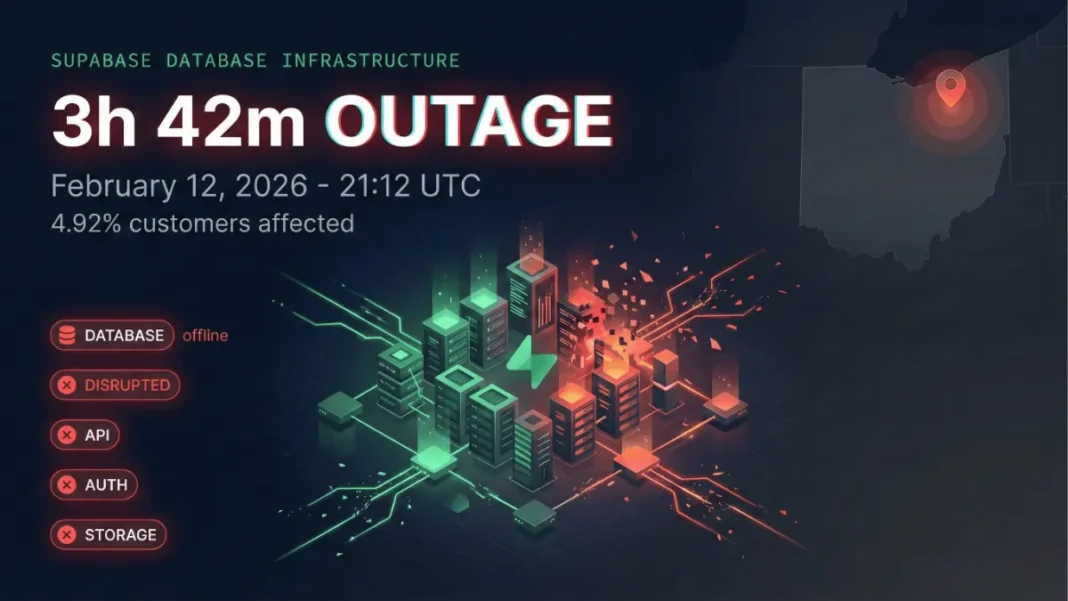
- Supabase suffered a 3 hour 42 minute outage starting February 12, 2026 at 21:12 UTC
- All services in us-east-2 (Ohio) region went down, affecting 4.92% of customers
- Database, API, Storage, and Auth services became completely unreachable with 522 errors
- CEO Paul Copplestone issued public apology and committed to major structural changes
Supabase, the open-source Firebase alternative trusted by thousands of production applications, experienced its most significant service disruption in recent memory on February 12, 2026. The incident exposed critical infrastructure vulnerabilities that left paying customers without database access for nearly four hours. This breakdown examines what happened, who was affected, and what Supabase is doing to prevent future failures.
What Happened During the Outage
The incident began at precisely 21:12 UTC on February 12, 2026, when all Supabase services in the us-east-2 (Ohio) region simultaneously became unreachable. Users attempting to access their databases encountered 522 connection timeout errors, a critical failure indicating complete infrastructure collapse.
The outage affected every layer of Supabase’s service stack. Database connections failed, API endpoints returned timeout errors, Storage buckets became inaccessible, and authentication services went offline. Users reported that even basic project access and dashboard functionality became unavailable.
Production databases on paid plans remained down for over two hours before recovery efforts could restore service. The incident required extensive intervention to resolve the underlying infrastructure issues.

Timeline and Duration
CEO Paul Copplestone confirmed the outage lasted 3 hours and 42 minutes from initial failure to resolution. The incident began at 21:12 UTC and full service restoration occurred around 00:54 UTC on February 13, 2026.
Independent monitoring by StatusGator detected the incident 15 minutes after the initial failure and tracked a total duration of 4 hours and 11 minutes. The official Supabase status page recorded the incident from 21:32 UTC on February 12 to 01:53 UTC on February 13, a span of 4 hours and 21 minutes.
Why the Timeline Differences?
The variance between Copplestone’s 3h42m figure and independent monitoring times (4h11m and 4h21m) likely reflects different measurement methodologies. The CEO’s timeline may represent core service restoration, while status monitors tracked complete system recovery including verification and final clearance.
Scope of Impact: Who Was Affected
Supabase CEO Paul Copplestone confirmed that 4.92% of all Supabase customers experienced complete service unavailability. While this percentage appears modest, it translated to thousands of production applications suddenly losing database connectivity during peak hours.
The disruption was geographically concentrated in the us-east-2 (Ohio) region. All projects hosted in this AWS availability zone lost access to Postgres databases, authentication systems, storage buckets, real-time subscriptions, and edge functions.
Real-World Consequences
Production applications relying on Supabase’s us-east-2 infrastructure faced immediate operational impact. E-commerce platforms couldn’t process transactions, SaaS applications lost user authentication capabilities, and real-time collaboration tools went silent. The timing of evening hours in UTC corresponding to afternoon in U.S. East Coast and morning in Asia amplified business disruption.
Supabase’s Official Response
Paul Copplestone addressed the incident publicly within hours through X (formerly Twitter). His statement on February 13 acknowledged the 3h42m duration and offered a direct apology: “I’m sorry to everyone affected. There is no good excuse – you trust us with your infra and we need to do better”.
Supabase published a comprehensive post-mortem on their official blog on February 13, 2026, one day after the incident. The document provided detailed incident information and analysis. This transparency contrasts with many cloud providers who delay incident reports for weeks.
Copplestone committed publicly to “major structural changes” to prevent recurrence. He emphasized that the company would work to earn back customer trust through concrete infrastructure improvements.
Technical Context: Why This Matters
Supabase markets itself as an open-source alternative to Firebase, positioning reliability as a core differentiator. The platform provides Postgres databases, authentication, real-time subscriptions, storage, and edge functions in a managed environment. Production users depend on consistent uptime to maintain their own customer commitments.
The incident reveals inherent challenges in managed database services. When Supabase experiences regional failures, customers lack immediate failover options unless they’ve architected independent redundancy. The platform currently offers 13 regional deployments worldwide, but individual projects typically reside in a single region.
Service Reliability History
StatusGator’s independent monitoring has tracked 691 outages across Supabase’s service components since September 2022. The platform monitors 26 distinct service components including Database, Auth, Storage, Realtime, and regional infrastructure across multiple availability zones.
The February 12 incident ranks among the most severe in duration and scope based on available historical data. Previous incidents with 522 connection errors have occurred, but rarely affected entire regional deployments simultaneously.
Lessons for Supabase Users
Production applications on Supabase should implement protective measures to mitigate single-region failure risks. First, design applications with graceful degradation so temporary database unavailability doesn’t cause complete application failures.
Second, establish monitoring independent of Supabase’s status page. Third-party services like StatusGator detected this incident and can provide alerts when official status pages experience delays.
Third, evaluate whether your application’s criticality justifies multi-region architecture or hybrid deployment strategies that combine Supabase with fallback systems.
Cost-Benefit Analysis
Teams must weigh Supabase’s developer experience benefits against infrastructure risks. The platform’s generous free tier and simple deployment attract early-stage projects. However, scaling to production requires acknowledging that regional outages affecting thousands of applications remain possible.
Industry Perspective on the Incident
The developer community’s response on X and Reddit showed mixed reactions. Some praised Supabase’s transparent incident handling and rapid post-mortem publication. Others questioned whether a managed database provider can consistently deliver production-grade reliability given the severity and duration of this outage.
Independent monitoring by StatusGator confirms Supabase has experienced 691 tracked incidents since September 2022 across its global infrastructure. The platform uses four status levels up, warn, down and maintenance to classify service health.
What Comes Next
Supabase’s promised “major structural changes” will likely determine customer confidence moving forward. The company’s open-source foundation allows community visibility into infrastructure improvements as they’re implemented.
Users should monitor for updated SLA commitments, architectural guidance for high-availability deployments, and potential multi-region failover capabilities. The incident may accelerate Supabase’s development of cross-region redundancy options.

Frequently Asked Questions (FAQs)
What caused the Supabase outage on February 12, 2026?
Supabase experienced a complete infrastructure failure in us-east-2 at 21:12 UTC affecting all service layers. The company published a detailed post-mortem on February 13, 2026 with root cause analysis and prevention measures.
How many Supabase customers were affected by the outage?
The incident impacted 4.92% of all Supabase customers, specifically those with projects hosted in the us-east-2 Ohio region. All services in this region became unavailable.
How long did the Supabase outage last?
CEO Paul Copplestone stated the outage lasted 3 hours and 42 minutes. Independent monitoring services recorded durations between 4h11m and 4h21m, likely due to different measurement methodologies.
Did Supabase provide compensation for the outage?
Public statements focused on apologies and structural improvements rather than compensation details. Customers on paid plans should review their service agreements for SLA credit eligibility.
How quickly did Supabase detect the outage?
The incident began at 21:12 UTC. The official status page showed detection at 21:32 UTC, and independent monitoring detected issues within 15 minutes of initial failure.
What is Supabase’s overall reliability record?
StatusGator has tracked 691 outages since September 2022 across Supabase’s 26 service components and regional deployments. The platform maintains transparent status reporting through its official status page.
What errors did users experience during the outage?
Users encountered 522 connection timeout errors when attempting to access databases, APIs, authentication services, and storage. These errors indicate complete infrastructure unavailability.
Where can I read Supabase’s official incident report?
Supabase published a comprehensive post-mortem on their official blog at supabase.com/blog/supabase-incident-on-february-12-2026 on February 13, 2026.
This analysis relies exclusively on publicly verified information from official Supabase sources and independent monitoring services. Timeline discrepancies between the CEO’s stated 3h42m duration and independent monitoring measurements (4h11m-4h21m) are noted for accuracy.

