

Quick Brief
- Sony opens third global DMPC facility in Tokyo headquarters, joining US and UK locations in February 2026
- Facility combines VENICE 2 cameras, Crystal LED VERONA walls, and XYN spatial content tools under one roof
- End-to-end workflow testing from virtual production shoots to post-production and test screenings enabled
- Initial focus serves professional cinematographers before expanding to next-generation creator training programs
Sony has fundamentally altered how filmmakers approach virtual production and DMPC Japan proves the company is accelerating this transformation. The facility, opening February 2026 inside Sony Group’s Tokyo headquarters, becomes the third Digital Media Production Center globally after locations in the United States and United Kingdom. This Tokyo base integrates every stage of modern content creation from hands-on equipment testing to virtual production shoots, XR-based spatial content development, post-production color grading, and final test screenings enabling creators to validate complete workflows without leaving the building.
The strategic positioning in Japan addresses growing demand for spatial content technologies as XR adoption expands across film, broadcast, and immersive entertainment sectors. By housing production studios alongside post-production facilities, DMPC Japan eliminates the traditional separation between capture and finishing environments that slows creative iteration.
Production Infrastructure: Cinema-Grade Tools Meet Spatial Computing
DMPC Japan deploys Sony’s flagship CineAlta VENICE 2 camera system, featuring interchangeable sensor blocks with 8.6K (8640 x 5760) and 6K (6048 x 4032) full-frame options delivering 16 stops of dynamic range. The production studios include Cinema Line cameras, professional lighting equipment, and a production design set developed in partnership with the Japan Film and Television Art Directors Association. This configuration supports practical test shoots across diverse filming scenarios before productions commit to full-scale deployment.
Post-production suites feature the BVM-HX3110 reference monitor for color-critical grading work, paired with BRAVIA 9 displays for large-screen client review. The co-location of capture and finishing tools enables cinematographers to move from shoot to color grade within the same facility, compressing traditional multi-day workflows into hours.

Virtual Production Ecosystem: Crystal LED and Real-Time Rendering
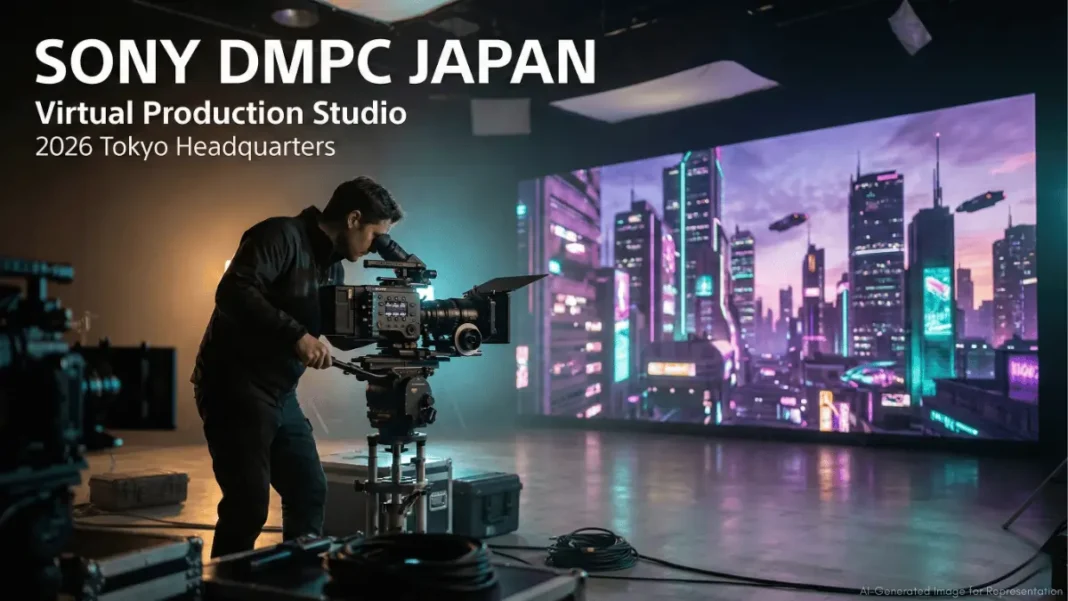
The centerpiece is an In-Camera VFX studio built around Sony’s Crystal LED VERONA wall system synchronized with the OCELLUS camera-tracking system. Crystal LED micro-LED displays provide exceptional brightness and color accuracy that eliminates the green screen replacement workflow. When combined with VENICE 2’s sensor technology and the Virtual Production Tool Set software suite, the system captures live action and computer-generated environments simultaneously through the camera.
Traditional chroma key methods require extensive post-processing to composite blue or green screen footage with digital backgrounds. DMPC Japan’s In-Camera VFX approach records final-quality images in real time, allowing directors and cinematographers to see accurate lighting, reflections, and interactive elements during the shoot rather than months later in post-production. The facility also supports multi-camera live switching for broadcast applications using HDC-F5500 system cameras and the MLS-X1 live production switcher.
What makes Crystal LED superior for virtual production?
Crystal LED technology provides pixel-level brightness control and color accuracy that matches VENICE 2’s sensor characteristics. Unlike conventional LED panels that create moiré patterns or flicker at high frame rates, Crystal LED VERONA displays synchronize with cinema camera sensors to produce artifact-free footage. The system maintains consistent color temperature across the entire display surface, eliminating the hot spots and color shifts that plague standard LED walls during camera movement.
XR and Spatial Content Creation Tools
As 3D computer graphics production demands escalate alongside XR adoption, DMPC Japan incorporates Sony’s XYN solution suite to support volumetric and spatial content workflows. The XYN Spatial capture solution enables 3DCG production through advanced motion capture technology via XYN Motion Studio and mocopi Professional mode. Creators can produce content for glasses-free 3D viewing using Spatial Reality displays, addressing emerging distribution formats beyond traditional 2D screens.
Motion capture integration allows filmmakers to blend live performance with virtual environments in real time, capturing actor movements and translating them to digital characters or spatial data layers simultaneously with principal photography. This convergence of physical and digital production techniques expands creative possibilities while maintaining the efficiency gains of consolidated workflows.
Global Knowledge Exchange and Talent Development
DMPC Japan functions as a hub for international collaboration, connecting with sister facilities in the US and UK to share production techniques, equipment workflows, and project case studies across regions. The facility provides a practical environment where cinematographers, camera operators, and post-production teams from multiple countries can gather for hands-on learning and joint problem-solving sessions.
Ahead of the official February 2026 opening, the facility hosted a masterclass under Japan’s “Cinematic Quantum” program, a multi-year initiative supported by the Agency for Cultural Affairs and Japan Arts Council. Director of Photography Oren Soffer conducted advanced training for professional cinematographers, demonstrating the educational capacity the center will provide to both established and emerging creators.
The facility initially serves professional creators before expanding its mission to nurture next-generation talent specializing in spatial content creation. This phased approach ensures production workflows are thoroughly validated with experienced filmmakers before introducing training programs for students and early-career professionals entering XR and virtual production fields.
How does DMPC Japan compare to similar facilities globally?
DMPC Japan joins Sony’s existing centers in Hollywood and the UK, creating a network that operates across major film production markets. The Tokyo location distinguishes itself through integration of XYN spatial content tools and emphasis on glasses-free 3D workflows, reflecting Asia-Pacific market demand for immersive content formats. While independent facilities like XR Studios focus primarily on motion capture and photogrammetry, DMPC Japan provides complete end-to-end validation from virtual production through final color grading and screening.
Production Workflow Validation: From Concept to Final Delivery
The facility enables comprehensive workflow testing across Sony’s entire production ecosystem from camera sensors and lenses through virtual production integration, post-production color science, and final output formats. Recent examples include cinematographer Barry Baz Idoine’s collaboration with Sony at the Hollywood DMPC to validate workflows and equipment for the short film “Cut to the Chase” using advanced virtual production technologies. These real-world projects inform future product development by identifying friction points and optimization opportunities before consumer release.
Sony’s approach prioritizes practical creator feedback gathered through hands-on production scenarios rather than theoretical equipment demonstrations. By inviting professional cinematographers to push the boundaries of virtual production and XR workflows in actual project contexts, DMPC Japan generates insights that directly influence camera firmware updates, software tool enhancements, and workflow documentation improvements.
The cross-pollination between facilities means breakthroughs discovered at the Tokyo location can be rapidly shared with creators using DMPC centers in Los Angeles and the UK, accelerating global adoption of proven techniques.
Market Implications: Virtual Production Becomes Standard Practice
The establishment of DMPC Japan reflects broader industry shifts as virtual production transitions from experimental technique to standard practice for high-budget film, television, and commercial projects. Major productions including Disney’s “The Mandalorian” demonstrated the creative and financial advantages of LED volume stages, prompting studios worldwide to invest in similar infrastructure. Sony’s multi-location facility network positions the company to lead both equipment sales and workflow education as this transition accelerates.
The integration of XR and spatial content tools within the same facility as traditional cinema cameras signals Sony’s expectation that volumetric capture and immersive content formats will become routine elements of mainstream production rather than specialized niche applications. As Apple Vision Pro and competing spatial computing platforms expand distribution, content creation facilities must support both conventional 2D delivery and emerging 3D formats, a capability DMPC Japan provides through unified workflows.
Limitations and Considerations
Access to DMPC Japan initially restricts to professional creators and Sony partners rather than open public availability. Independent filmmakers and small production companies may face barriers to facility usage compared to larger studios with established Sony relationships. The concentration of cutting-edge equipment in centralized locations rather than decentralized rental markets could limit access for creators unable to travel to Tokyo, Los Angeles, or the UK for extended periods.
While virtual production reduces certain post-production costs, the upfront investment in Crystal LED walls, camera tracking systems, and real-time rendering infrastructure remains substantial. Productions must achieve sufficient scale to justify virtual production workflows over traditional location shooting or green screen methods.

Frequently Asked Questions (FAQs)
What is Sony DMPC Japan?
Sony DMPC Japan is a Digital Media Production Center in Tokyo that provides creators with end-to-end workflow testing facilities for virtual production, XR content creation, and traditional filmmaking. The facility features VENICE 2 cameras, Crystal LED walls, post-production suites, and spatial content tools under one roof.
Where are Sony’s other DMPC facilities located?
Sony operates two additional DMPC locations before the Tokyo opening one in the United States (Hollywood) and one in the United Kingdom. These three facilities collaborate to share production techniques, equipment workflows, and case studies globally.
What cameras and equipment does DMPC Japan feature?
The facility includes Sony’s CineAlta VENICE 2 with interchangeable 8.6K and 6K sensor blocks, Cinema Line cameras, professional lighting equipment, Crystal LED VERONA walls, OCELLUS camera tracking, BVM-HX3110 reference monitors, and XYN spatial content creation tools.
What is In-Camera VFX virtual production?
In-Camera VFX captures live action performers and computer-generated backgrounds simultaneously through the camera using LED video walls. This eliminates traditional green screen replacement and allows directors to see final-quality images during shooting rather than in post-production.
Who can access DMPC Japan facilities?
Initially, DMPC Japan serves professional creators, cinematographers, camera operators, and post-production teams. The facility will later expand to provide training programs for next-generation creators specializing in spatial content production.
How does Crystal LED improve virtual production quality?
Crystal LED micro-LED displays provide pixel-level brightness control, exceptional color accuracy, and synchronization with cinema camera sensors that prevents moiré patterns and flicker. The technology maintains consistent color temperature across large display surfaces, eliminating hot spots and color shifts.
What is XYN spatial content creation?
XYN is Sony’s solution suite for 3D computer graphics production, motion capture, and volumetric content creation. The system supports glasses-free 3D viewing through Spatial Reality displays and integrates motion capture data with traditional filmmaking workflows.
When does DMPC Japan officially open?
Sony opened DMPC Japan in February 2026 inside the Sony Group headquarters in Minato-ku, Tokyo. The facility hosted pre-launch masterclasses in January 2026 as part of Japan’s Cinematic Quantum program.

