

Quick Brief
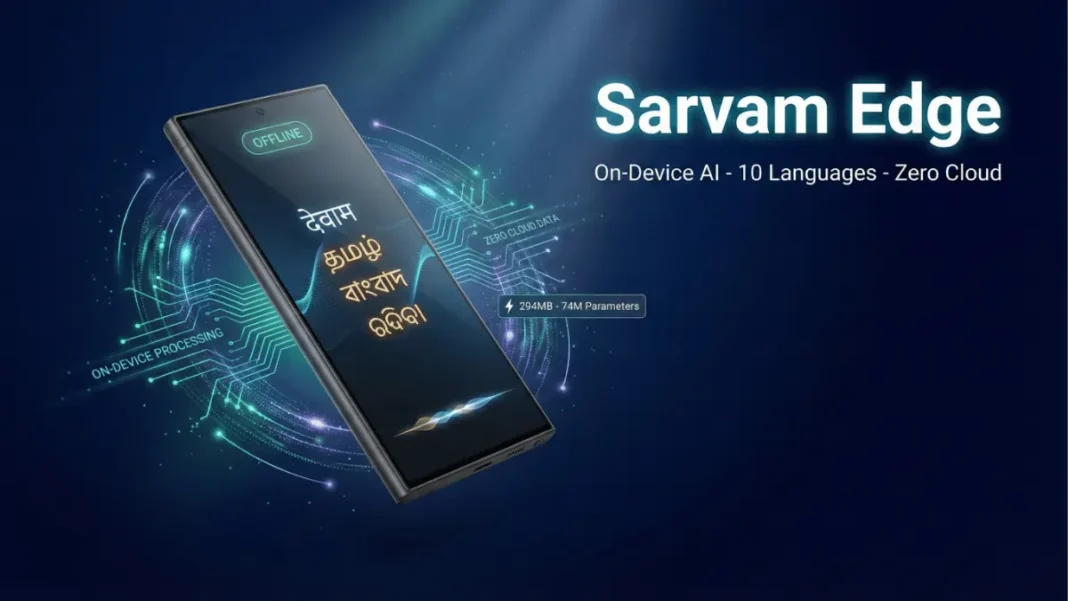
- Sarvam Edge runs speech recognition, translation, and synthesis completely offline on smartphones
- Supports 10 Indian languages with 74M-parameter ASR model and 294MB footprint
- Zero per-query cloud costs and complete data privacy information never leaves device
- Announced February 14, 2026, ahead of India’s AI Impact Summit with global device partnerships
Indian AI startup Sarvam AI has fundamentally redefined how artificial intelligence reaches users and the February 14, 2026 announcement of Sarvam Edge proves it. This isn’t another cloud-based AI service requiring constant connectivity. Sarvam Edge runs entirely on your smartphone, processing speech recognition, translation, and text-to-speech locally without sending a single byte to external servers. The shift matters because it eliminates three barriers that have limited AI adoption in India: network dependency, per-query costs, and privacy concerns.
What Makes Sarvam Edge Different From Cloud AI
Traditional AI models run on distant data centers, requiring stable internet connections and processing each query through remote servers. Sarvam Edge flips this model by embedding intelligence directly into devices people already own. The system delivers instant responses with no round trip to data centers, no queueing behind other users, and no variance based on network conditions.
The economic shift is equally significant. Cloud AI services charge per query, creating scaling concerns as user bases grow. With on-device inference, the cost is embedded in the device itself there are no usage-based pricing tiers or bandwidth constraints. This changes what becomes economically viable: education tools for students, productivity software for small businesses, and assistive technologies for underserved communities can now reach contexts where cloud costs would be prohibitive.
What is Sarvam Edge’s core technology?
Sarvam Edge is an on-device AI stack that runs speech recognition, speech synthesis, and multilingual translation entirely offline on smartphones. The system supports 10 Indian languages using compact models totaling under 700MB combined, processing locally without cloud dependency or per-query costs.
Speech Recognition Built for Real India
The speech recognition engine delivers production-grade, on-device transcription specifically engineered for the Indian market. At its core sits a single unified multilingual model supporting 10 popular Indian languages within one compact 74-million-parameter architecture. Instead of maintaining separate models per language, the system uses automatic language identification, eliminating manual user selection and enabling seamless multilingual interaction.
The technical specifications reveal aggressive optimization: the model footprint measures just 294MB in FP16 format. Time-to-first-token remains under 300 milliseconds, enabling responsive streaming experiences suitable for real-time applications. Running on Qualcomm’s Snapdragon 8 Gen 3 mobile chip, the inference stack achieves a real-time factor of approximately 0.12 meaning speech processes 8.5 times faster than real time.
Accuracy extends beyond phonetic transcription. The architecture maintains high accuracy on 8KHz audio typical of telephony systems, handles multi-speaker environments with overlapping speech, and remains resilient in noisy backgrounds. A built-in inverse text normalization engine converts spoken forms into correct written conventions, formatting numbers, dates, currencies, and temperature units appropriately. The system preserves Indian proper nouns, regional names, and entities with high fidelity critical for practical deployment across diverse linguistic contexts.
Benchmarking against the Vistaar dataset, which spans 59 test environments across domains like news, education, and tourism, demonstrates competitive Word Error Rates and Character Error Rates across supported Indic languages.
Text-to-Speech in 10 Languages From One Model
The speech synthesis component provides reliable text-to-speech directly on device using a single 24-million-parameter model. This unified architecture supports 10 Indian languages and 8 multilingual speakers while maintaining consistent voice identity across languages. The entire deployable footprint measures approximately 60MB.
Performance metrics measured on Samsung Galaxy S25 Ultra show Time to First Audio of 260 milliseconds from text input to first audible output. The Real-Time Factor of 0.19 means audio generates approximately 5.2 times faster than real time, allowing streaming inference where playback begins before full sentence generation completes.
Quality validation uses Character Error Rate measurement, where generated speech is re-evaluated through automatic speech recognition. The model achieves an overall mean CER of 0.0173 on Sarvam’s TTS general benchmark dataset, indicating synthesized speech reliably preserves intended words and structure across all languages. This matters for voice interfaces and assistive systems where downstream errors must be minimized.
How does Sarvam Edge handle custom voices?
Sarvam Edge supports custom voice cloning within its unified multilingual model using approximately one hour of curated speech data. The adapted voice works across all supported languages while maintaining consistent identity, deployable on-device within the same 60MB footprint with identical latency characteristics.
Translation Across 110 Language Pairs
Translation on the Edge provides high-performance neural machine translation directly on device, supporting 11 languages including 10 Indian languages and English. This enables bidirectional translation across 110 language pairs without pivoting through an intermediate language, a technical achievement that preserves meaning and reduces compounding errors.
The multilingual model measures approximately 150 million parameters with a 334MB on-device memory footprint. Benchmarked on Qualcomm Snapdragon 8 Gen3, Time to First Token reaches approximately 200 milliseconds, enabling near-instant responses in interactive settings. Streaming throughput hits 30 tokens per second, supporting smooth real-time translation even for longer sentences.
The architecture handles real-world complexity. It normalizes dates and currencies, processes noisy inputs like spelling errors and chat-style language, and manages complex alphanumeric formatting. Code-mixed and colloquial expressions receive native support. Users can toggle between international Hindu-Arabic numerals like “100 रुपये” and native Indic numerals like “१०० रुपये,” adapting translations to audience and context without retraining.
Compared to a 600-million-parameter state-of-the-art open-source multilingual edge model, Sarvam Edge achieves competitive or superior quality at 4 times smaller size. This compression without quality loss improves deployability without sacrificing user experience.
Privacy and Accessibility at National Scale
When AI processes entirely on-device, data never leaves the user’s hands. Processing a document, translating a conversation, or asking a question keeps information local, no server logs queries, no database stores conversations, no privacy policy requires parsing. The model runs, produces a result, and that’s it.
This architecture works everywhere: on flights, in rural areas with intermittent connectivity, during network outages, when bandwidth-constrained, or when cloud services are unavailable. CNBC TV18’s coverage notes this positioning is “particularly relevant in India, where bandwidth variability, rural connectivity gaps and cost sensitivity can limit the reach of cloud-first AI services”.
Sarvam AI frames the strategic shift directly: “The question is no longer whether India can train powerful models. The question is whether they can run everywhere, every day”. The company states Sarvam Edge is being developed in close collaboration with leading global device manufacturers, though specific OEM partners have not been publicly named.
Does Sarvam Edge work without internet connection?
Yes, Sarvam Edge operates completely offline. All processing including speech recognition, translation, and text-to-speech runs locally on the device without requiring internet connectivity. It functions on flights, in rural areas with no network coverage, and during outages.
Real-World Demonstrations
Sarvam AI showcased three practical implementations demonstrating the stack’s capabilities:
- Vision OCR on MacBook Pro: Uploading an Odia image file with transcription running entirely locally, internet connectivity turned off. The system sustained transcription speeds exceeding 40 tokens per second while maintaining peak memory usage below 10GB.
- Stock Brokerage App on Android: A voice-driven financial assistant running locally on device. Users interact through speech to retrieve portfolio overviews, check holdings, view balances, execute buy/sell transactions, conduct market research, assess trends, and receive real-time stock quotes all processed entirely on-device without cloud connectivity.
- Real-Time Voice Translation: Demonstrating speech-to-speech translation between Indian languages. The system processes speech recognition, translation, and expressive text-to-speech seamlessly in real time.
Strategic Timing and Industry Context
The February 14, 2026 announcement comes just ahead of India’s AI Impact Summit (February 16-20), where questions around sovereign AI, cost efficiency, and large-scale deployment are expected to dominate discussions. Co-founder Pratyush Kumar described the effort as focused on making models “super small in memory and compute footprints, while being close to accuracy of much larger models”.
The broader vision extends beyond smartphones to “AI-enabled glasses, intelligent audio systems, assistive wearables devices where intelligence is not an app, but a property of the hardware itself”. This aligns with industry movement toward edge computing, where Qualcomm India President Savi Soin has stated that on-device AI will spark “the next G moment” in India’s tech landscape.
Technical Comparison: Sarvam Edge vs Cloud Models
| Feature | Sarvam Edge | Cloud AI |
|---|---|---|
| Latency | <300ms time-to-first-token | Variable, depends on network |
| Privacy | Data never leaves device | Queries sent to remote servers |
| Network Dependency | Works completely offline | Requires active internet connection |
| Cost Model | No per-query charges | Usage-based pricing per API call |
| Model Size | 74M params (ASR), 294MB footprint | Typically billions of parameters |
| Language Support | 10 Indian languages | Varies by provider |
| Deployment | Embedded in device | Runs on remote data centers |
Limitations and Considerations
While Sarvam Edge delivers significant advantages in privacy, cost, and accessibility, the approach involves trade-offs. On-device models must balance capability against strict memory and compute constraints that cloud systems don’t face. The 74-million-parameter speech recognition model, while highly optimized, cannot match the raw capacity of cloud-based models with billions of parameters.
Device hardware requirements also matter. The benchmarks cite performance on premium chipsets like Qualcomm Snapdragon 8 Gen 3 and Samsung Galaxy S25 Ultra. Performance on mid-range or budget devices with less capable processors may vary. Sarvam AI has not yet disclosed minimum hardware specifications for optimal operation.
Model updates present another consideration. Cloud AI systems update continuously, with improvements deployed immediately to all users. On-device models require updates distributed through app stores or system updates, potentially creating version fragmentation across devices.

Frequently Asked Questions (FAQs)
What languages does Sarvam Edge support?
Sarvam Edge supports 10 popular Indian languages for speech recognition and text-to-speech, plus English for translation capabilities. The unified multilingual model provides automatic language identification without manual user selection, enabling seamless multilingual interaction across all supported languages.
How much storage space does Sarvam Edge require?
The complete Sarvam Edge stack requires approximately 700MB of device storage. This includes 294MB for the 74M-parameter speech recognition model, 60MB for the 24M-parameter text-to-speech model, and 334MB for the 150M-parameter translation model.
Can Sarvam Edge run on older smartphones?
Sarvam AI benchmarked Sarvam Edge on premium chipsets including Qualcomm Snapdragon 8 Gen 3 and Samsung Galaxy S25 Ultra. The company has not yet disclosed minimum hardware specifications, though models are designed for deployment on “devices people already have”.
Is Sarvam Edge available for download now?
Sarvam AI announced Sarvam Edge on February 14, 2026, and is developing it in collaboration with global device manufacturers. The company has not yet announced public availability dates or specific OEM partnerships.
How does Sarvam Edge compare to Google’s on-device AI?
Sarvam Edge specifically targets Indian languages with 10-language support designed for local market conditions. Google’s current native on-device support for Indian languages remains limited, which is why Sarvam AI benchmarked against Google Cloud STT rather than on-device alternatives.
What is the accuracy of Sarvam Edge speech recognition?
Sarvam Edge achieves competitive Word Error Rates and Character Error Rates across supported Indic languages when benchmarked against the Vistaar dataset spanning 59 test environments. The architecture maintains high accuracy on 8KHz telephony audio, handles multi-speaker environments, and remains resilient in noisy backgrounds.
Does Sarvam Edge work for voice cloning?
Yes, Sarvam Edge supports custom voice cloning. With approximately one hour of curated speech data, users can adapt new speakers to work across all supported languages while maintaining consistent voice identity within the same 60MB on-device footprint.

