

Essential Points
- Sarvam AI launched the Indus beta on February 20, 2026, powered by two open-source models Sarvam-30B and Sarvam-105B both trained in India
- Indus supports all 22 official Indian languages natively, including voice interaction with 35+ Indian-accent voices across 11 languages
- Sarvam Vision scores 84.3% on olmOCR-Bench in 2026, outperforming Gemini 3 Pro, ChatGPT, and DeepSeek OCR v2 on Indian-script documents
- Both models are fully open source; enterprises and government agencies can deploy them on domestic infrastructure under India’s data localisation rules
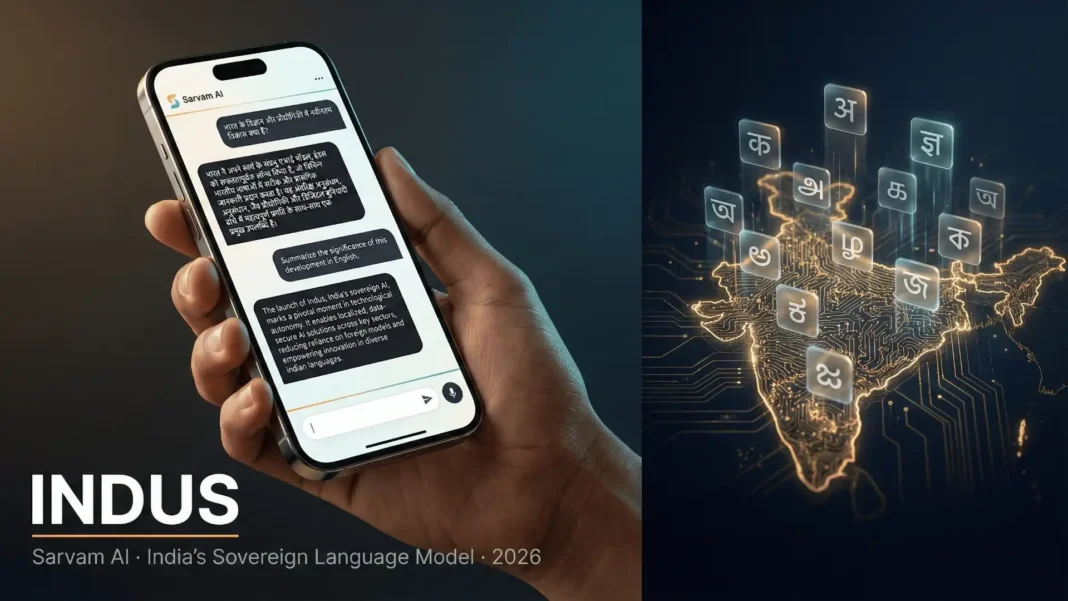
India did not license its sovereign AI from Silicon Valley. On February 20, 2026, Sarvam AI launched Indus, a chat application running on 105-billion-parameter models trained from scratch on domestic Indian infrastructure, supporting all 22 official Indian languages, and released as fully open source. Two days earlier, at the India AI Impact Summit, Sarvam had unveiled those models alongside BharatGen Param 2 and Gnani three indigenous AI systems in one event, marking a deliberate national shift from AI consumer to AI creator. What follows is a verified breakdown of what Indus is, what it does, and where it currently falls short.
What Is Sarvam AI Indus?
Indus is a general-purpose AI chat application built by Bengaluru-based Sarvam AI, available on iOS, Android, and web at indus.sarvam.ai as of February 2026. It accepts typed or spoken prompts and delivers responses in text or audio across all 22 official Indian languages and English. Sign-in requires a phone number, Google account, or Apple ID.
The product is currently in limited beta with a rolling waitlist due to compute capacity limits. It competes directly with ChatGPT, Google Gemini, Anthropic’s Claude, and Microsoft Copilot but with a structural difference that none of those platforms can replicate: the models powering it were built in India, trained on Indian infrastructure, and kept under Indian data sovereignty.
What is Sarvam AI Indus?
Sarvam AI Indus is India’s sovereign AI chat application, launched in beta on February 20, 2026. It is powered by Sarvam-30B and Sarvam-105B two open-source large language models trained from scratch in India under the India AI Mission mandate. It supports all 22 official Indian languages with native voice interaction across iOS, Android, and web.
 GroqCloud’s Global Infrastructure Push Has Reached 3.5 Million Developers, Here’s What Changed
The Models: Sarvam-30B and Sarvam-105B
Sarvam unveiled two models at the India AI Impact Summit on February 18, 2026: Sarvam-30B and Sarvam-105B. Both were trained entirely on domestic Indian GPU infrastructure with India AI Mission support, and both are released as open source freely available to developers, enterprises, and government agencies.
The 30B model is engineered for efficiency: fast inference, lower compute requirements, and broad deployability including on resource-constrained infrastructure. The 105B model is Sarvam’s flagship at approximately one-sixth the parameter count of DeepSeek R1’s 600B, it delivers competitive benchmark performance on mathematical reasoning, coding, and multilingual tasks while costing less than Google Gemini Flash per query. Parameter count is not a perfect proxy for capability, but the 105B size places Sarvam in the upper tier for models built by Indian startups.
A third component Sarvam Vision handles document and image recognition, scoring 84.3% on olmOCR-Bench in 2026 and outperforming Gemini 3 Pro, ChatGPT, and DeepSeek OCR v2 on multi-script Indian document recognition. This matters directly for India, where documents span Devanagari, Tamil, Telugu, and dozens of other writing systems that foreign OCR systems routinely misread.
| Model | Parameters | Primary Use | Open Source |
|---|---|---|---|
| Sarvam-30B | 30 billion | General chat, efficient inference, edge deployment | Yes |
| Sarvam-105B | 105 billion | Complex reasoning, coding, multilingual depth | Yes |
| Sarvam Vision | Not disclosed | Document OCR, image analysis, Indian-script recognition | Yes |
| Speech models | Not disclosed | Voice across 22 Indian languages, 35+ voices, 11 languages live | Partial |
What are the Sarvam-30B and Sarvam-105B models?
Sarvam-30B and Sarvam-105B are open-source large language models unveiled at the India AI Impact Summit on February 18, 2026. Both were trained from scratch in India on domestic compute infrastructure. Sarvam-105B is approximately one-sixth the size of DeepSeek R1 yet costs less than Google Gemini Flash while outperforming it on key Indian-language benchmarks.
22 Languages: Built In, Not Bolted On
Indus supports all 22 officially recognised Indian languages as a native capability not as translations layered over an English-first model. This is the most significant technical differentiator between Indus and every foreign AI platform operating in India in 2026. Anthropic added 10 Indic languages to Claude in 2026; Google continues expanding Gemini’s Indic capabilities both as additions to English-first systems. Sarvam’s models were trained on Indian linguistic data from the ground up.
Voice interaction is live across 11 languages with 35+ Indian-accent voices in the current beta, with expansion to all 22 languages underway. Critically, Indus handles code-switching the fluid mixing of languages like Hindi and English (Hinglish) or Tamil and English that is a daily reality for hundreds of millions of Indian users and a consistent failure point for foreign AI trained on monolingual data.
Indus vs. ChatGPT, Gemini, and Claude in 2026
India is one of the world’s most active generative AI markets: OpenAI reports ChatGPT now counts more than 100 million weekly active users in the country, and Anthropic reports India represents 5.8% of global Claude usage, second only to the US. These figures show both demand and the scale of competition Indus enters.
| Dimension | Sarvam Indus | ChatGPT (OpenAI) | Gemini (Google) | Claude (Anthropic) |
|---|---|---|---|---|
| Indian languages | All 22 native | Handful add-on | 9+ Indian languages | 10 Indic languages added 2026 |
| Voice in Indian languages | 35+ voices, Indian accents, 11 languages | Limited | Partial | No native voice |
| Code-switching (Hinglish) | Native | Poor | Moderate | Limited |
| Data sovereignty | India trained and hosted domestically | US servers | US servers | US servers |
| Open-source models | Yes 30B and 105B | No | Partial (Gemma) | No |
| Indian-script document OCR | 84.3% olmOCR-Bench beats global leaders | Lower on Indic scripts | Lower than Sarvam Vision | Limited |
| India AI Mission backed | Yes sovereign mandate | No | No | No |
| Cost vs. Gemini Flash | Lower cost, competitive benchmarks | Higher | Baseline | Higher |
| Pricing (beta) | Free | Free + $20/mo Plus | Free + $20/mo Advanced | Free + $20/mo Pro |
| Current availability | India only limited beta waitlist | Global | Global | Global |
The honest assessment for 2026: for Indian-language tasks, regional voice interaction, and Indian-script document processing, Indus leads. For advanced English reasoning, complex coding, and global knowledge tasks, ChatGPT, Gemini, and Claude remain stronger. The smart approach is to use Indus where it excels and complement with global tools for tasks where it does not yet match.
How does Indus compare to ChatGPT in 2026?
Indus is built natively for Indian users trained on Indian data, hosted on Indian infrastructure, supporting all 22 official Indian languages with voice. ChatGPT leads on English reasoning and global knowledge. Indus leads on Indian-language accuracy, code-switching, and Indian-script document recognition. Sarvam Vision outperforms ChatGPT on olmOCR-Bench in 2026.
The India AI Mission: What Sovereign Mandate Means
In 2026, the Government of India formally selected Sarvam AI to build India’s sovereign LLM ecosystem under the India AI Mission. This is not a grant or a partnership, it is a structural mandate that gives Sarvam access to domestic GPU compute infrastructure, Indian government datasets for training, and a deployment pathway into regulated sectors including banking, healthcare, government services, and education.
The result: Sarvam’s models were trained without routing data through AWS, Azure, or Google Cloud. For Indian enterprises operating under data localisation regulations, this resolves a governance problem that no foreign AI platform can address. Sundar Pichai, CEO of Google, publicly praised Sarvam AI’s approach in 2026 external validation that India’s sovereign AI strategy is substantive.
The India AI Impact Summit on February 18, 2026, where Sarvam’s models were unveiled, also saw BharatGen Param 2 and Gnani presented three indigenous AI systems in one event, a signal of coordinated national AI development rather than isolated startup efforts.
Open Source: What It Enables for India’s AI Ecosystem
Both Sarvam-30B and Sarvam-105B are released as open source in 2026. This decision amplifies India’s AI ecosystem far beyond what Sarvam alone could build. Any Indian developer can fine-tune and deploy these models for sector-specific applications. Indian enterprises, banks, hospitals, manufacturers can run them on private infrastructure without API dependency or data leaving their systems. State governments and central ministries gain access to a sovereign AI foundation that meets data localisation requirements by design.
The open-source release also positions Sarvam’s models as a global reference point for multilingual Indic AI, not just a domestic product. Sarvam AI was founded by Vivek Raghavan and Pratyush Kumar, two AI researchers who left leading global research roles to build India’s sovereign AI infrastructure from scratch. Co-founder Pratyush Kumar framed the core challenge on X: “The transition from ‘I trained a model’ to ‘I’m using the model at population scale’ that is a problem worth solving.”
Device and Enterprise Partnerships
Alongside the model launch, Sarvam announced two partnerships that extend Indus well beyond the smartphone browser. A partnership with HMD brings AI features to Nokia feature phones, a critical deployment for India’s still-significant feature phone user base, where AI that works with constrained hardware and unreliable connectivity could be transformative for first-time users. A partnership with Bosch targets automotive voice applications low-latency, in-vehicle AI assistance in Indian languages.
Sarvam has also flagged enterprise offerings and hardware plans, signalling a strategy aimed at the full device spectrum from entry-level handsets to in-vehicle systems, not a single chat interface. AI agents within the Indus app are confirmed as planned but not yet live in the current beta.
What partnerships has Sarvam AI announced for Indus in 2026?
Sarvam announced two key partnerships at the India AI Impact Summit in February 2026: a partnership with HMD to bring AI features to Nokia feature phones and a partnership with Bosch for automotive voice applications. Both extend Indus beyond smartphone browsers into India’s broader device ecosystem, from entry-level handsets to in-car systems.
Core Features: What Indus Does Today
- AI Chat: General-purpose conversational AI in English and 22 Indian languages for research, writing, document analysis, and everyday queries
- Voice Interaction: Voice-first design with 35+ Indian-accent voices across 11 languages; speech models trained on Indian intonations, not foreign-accented approximations
- Document Upload and Analysis: Upload PDFs and images for AI-powered summarisation and Q&A; Sarvam Vision’s 84.3% olmOCR-Bench score means Indian-script documents are read accurately
- Document Writing and Editing: Draft and edit documents inside the app writing assistant in the user’s own language, not just a Q&A tool
- Web Research: Searches the web for current information and answers queries with sourced context, covering India-specific topics more accurately than globally trained models
- Code-Switching: Handles Hinglish, Tamil-English, and other mixed-language inputs natively within a single conversation without reconfiguration
- AI Agents: Confirmed as planned not yet live in the current beta release
Limitations and What to Expect
Indus in February 2026 is a beta product. The following limitations are confirmed from published reports:
- Chat history: Users cannot delete individual conversations removing all chat history requires deleting the account entirely
- Reasoning mode: The app’s reasoning behaviour cannot be disabled, which adds latency on simple queries that do not require deep reasoning
- Waitlist: Most users encounter a waitlist at signup due to limited compute; invite codes allow immediate access
- Availability: Currently limited to India
- English-first professional tasks: For complex coding, advanced English-language reasoning, and global knowledge, ChatGPT, Gemini, and Claude remain stronger in 2026
- AI agents: Promised but not yet live
- Voice depth across all 22 languages: Voice is confirmed for 11 languages with expansion underway not all 22 are voice-enabled at beta launch
Co-founder Pratyush Kumar stated on X that access will broaden over time and that the team is actively collecting user feedback to refine the experience.
What are the current limitations of Sarvam Indus AI in 2026?
Indus in February 2026 beta cannot delete individual chat histories without full account deletion, and the reasoning mode cannot be disabled adding latency on simple queries. Access is limited to India with a waitlist due to compute constraints. AI agents are planned but not live. For complex English-language tasks, ChatGPT and Gemini remain stronger.
Frequently Asked Questions (FAQs)
What is Sarvam AI Indus and who built it?
Sarvam AI Indus is India’s sovereign AI chat application, launched in limited beta on February 20, 2026, by Bengaluru-based Sarvam AI. Founded by Vivek Raghavan and Pratyush Kumar, Sarvam was selected by India’s AI Mission to build the country’s sovereign LLM ecosystem. Indus runs on Sarvam-30B and Sarvam-105B both trained from scratch in India on domestic compute and released as open source.
What models power Sarvam Indus AI in 2026?
Indus is powered by Sarvam-30B and Sarvam-105B, unveiled at the India AI Impact Summit on February 18, 2026. The 30B model is optimised for efficient, fast inference. The 105B model roughly one-sixth the size of DeepSeek R1 outperforms Google Gemini Flash on cost benchmarks. Sarvam Vision scores 84.3% on olmOCR-Bench, beating Gemini 3 Pro, ChatGPT, and DeepSeek OCR v2 on Indian-script documents.
How many Indian languages does Sarvam Indus support in 2026?
Indus supports all 22 official Indian languages natively trained from the ground up on Indian linguistic data, not translated from an English base. Voice interaction is live in 11 languages with 35+ Indian-accent voices, expanding to all 22. Code-switching Hinglish, Tamil-English mixing is handled natively, a capability foreign AI platforms do not replicate accurately.
How do I access Sarvam Indus AI in 2026?
Access Indus at indus.sarvam.ai on the web, on the Google Play Store for Android, or on the Apple App Store for iOS. Sign up with your mobile number for OTP verification, or use your Google or Apple ID. Many users are currently placed on a waitlist an invite code from Sarvam or an existing user provides immediate access during the phased beta rollout.
Is Sarvam Indus AI free to use in 2026?
Sarvam Indus AI is free in beta as of February 2026. Chat, voice, document upload, web research, and document writing are all included at no cost. No paid consumer tiers have been announced. The Sarvam-30B and Sarvam-105B models are open source and free to download. Sarvam’s enterprise API services are priced separately.
What partnerships has Sarvam AI announced alongside Indus?
Sarvam announced partnerships with HMD to bring AI features to Nokia feature phones and with Bosch for automotive voice applications. HMD targets India’s feature phone user base where constrained hardware and patchy connectivity require efficient on-device AI. The Bosch partnership addresses in-vehicle Indian-language voice assistance. Both were announced at the India AI Impact Summit in February 2026.
What are the current beta limitations of Indus?
Users cannot delete individual chat histories, account deletion is required to remove all conversation data. The reasoning mode cannot be disabled, which adds latency on simple queries. Access is currently India-only with a rolling waitlist. AI agents are planned but not yet live. Voice is currently available in 11 of 22 supported languages. Sarvam is actively collecting feedback to address these in future releases.
Can Indian enterprises use Sarvam models for business deployments?
Yes. Sarvam-30B and Sarvam-105B are open source enterprises that can deploy them on private domestic infrastructure, maintaining full compliance with Indian data localisation regulations. This allows government agencies, healthcare providers, financial institutions, and enterprises to run sovereign AI without routing sensitive data through foreign servers. Enterprise-specific offerings and SLAs are flagged by Sarvam as upcoming.

