

Quick Brief
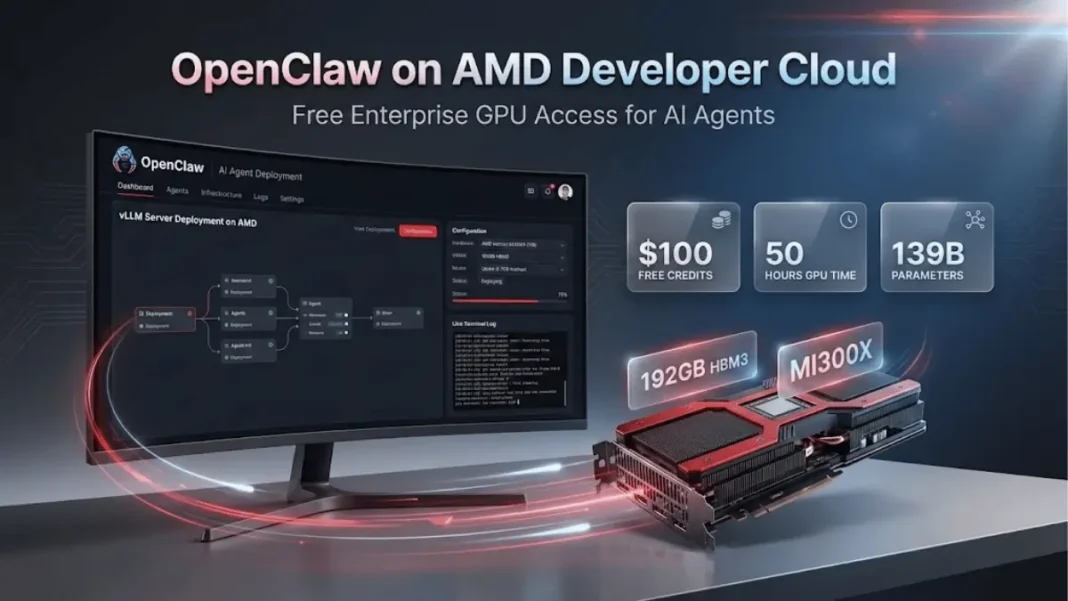
- AMD AI Developer Program grants $100 free credits for 50 hours of MI300X access
- Single MI300X instance provides 192GB memory enough for 139B parameter models
- OpenClaw connects to vLLM through OpenAI-compatible API endpoints
- MiniMax-M2.1 model runs entirely free using enterprise-grade AMD hardware
OpenClaw users face a persistent challenge: consumer GPUs cannot handle large language models that power truly capable AI agents. AMD Developer Cloud eliminates this barrier by offering free access to Instinct MI300X accelerators with 192GB of memory. This guide demonstrates production deployment of OpenClaw with vLLM on enterprise infrastructure at zero cost.
AMD AI Developer Program: 50 Hours of Free GPU Time
The AMD AI Developer Program provides new members with $100 in credits, sufficient for approximately 50 hours on a single MI300X instance. Registration requires an AMD account and grants immediate access to the member portal where activation codes appear after enrollment. Members who publicly share projects may qualify for additional credits beyond the initial allocation.
Beyond GPU access, the program includes a one-month DeepLearning.AI Premium membership, monthly hardware sweepstakes entry, and free AMD training courses. This combination addresses both immediate compute needs and long-term skill development for AI practitioners.
Setting Up Your MI300X Instance in 3 Steps
What hardware does AMD Developer Cloud provide for OpenClaw?
AMD Developer Cloud offers single MI300X instances with 192GB HBM3 memory and ROCm software pre-installed. Each droplet provides root access via SSH or web console. This configuration supports models up to 139 billion parameters in FP8 precision without compression.
Creating a GPU droplet requires three configuration choices. First, select the MI300X hardware tier from available instance types. Second, choose the ROCm Software image to ensure compatibility with the latest vLLM releases. Third, add your SSH public key for secure access instructions for key generation appear directly on the setup page.
Once provisioned, the droplet becomes accessible via terminal using ssh root@<DROPLET_IP> or through the browser-based web console.
Installing vLLM with ROCm Optimization
vLLM serves as the inference engine connecting OpenClaw to large language models. The ROCm-optimized version includes specific flash attention implementations that improve performance on AMD hardware. Installation begins with environment preparation to isolate dependencies.
Create a Python virtual environment and activate it with these commands:
apt install python3.12-venv
python3 -m venv .venv
source .venv/bin/activate
Install the ROCm-optimized vLLM build using pip with the ROCm wheel repository:
pip install vllm==0.15.0+rocm700 --extra-index-url https://wheels.vllm.ai/rocm/0.15.0/rocm700
This specific build includes CK Flash Attention support optimized for MI300X hardware.
Deploying MiniMax-M2.1 Model With 139B Parameters
The MiniMax-M2.1 model provides 139 billion parameters in FP8 quantization, fitting comfortably within MI300X’s 192GB capacity. This model supports tool calling, reasoning chains, and context windows up to 194,000 tokens.
How do you configure firewall access for vLLM endpoints?
Open port 8090 using Ubuntu’s UFW firewall to allow HTTP traffic to your model endpoint. Run ufw allow 8090 before launching vLLM. This creates an inbound rule permitting connections from OpenClaw running on your local machine or other authorized clients.
Launch the vLLM server with this configuration:
VLLM_USE_TRITON_FLASH_ATTN=0 vllm serve cerebras/MiniMax-M2.1-REAP-139B-A10B \
--served-model-name MiniMax-M2.1 \
--api-key YOUR_SECURE_KEY \
--port 8090 \
--enable-auto-tool-choice \
--tool-call-parser minimax_m2 \
--trust-remote-code \
--reasoning-parser minimax_m2_append_think \
--max-model-len 194000 \
--gpu-memory-utilization 0.99
Replace YOUR_SECURE_KEY with a randomly generated string to authenticate API requests. The VLLM_USE_TRITON_FLASH_ATTN=0 environment variable forces CK Flash Attention usage for optimal MI300X performance.
Model weights download automatically from HuggingFace. Once loaded, vLLM creates an OpenAI-compatible endpoint at http://<DROPLET_IP>:8090/v1.
Connecting OpenClaw to Your vLLM Endpoint
OpenClaw installation requires a single command on Mac or Linux systems:
curl -fsSL https://openclaw.ai/install.sh | bash
During installation, select “Open the Web UI” when prompted about hatching your bot. The web interface launches automatically in your default browser.
Navigate to Settings > Config to add your vLLM provider. Create a new provider entry with these values:
- Name: vllm
- API: openai-completions
- API Key: The secure key you defined during vLLM launch
- Base URL: http://<DROPLET_IP>:8090/v1
Under the Models section, add a model definition:
- API: openai-completions
- Context Window: 194000
- ID: MiniMax-M2.1
These values must match the max-model-len and served-model-name parameters used when launching vLLM.
Finally, set your primary agent model to vllm/MiniMax-M2.1 in the Agents section. This format combines the provider name and model ID you configured in previous steps. Click Apply to save changes.
Real-World Performance and Cost Analysis
| Configuration | GPU Memory | Cost Per Hour | Context Window |
|---|---|---|---|
| MI300X (AMD Cloud) | 192GB | $0 (free credits) | 194,000 tokens |
| Local RTX 4090 | 24GB | Hardware purchase required | Varies by model |
| Oracle Cloud ARM | 24GB RAM | $0 (free tier) | API-dependent |
The MI300X configuration enables substantially larger models than consumer hardware permits. Free credits cover approximately 50 hours of continuous operation sufficient for prototyping, testing, and small-scale production deployments.
What are the limitations of free AMD Developer Cloud access?
Free credits expire after consumption or account inactivity exceeding program terms. Members cannot reserve instances indefinitely droplets must be deleted when not actively used. Public project sharing becomes mandatory for additional credit requests beyond the initial $100 allocation.
Extending Your Setup: Alternative Models and Frameworks
The same vLLM infrastructure supports hundreds of open-source models from HuggingFace. Llama 3.1 70B, Mixtral 8x22B, and Qwen 2.5 72B all run within MI300X memory constraints using similar launch commands. Simply modify the model identifier and adjust max-model-len based on the model’s documented context window.
For developers requiring permanent infrastructure, Oracle Cloud’s Always Free tier provides 4 OCPU + 24GB RAM indefinitely. This configuration handles OpenClaw with API-based models but lacks local LLM hosting capabilities that MI300X enables.
Considerations for Production Deployment
Enterprise deployments benefit from MI300X’s consistent performance and massive memory capacity. However, free tier limitations necessitate hybrid architectures for 24/7 availability. Consider using AMD credits for development and testing, then migrating to paid instances or self-hosted infrastructure for production workloads.
Security best practices include rotating API keys regularly, restricting firewall rules to specific IP addresses, and monitoring credit consumption. The AMD member portal displays real-time usage metrics and remaining credit balances.
Frequently Asked Questions (FAQs)
How long does $100 in AMD Developer Cloud credits last?
Credits provide approximately 50 hours on a single MI300X instance. Actual duration varies based on instance type and usage patterns. Sharing projects publicly may qualify you for additional credits beyond the initial allocation.
Can I run multiple OpenClaw agents on one MI300X instance?
Yes, vLLM’s architecture supports concurrent requests from multiple clients. A single MI300X can handle multiple simultaneous OpenClaw sessions. Configure max-num-seqs parameter to control concurrency limits based on your memory and performance requirements.
What happens when free credits expire?
Your droplet remains accessible but begins consuming paid credits if payment methods are configured. Otherwise, AMD suspends the instance until you add credits or delete it. Download any necessary data before credit exhaustion.
Does vLLM on MI300X support tool calling and function execution?
Yes, MiniMax-M2.1 includes native tool calling capabilities enabled via the --enable-auto-tool-choice flag. OpenClaw leverages this for file operations, web searches, and API integrations without additional configuration.
How does MI300X compare to consumer GPUs for running large models?
MI300X provides 192GB of memory compared to 24GB in high-end consumer GPUs like RTX 4090. This allows running models with 139 billion parameters that would not fit on consumer hardware without extensive quantization or offloading.
Can I access AMD Developer Cloud globally?
Yes, AMD Developer Cloud supports global access. Registration and usage are available worldwide through the AMD AI Developer Program portal.

