

Summary: LG Nova showcased four new AI-first ventures at CES 2026, including ReliefAI Health for mental healthcare, PADO AI for data center energy optimization, Primefocus Health for remote patient monitoring, and OnVibe for SMB marketing. The North America innovation arm also featured 8 startup partners across healthtech, AI, and cleantech sectors, demonstrating LG’s commitment to collaborative innovation beyond traditional consumer electronics.
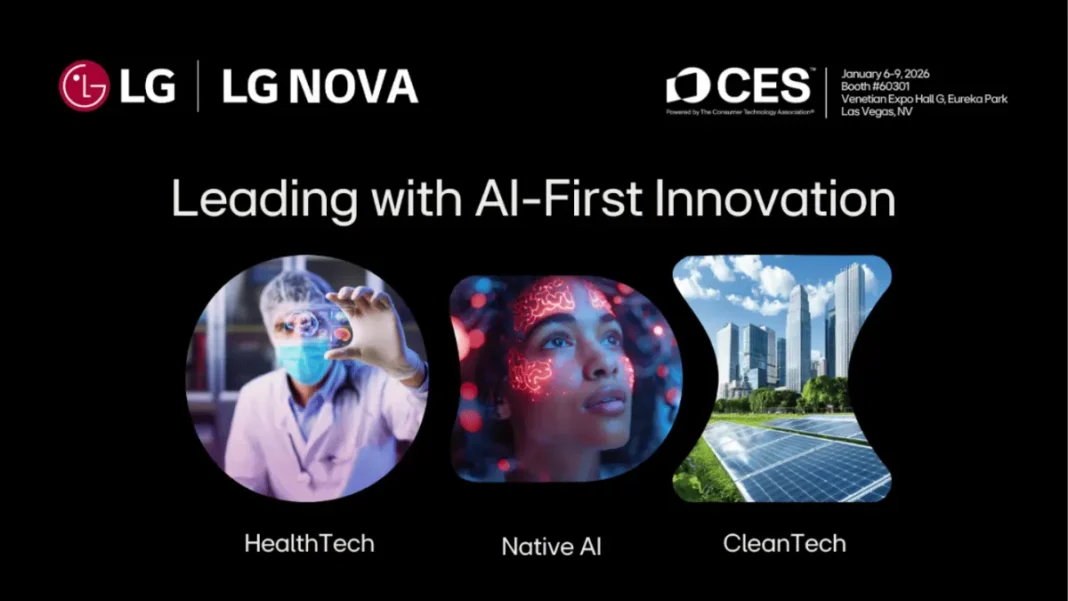
LG Nova, the North America innovation center for LG Electronics, has debuted four new AI-powered business ventures at CES 2026, marking a strategic expansion beyond traditional consumer electronics into healthcare, energy management, and small business tools. The showcase at Eureka Park features companies developed through LG’s entrepreneur-in-residence program alongside eight startup partners, addressing real-world challenges in mental health access, data center efficiency, and remote patient care.
The announcement positions LG as a serious player in corporate AI incubation, competing with programs from Google’s Area 120 and Microsoft’s M12 Ventures. Unlike traditional venture capital arms that simply invest, LG Nova co-founds companies with entrepreneurs-in-residence, providing technical resources, LG’s hardware ecosystem access, and go-to-market support.
What Is LG Nova and How Does Its Incubation Model Work?
LG Nova operates as LG Electronics’ North America innovation hub based in Santa Clara, California. Founded to bring external innovation into LG’s ecosystem, the center focuses on launching new ventures that could become LG’s next growth engines beyond appliances and displays.
The Entrepreneur-in-Residence Approach
LG Nova employs entrepreneurs-in-residence who work inside the organization to develop business concepts from scratch. These founders get access to LG’s engineering teams, supply chain networks, and distribution channels while maintaining startup agility. The model differs from accelerators because LG becomes a co-founder rather than just a mentor or investor.
Sokwoo Rhee, Executive Vice President at LG Electronics and Head of LG Nova, explains the strategy: “We believe our collaboration model, working with startups, industry experts and entrepreneurs, gives us a leading advantage in creating new businesses that will change their respective industries”.
From Concept to Commercial Launch
The incubation timeline typically spans 12-18 months from ideation to market entry. Portfolio companies receive pre-seed and seed funding directly from LG, technical co-development support, and validation through LG’s customer base. This approach lets ventures test product-market fit faster than traditional startups bootstrapping without corporate backing.
What makes LG Nova different from traditional corporate VC?
LG Nova co-founds companies with entrepreneurs-in-residence rather than just investing. Portfolio companies access LG’s engineering resources, supply chain, and distribution channels while maintaining startup independence. This collaborative model accelerates time-to-market compared to traditional venture capital.
New Portfolio Companies Debuting at CES 2026
LG Nova unveiled four new ventures developed by its internal team, each targeting high-growth markets with AI-native platforms.
ReliefAI Health: AI-Powered Mental Healthcare Platform
ReliefAI Health builds connected care infrastructure specifically for mental health providers and patients. The platform uses AI to strengthen therapist-client relationships through session prep insights, progress tracking, and personalized intervention recommendations.
The system analyzes patient self-reported data, session notes, and behavioral patterns to surface actionable insights for clinicians. This addresses a critical gap in mental healthcare where therapists often lack real-time data between weekly sessions. With the US facing a shortage of 10,000+ mental health professionals, AI-augmented care tools help existing providers serve more patients effectively.
Real-world application: A therapist using ReliefAI could receive alerts when a patient’s self-check-in data shows deteriorating mood patterns, enabling proactive outreach before crisis escalation.
PADO AI Orchestration: Energy Management for Data Centers
PADO AI tackles one of tech infrastructure’s biggest challenges: optimizing data center power consumption while maintaining compute performance. The platform coordinates workload scheduling with distributed energy resources (DERs), gray space infrastructure, and grid services using proprietary machine learning models.
Technical specifications:
- Real-time workload analysis and forecasting
- Integration with on-site solar, battery storage, and grid demand response programs
- Optimization for compute-per-megawatt efficiency metrics
- Revenue generation through grid stabilization services
Data centers currently consume 1-2% of global electricity, projected to reach 8% by 2030 as AI training demands surge. PADO’s approach lets facilities increase computing capacity without proportional power infrastructure upgrades by shifting non-urgent workloads to peak renewable generation periods.
Competitive positioning: PADO competes with Google’s data center AI management tools and startup Crusoe Energy, but differentiates through its DER orchestration layer.
Primefocus Health: Modular Remote Care Platform
Primefocus Health provides healthcare systems with customizable remote patient monitoring (RPM) infrastructure for chronic and acute conditions. The modular architecture lets providers deploy condition-specific programs cardiac rehab, diabetes management, post-surgical recovery without building custom technology.
Platform capabilities:
- Coordinated vital sign monitoring via connected devices
- Patient education delivery and adherence tracking
- Automated alert systems for clinicians when thresholds breach
- Integration with existing EHR systems (Epic, Cerner)
The platform addresses healthcare access disparities in rural areas where specialists may be 100+ miles away. By enabling proactive interventions before complications require hospitalization, Primefocus aims to reduce readmission rates and lower overall care costs.
OnVibe: Social Media Marketing Intelligence for SMBs
OnVibe delivers AI-powered social media analytics and content optimization for small businesses and content creators. The platform provides cross-platform audience insights, posting strategy recommendations, and content performance predictions.
Feature set:
- Audience demographic and behavior analysis across platforms
- Content optimization suggestions based on engagement patterns
- Competitor benchmarking and gap identification
- Distribution timing recommendations
Most social media management tools target enterprises with $10,000+ annual budgets. OnVibe positions itself for the 33 million US small businesses that need professional-grade analytics at accessible pricing.

Startup Partners Showcased at Eureka Park
Beyond its portfolio companies, LG Nova featured eight startup partners demonstrating complementary technologies.
AI and Workforce Intelligence
Revelio Labs aggregates and standardizes hundreds of millions of public employment records into a universal workforce database. The platform provides labor market insights for talent acquisition, compensation planning, and competitive intelligence. HR teams use Revelio to identify emerging skill trends, benchmark salaries by geography and company size, and forecast hiring needs.
Roll offers AI-powered video production that transforms smartphone footage into multi-camera, professionally edited content. The platform processes in-person and remote recordings into broadcast-quality videos within hours, eliminating traditional production costs. Content creators and corporate communications teams use Roll to scale video output without proportional budget increases.
Stitch AI builds contextual intelligence infrastructure that connects organizational knowledge across departments. The platform creates a unified context layer enabling AI systems to access relevant institutional knowledge for decision support. This addresses the “AI hallucination” problem by grounding outputs in verified company data rather than generic training sets.
HealthTech Innovations
VeeOne Health unifies acute and post-acute care workflows into a single platform with AI-driven biometric monitoring. The system addresses substance abuse treatment and chronic disease management through continuous patient data collection and predictive analytics. Providers can identify relapse risk factors or disease progression early, enabling timely interventions.
OneStep turns smartphones into clinical-grade gait analysis tools for physical therapy and fall prevention. The FDA-listed platform analyzes walking patterns to assess injury risk, track surgical recovery progress, and optimize orthotics/prosthetics fitting. Physical therapists use OneStep to monitor patients between in-person visits, catching mobility issues before they cause falls or complications.
CleanTech Solutions
Derapi provides interoperability infrastructure for distributed energy resources (DERs). The platform connects smart energy devices solar inverters, battery storage, EV chargers to grid management software through secure APIs. This enables utilities and energy aggregators to coordinate DERs for grid stability services, unlocking revenue streams for device owners.
OnSense delivers predictive maintenance for HVAC and building equipment using IoT sensors and AI analysis. The platform predicts equipment failures before they occur, guides technicians through repairs, and extends asset lifespans through optimized maintenance schedules. Property managers reduce emergency service calls by 30-40% while cutting energy waste from malfunctioning systems.
How LG Nova’s Strategy Differs from Traditional Corporate VC
Most tech giants operate venture arms that invest in external startups without deep integration Intel Capital, Salesforce Ventures, and Qualcomm Ventures follow this model. LG Nova’s approach mirrors Google X (now just “X”) and Microsoft’s internal incubation programs, where the corporation actively builds companies rather than just funding them.
Key differentiators:
| Aspect | Traditional Corporate VC | LG Nova Model |
|---|---|---|
| Involvement | Board seat + quarterly reviews | Co-founder with daily collaboration |
| Resources | Capital only | Capital + engineering + supply chain + distribution |
| Timeline | 5-7 year investment horizon | 12-18 month incubation to commercial launch |
| IP ownership | Startup retains 100% | Shared between LG and founders |
| Success metrics | Financial returns on exit | Strategic value + revenue contribution to LG |
This structure gives LG portfolio companies advantages in hardware integration and manufacturing scale, but may limit exit flexibility since LG likely holds significant equity.
How does LG Nova incubate AI startups?
LG Nova operates an entrepreneur-in-residence program where founders work inside LG to develop ventures. Portfolio companies receive funding, access to LG’s engineering teams and supply chain, and go-to-market support. The incubation period typically runs 12-18 months before commercial launch.
Market Impact and Real-World Applications
The four new ventures target markets collectively worth $200+ billion annually, with healthcare technology and data center infrastructure representing the largest opportunities.
Addressing Healthcare Access Gaps
Mental health and remote patient monitoring address critical shortages in US healthcare infrastructure. The American Psychological Association reports 47% of psychologists have waitlists, with rural areas facing the most severe access problems. ReliefAI and Primefocus Health enable existing providers to serve more patients through technology augmentation rather than requiring massive clinician recruitment.
Reimbursement models are shifting to support these platforms. Medicare now covers remote patient monitoring under CPT codes 99457/99458, generating $50-100 per patient monthly for provider practices. This creates sustainable business models for RPM platforms beyond grant funding or venture subsidies.
Solving Data Center Efficiency Challenges
PADO AI addresses infrastructure constraints limiting AI development. Major cloud providers AWS, Azure, Google Cloud face power capacity limits in key regions, forcing them to delay new data center construction or reduce compute availability. Energy optimization software that increases compute-per-megawatt by even 10-15% unlocks billions in deferred capital expenditure.
The platform also enables data center operators to participate in grid demand response programs, generating $20-50 per megawatt-hour during peak periods. This transforms data centers from pure cost centers into partial revenue generators through energy arbitrage.
Empowering Small Business Growth
OnVibe targets the social media management gap between free native analytics (limited insights) and enterprise platforms ($500-2000/month). Small businesses spend 15-20 hours weekly on social media but lack data to optimize that investment. AI-powered recommendations can reduce posting time by 40% while improving engagement rates.
The addressable market includes 33 million US small businesses plus 50+ million content creators globally. Even capturing 1% at $50-100 monthly would generate $200-400 million ARR, validating the venture’s commercial potential.
Technical Specifications and Platform Details
ReliefAI Health Architecture
- AI Models: Natural language processing for session notes, sentiment analysis for patient check-ins, predictive models for intervention timing
- Integration: HIPAA-compliant APIs for EHR systems and telehealth platforms
- Data security: End-to-end encryption, SOC 2 Type II certified infrastructure
PADO AI Technical Stack
- ML frameworks: Proprietary reinforcement learning models for workload optimization
- Data inputs: Real-time power consumption, weather forecasts, grid pricing signals, compute queue status
- Hardware compatibility: Supports NVIDIA, AMD, and Intel server architectures
- DER integration: REST APIs for solar inverters, battery management systems, and smart thermostats
Primefocus Health Platform Components
- Device support: Blood pressure monitors, pulse oximeters, glucose meters, weight scales, ECG patches
- EHR integration: HL7 FHIR APIs for Epic, Cerner, Allscripts
- Clinical workflows: Customizable alert protocols, patient education libraries, telehealth scheduling
- Compliance: HIPAA, FDA guidance for remote monitoring
OnVibe Feature Specifications
- Platform coverage: Instagram, Facebook, TikTok, LinkedIn, X (Twitter), YouTube
- Analytics depth: Engagement rate analysis, audience demographic breakdown, optimal posting time recommendations
- Content tools: AI caption generation, hashtag suggestions, image optimization tips
- Pricing model: Freemium with advanced features at $49-99/month
Advantages of LG Nova’s Approach
- Resource access: Portfolio companies leverage LG’s global supply chain and manufacturing capabilities
- Faster validation: Direct access to LG’s customer base enables rapid product-market fit testing
- Hardware-software integration: Ventures can build solutions optimized for LG devices and infrastructure
- Strategic alignment: Focus on high-growth verticals (healthcare, energy) positions LG for future revenue streams
- Collaborative ecosystem: Startup partners gain credibility from LG association and cross-portfolio synergies
Limitations and Challenges
- Corporate constraints: Ventures may face slower decision-making than pure startups due to LG approval processes
- Exit limitations: Shared IP ownership could complicate future acquisitions or IPO scenarios
- Market perception: Some customers may hesitate to adopt “LG” healthcare or energy products outside traditional electronics
- Long enterprise sales: Healthcare and energy verticals require 12-24 month sales cycles delaying revenue
- Regulatory complexity: Healthcare ventures navigate FDA oversight and HIPAA compliance slowing feature deployment
LG Nova Portfolio Companies: Market Positioning
| Company | Vertical | Primary Value | Target Customer | Key Differentiator |
|---|---|---|---|---|
| ReliefAI Health | Mental Healthcare | Therapist-client platform | Mental health providers | AI-augmented clinical care vs. self-help apps |
| PADO AI Orchestration | Data Centers | Energy optimization | Cloud providers, hyperscalers | DER integration + grid revenue |
| Primefocus Health | Remote Care | RPM infrastructure | Healthcare systems | Modular, condition-specific programs |
| OnVibe | Marketing | Social media analytics | SMBs, content creators | Cross-platform AI insights at SMB pricing |
LG Nova vs. Other Corporate Innovation Programs
| Program | Model | Focus Areas | Notable Ventures | Geographic Base |
|---|---|---|---|---|
| LG Nova | Co-founding + incubation | AI, healthtech, cleantech | ReliefAI, PADO AI | Santa Clara, CA |
| Google X | Internal moonshots | Transportation, healthcare | Waymo, Verily | Mountain View, CA |
| Microsoft M12 | Traditional VC | Enterprise SaaS, AI | Invested in 100+ startups | Redmond, WA |
| Samsung NEXT | Hybrid (invest + incubate) | AI, IoT, infrastructure | Scaled to 50+ investments | Mountain View, CA |
Expert Analysis: Why This Matters for AI Adoption
LG Nova’s CES 2026 showcase signals a strategic shift for major electronics manufacturers toward software and services revenue. As consumer hardware margins compress, companies like LG need new growth engines beyond appliances and TVs.
Three strategic implications:
- Corporate innovation is shifting toward co-founding rather than just acquiring. Building ventures internally with entrepreneur-in-residence models lets corporations capture more value than late-stage acquisitions. Samsung, Sony, and Panasonic are likely watching LG Nova’s success to inform their innovation strategies.
- Healthcare and energy infrastructure are becoming tech battlegrounds. LG’s focus on these verticals positions them against not just traditional competitors but also software giants (Microsoft in healthcare, Google in energy) and pure-play startups. The company with the best hardware-software integration will win these markets.
- AI adoption depends on industry-specific applications, not general-purpose models. ReliefAI, PADO, and Primefocus demonstrate that AI’s value lies in solving narrow, high-value problems rather than building generic chatbots. Vertical AI companies are raising capital at 2-3x higher valuations than horizontal AI tools.
Risks and limitations:
- Time to revenue: Enterprise sales cycles for healthcare and energy platforms run 12-24 months, delaying validation of product-market fit
- Regulatory complexity: Healthcare ventures face FDA oversight and HIPAA compliance, slowing feature deployment compared to consumer apps
- Corporate bureaucracy: Even with dedicated teams, LG Nova ventures may move slower than pure startups due to internal approval processes
Where is the LG Nova booth at CES 2026?
LG Nova’s exhibit is located in Eureka Park at the Venetian Expo, Hall G, Booth #60301. The showcase runs January 6-9, 2026, featuring portfolio companies, startup partners, tech talks, and meetings with LG executives and entrepreneurs-in-residence.
How to Engage with LG Nova Portfolio Companies
For potential customers:
- Visit the Eureka Park booth for product demonstrations and technical discussions
- Request pilot programs through individual company websites (linked on lgnova.com/ces2026)
- Attend in-booth tech talks scheduled throughout CES 2026
For entrepreneurs and startups:
- LG Nova accepts proposals for its entrepreneur-in-residence program through lgnova.com
- Partnership opportunities available for complementary technologies in healthtech, cleantech, and AI
- Connect with Sokwoo Rhee and the LG Nova team during CES for collaboration discussions
For developers and technical teams:
- API documentation for PADO AI and ReliefAI available under NDA for integration partners
- Technical white papers on energy optimization and clinical AI workflows expected Q1 2026
Frequently Asked Questions (FAQs)
What is LG Nova and what does it do?
LG Nova is LG Electronics’ North America innovation center based in Santa Clara, California. It co-founds AI-first businesses with entrepreneurs-in-residence, providing capital, engineering resources, supply chain access, and go-to-market support. The center focuses on healthtech, cleantech, AI, and small business solutions.
What AI startups did LG Nova announce at CES 2026?
LG Nova unveiled four new portfolio companies: ReliefAI Health (mental healthcare platform), PADO AI Orchestration (data center energy management), Primefocus Health (remote patient monitoring), and OnVibe (social media marketing for SMBs). The showcase also featured eight startup partners including Revelio Labs, Roll, VeeOne Health, and OneStep.
How does ReliefAI Health work for mental healthcare?
ReliefAI Health uses AI to analyze patient self-reported data, session notes, and behavioral patterns to provide therapists with actionable insights. The platform surfaces intervention recommendations, tracks patient progress between sessions, and alerts clinicians to potential crisis situations, strengthening the therapist-client relationship.
What is PADO AI Orchestration for data centers?
PADO AI is an energy management platform that coordinates data center workloads with distributed energy resources, gray space infrastructure, and grid services. Using machine learning, it optimizes compute-per-megawatt efficiency, enables participation in grid demand response programs, and reduces power consumption while maintaining performance.
How does LG Nova’s collaboration model work?
LG Nova operates an entrepreneur-in-residence program where founders work inside LG to develop ventures from concept to commercial launch. Portfolio companies receive funding, access to LG’s engineering teams and supply chain, and distribution support while maintaining startup agility. The model emphasizes co-founding rather than just investing.
What is Primefocus Health remote care platform?
Primefocus Health provides healthcare systems with modular remote patient monitoring infrastructure. The platform enables customizable programs for chronic and acute conditions through coordinated vital sign monitoring, patient education, automated alerts, and EHR integration. It addresses healthcare access gaps in rural and underserved areas.
Which startups are partnering with LG Nova at CES 2026?
LG Nova featured eight startup partners: Revelio Labs (workforce intelligence), Roll (AI video production), Stitch AI (contextual intelligence), VeeOne Health (acute care platform), OneStep (gait analysis), Derapi (DER interoperability), and OnSense (predictive maintenance).
How does LG Nova differ from traditional corporate venture capital?
Unlike traditional corporate VC that invests with minimal involvement, LG Nova co-founds companies with deep integration. Portfolio companies access LG’s engineering resources, supply chain, and distribution channels rather than just capital. The incubation timeline is 12-18 months versus 5-7 year investment horizons in traditional VC.
Featured Snippet Boxes
What makes ReliefAI Health different from other mental health apps?
ReliefAI Health focuses on therapist-client collaboration rather than replacing clinicians. The AI analyzes patient data to provide therapists with actionable insights and intervention recommendations, strengthening professional care rather than offering self-help tools like most consumer mental health apps.
How does PADO AI help data centers save money?
PADO AI increases compute-per-megawatt efficiency by coordinating workloads with renewable energy availability and grid pricing signals. It also enables data centers to generate revenue through grid stabilization services, transforming them from pure cost centers into partial revenue generators.

