

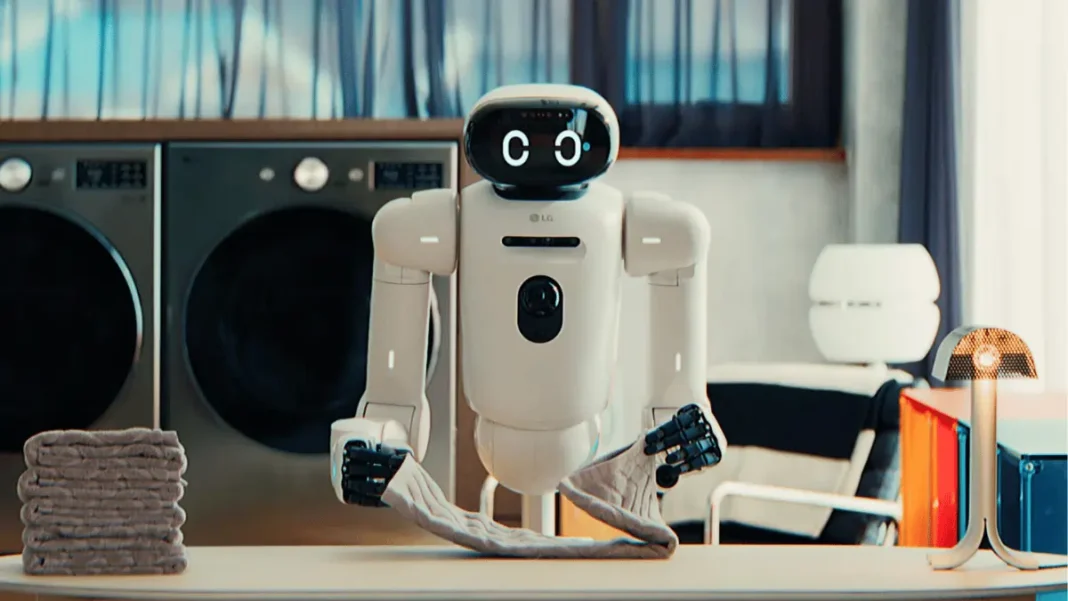
LG introduced the ClOiD humanoid home robot at CES 2026, featuring two articulated arms with 7 degrees of freedom each, five individually actuated fingers per hand, and an “Affectionate Intelligence” AI system that learns household routines. Unlike wheeled competitors, ClOiD’s human-optimized form factor targets delicate household tasks like folding laundry and organizing items. The robot represents LG’s “Zero Labor Home” strategy, competing directly with Tesla Optimus and 1X NEO in the emerging $25 billion home robotics market projected for 2026.
LG Electronics unveiled its ClOiD humanoid home robot at CES 2026, marking the company’s most ambitious push into domestic robotics with a machine designed to handle everyday household chores through advanced dexterity and adaptive AI. The robot embodies LG’s “Zero Labor Home” vision a future where technology eliminates the time burden of daily housework, allowing people to focus on what matters most.
The LG ClOiD is a humanoid home robot with two articulated arms (7 degrees of freedom each), five individually actuated fingers per hand, and AI-powered learning that adapts to household routines. It’s designed to perform delicate tasks like folding laundry, organizing items, and coordinating smart home devices.
What Is the LG ClOiD Home Robot?
ClOiD is LG’s first general-purpose humanoid robot built specifically for indoor household environments. Unlike single-purpose robots like vacuum cleaners, ClOiD features a human-optimized form factor with articulated arms and hands capable of manipulating a wide variety of household objects. The robot was showcased at LG’s booth (#15004, Las Vegas Convention Center) during CES 2026, held January 6-9.
LG established the HS Robotics Lab within its Home Appliance Solution Company specifically to develop ClOiD’s core technologies. The company views robotics as a strategic future growth engine and has pursued joint research initiatives with leading robotics firms in Korea and globally.
The robot represents a significant engineering leap beyond LG’s existing CLOi product line, which previously consisted of service robots for commercial hospitality and healthcare settings. ClOiD targets the consumer home market directly, competing with Tesla’s Optimus, 1X’s NEO, and other emerging humanoid home assistants.
Core Technical Specifications
Articulated Arms & Dexterity System
ClOiD’s two arms are powered by motors delivering seven degrees of freedom each, providing versatile motion patterns similar to natural human arm movements. This configuration allows the robot to reach objects at various heights and angles throughout typical living spaces.
Each hand features five individually actuated fingers, enabling advanced dexterity for delicate and precise tasks that require fine motor control. This finger design represents a critical differentiator many competing robots use simplified gripper mechanisms with 2-3 contact points, while ClOiD’s five-finger system can manipulate irregular-shaped objects, operate appliance controls, and handle fragile items like glassware.
For context, Boston Dynamics’ Atlas robot features 29 degrees of freedom in its upper body alone, while SwitchBot’s Onero H1 touts impressive DoF capabilities but operates on a wheeled base rather than a humanoid form. ClOiD’s 14 degrees of freedom (7 per arm) plus finger articulation falls in the mid-range for manipulation-focused robots, prioritizing household task versatility over industrial-grade complexity.
Affectionate Intelligence AI Platform
LG powers ClOiD with what it calls “Affectionate Intelligence” an AI system designed to learn from interactions, recognize patterns in household routines, and refine its responses over time to provide increasingly personalized support. The platform uses visual language models to interpret surroundings, similar to advanced systems deployed in other humanoid robots.
The AI enables ClOiD to navigate homes autonomously, detect when tasks require attention, and interact through a built-in display and speaker. The robot can adapt to residents’ schedules and lifestyles, theoretically learning preferences like how you fold towels, where you store cleaning supplies, or when you typically prepare meals.
LG has not disclosed the specific large language model (LLM) or vision-language model (VLM) powering ClOiD’s intelligence layer. For comparison, Figure AI’s robots utilize OpenAI’s multimodal models, while Tesla Optimus leverages the same AI stack that powers Tesla vehicles’ Full Self-Driving capabilities.
Form Factor & Mobility Design
ClOiD features a “suitable form factor optimized for today’s living environments,” according to LG’s official announcement. While exact dimensions and weight specifications were not disclosed in the CES 2026 reveal, the robot is designed to operate smoothly in spaces built around human body proportions.
Unlike wheeled service robots, ClOiD’s humanoid configuration allows it to navigate stairs, reach high shelves, and interact with environments designed for bipedal humans. This represents a mobility advantage over competitors like Samsung’s Ballie and SwitchBot’s Onero H1, which are constrained to single-floor operation.
The robot incorporates multiple cameras and sensors throughout its head, arms, hands, and torso to enhance perception capabilities. These sensors enable real-time environmental mapping, obstacle avoidance, and object recognition necessary for autonomous task completion.

What Can ClOiD Actually Do?
Household Task Capabilities
LG designed ClOiD to perform a wide range of indoor household tasks, though the company has been strategic about not overpromising specific capabilities before real-world testing. Based on the CES 2026 demonstration and official communications, ClOiD targets these task categories:
- Laundry management: Folding clothes, sorting items, transferring loads between washer and dryer
- Organization: Arranging items on shelves, decluttering surfaces, sorting mail
- Light cleaning: Wiping counters, organizing kitchens, straightening living spaces
- Object manipulation: Carrying items between rooms, opening doors, operating appliance controls
- Home coordination: Serving as a central AI assistant to manage other smart devices
The robot’s delicate manipulation capabilities distinguish it from earlier robotic assistants that struggled with fine motor skills. ClOiD’s five-finger hands enable it to grasp irregular objects, operate touchscreens, and handle fragile items, tasks that remain challenging for many industrial robots.
Testing Disclosure: AdwaitX has not conducted hands-on testing with ClOiD. All capability claims are based on LG’s official announcements and CES 2026 demonstrations. Real-world performance may differ from controlled demo environments, as historically seen with other humanoid robot unveilings.
Smart Home Integration
ClOiD is designed to connect seamlessly with other LG appliances and third-party smart home devices, creating a unified network where the robot can control lighting, temperature, and security systems. This interconnected approach positions ClOiD as a central hub for home management, potentially reducing the need for multiple apps or voice assistants.
The robot can interpret voice commands, gesture recognition, and touchscreen input, making it accessible even for users with limited technical experience. This user-centric interface design could accelerate adoption, especially in households seeking AI integration without steep learning curves.
LG’s existing smart home ecosystem which includes AI-enabled appliances, ThinQ platform integration, and voice assistant compatibility provides ClOiD with an established foundation for device coordination. The robot can theoretically manage refrigerator settings, adjust washing machine cycles, control HVAC systems, and orchestrate lighting scenes based on learned preferences.
How ClOiD Compares to Other Home Robots
| Feature | LG ClOiD | Tesla Optimus | 1X NEO | SwitchBot Onero H1 |
|---|---|---|---|---|
| Arms | 2 arms, 7 DoF each | 2 arms, 22 DoF hands | 2 arms (specs not disclosed) | 2 articulated arms |
| Fingers | 5 per hand, individually actuated | 22 DoF in Gen 3 hands | Soft, safe grip | Not disclosed |
| Mobility | Humanoid form (implied bipedal) | Bipedal walking | Bipedal, silent motion | Wheeled base |
| AI Platform | Affectionate Intelligence | Tesla FSD-based AI | Safety-first learning | Vision-action model |
| Target Use | General household tasks | Chores & ecosystem integration | Elderly care, family safety | Task coordination with other bots |
| Pricing | Not announced | ~$25,000 (est.) | $20,000 or $499/month | Not announced |
| Availability | CES 2026 reveal | Limited deployments | Pre-production Beta | Preorder soon |
| Key Differentiator | LG appliance integration | Tesla ecosystem, spatial AI | Soft body, silent operation | Multi-bot orchestration |
ClOiD vs Tesla Optimus
Tesla Optimus brings automotive manufacturing expertise and advanced AI capabilities derived from the company’s Full Self-Driving platform. Optimus features 22 degrees of freedom in its Gen 3 hands alone, significantly more complex than ClOiD’s disclosed specifications. The robot has demonstrated impressive spatial awareness, capable of mapping environments in real-time and avoiding obstacles with precision.
LG counters with established consumer electronics manufacturing and global distribution networks that could enable faster scaling to consumer markets. ClOiD’s integration with LG’s existing appliance ecosystem provides a practical advantage for households already invested in LG smart home products.
Pricing estimates place Optimus around $25,000, though Tesla has not confirmed consumer availability timelines. LG has not announced ClOiD pricing, making direct cost comparison premature.
ClOiD vs 1X NEO
1X’s NEO robot emphasizes safety and silent operation, featuring a soft body designed specifically for family environments with children and elderly residents. NEO is available for $20,000 upfront or through a $499/month subscription model, the first humanoid home robot to offer flexible payment options.
NEO’s design philosophy prioritizes a non-threatening appearance (described as “a person in a tracksuit”) and maximum safety, while ClOiD focuses on task versatility through advanced manipulation capabilities. NEO robots are currently in pre-production beta phase with select customers.
ClOiD’s five individually actuated fingers suggest greater manipulation precision for complex household tasks, while NEO’s soft-grip design optimizes for safe human interaction over delicate object handling.
ClOiD vs SwitchBot Onero H1
SwitchBot’s Onero H1, also unveiled at CES 2026, takes a hybrid approach with articulated arms mounted on a wheeled base rather than a full humanoid form. This design trades stair navigation capability for enhanced stability and lower manufacturing complexity.
Onero’s key advantage lies in orchestration it’s designed to coordinate with SwitchBot’s existing ecosystem of task-specific robots including vacuums, humidifiers, and air purifiers. This positions Onero as an “embodied smart home assistant” rather than a standalone task executor.
ClOiD’s humanoid form factor enables stair access and vertical reach that wheeled competitors cannot match, but may introduce balance and navigation complexities that wheeled platforms avoid. SwitchBot announced that Onero H1 will be available for preorder soon, giving it a potential time-to-market advantage.
The “Zero Labor Home” Vision Explained
LG’s “Zero Labor Home, Makes Quality Time” concept represents the company’s long-term goal of freeing customers from time-consuming housework demands. The vision extends beyond a single robot it encompasses an integrated ecosystem where ClOiD coordinates with smart appliances, sensors, and AI systems to automate home management comprehensively.
Baik Seung-tae, Senior Vice President at LG Electronics, explained that the company aims to “showcase our vision of a ‘zero-labor home’ at CES 2026,” positioning robotics as central to LG’s future growth strategy. This represents a fundamental shift for LG from manufacturing individual smart appliances to orchestrating holistic home automation solutions.
The concept faces significant technical hurdles. General-purpose home robots must navigate chaotic environments, manipulate thousands of different object types, adapt to unique household layouts, and operate safely around children and pets. As one analysis noted, this represents “the consumer tech industry’s equivalent of a moonshot”.
Practical implementation also raises questions about maintenance, reliability, and user expectations. Early adopters of home robots frequently report that video demonstrations differ significantly from real-world performance. LG will need to manage customer expectations carefully to avoid the disappointment that has plagued previous robotic home assistant launches.
LG ClOiD Technical Specifications
| Component | Specification | Details |
|---|---|---|
| Arms | 2 articulated arms | 7 degrees of freedom each |
| Hands | 5-finger design | Individually actuated fingers per hand |
| AI Platform | Affectionate Intelligence | Learning system with visual language models |
| Form Factor | Humanoid | Optimized for standard living environments |
| Sensors | Multi-camera array | Cameras in head, arms, hands, torso |
| Navigation | Autonomous | Obstacle avoidance, environmental mapping |
| Connectivity | Smart home integration | LG ThinQ platform + third-party devices |
| Interface | Multi-modal | Voice commands, gesture recognition, touchscreen |
| Mobility | Bipedal (implied) | Human-optimized form factor |
| Release Date | Not announced | Revealed at CES 2026 |
| Pricing | Not disclosed | Competitors range $20K-$25K |
Note: LG has not published complete technical specifications. Data compiled from official announcements and CES 2026 demonstrations. Specifications subject to change before consumer release.
Frequently Asked Questions
When will the LG ClOiD robot be available to buy?
LG has not announced a consumer release date for ClOiD. The robot was unveiled at CES 2026 (January 6-9) but remains in the demonstration phase without confirmed availability timelines.
How much does the LG ClOiD home robot cost?
LG has not disclosed ClOiD pricing. Competing humanoid home robots range from $20,000 (1X NEO with subscription option) to an estimated $25,000 for Tesla Optimus, providing a potential reference range.
What household tasks can ClOiD actually perform?
ClOiD is designed for laundry management (folding, sorting), organization (arranging items, decluttering), light cleaning (wiping surfaces), object manipulation (carrying items, operating controls), and smart home coordination. Real-world capabilities remain unverified by independent testing.
How does ClOiD’s AI learn my household routines?
ClOiD uses “Affectionate Intelligence” AI that observes interactions, recognizes patterns in daily routines, and refines responses over time to provide personalized support. The system uses visual language models to interpret environments and adapt to residents’ schedules.
Does ClOiD work with non-LG smart home devices?
LG states ClOiD integrates with LG appliances and third-party smart home devices, though specific compatibility details have not been disclosed. Integration likely operates through standard smart home protocols and LG’s ThinQ platform.
Can ClOiD navigate stairs?
ClOiD’s humanoid form factor is designed to “operate smoothly in spaces built around human body proportions,” implying stair capability, but LG has not explicitly confirmed stair navigation. This represents a potential advantage over wheeled competitors like SwitchBot Onero H1.
How many degrees of freedom does ClOiD have?
Each of ClOiD’s two arms features seven degrees of freedom, with five individually actuated fingers per hand. For comparison, Boston Dynamics’ Atlas has 29 degrees of freedom in its upper body alone.
Is ClOiD safe around children and pets?
LG has not disclosed specific safety certifications or features. The robot uses multiple cameras and sensors for obstacle detection and environmental mapping. Competitor 1X NEO emphasizes a soft body design specifically for family safety, suggesting ClOiD’s safety features may differ.

FEATURED SNIPPET BOXES
What is the LG ClOiD robot?
The LG ClOiD is a humanoid home robot with two articulated arms (7 degrees of freedom each), five individually actuated fingers per hand, and AI-powered learning that adapts to household routines. It performs tasks like folding laundry and coordinating smart home devices.
How much does the LG ClOiD cost?
LG has not announced ClOiD pricing. Competing humanoid home robots like 1X NEO cost $20,000 (or $499/month subscription), while Tesla Optimus is estimated around $25,000, providing a potential reference range for ClOiD’s eventual pricing.
What is LG’s Zero Labor Home concept?
LG’s “Zero Labor Home” vision aims to eliminate time-consuming housework through integrated robotics and smart home automation. ClOiD serves as a central AI assistant coordinating appliances, sensors, and devices to automate home management comprehensively.
How does ClOiD compare to Tesla Optimus?
ClOiD features 7 DoF arms with 5-finger hands and LG appliance integration, while Optimus offers 22 DoF hands with Tesla’s FSD-based AI. LG brings consumer electronics expertise; Tesla brings automotive manufacturing and advanced spatial AI capabilities.
When will ClOiD be available to consumers?
LG has not provided a consumer release timeline. ClOiD was demonstrated at CES 2026 (January 6-9) but remains in the reveal phase without confirmed availability dates or preorder options.
What makes ClOiD’s hands special?
ClOiD’s hands feature five individually actuated fingers on each hand, enabling delicate manipulation of irregular objects, operation of appliance controls, and handling of fragile items capabilities that challenge simpler robotic gripper designs.

