

Key Takeaways
- Intel’s hybrid execution processes sensitive data locally while routing public tasks to cloud, eliminating full cloud dependency
- Local-first processing significantly reduces cloud token costs by handling document analysis and planning on Intel Core Ultra Series 3 chips
- Series 3 processors support AI models exceeding 30 billion parameters with low-power, always-on execution for 24/7 agent availability
- OpenClaw’s 188,000 GitHub stars as of February 2026 demonstrate demand for autonomous agents Intel now optimizes for enterprise deployment
Intel has fundamentally redefined how autonomous AI agents operate on personal computers and OpenClaw proves it works. Dr. Olena Zhu, Head of AI Solutions at Intel PC Ecosystem, revealed optimizations addressing the core challenge enterprises face: deploying AI agents that balance privacy, cost control, and performance. These modifications position Intel-based AI PCs as the infrastructure for next-generation agentic AI workloads.
Why OpenClaw’s Cloud-Only Model Creates Enterprise Friction
OpenClaw gained viral attention as an autonomous AI assistant capable of reasoning, planning, and executing tasks independently. Despite surpassing 188,000 GitHub stars as of February 2026, the platform operates predominantly through cloud-only execution. Even with local software installation, user requests transmit to remote AI models, creating three critical pain points for organizations.
Sensitive data like meeting transcripts, proprietary documents, and private files pass through external servers. This architecture violates data residency requirements many enterprises maintain. Cloud API calls accumulate token charges with every context processing and reasoning step. Organizations struggle to predict costs as usage scales across teams.
How does Intel’s hybrid approach solve OpenClaw’s security concerns?
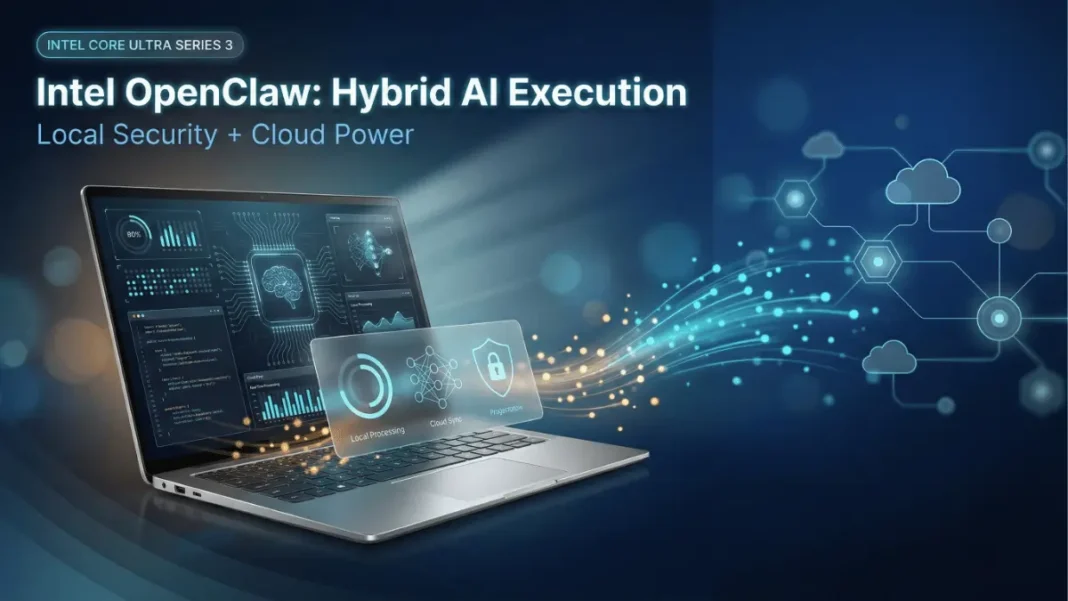
Intel optimizes OpenClaw to use hybrid execution that processes sensitive tasks locally while routing non-sensitive workloads to cloud models. Documents, transcripts, and private files remain on the PC under organizational control. Only public research tasks requiring extensive compute engage cloud services with explicit user approval. This architecture maintains full agent functionality while limiting data transmission to external systems.

Hybrid Execution Protects Privacy Without Sacrificing Capability
Intel’s optimization introduces a local-cloud split that categorizes tasks by sensitivity level. Deep research on public information utilizes cloud models for heavy computation. Sensitive operations including document understanding, private file analysis, and proprietary data processing execute entirely on the Intel AI PC.
The hybrid model preserves OpenClaw’s ability to interact with external systems and tools. Agents maintain context awareness and planning capabilities while keeping confidential information isolated. Intel engineers achieved this balance by leveraging the computational power of Core Ultra Series 3 processors, which handle substantial on-device AI workloads.
Cloud services activate only when tasks exceed local capabilities or explicitly require external data sources. Users retain approval authority over which operations transmit to cloud infrastructure. This approach aligns with zero-trust security frameworks increasingly adopted by regulated industries.
Local Processing Significantly Reduces Token Costs Through On-Device Reasoning
Running OpenClaw on Intel AI PCs delivers measurable cost reductions through minimized cloud token consumption. Document understanding, summarization, retrieval operations, and intermediate planning steps process locally. These tasks typically generate the highest token volumes in agent workflows.
Organizations deploying cloud-only AI agents face unpredictable expenses as usage scales. A single document analysis session can consume thousands of tokens across multiple API calls. Intel’s hybrid approach shifts this processing to on-device compute, where marginal costs approach zero after hardware acquisition.
What specific tasks does Intel’s optimization handle locally?
Intel’s OpenClaw optimization processes document understanding, summarization, retrieval, and intermediate planning steps on the AI PC. Context processing and agent reasoning execute locally, significantly reducing the size and frequency of cloud model requests. This local-first strategy allows organizations to scale OpenClaw usage predictably while lowering per-task token costs across users and workflows.
The optimization maintains consistent performance while making AI agent deployment economically viable for mid-sized teams. Document-heavy operations and multi-step reasoning tasks show the most substantial savings when shifted to local processing.
Intel Core Ultra Series 3 Enables Always-On Agents
OpenClaw’s enhanced efficiency on Intel platforms stems from Core Ultra Series 3 processors (codename Panther Lake), which launched at CES 2026 on January 5. These chips deliver high AI performance at low power consumption, supporting models exceeding 30 billion parameters in local and hybrid configurations.
Series 3 architecture allows continuous operation of key agent functions including context understanding, planning, memory management, and monitoring. The processor maintains these workloads while preserving laptop battery life and thermal limits. PCs remain in standby mode during idle periods but respond instantly when users initiate tasks.
This always-on capability transforms AI agents from on-demand tools into persistent assistants. OpenClaw can monitor incoming emails, track calendar changes, and prepare briefing documents without active user sessions. Intel’s 18A process technology, used to manufacture Series 3 chips domestically in the United States, enables up to 1.9x higher large language model performance compared to previous generations.
The platform supports over 200 device designs from global partners, making optimized OpenClaw deployment accessible across laptop and desktop form factors. Top-tier configurations deliver up to 27 hours of battery life, enabling full-featured AI agents without compromising portability.
Hybrid AI Represents the Future Intel Bets On
Intel’s work with OpenClaw validates a broader strategic direction: hybrid AI infrastructure combining local and cloud intelligence. Dr. Zhu’s team evaluated the agent across document analysis, meeting processing, task planning, and tool coordination scenarios. These tests reinforced Intel’s commitment to local-first AI with selective cloud augmentation.
Future hybrid solutions will incorporate deep collaboration between local and cloud models. Cloud systems will decompose complex tasks into smaller workloads, guiding local agents through execution while keeping private data on-device. This architecture positions users in control of their data while accessing advanced AI capabilities.
Intel previewed “Super Builder” releases incorporating hybrid collaborative AI agents. These platforms will orchestrate cloud-optimized and local-optimized AI processing seamlessly. The technology builds on Intel AI Assistant Builder 2.0, which launched with Lenovo and Acer at IFA Berlin in September 2025, supporting multi-agent orchestration and model context protocol frameworks.
Can OpenClaw run entirely offline with Intel’s optimization?
OpenClaw can execute many functions offline using Intel’s hybrid optimization, including document analysis, summarization, context understanding, and planning. Tasks requiring internet data or exceeding local compute capabilities will still access cloud models. The system prioritizes local processing by default, engaging cloud services only when necessary.
Enterprise Deployment Considerations
Organizations evaluating Intel-optimized OpenClaw should assess three implementation factors. First, network policies must allow selective cloud access for non-sensitive tasks while blocking transmission of classified data. Intel’s optimization respects enterprise firewall configurations and data loss prevention rules.
Second, teams require Intel Core Ultra Series 3 hardware to achieve the performance and efficiency targets Dr. Zhu’s team demonstrated. Earlier generation AI PCs may support hybrid execution but with reduced local model capacity. Budget planning should account for hardware refresh cycles to maximize ROI.
Third, AI governance frameworks need updating to accommodate hybrid execution models. Policies should define which data categories process locally versus cloud, establish approval workflows for external API calls, and monitor token consumption across both execution modes. Intel provides configuration tools to enforce these boundaries programmatically.
Security Implications of Hybrid Agent Architecture
OpenClaw’s hybrid deployment introduces new security considerations alongside its privacy benefits. Security researchers analyzed the platform’s attack surface in February 2026, identifying risks in cross-system orchestration. Organizations must secure both local AI runtime environments and cloud API authentication mechanisms.
Local processing reduces data exposure during transmission but concentrates sensitive information on endpoint devices. Disk encryption, secure boot, and endpoint detection become critical safeguards. Intel’s Core Ultra Series 3 includes hardware security features supporting these requirements, but proper configuration remains IT’s responsibility.
Cloud-side risks persist for tasks routed externally. API key management, request logging, and model output validation prevent unauthorized access or data leakage. Hybrid architectures require monitoring both local agent behavior and cloud service interactions to detect anomalies indicating compromise.
Limitations and Trade-Offs
Intel’s hybrid approach delivers compelling benefits but involves inherent compromises. Local AI models, even with 30 billion parameter support, cannot match the reasoning depth of frontier cloud models exceeding 400 billion parameters. Complex analytical tasks may require cloud escalation, reintroducing latency and cost.
Series 3 processors’ power efficiency impresses but doesn’t eliminate battery drain during sustained AI workloads. Users running continuous document analysis or real-time monitoring will see faster battery depletion than traditional computing tasks. Desktop deployments avoid this constraint entirely.
Organizations with strict air-gap requirements cannot benefit from hybrid execution. These environments need fully local solutions, which OpenClaw supports but with reduced capability compared to Intel’s optimized hybrid configuration. Regulatory compliance in defense, healthcare, and finance sectors may mandate cloud-free operation.

Frequently Asked Questions (FAQs)
What makes Intel’s OpenClaw optimization different from standard installations?
Intel’s optimization implements hybrid execution that splits tasks between local and cloud processing based on sensitivity. Standard OpenClaw installations route most operations to cloud APIs. Intel’s version processes documents, context, and planning on Intel Core Ultra Series 3 chips, significantly reducing costs and improving privacy.
How much can organizations save on AI token costs with Intel’s hybrid approach?
Organizations can significantly reduce cloud token expenses when shifting document analysis, summarization, and reasoning tasks to local processing on Intel AI PCs. Actual savings depend on workflow composition, usage patterns, and model selection. Document-heavy operations and multi-step reasoning show the most substantial cost reductions.
Does OpenClaw require internet connectivity with Intel’s hybrid optimization?
OpenClaw can operate many functions offline including document understanding, context analysis, and task planning. Internet access becomes necessary for public research tasks, real-time data retrieval, and workloads exceeding local model capacity. The system defaults to local processing when possible.
Which Intel processors support optimized OpenClaw deployment?
Intel Core Ultra Series 3 processors (Panther Lake) provide the recommended platform, supporting AI models exceeding 30 billion parameters with low power consumption. These chips launched at CES 2026 and are manufactured using Intel’s 18A process technology. Earlier AI PC generations may run hybrid execution with reduced local model capacity and higher power draw.
Can hybrid AI agents comply with GDPR and data residency regulations?
Intel’s hybrid approach helps compliance by processing sensitive personal data locally while routing non-sensitive tasks to cloud services. Organizations must configure data classification rules defining which information stays on-device. Proper implementation supports GDPR, HIPAA, and industry-specific regulations requiring data residency controls.
What is Intel Super Builder and how does it relate to OpenClaw?
Intel Super Builder represents the next evolution of AI Assistant Builder, incorporating hybrid collaborative AI agents that orchestrate local and cloud processing. It builds on technology demonstrated with OpenClaw optimization and will support multi-agent workflows when released. The platform extends capabilities introduced in AI Assistant Builder 2.0, which launched at IFA Berlin in September 2025.
How does OpenClaw’s 188,000 GitHub stars compare to other AI agents?
OpenClaw reached over 188,000 GitHub stars as of February 2026, making it one of the most-starred open-source AI agent projects. The viral adoption reflects strong developer interest in autonomous assistants that can reason, plan, and execute tasks independently across various computing environments.

