

Quick Brief
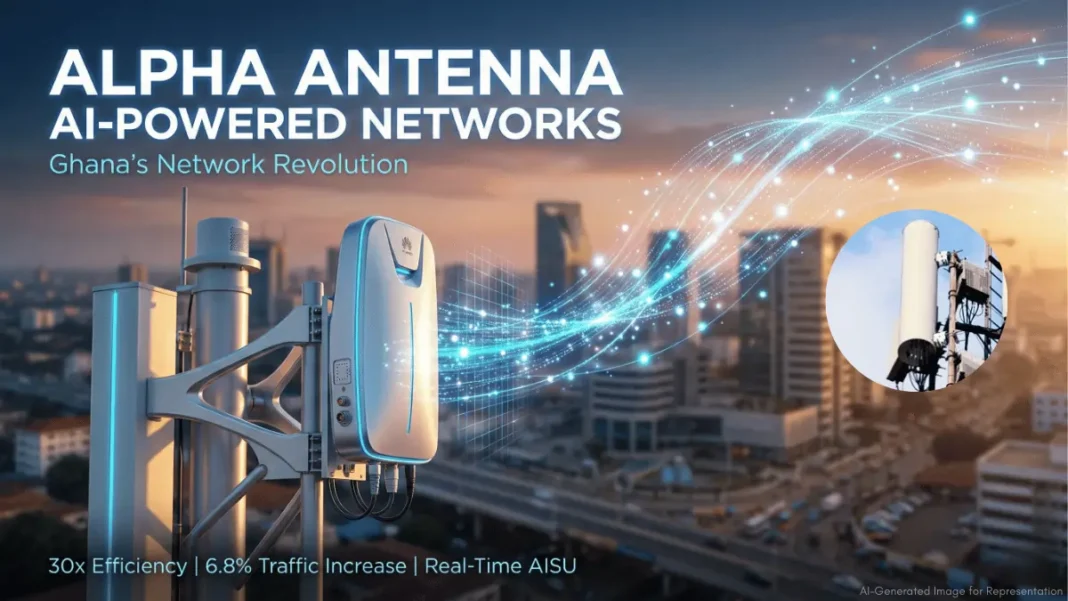
- MTN Ghana deployed world’s first large-scale Alpha Antenna network in February 2026
- Network traffic increased 6.8% while operations efficiency jumped 30x post-deployment
- AISU technology enables real-time antenna parameter retrieval without manual site visits
- Optimization cycles collapsed from weeks to minutes through AI-powered dynamic adjustments
MTN Ghana and Huawei completed the world’s first large-scale deployment of the Alpha Antenna on February 14, 2026, marking a fundamental shift in how African telecommunications networks operate. The deployment in Ghana validates a transition from manual network management to AI-driven autonomous systems, recording a 6.8% regional traffic increase and 30x improvement in maintenance efficiency. This milestone establishes a new benchmark for autonomous driving networks across Africa and positions Ghana as a testing ground for next-generation telecommunications infrastructure that eliminates manual intervention.
What Makes the Alpha Antenna Different
The Alpha Antenna represents the first antenna system to simultaneously deliver high efficiency, full digitalization, and simplified deployment across all frequency bands. Unlike traditional antennas requiring manual site visits for parameter adjustments, the Alpha series integrates two breakthrough components: the Antenna Information Sensor Unit (AISU) and Array Information Mapping Unit (AIMU). The AISU measures engineering parameters including azimuth, mechanical tilt, longitude, latitude, and altitude in real-time using GPS-based direction measurement. The AIMU provides exact visualization of network topology, eliminating configuration errors that plague conventional systems.
The antenna weighs just 25 kilograms thanks to its Dragon Wings architecture, a bionic design combining an innovative internal load-bearing structure with GFRPP Pro radome material. Installation time drops by 50% compared to traditional antennas through padlock bracket support and plug-and-play feeder connectors. Signal Direct Injection Feeding (SDIF) technology minimizes signal loss and maximizes RF efficiency to its theoretical limit across all frequency bands.

How AISU Technology Eliminates Manual Network Management
Traditional network operations depend on technicians physically visiting cell sites to check antenna alignment, adjust tilt angles, and verify configuration settings, a process consuming weeks per optimization cycle. The AISU changes this paradigm by enabling fully automated, real-time retrieval of antenna parameters from remote network management systems. MTN Ghana’s deployment demonstrates how AISU transmits site engineering parameters directly to operators, allowing immediate adjustments without dispatching field teams.
The technology supports remote adjustment of multi-dimensional beams, allowing networks to dynamically adapt coverage and capacity based on real-time demand patterns. This capability proved critical during MTN Ghana’s testing phase, where network optimization cycles collapsed from weeks to minutes while maintaining superior user experience. The precision of AISU measurements ensures configuration accuracy that manual methods cannot match, directly addressing the persistent challenges of slow adaptation and inconsistent accuracy in network operations.
What is the Antenna Information Sensor Unit (AISU)?
The AISU is a GPS-enabled device installed at the top of antennas that measures engineering parameters including azimuth, tilt, and location in real-time. It belongs to Huawei’s SAA (Site Antenna Automation) solution, enabling remote management of antenna parameters without manual site visits.
The Autonomous Driving Network Vision
Huawei’s Autonomous Driving Network (ADN) concept applies automotive self-driving principles to telecommunications infrastructure. The system utilizes network automation, AI algorithms, and digital twin technologies to create networks capable of self-optimization and autonomous evolution. The Alpha Antenna serves as the “digital foundation” enabling ADN implementation by providing networks with closed-loop capabilities for “real-time retrieval, precise control, and dynamic optimization”.
MTN Ghana’s deployment validates the ADN model’s transition from passive, reactive manual intervention to proactive, AI-powered network management. The system continuously monitors network performance, identifies optimization opportunities, and executes adjustments without human intervention. This approach resolves Total Cost of Ownership (TCO) structure problems that plague traditional telecom networks through system-level innovations. The technology positions operators to handle multi-play network business evolution from B2C to B2X, covering vertical markets including drones, Internet of Vehicles, and AR/VR applications.
Performance Gains From Ghana Deployment
Post-deployment testing in Ghana recorded measurable improvements across multiple network performance metrics. Regional traffic increased 6.8% as optimized coverage patterns captured previously underserved areas and improved signal quality for existing users. The 30x improvement in operations and maintenance efficiency directly stems from eliminating manual site visits and enabling instant remote adjustments.
Network engineers at MTN Ghana previously spent weeks planning and executing optimization campaigns involving field teams visiting dozens of cell sites. The Alpha Antenna deployment transformed this workflow adjustments that required multi-week campaigns now complete in minutes through remote beam steering and parameter updates. The system’s real-time adaptation to network demands maintains consistent user experience even during traffic peaks that would previously trigger service degradation.
How does the Alpha Antenna improve network efficiency?
The Alpha Antenna improves efficiency through SDIF technology that minimizes signal loss, Meta Lens technology reducing emission dissipation, and 25-kilogram lightweight design cutting tower management costs. Real-time parameter adjustment eliminates weeks-long optimization cycles.
Technical Architecture and Components
The Alpha series employs Signal Direct Injection Feeding (SDIF) technology across all frequency bands, using an innovative architecture that minimizes signal loss and maximizes RF efficiency to its theoretical limit. Meta Lens technology applies across all bands to reduce emission dissipation, enabling operators to enhance network coverage and user experience simultaneously. The next-generation AISU features upgraded algorithms suitable for diverse deployment scenarios, from urban high-rises to rural towers.
The Dragon Wings architecture represents a breakthrough in antenna design engineering. The bionic internal load-bearing structure distributes weight efficiently while maintaining structural integrity in harsh weather conditions. The GFRPP Pro radome material provides weather protection without adding excessive weight critical for African deployments where towers face strong winds and extreme temperatures. The 25-kilogram weight significantly reduces tower loading requirements and associated reinforcement costs compared to traditional antennas weighing 40-50 kilograms.
Full-dimensional beam adjustment capabilities allow dynamic reorientation of beam projection and pattern reconfiguration. This technology enables real-time network optimization responding to traffic patterns, user density changes, and temporary coverage needs during events. The padlock bracket support system and plug-and-play feeder connectors simplify installation procedures that traditionally require specialized tools and extended tower climbing time.
Africa’s Digital Infrastructure Transformation
MTN Ghana’s Alpha Antenna deployment occurs within broader African digital transformation initiatives. The operator committed to exceeding $1 billion in infrastructure investment by 2026, with $650 million allocated for 2023 alone. MTN Ghana’s 4G coverage reached 99.3% with 2G/3G at 99.5%, supported by 350 new sites and 1,000 4G site upgrades planned.
Fiber infrastructure expansion remains critical MTN Ghana deployed approximately 9,000 kilometers of fiber with continued extensions planned, particularly in the Western North Region throughout 2026. The company targets reliable 5 Mbps minimum speeds for 4G transactions while addressing 3G connection challenges during peak hours. Active 5G nodes now operate in major African cities including Johannesburg, Cape Town, and Nairobi, establishing the digital backbone required for autonomous network technologies.
The Alpha Antenna deployment addresses specific African infrastructure challenges including remote site access difficulties, limited technical workforce availability, and high operational costs from manual network management. AI-powered automation reduces dependency on skilled technician availability while improving network performance beyond what manual optimization achieves.
What is an Autonomous Driving Network in telecommunications?
An Autonomous Driving Network (ADN) applies self-driving car concepts to telecom infrastructure. It uses network automation, AI, and digital twin technologies to enable self-optimization, autonomous evolution, and proactive problem resolution without human intervention.
Implications for Global Telecom Industry
Huawei launched the Alpha series at the Global Antenna Technology & Industry Forum 2024 in Athens, Greece, positioning it as essential infrastructure for the mobile AI era. The technology addresses emerging requirements from AI-driven applications demanding greater downlink and uplink bandwidth with lower latency. Growing network size and complexity underscore the urgency for efficient operations and maintenance solutions that scale without proportional staffing increases.
The Ghana deployment provides validated performance data proving Alpha Antenna viability at scale. Other operators monitoring MTN Ghana’s results can now make informed deployment decisions based on real-world performance metrics rather than laboratory testing. The 30x efficiency improvement directly impacts operator economics network teams managing 1,000 sites with traditional methods could potentially manage 30,000 sites with Alpha Antenna technology and equivalent staffing.
The shift toward autonomous networks reflects broader industry recognition that manual network management cannot scale to meet 5G and AI application demands. Operators must handle exponentially growing data traffic, increasingly complex network topologies, and rising customer experience expectations while controlling operational costs. The Alpha Antenna and ADN approach offers a scalable solution addressing these converging pressures.
Comparing Alpha Antenna to Traditional Systems
| Feature | Alpha Antenna | Traditional Antenna |
|---|---|---|
| Parameter Retrieval | Real-time automated via AISU | Manual site visits required |
| Optimization Cycle | Minutes with remote adjustments | Weeks with field team deployment |
| Weight | 25 kg with Dragon Wings design | 40-50 kg typical weight |
| Installation Time | 50% faster with plug-and-play | Standard manual installation |
| Configuration Accuracy | Exact with AIMU topology mapping | Prone to human error |
| RF Efficiency | Theoretical maximum via SDIF | Standard efficiency with signal loss |
Limitations and Deployment Considerations
The Alpha Antenna requires compatible network management systems capable of processing real-time AISU data and executing automated adjustments. Operators must invest in backend infrastructure and AI algorithms before realizing full autonomous network benefits. Initial deployment costs exceed traditional antenna purchases, though operational savings offset this premium over the system lifecycle.
Technical teams need training on new operational paradigms shifting from hands-on field work to remote network management requires different skill sets and workflows. Some markets face regulatory requirements mandating manual verification of antenna parameters, potentially limiting automation benefits until policies update.
The technology performs optimally in network environments with sufficient site density and overlapping coverage sparse rural deployments with isolated towers gain fewer benefits from dynamic beam steering. Tower infrastructure must support antenna weight and wind loading, though the 25-kilogram Alpha design addresses many existing tower limitations.
Future Outlook for AI-Powered Networks
MTN Ghana’s successful deployment establishes a foundation for expanding AI-driven intelligent networks across Africa. The validated performance gains provide compelling business cases for operators evaluating autonomous network technologies. Huawei positions the Alpha series as foundational infrastructure for diverse 5G applications including IoV, AR/VR, and vertical industry solutions.
The ADN concept extends beyond antennas to encompass end-to-end network automation from radio access networks through core infrastructure to service delivery platforms. Future implementations will integrate Alpha Antenna capabilities with AI-powered spectrum management, predictive maintenance, and automated service provisioning. Network digital twins will enable simulation and testing of configuration changes before deployment, further reducing optimization risks.
As mobile AI applications proliferate, networks require intelligence capable of adapting to rapidly changing traffic patterns and service requirements. The Alpha Antenna’s real-time optimization capabilities position operators to support emerging use cases that traditional static network configurations cannot accommodate. The Ghana deployment demonstrates this technology’s readiness for production environments handling real subscriber traffic and commercial service obligations.
Frequently Asked Questions (FAQs)
What is the Huawei Alpha Antenna?
The Huawei Alpha Antenna is a next-generation base station antenna featuring integrated AISU and AIMU components that enable real-time parameter monitoring, remote adjustment, and AI-powered optimization. It weighs 25 kilograms and supports autonomous network operations.
Where was the first Alpha Antenna deployed?
MTN Ghana deployed the world’s first large-scale Alpha Antenna network in Ghana, completing installation on February 14, 2026. The deployment covered regional network infrastructure demonstrating 6.8% traffic increases and 30x efficiency improvements.
How does AISU technology work?
AISU (Antenna Information Sensor Unit) uses GPS-based measurement to capture antenna engineering parameters including azimuth, tilt, and location. It transmits this data to network management systems for real-time monitoring and remote adjustment without manual site visits.
What are Autonomous Driving Networks?
Autonomous Driving Networks (ADN) apply self-driving concepts to telecommunications, using AI, automation, and digital twins to enable self-optimization and autonomous evolution. Networks can detect issues, optimize performance, and adapt to demand without human intervention.
What efficiency gains does the Alpha Antenna provide?
MTN Ghana’s deployment achieved 30x improvement in operations and maintenance efficiency by eliminating manual site visits. Network optimization cycles dropped from weeks to minutes through remote parameter adjustments and AI-powered dynamic beam steering.
How much does the Alpha Antenna weigh?
The Alpha Antenna weighs 25 kilograms thanks to its Dragon Wings architecture featuring bionic internal structure and GFRPP Pro radome material. This 40-50% weight reduction compared to traditional antennas lowers tower loading requirements and installation costs.
What is SDIF technology in antennas?
Signal Direct Injection Feeding (SDIF) is an innovative architecture minimizing signal loss and maximizing RF efficiency to theoretical limits. Applied across all frequency bands in Alpha series antennas, it enhances network coverage and reduces power consumption.
Can the Alpha Antenna work with existing networks?
The Alpha Antenna integrates with existing network infrastructure through standard interfaces and plug-and-play feeder connectors. Operators need compatible network management systems to leverage full AISU and autonomous optimization capabilities.

