

At a Glance
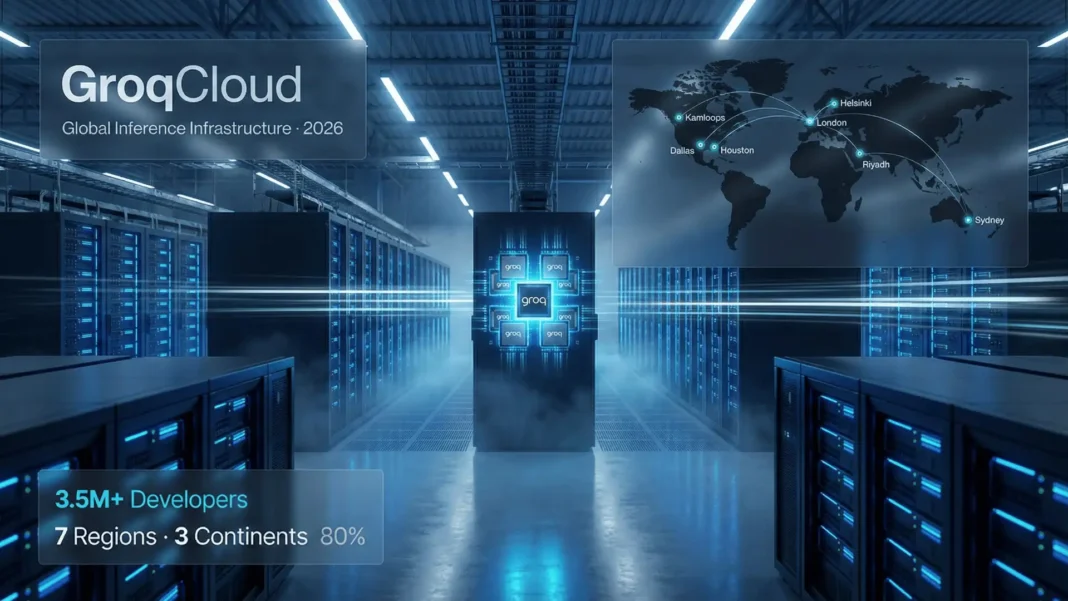
- GroqCloud surpassed 3.5 million developers as its UK data center with Equinix went live
- Groq built 12 data centers in 2025; CEO Jonathan Ross confirmed 12+ more planned across Asia and additional regions in 2026
- Saudi Arabia committed $1.5 billion in February 2025 to purchase additional Groq LPU chips, building on a December 2024 deployment with Saudi Aramco
- $750M raised at a $6.9B valuation; Bell Canada partnership covers six sovereign AI sites, with Kamloops, BC as the first
Three years ago, Groq was a niche hardware startup with a compelling chip and an unproven thesis. Today, GroqCloud serves 3.5 million developers across three continents and demand still outruns capacity. The company built 12 data centers in 2025 alone. Its UK launch with Equinix, paired with a $1.5 billion Saudi chip-purchase commitment and a 4.5MW Sydney facility, marks a structural inflection point in how AI inference infrastructure gets deployed at production scale.
Why GroqCloud’s Architecture Differs from GPU Clouds
Groq’s edge isn’t simply more hardware, it’s a fundamentally different hardware class. The LPU (Language Processing Unit) is purpose-built for AI inference, delivering deterministic execution where GPUs introduce unpredictable latency spikes under load. Groq’s Sydney facility benchmarks at up to 5x faster and lower-cost compute than traditional GPUs and hyperscaler clouds.
Unlike stateless inference APIs, GroqCloud targets consistency over average throughput. Enterprises running real-time applications, customer support systems, financial decision engines, live content pipelines need predictable response times on every request, not median response times across millions of calls. Groq’s LPU architecture is built around this constraint.
The UK Data Center: Europe’s New Inference Anchor
What is Groq’s new UK data center?
Groq launched a UK data center in partnership with Equinix, extending GroqCloud’s European footprint after its Helsinki facility opened in July 2025. The deployment brings LPU-powered AI inference closer to European developers, cutting transatlantic latency while enabling private connectivity through Equinix Fabric for regulated industries requiring data sovereignty.
Groq’s UK launch follows a deliberate colocation pattern: Helsinki, Finland in July 2025; Sydney, Australia on November 17, 2025; and now the UK all built inside Equinix facilities. Private connectivity via Equinix Fabric lets enterprises route inference traffic without traversing the public internet, a direct requirement for regulated industries in banking, healthcare, and government.
The UK sits at the center of Europe’s AI deployment wave. Research institutions, enterprise AI teams, and AI-native startups represent dense inference demand in the region. Groq’s timing also aligns with EU AI Act data residency requirements, which local infrastructure directly supports.
GroqCloud’s 2024–2026 Global Infrastructure Timeline
| Region | Location | Partner | Status |
|---|---|---|---|
| Middle East | Saudi Arabia (KSA) | Saudi Aramco | Live (Dec 2024) |
| US | Dallas, TX | Equinix | Live (May 2025) |
| US | Houston, TX | DataBank | Live (May 2025) |
| Canada | Kamloops, BC (Site 1 of 6) | Bell Canada | Live (2025) |
| Middle East | Saudi Arabia | HUMAIN / PIF | Expanded (2025) |
| Europe | Helsinki, Finland | Equinix | Live (Jul 2025) |
| Europe | United Kingdom | Equinix | Live (2025) |
| Asia-Pacific | Sydney, Australia (4.5MW) | Equinix | Live (Nov 17, 2025) |
| Asia + Other Regions | Multiple (TBD) | Various | Planned 2026 |
3.5 Million Developers: What This Demand Signal Actually Means
How many developers use GroqCloud?
GroqCloud has surpassed 3.5 million registered developers as of 2025, with production traffic consistently outpacing available capacity. CEO and Founder Jonathan Ross stated demand repeatedly exceeds what Groq builds: “Every time we over-compensate by trying to build more, people surprise us by needing even more than we built.” India represents a particular growth pocket due to Groq’s LPU speed and power-efficiency advantages.
The 3.5 million figure carries weight beyond marketing. Production traffic measured in tokens billed, not free-tier signups has increased consistently alongside developer growth. Ross, speaking to RCRTech, attributed India’s traction specifically to the LPU’s faster performance at lower power draw, making enterprise inference economically viable at scale in markets where GPU operating costs compress margins.
India represents a specific high-growth pocket. As Indian enterprises transition AI from pilots into production, that cost-efficiency argument compounds across industries. Canva in Australia is already a confirmed GroqCloud customer at production scale, illustrating the Asia-Pacific commercial traction Groq is building on.
How GroqCloud Compares to Top Inference Competitors
How does GroqCloud compare to Together AI and Fireworks AI?
GroqCloud differentiates through its proprietary LPU hardware, delivering deterministic low-latency inference not achievable on GPU-based platforms like Together AI or Fireworks AI. Together AI leads on model library depth and fine-tuning support, while GroqCloud’s speed advantage is most pronounced for real-time, latency-sensitive production applications where consistent response time is non-negotiable.
| Platform | Hardware | Latency Profile | Model Library | Fine-Tuning | Pricing | Best For |
|---|---|---|---|---|---|---|
| GroqCloud | Proprietary LPU | Deterministic, ultra-low | Curated (Llama, Mixtral) | No | Pay-per-token | Real-time apps, production inference |
| Together AI | GPU clusters | Variable | 200+ open models | Yes | Pay-per-token | Custom models, RAG workflows |
| Fireworks AI | GPU clusters | Optimized GPU | Curated + fine-tuned | Yes | Pay-per-token | Fast open-model inference |
| SambaNova Cloud | Proprietary RDU | Low | Enterprise-focused | Limited | Enterprise license | Large-scale enterprise LLM |
| Cerebras | Proprietary WSE | Ultra-fast (large models) | Limited | No | Enterprise | Very large model inference |
The $750M Raise, $1.5B Saudi Commitment, and HUMAIN Partnership
How much funding has Groq raised?
Groq raised $750 million at a post-money valuation of $6.9 billion as of August 2025. Saudi Arabia separately committed $1.5 billion in February 2025 to purchase additional Groq LPU chips, channeled through HUMAIN, a sovereign AI vehicle backed by Saudi Arabia’s Public Investment Fund (PIF). Groq and Saudi Aramco had already launched a live deployment in December 2024, preceding both the HUMAIN partnership and the chip-purchase commitment.
The HUMAIN partnership, formalized in May 2025, gives Groq both geopolitical credibility and a funded Middle East deployment footprint. Capital from the $750M raise flows into colocation agreements and chip deployment across Equinix and DataBank facilities, an asset-efficient model that scales faster than building proprietary data centers.
Bell Canada adds a sovereign AI dimension to Groq’s North America footprint. The partnership spans six planned sites, with Kamloops, British Columbia serving as the first operational location, a structure that gives Canada dedicated, sovereign AI inference infrastructure built on LPU technology.
Callimacus: What Production-Scale LPU Inference Looks Like
What companies use GroqCloud in production?
Solomei AI built Callimacus, a multi-agent “pageless” e-commerce platform for luxury fashion house Brunello Cucinelli, using GroqCloud as its inference layer. The platform generates a distinct, intent-driven shopping experience for each visitor in real time, orchestrating multiple AI agents per interaction at global scale, a workload that cannot tolerate latency variance.
The Callimacus deployment is instructive precisely because it stresses GroqCloud’s practical ceiling. Orchestrating multiple AI agents per user interaction, in real time, for a global luxury brand, exposes GPU latency variance immediately. Brunello Cucinelli’s platform generates a distinct interface per visitor without perceptible delay the exact benchmark GroqCloud’s deterministic execution is designed to sustain.
Limitations and Honest Considerations
GroqCloud’s LPU architecture is purpose-built for inference and does not support model training or fine-tuning a meaningful gap for teams needing custom model development on a single platform. Its model catalog remains curated rather than exhaustive; teams needing broader open-source library access will find Together AI more flexible. For enterprise teams requiring both training and inference on one platform, GroqCloud is inference-only by design.

Frequently Asked Questions (FAQs)
What is GroqCloud and how does it work?
GroqCloud is Groq’s managed AI inference platform powered by its proprietary Language Processing Unit (LPU). It provides developers and enterprises with ultra-low-latency, deterministic AI inference through a distributed global data center network. GroqCloud targets production workloads where consistent response times, cost efficiency, and execution speed are non-negotiable.
How fast is Groq’s LPU compared to standard GPU inference?
Groq’s Sydney facility benchmarks at up to 5x faster and lower-cost compute than traditional GPUs and hyperscaler cloud services, per the official Groq press release published November 17, 2025. The advantage is most significant for sequential, real-time inference tasks rather than batch processing or model training workloads.
Which countries have GroqCloud data centers in 2026?
GroqCloud operates data centers in the United States (Dallas, Houston), Canada (Kamloops, BC — first of six Bell Canada sovereign AI sites), Saudi Arabia (Aramco deployment Dec 2024; HUMAIN expanded 2025), Finland (Helsinki, July 2025), the United Kingdom, and Australia (Sydney, November 17, 2025). Additional sites across Asia and other regions are planned for 2026.
Does GroqCloud support model fine-tuning or training?
No. GroqCloud is designed exclusively for inference workloads and does not support model training or fine-tuning. Teams requiring custom model development should evaluate Together AI or Fireworks AI, both of which offer fine-tuning capabilities alongside GPU-based inference deployment.
How much has Groq raised and what is its current valuation?
Groq raised $750 million at a post-money valuation of $6.9 billion as of August 2025. Saudi Arabia separately committed $1.5 billion in February 2025 to purchase additional LPU chips through HUMAIN, backed by Saudi Arabia’s Public Investment Fund (PIF).
Who is the CEO and Founder of Groq?
Jonathan Ross is the CEO and Founder of Groq. Ross has publicly stated that user demand consistently outpaces the company’s infrastructure build-out pace, driving the accelerated data center expansion strategy across 2025 and into 2026.
Who are GroqCloud’s main inference competitors?
GroqCloud’s primary competitors are Together AI, Fireworks AI, SambaNova Cloud, and Cerebras. Together AI and Fireworks AI operate GPU clusters and support fine-tuning; SambaNova and Cerebras use proprietary chips. GroqCloud’s differentiator is the LPU’s deterministic latency profile under production load, a property that GPU-based platforms cannot replicate by architecture.
Is GroqCloud available for private enterprise deployments?
Yes. Through Equinix Fabric, GroqCloud supports private connections that bypass the public internet, enabling data sovereignty and compliance for regulated industries. This private access is available across US, EMEA, and Asia-Pacific regions through Equinix’s interconnection infrastructure.

