

Key Takeaways
- Claude Opus 4.6 launched February 5, 2026 with 1M token context window for complex enterprise tasks
- Adaptive thinking dynamically adjusts reasoning depth, optimizing speed and accuracy across workflows
- Microsoft Foundry integration provides enterprise security with unified AI platform capabilities
- Premium pricing at $10 input/$37.50 output per million tokens beyond 200K context window
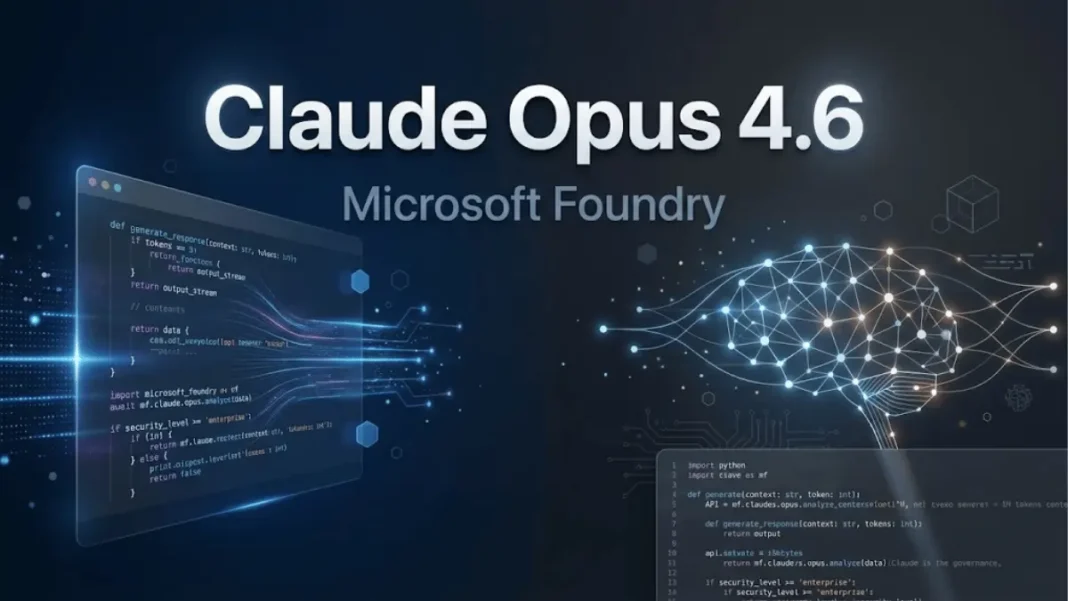
Anthropic’s Claude Opus 4.6 entered Microsoft Foundry on February 5, 2026, bringing frontier intelligence to enterprise AI at unprecedented scale. This marks the first time organizations can deploy Opus-level reasoning with Azure’s security infrastructure and managed AI services simultaneously. The integration positions Microsoft Foundry as a platform where adaptive thinking meets enterprise governance without infrastructure complexity.
Microsoft Foundry combines intelligence and trust the ability to deploy autonomous AI agents while maintaining audit trails, compliance controls, and data sovereignty. Claude Opus 4.6 delivers the intelligence component with capabilities that compress multi-day coding projects into hours and enable AI agents to operate computers with visual understanding.
What Claude Opus 4.6 Brings to Microsoft Foundry
Claude Opus 4.6 represents Anthropic’s most capable model for production coding, sophisticated agents, and professional knowledge work. The model supports a 200K context window as standard, with beta access to 1M tokens for handling entire codebases or lengthy document analysis. Output capacity reaches 128K tokens, enabling comprehensive responses without fragmentation.
The model processes both text and images, analyzing charts, technical diagrams, and visual assets to return structured insights. Anthropic launched Opus 4.6 simultaneously across multiple platforms including Microsoft Foundry, AWS Bedrock, Google Vertex AI, and direct API access on February 4-5, 2026.
Base pricing stands at $5 input and $25 output per million tokens for standard 200K context. Premium pricing applies beyond 200K token context usage at $10 input and $37.50 output per million tokens. This represents Anthropic’s most advanced model tier designed for complex enterprise workflows.
Adaptive Thinking: Dynamic Reasoning That Scales
What makes adaptive thinking different from extended thinking?
Adaptive thinking allows Claude Opus 4.6 to dynamically allocate reasoning resources based on task complexity. Simple queries receive fast responses without unnecessary processing, while complex multi-step problems trigger deeper analytical chains. This replaces fixed thinking levels with intelligent adjustment across workflow stages.
Developers can set maximum effort controls across four levels low, medium, high, and max, giving fine-grained control over token allocation between thinking, tool usage, and output generation. The system automatically decides when and how much reasoning each task requires, optimizing both performance and cost.
This capability proves essential for agentic workflows where tasks vary dramatically in complexity. A coding agent might breeze through routine refactoring but allocate substantial reasoning to architectural decisions, all within the same session.
Enterprise Coding: From Requirements to Production
Claude Opus 4.6 handles complete development lifecycles, covering requirements gathering, implementation, testing, and maintenance. The model plans carefully before executing, sustains effort across long-running tasks, and catches its own mistakes through strong code review capabilities.
Early testing shows significant improvements in agentic planning: the model breaks complex assignments into independent subtasks, runs tools and subagents in parallel, and identifies blockers with precision. This enables senior engineers to delegate work that previously consumed days while focusing on reviews and strategic decisions.
Macroscope, an AI code review platform, relies on Anthropic’s models to catch production bugs before deployment. The company plans to scale globally on Azure infrastructure, leveraging Foundry’s managed services for operational control.
Major technology companies including Notion, GitHub, Replit, Cursor, and Windsurf have integrated Claude Opus 4.6 into their development workflows. These platforms use the model’s coding capabilities to accelerate software development and reduce time-to-production.
Knowledge Work Across Three Pillars
Anthropic defines enterprise knowledge work through search, analyze, and create capabilities. Claude Opus 4.6 excels across all three dimensions when deployed through Microsoft Foundry’s governance framework.
The model understands professional domain conventions, producing documents, spreadsheets, and presentations that match expert-created quality. Legal firm Dentons uses Claude in Foundry for drafting, review, and research workflows requiring precise reasoning and compliance sensitivity. Better model reasoning reduces rework and improves consistency, allowing lawyers to focus on higher-value judgment calls.
Adobe tests Claude models in Microsoft Foundry to deliver powerful, responsible experiences while maintaining enterprise governance and scale. The flexible environment enables evaluation of frontier capabilities without sacrificing trust controls.
Financial Analysis With Extended Context
Claude Opus 4.6 connects insights across regulatory filings, market reports, and internal enterprise data analysis that traditionally requires days of manual compilation. The model navigates nuanced financial contexts, generates compliance-sensitive outputs, and maintains traceability across complex analytical workflows.
When deployed through Foundry, these workflows benefit from Azure’s security, compliance, and auditability features. Organizations apply frontier AI to high-stakes analysis with confidence, knowing that data remains within their security perimeter.
Thomson Reuters and Norway’s sovereign wealth fund NBIM use Claude Opus 4.6 for professional knowledge work requiring deep analysis and regulatory awareness. Financial institutions leverage the extended context for comprehensive document review.
Computer Use and Agentic Capabilities
Claude Opus 4.6 delivers major advances in computer use, demonstrating strong performance on industry benchmarks for visual understanding and multi-step navigation. The model can interact with software, navigate interfaces, complete forms, and move data across applications.
When deployed as secure, governed agents in Microsoft Foundry, these capabilities enable automation of workflows spanning legacy systems, document processing, and operational tools. Opus 4.6 manages complex, multi-tool workflows with minimal oversight essential for teams operating AI systems at enterprise scale.
The model proactively spins up subagents, parallelizes work, and drives tasks forward autonomously. Momentic AI processes millions of tokens per hour on Opus models through Azure’s platform, which works seamlessly with Anthropic’s SDK and supports beta features like reasoning effort controls.
For security workflows, Opus 4.6 delivers deep reasoning that identifies subtle patterns and complex attack vectors with high accuracy. Everstar, focused on nuclear energy deployments, uses Anthropic’s capabilities for secure government and nuclear customer applications.
Context Compaction and Long Conversations
How does context compaction work in Claude Opus 4.6?
Context compaction (beta) supports long-running conversations and agentic workflows by automatically summarizing older context as token limits approach. This prevents conversation truncation in extended sessions where agents accumulate substantial interaction history.
The feature proves valuable for customer support agents, ongoing research projects, and development workflows where context builds over hours or days. Rather than losing early conversation details, the model compresses them into dense summaries while preserving critical information.
Organizations can maintain continuous agent sessions without manual context management or conversation restarts. This reduces cognitive overhead for both AI systems and human supervisors monitoring agent progress.
Microsoft Foundry Integration Advantages
Microsoft Foundry provides the system context where Opus 4.6’s intelligence operates responsibly at scale. The platform consolidates agents, AI models, built-in tools, and unified governance into a single environment.
Foundry IQ enables Claude to access data from Microsoft 365 Work IQ, Fabric IQ, and web sources without moving information outside security boundaries. This knowledge access powers agents that understand business context across document repositories, communication systems, and operational databases.
The platform includes native MLOps workflows with automated training, testing, deployment, and monitoring. Integration with GitHub and Azure DevOps supports CI/CD pipelines for AI models. Organizations deploy at scale across cloud, on-premises, or edge environments.
Microsoft Copilot Studio offers a no-code path to building, orchestrating, and deploying Claude Opus 4.6 agents. Teams can create advanced AI workflows without custom programming, accelerating time-to-production for business users.
Comparison: Claude Opus 4.6 vs. Competing Models
| Capability | Claude Opus 4.6 | GPT-4 Turbo | Gemini 1.5 Pro |
|---|---|---|---|
| Context window | 1M tokens (beta) | 128K tokens | 2M tokens |
| Max output | 128K tokens | 4K tokens | 8K tokens |
| Adaptive thinking | Yes | No | Limited |
| Computer use | Advanced | Basic | Moderate |
| Coding focus | Production-ready | General purpose | Multimodal priority |
| Base pricing | $5/$25 per M tokens | $10/$30 per M tokens | $3.50/$10.50 per M tokens |
Claude Opus 4.6 prioritizes production coding and autonomous agents. The model’s 128K output capacity significantly exceeds competing models, enabling complete code generation and comprehensive document creation in single responses. Organizations increasingly deploy multiple models strategically, routing tasks based on each model’s strengths.
Limitations and Considerations
Claude Opus 4.6 carries premium pricing beyond 200K tokens at $10 input/$37.50 output per million tokens, making it cost-intensive for high-volume tasks. Organizations should route straightforward queries to Sonnet or Haiku models while reserving Opus for complex reasoning requiring extended context.
The 1M context window remains in beta with potential stability considerations. Production deployments should validate performance at scale before committing mission-critical workflows to extended context operations.
Adaptive thinking introduces variability in response times and token consumption. Budgeting becomes less predictable compared to fixed-thinking models, requiring monitoring systems that track actual usage patterns.
Context compaction remains in beta status, and organizations should test thoroughly before deploying in production environments where conversation continuity is critical.
Industry Adoption Patterns
Enterprise adoption accelerated immediately following the February 5, 2026 launch. Major platforms including Box, Figma, Shopify, Ramp, and Vercel integrated Claude Opus 4.6 within days of release. SentinelOne applies the model to cybersecurity workflows requiring deep pattern recognition.
Coding-focused platforms like Bolt.new, Lovable, and Shortcut.ai leverage Opus 4.6’s production-ready capabilities for autonomous development workflows. Harvey uses the model for legal analysis and document generation. Rakuten deploys Opus 4.6 across e-commerce operations requiring multilingual understanding.
The model supports agentic workflows where AI systems operate with increasing autonomy-what industry observers call the “vibe working” era where humans set goals and AI executes complex multi-step processes. This represents a shift from conversational AI toward autonomous systems that handle complete workflows.

Frequently Asked Questions (FAQs)
What is the pricing for Claude Opus 4.6 on Microsoft Foundry?
Claude Opus 4.6 pricing follows a tiered structure based on context window usage. Standard 200K context costs $5 input and $25 output per million tokens. Usage beyond 200K tokens incurs premium charges at $10 input and $37.50 output per million tokens. Exact pricing may vary by region and enterprise agreement terms through Azure.
Can Claude Opus 4.6 replace human developers?
Claude Opus 4.6 excels at executing complex coding tasks but functions as an autonomous assistant rather than developer replacement. Senior engineers delegate implementation work while focusing on architecture, code review, and strategic decisions. The model handles requirements gathering through maintenance but requires human oversight for production systems.
How does Microsoft Foundry security work with Claude?
Microsoft Foundry provides enterprise-grade security through Azure infrastructure, ensuring data remains within organizational boundaries. The platform offers unified tracing, monitoring, governance controls, and compliance frameworks. Organizations maintain audit trails and access controls while deploying Claude capabilities at scale.
What tasks benefit most from Claude Opus 4.6?
Production coding, sophisticated AI agents, complex document creation, financial analysis, and cybersecurity workflows gain maximum value from Opus 4.6. Tasks requiring extended reasoning, large context understanding, or autonomous computer use justify the premium pricing. Simple queries should route to lower-cost Sonnet or Haiku models.
Is the 1M context window stable for production use?
The 1M token context window remains in beta status as of February 2026. Organizations should validate performance and stability for their specific use cases before deploying mission-critical workflows at maximum context length. Standard 200K context offers production-ready stability with proven performance.
How does adaptive thinking affect response time?
Adaptive thinking varies response time based on task complexity. Simple tasks complete quickly without unnecessary processing, while complex problems receive deeper analysis that extends latency. Organizations can set maximum effort controls across four levels to balance speed and reasoning depth.
When was Claude Opus 4.6 released?
Anthropic launched Claude Opus 4.6 on February 4-5, 2026 across multiple platforms simultaneously. The model became available through Microsoft Foundry, AWS Bedrock, Google Vertex AI, and Anthropic’s direct API on the same day. This coordinated multi-platform launch enabled immediate enterprise adoption.

