

Quick Brief
- Anthropic partners with CodePath to integrate Claude AI into curriculum serving 20,000+ students at community colleges and HBCUs
- Over 40% of CodePath students come from families earning under $50,000 annually
- Fall 2025 pilot saw 100+ students contribute to open-source projects like GitLab using Claude Code
- Howard University launched first-ever AI course for academic credit using Claude-assisted development in January 2026
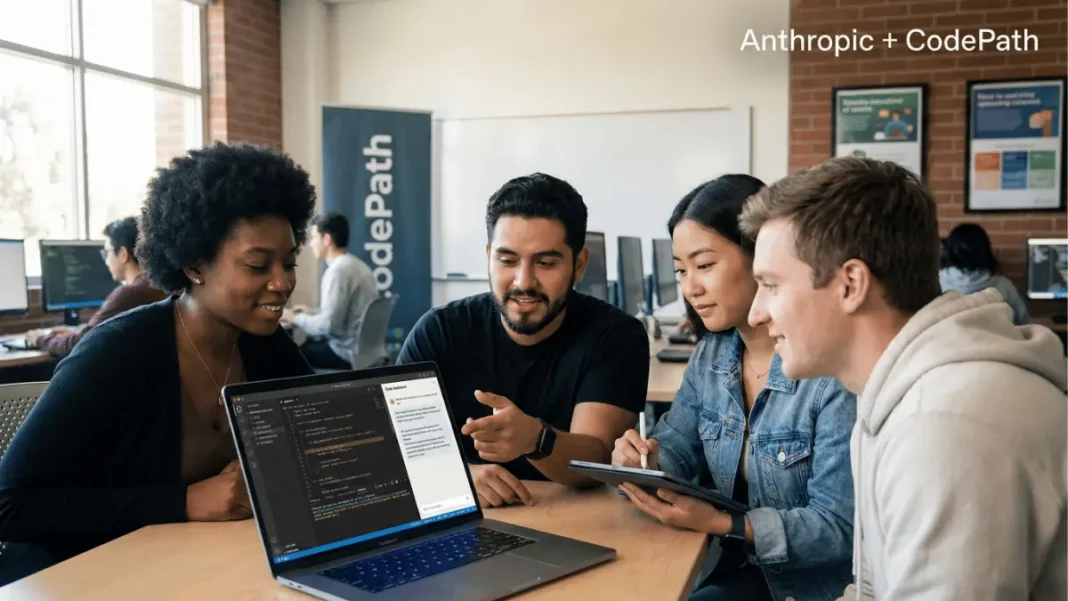
Anthropic has fundamentally altered the economics of AI education access and 20,000 students will feel the impact first. The AI company announced a partnership with CodePath, the nation’s largest provider of collegiate computer science education, to redesign coding curricula around Claude and Claude Code. This move places frontier AI tools directly into the hands of community college, state school, and HBCU students who have historically been excluded from such resources.
What the Partnership Delivers
CodePath is integrating Claude into three core AI engineering courses: Foundations of AI Engineering, Applications of AI Engineering, and AI Open-Source Capstone. Students learn to build with Claude Code from day one, contributing to real-world open-source projects as part of their coursework.
In fall 2025, over 100 CodePath students piloted Claude Code to contribute to projects including GitLab, Puter, and Dokploy. Laney Hood, a computer science major at Texas Tech University, stated that “Claude Code was instrumental in my learning process, especially since I came into the project with very little experience in the programming languages used in the repository [including TypeScript and Node.js]”.
Howard University represents the first institution to offer CodePath’s applied AI curriculum for academic credit. The redesigned Intro to Artificial Intelligence course, developed in partnership with the Thurgood Marshall College Fund, launched in January 2026 and gives students experience with Claude-assisted software development.
The Economic Equity Argument
Why does this partnership matter for economic mobility?
Over 40% of CodePath students come from families earning under $50,000 per year. CodePath’s mission centers on providing industry-vetted courses and career networks traditionally reserved for students at wealthier institutions. By integrating Claude, the organization aims to eliminate the resource gap that perpetuates inequality in tech access.
Michael Ellison, Co-founder and CEO of CodePath, stated: “We now have the technology to teach in two years what used to take four. But speed for some and not others just widens inequality“. He emphasized that partnering with Anthropic means students at historically overlooked institutions learn to build with Claude from day one, fundamentally changing who gets to shape the AI economy.
How Claude Changes Coding Education
Compressed Learning Timelines
The partnership enables students to acquire skills in two years that traditionally required four. Claude Code assists with debugging, explains programming principles in real-time, and guides students through unfamiliar languages and frameworks. This acceleration matters most for students who cannot afford extended degree programs or come from backgrounds where four-year university attendance is financially prohibitive.
Real-World Project Experience
CodePath students contribute to actual open-source repositories used by thousands of developers. Claude Code reduces the barrier to entry for complex codebases, allowing students with limited experience in specific languages to make meaningful contributions. This hands-on approach replaces theoretical exercises with portfolio-building work that matters during job applications.
Career Preparation Aligned With Industry Reality
Entry-level engineering roles in 2026 assume AI-assisted software development. Students learning without AI tools enter the workforce at a disadvantage compared to peers who trained with Claude, ChatGPT, or similar systems. CodePath’s curriculum acknowledges this shift and prepares students for the actual conditions they will face in professional environments.
Anthropic’s Broader Education Strategy
The CodePath partnership extends Anthropic’s existing education commitments:
- American Federation of Teachers (AFT): Free AI training offered to 1.8 million members across the US
- Iceland National Pilot: Ministry of Education partnership giving teachers nationwide access to Claude
- Rwanda Program: Collaboration with government and ALX to bring Claude-powered learning companion to hundreds of thousands of students and young professionals across Africa
- White House Pledge: Commitment to expand AI education through cybersecurity education, Presidential AI Challenge, and free AI curriculum for educators
These initiatives share a common structure: placing Claude in contexts where AI tools would otherwise be inaccessible due to cost, infrastructure limitations, or institutional resource constraints.
Research Component: Measuring AI’s Impact on Economic Opportunity
Anthropic and CodePath will collaborate on public research exploring how AI changes coding education and the dynamics of economic opportunity. The research will gather data from students, educators, and industry leaders about what works and what fails as AI reshapes how people build technical skills and enter the workforce.
This research matters because no long-term studies yet exist on AI-assisted learning outcomes at scale. CodePath’s 20,000-student population provides a statistically significant sample size for understanding how different student demographics respond to AI-integrated curricula.
What This Means for Community Colleges
Community colleges have experienced a surge in AI program integration since 2024. Institutions including Chandler-Gilbert Community College and Maricopa Community Colleges were among the first to offer AI and machine learning associate degrees five years ago. The Anthropic-CodePath partnership accelerates this trend by providing curriculum design expertise and direct access to frontier AI models.
CodePath serves students at community colleges, state schools, and HBCUs institutions that collectively educate the majority of US undergraduates. Partnerships like this one determine whether AI skills become democratized or remain concentrated among students at elite universities with independent access to expensive AI tools.
Limitations and Considerations
The partnership focuses on students already enrolled in CodePath programs, which requires application and acceptance. While CodePath serves 20,000+ students, millions more attend community colleges without access to these resources. The model’s scalability depends on CodePath’s ability to expand enrollment while maintaining program quality.
Additionally, AI-assisted education raises questions about dependency. Students must learn when to use AI tools and when to work through problems independently to build fundamental understanding. CodePath’s curriculum design will need to balance AI assistance with skill development that persists even without AI access.

Frequently Asked Questions (FAQs)
What is the Anthropic CodePath partnership?
Anthropic is partnering with CodePath to integrate Claude and Claude Code into computer science curricula serving 20,000+ students at community colleges, state schools, and HBCUs. CodePath is redesigning three AI engineering courses to place Claude at the center of coding education.
Which students have access to Claude through CodePath?
Students enrolled in CodePath programs at community colleges, state schools, and historically Black colleges and universities (HBCUs) have access. Over 40% come from families earning under $50,000 annually.
What is Claude Code?
Claude Code is Anthropic’s AI assistant designed for software development tasks. It helps students debug code, understand unfamiliar programming languages, and contribute to open-source projects.
When did the partnership begin?
CodePath piloted Claude Code with over 100 students in fall 2025. The formal partnership was announced in February 2026, with Howard University launching the first credit-bearing course using Claude in January 2026.
How does this partnership address educational inequality?
By providing frontier AI tools to students at under-resourced institutions, the partnership aims to eliminate the technology access gap that favors students at wealthier universities. CodePath focuses on students from families earning under $50,000 annually who traditionally lack access to industry-standard AI development tools.
What courses integrate Claude?
Three core courses use Claude: Foundations of AI Engineering, Applications of AI Engineering, and AI Open-Source Capstone. Howard University’s redesigned Intro to Artificial Intelligence course is the first to offer academic credit.
What open-source projects have students contributed to?
Fall 2025 pilot participants contributed to GitLab, Puter, and Dokploy using Claude Code assistance. Students worked with languages including TypeScript and Node.js.
Will Anthropic and CodePath publish research findings?
Yes. The partnership includes a research component examining how AI changes coding education and economic opportunity dynamics. Findings will be shared publicly based on data from students, educators, and industry leaders.

