

Essential Points
- COBOL processes 95% of US ATM transactions, yet the average COBOL developer is now 55 years old with 10% retiring annually
- 220 billion lines of COBOL remain in active production daily across banking, government, and airline infrastructure
- Legacy system maintenance consumes roughly 80% of IT budgets at the ten most critical federal agencies, blocking modernization investment
- 60% of COBOL-dependent organizations cite finding skilled developers as their single biggest operational challenge
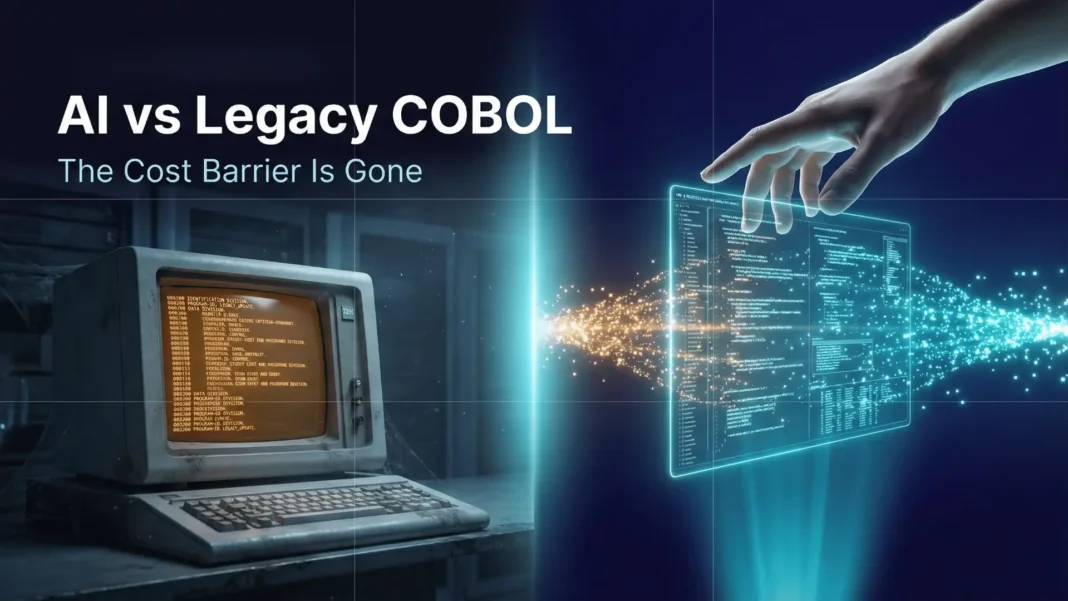
The economics of COBOL modernization just changed permanently. Anthropic’s Claude Code announcement sent IBM shares down 11% in a single trading session, a market signal that AI has crossed a meaningful threshold in legacy code handling. This analysis, based on a structured review of the Claude Code modernization framework and cross-referenced against verified 2025 to 2026 industry data, breaks down exactly what shifted, what it costs, and what your team needs to act on now.
Why COBOL Still Powers Critical Infrastructure
COBOL is not a museum piece. It processes 95% of US ATM transactions and 220 billion lines run in active production daily across banking, airlines, and government systems. Over 43% of global banking systems continue to run on COBOL, a language developed in the late 1950s. The problem is not the code itself. The problem is that the engineers who built these systems are leaving, and they take decades of undocumented institutional knowledge with them.
The average COBOL developer is now 55 years old, and 10% of that workforce retires every year. COBOL is no longer taught in mainstream computer science curricula, creating a structural talent gap with no natural pipeline to fill it. This is not a slow-moving risk. It compounds every quarter as systems grow older and the expert pool shrinks.
The Cost Equation That Blocked Modernization
Modernizing a COBOL system traditionally required assembling large consultant teams to manually map workflows, trace dependencies, and reconstruct business logic that existed nowhere in documentation. These engagements stretched across multiple years and carried price tags that most organizations could not justify against systems that, while aging, still functioned reliably.
The ten federal legacy systems most in need of modernization already cost $337 million per year just to operate, consuming roughly 80% of those specific agencies’ IT budgets. Spending additional capital on a multi-year modernization project, with uncertain outcomes and high execution risk, made the math impossible for most decision-makers. Projects stalled. Technical debt accumulated. US technical debt reached $1.52 trillion as of the most recent IT-CISQ measurement.
How AI Flips the Modernization Equation
Anthropic’s core argument is direct: legacy code modernization stalled because understanding the code cost more than rewriting it, and AI reverses that relationship. Claude Code automates the exploration and analysis phases that historically consumed the majority of total project effort, enabling teams to modernize systems in quarters instead of years.
The capabilities that change the cost model most significantly include:
- Mapping dependencies across thousands of lines of code automatically
- Documenting workflows that no living engineer remembers building
- Identifying implicit coupling through shared files, databases, and global state
- Surfacing technical debt and refactoring opportunities before migration begins
- Generating preliminary function tests that verify migrated code against legacy outputs
60% of organizations using COBOL already report that finding skilled developers is their biggest challenge, and 46% of IT professionals have noticed an active shortage. AI directly reduces the volume of specialized COBOL expertise required to begin a modernization project, lowering the human capital barrier alongside the financial one.
The Four-Phase AI Modernization Workflow
Claude Code follows a structured execution model that keeps human engineers in control of strategic decisions while automating high-volume analytical work.
Phase 1: Automated Exploration and Discovery
AI reads the entire COBOL codebase and builds a structural map. It traces execution paths through called subroutines, identifies program entry points, tracks data flows across modules, and documents implicit dependencies that static analysis tools miss. This includes initialization sequences that affect runtime behavior and file operations that create coupling between modules.
These hidden relationships are precisely what makes COBOL modernization risky in practice. Surfacing them before migration begins eliminates the most common source of project failures.
Phase 2: Risk Analysis and Opportunity Mapping
Once the codebase is mapped, AI categorizes components by migration risk. Modules with high coupling are flagged for careful handling. Isolated components become candidates for early, independent modernization. Duplicated logic is identified as a refactoring opportunity. This risk map gives your team a prioritized starting point rather than a blank slate.
Phase 3: Strategic Planning with Human Oversight
This phase is where your engineers lead. AI recommends sequencing based on complexity, dependencies, and risk scores, but your team makes final decisions based on regulatory requirements, business priorities, and operational constraints. Target architecture, code standards, and integration requirements are defined here before any code changes occur.
This division of labor is intentional. AI handles pattern recognition at scale. Humans handle judgment.
Phase 4: Incremental Implementation with Continuous Validation
Execution moves one component at a time. AI translates COBOL logic into modern languages, builds API wrappers around legacy components that remain in place temporarily, and creates scaffolding to run old and new code in parallel during transition. Each step is validated before the next begins. There are no large-scale changes in flight where failure requires rolling back weeks of work.
AI Tools Competing in the COBOL Modernization Space
Claude Code is not the only tool in this market. A comparison of the leading platforms shows different strengths depending on your modernization strategy.
| Platform | Primary Approach | Key Strength | Best For |
|---|---|---|---|
| Claude Code (Anthropic) | AI-driven analysis and translation | Automated exploration, dependency mapping, business logic documentation | Organizations with undocumented legacy systems |
| IBM Z Transformation Tools | Mainframe-native migration | z/OS COBOL support, CI/CD integration, DevOps pipelines | IBM mainframe-heavy environments |
| Micro Focus Enterprise Suite | Automated refactoring and rehosting | Multi-dialect COBOL support, cloud deployment | Banking and insurance modernization |
| TSRI Modernization Platform | Automated code translation to Java | API generation, hybrid cloud support | ERP migration to microservices |
| Astadia FastTrack | Mainframe offloading to cloud | Federal and financial sector focus, functional equivalency testing | Risk-averse, regulated industries |
Limitations and Honest Considerations
AI dramatically reduces the analytical burden of COBOL modernization, but it does not eliminate execution risk. Data format incompatibilities, particularly EBCDIC encoding and packed decimals on mainframe systems, require specialized handling that automated translation tools do not always resolve cleanly. Business logic embedded in undocumented edge-case behavior still requires domain expert review. AI-generated tests validate outputs, but your team must determine which business scenarios need manual subject-matter validation.
Organizational resistance and lack of internal expertise are among the most cited modernization challenges alongside high upfront investment costs. A successful project requires change management alongside technical execution.
What This Means for Enterprise Teams in 2026
The market signal from IBM’s share drop confirms that enterprise buyers are actively reassessing long-term consulting contracts for COBOL work. Organizations that were waiting for modernization economics to improve now have a credible answer. Anthropic’s recommended entry point is a single component with clear boundaries and moderate complexity, using AI to analyze and document it fully before any migration work begins.
For teams in finance, government, and airlines running production COBOL, this is not a question of whether to modernize. It is a question of how long the current talent and maintenance cost trajectory remains sustainable. With 10% of the COBOL workforce retiring every year and technical debt compounding, the cost of waiting rises faster than the cost of starting.
 Claude Under Attack: How Three Chinese AI Labs Extracted 16 Million Exchanges from Anthropic
Frequently Asked Questions (FAQs)
What percentage of ATM transactions run on COBOL systems?
95% of ATM transactions in the US are processed by COBOL-based systems, according to Reuters data cited across multiple industry reports. Additionally, 220 billion lines of COBOL remain in active production daily across banking, government, and airline infrastructure worldwide.
Why has COBOL modernization been so expensive historically?
Modernization required large consultant teams to manually map workflows and reconstruct business logic from systems built decades ago with no surviving documentation. The cost of understanding the codebase consistently exceeded the perceived cost of leaving it in place, which stalled most projects indefinitely.
What does Claude Code actually do in a COBOL modernization project?
Claude Code automates dependency mapping, workflow documentation, risk analysis, and code translation. It identifies hidden coupling through shared files and global state, generates preliminary function tests, and builds scaffolding for parallel operation of old and new code during incremental migration.
How severe is the COBOL developer shortage?
The average COBOL developer is 55 years old, and 10% of the COBOL workforce retires annually. 60% of organizations using COBOL report finding skilled developers as their biggest challenge, and 46% of IT professionals have already noticed an active shortage.
What are the biggest risks in COBOL migration projects?
Primary risks include data format incompatibilities such as EBCDIC encoding and packed decimals, undocumented edge-case business logic, high module coupling that increases migration fragility, and organizational resistance to change. Incremental execution with validation at each step is the standard risk mitigation approach.
Which industries are most dependent on COBOL systems today?
Banking and financial services, federal and state government agencies, and major airlines carry the heaviest COBOL dependencies. 70% of banks globally still rely on legacy systems as of 2025, and over 43% of global banking systems run on COBOL.
How much does legacy system maintenance cost US federal agencies?
The ten federal legacy systems most in need of modernization cost $337 million annually to operate and maintain, consuming roughly 80% of those specific agencies’ IT budgets, according to a GAO Report.
How do organizations start a COBOL modernization project with minimal risk?
Start with a single component that has clear boundaries and moderate complexity. Use AI to analyze and document it thoroughly, plan the modernization with domain engineers, implement incrementally with testing at each step, and validate before expanding scope. This approach builds organizational confidence while keeping failure impact contained.

