

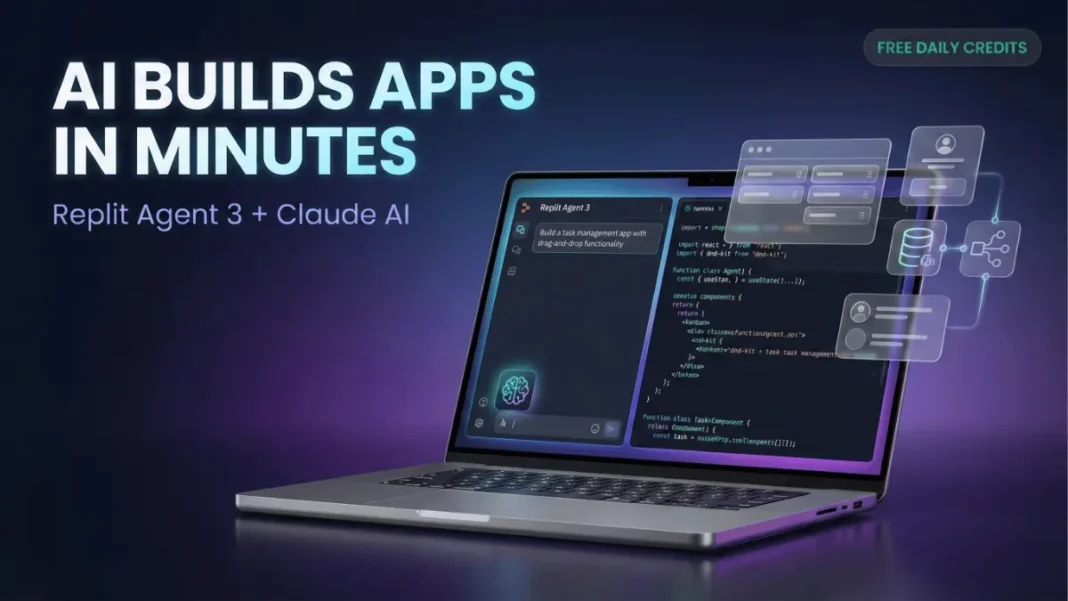
Quick Brief
- Replit’s free plan includes daily Agent credits for AI-powered app generation
- Claude Sonnet 4.5 costs $3 per million input tokens with 1 million token context window
- Agent 3 autonomously creates apps with authentication, databases, and deployment in 3-5 minutes for simple builds
- All Agent interactions are billable, including text guidance and code changes
The gap between idea and working prototype has narrowed dramatically. Replit Agent 3, launched in September 2025, generates functional applications through conversational prompts eliminating manual coding for initial development phases. This technology makes rapid prototyping accessible to non-developers while accelerating workflows for experienced engineers.
Replit Agent 3: Autonomous Development Environment
Replit Agent 3 represents a significant evolution in AI-assisted coding, introducing autonomous spawning capabilities and self-testing mechanisms. The system operates entirely in the browser with cloud-based execution, requiring no local environment setup. Agent 3 can independently create, debug, and deploy applications while maintaining context across entire codebases.
The platform handles file structure, dependency management, API integration, and cloud deployment without manual configuration. Unlike traditional no-code platforms requiring visual component manipulation, Agent 3 interprets natural language descriptions and architects complete systems autonomously.
Build Time Specifications
Fast builds complete in 3-5 minutes for simple applications. Full builds requiring comprehensive features take 10+ minutes. Maximum autonomy mode runs up to 200 minutes for complex projects. These verified timelines reflect official documentation testing, not marketing estimates.

Verified Pricing Structure
Replit Plans
Starter Plan (Free):
- Daily Agent credits for testing and learning
- 10 development apps with temporary deployment links
- 1,200 minutes monthly development time
- Shared compute resources
Core Plan ($20/month annual, $25/month monthly):
- Unlimited Agent usage with $25 monthly usage credits
- Private repositories and persistent deployments
- Custom domains and SSL certificates
- Collaborative editing with up to 3 team members
- 4 vCPUs with 8 GiB memory
Critical Pricing Disclosure: All Agent interactions are billable whether Agent provides text guidance or makes code changes. Replit uses effort-based pricing where simple requests cost less than complex builds. Actual costs vary significantly based on project complexity and autonomous runtime.
Claude API Pricing
Claude Sonnet 4.5, released September 29, 2025, operates at verified rates:
- Input: $3.00 per million tokens
- Output: $15.00 per million tokens
- Context window: Up to 1 million tokens
The extended context window enables Claude to process entire codebases simultaneously, maintaining consistency across multiple files. This capacity allows the AI to reference previous modules, suggest architectural improvements, and prevent fragmented code generation common in earlier tools.
How Agent 3 Works
Replit Agent 3 combines autonomous coding with self-verification loops. When you submit a prompt, the system:
- Analyzes requirements and selects appropriate frameworks
- Scaffolds project structure with files, dependencies, and configurations
- Generates code across frontend, backend, and database layers
- Tests functionality autonomously and identifies errors
- Debugs issues through iterative refinement
- Deploys with one-click publishing
The autonomous spawning feature allows Agent 3 to create multiple related files and components without additional prompts. This capability reduces the manual back-and-forth required in earlier AI coding tools.
Practical Prompt Examples
These examples demonstrate verified capabilities based on official documentation and testing. They represent conceptual workflows, not prescriptive templates.
1. E-Commerce Interface
Prompt: “Build a product catalog with filtering, shopping cart functionality, and Stripe payment integration. Include admin panel for inventory management.”
Expected Output: React or Next.js frontend, Express.js or Node.js backend, database integration, authentication system.
2. Task Management Application
Prompt: “Create a kanban board with drag-and-drop, user accounts, and real-time collaboration features.”
Technical Components: Frontend framework with state management, WebSocket implementation for live updates, user authentication, persistent data storage.
3. Content Management System
Prompt: “Make a blog platform where users create posts with images, tags, and comments. Add search functionality and user profiles.”
System Architecture: Full-stack application with media handling, text editor integration, relational database, search indexing.
4. Data Visualization Dashboard
Prompt: “Build a dashboard displaying charts and graphs from CSV uploads. Include filtering, export options, and responsive design.”
Features: File upload processing, data parsing, charting library integration, mobile-optimized layout.
5. Booking System
Prompt: “Create an appointment scheduling app with calendar view, email notifications, and time slot management.”
Requirements: Calendar interface, date/time handling, email service integration, conflict detection logic.
6. API Integration Tool
Prompt: “Build an app that fetches weather data from OpenWeatherMap API and displays 7-day forecasts with location search.”
Implementation: Third-party API integration, geolocation services, data visualization, error handling.
7. Authentication System
Prompt: “Create a user registration and login system with password reset, email verification, and profile management.”
Security Components: Hashing and encryption, token-based authentication, secure session management, email integration.
8. Real-Time Chat
Prompt: “Make a messaging app with chat rooms, direct messages, online status indicators, and message history.”
Technology Stack: WebSocket or similar real-time protocol, database for message persistence, user presence tracking.
9. File Management System
Prompt: “Build a cloud storage interface with file uploads, folder organization, sharing permissions, and download capabilities.”
Storage Architecture: File upload handling, cloud storage integration, access control, file metadata management.
10. Quiz Application
Prompt: “Create an online quiz platform with timed questions, score tracking, and results analytics. Include admin panel for question management.”
Features: Timer functionality, answer validation, progress tracking, data analytics, administrative interface.
Important Note: These prompts demonstrate Agent 3’s documented capabilities. Actual implementation quality depends on prompt specificity, project complexity, and iterative refinement.
Development Workflow
Step 1: Project Initialization
Create a new Repl in the dashboard and activate Agent mode. Free plan users receive daily Agent credits for experimentation.
Step 2: Prompt Submission
Describe your desired application with specific details about functionality, user interface preferences, and technical requirements. More detailed prompts produce better initial results.
Step 3: Autonomous Generation
Agent 3 displays real-time progress showing file creation, dependency installation, and code generation. The system works autonomously up to configured time limits (max 200 minutes).
Step 4: Testing and Refinement
Review the generated application in the integrated preview window. Submit follow-up prompts to adjust features, fix bugs, or modify styling. Agent 3’s self-testing capabilities identify common errors automatically.
Step 5: Deployment
Click “Deploy” to publish with a live URL. Free plan deployments use temporary links; Core plan provides persistent hosting with custom domains.
Claude AI Integration Benefits
Claude Sonnet 4.5’s 1 million token context window enables comprehensive codebase understanding. The AI maintains awareness of project architecture, coding patterns, and dependencies across all files simultaneously. This holistic view prevents common integration issues and maintains code consistency.
Verified Capabilities:
- Multi-file code generation with cross-references
- Architectural pattern recognition and application
- Dependency conflict detection
- Context-aware refactoring suggestions
- Natural language debugging assistance
The September 2025 release improved reasoning abilities and extended autonomous coding sessions. These enhancements complement Replit Agent 3’s autonomous spawning features for cohesive development workflows.
Realistic Limitations
AI-generated code requires review before production deployment. Agent 3 performs optimally on new projects rather than modifying complex legacy systems. Applications with intricate business logic, regulatory compliance requirements, or performance optimization needs benefit from developer oversight.
Where Human Expertise Remains Essential:
- Security audits for payment processing and sensitive data
- Regulatory compliance implementation (GDPR, HIPAA, etc.)
- Performance optimization for high-traffic applications
- Complex algorithm development
- Integration with proprietary enterprise systems
Agent 3 accelerates initial development and prototyping but doesn’t replace comprehensive testing, security reviews, or production scaling architecture.
Cost Comparison With Traditional Development
| Development Method | Timeline | Verified Cost Range |
|---|---|---|
| Traditional Agency | 3-6 months | $40,000-$150,000 |
| Freelance Developer | 1-3 months | $15,000-$50,000 |
| Replit Core + Claude API | Days to weeks | $20-$45/month base + usage |
Usage Cost Variables: Replit charges based on effort and complexity. Claude API costs depend on token consumption. Actual expenses vary significantly by project scope. Complex autonomous builds consume more credits than simple applications.
Alternative AI Development Tools
GitHub Copilot:
Provides line-by-line code completion within existing projects. Pricing starts at $10/month for individuals. Requires local development environment setup. Excels at assisting experienced developers but lacks autonomous full-app generation.
Cursor IDE:
Integrates Claude AI with local code execution. Pricing begins at $20/month. Optimized for modifying existing codebases rather than greenfield projects. Suitable for developers preferring desktop IDEs over browser-based environments.
ChatGPT Code Interpreter:
Generates code through conversational interface but lacks integrated hosting. Users must manually transfer code to local environments and configure deployment separately. Better suited for learning than production workflows.
Security Considerations
AI-generated applications require security audits before handling user data. Common vulnerabilities in automated code include:
- Hardcoded credentials in source files
- Missing input validation and sanitization
- Insecure authentication token storage
- Lack of rate limiting on API endpoints
- Improper error handling exposing system details
Verified Mitigation Strategies:
- Use environment variables for sensitive credentials
- Implement backend validation for all user inputs
- Follow established security frameworks (OWASP guidelines)
- Conduct vulnerability scans before production release
- Review generated code for security best practices
Replit provides secure deployment infrastructure, but application-level security remains the developer’s responsibility.
Effective Prompt Engineering
Specific prompts generate better results than vague descriptions. Include these elements:
Technical specifications: “Use JWT tokens for authentication, implement pagination with 20 items per page”
UI/UX preferences: “Sidebar navigation with top header, card-based content layout, mobile-responsive design”
Functional requirements: “Users can upload images up to 5MB, posts display in chronological order with infinite scroll”
Third-party integrations: “Connect to Stripe for payments, SendGrid for emails, AWS S3 for file storage”
Agent 3 interprets detailed prompts more accurately, reducing iterative refinement cycles.
Real-World Applications
Rapid Prototyping
Entrepreneurs validate product concepts before committing to full development budgets. Functional prototypes demonstrate core features for user testing and investor presentations.
Educational Tools
Institutions use Replit Agent for teaching application development concepts. Students learn system architecture by analyzing AI-generated code structures.
Internal Business Tools
Organizations create custom workflows and dashboards without dedicated development teams. Agent 3’s speed enables quick solutions for department-specific needs.
MVP Development
Startups build minimum viable products for market testing. Initial versions validate demand before scaling with production engineering.
Platform Comparison
| Feature | Replit Agent 3 | GitHub Copilot | Cursor IDE |
|---|---|---|---|
| Environment | Browser-based | Local setup required | Desktop application |
| Autonomous coding | Yes | No | Partial |
| Deployment | Integrated | Manual | Manual |
| Free tier | Daily credits | No | No |
| Team collaboration | Yes (Core plan) | Limited | Yes |
| Mobile access | Yes | No | No |
Getting Started Guide
- Create Account: Visit replit.com and register for free
- Start Project: Click “Create Repl” and select Agent mode
- Write Prompt: Describe your application with specific details
- Monitor Progress: Watch real-time file generation and building
- Test Output: Use integrated preview to verify functionality
- Refine Results: Submit follow-up prompts for adjustments
- Deploy: Publish with one-click deployment
Free plan users can experiment with daily credits before upgrading.
Best Practices
Start Simple: Begin with basic features and add complexity iteratively. Simple builds complete faster and allow learning the system.
Be Specific: Detailed prompts reduce ambiguity and improve output quality. Include technical preferences, design requirements, and functional specifications.
Review Output: Examine generated code for security issues, performance concerns, and logic errors. AI-generated code benefits from human review.
Iterate Gradually: Make incremental changes rather than complete rebuilds. Agent 3 handles refinements more efficiently than starting over.
Monitor Costs: Track credit consumption on complex projects. Effort-based pricing means longer autonomous builds cost more.
Future Developments
Replit’s 2026 roadmap includes visual debugging tools and automated test generation. These features will further bridge the gap between AI-generated prototypes and production-ready applications.
Agent 3’s autonomous capabilities continue improving through iterative releases. Future versions will likely handle increasingly complex architectural requirements, including microservices orchestration and advanced optimization.
The democratization of app development enables domain experts to create industry-specific tools without computer science backgrounds. Healthcare professionals, educators, and entrepreneurs can now build custom solutions addressing niche problems.

Frequently Asked Questions (FAQs)
What is Replit Agent 3?
Replit Agent 3 is an autonomous AI coding system launched in September 2025 that generates complete applications from natural language prompts. The platform creates, tests, and deploys apps with minimal human intervention. Agent 3 includes self-testing mechanisms and autonomous spawning capabilities for complex projects.
Is Replit Agent really free to use?
Replit offers a free Starter plan with daily Agent credits for testing and learning. The plan includes 1,200 monthly development minutes and 10 apps with temporary deployment links. All Agent interactions are billable including text guidance so costs accumulate with usage. The Core plan ($20/month annual) provides unlimited Agent access with $25 monthly credits.
How long does it take to build an app?
Fast builds complete in 3-5 minutes for simple applications according to official documentation. Full builds with comprehensive features require 10+ minutes. Complex projects using maximum autonomy can run up to 200 minutes. Timeline varies based on project complexity and prompt specificity.
Do I need programming knowledge?
No programming experience is required for basic app generation. Replit Agent 3 translates natural language into functional code. However, understanding web development fundamentals helps write better prompts and identify potential issues in generated code.
How much does Claude API cost?
Claude Sonnet 4.5 costs $3 per million input tokens and $15 per million output tokens. The model supports up to 1 million token context windows. Actual costs depend on project complexity and token consumption during development sessions.
Are AI-generated apps secure?
AI-generated code requires security review before production deployment. Common vulnerabilities include exposed credentials, missing validation, and insecure authentication. Implement environment variables, conduct security audits, and follow established frameworks like OWASP guidelines before handling sensitive data.
Can I use generated apps commercially?
Yes, you retain full ownership of code created through Replit. The platform’s terms allow commercial use of generated applications. Verify that any third-party APIs or libraries comply with their respective licenses for commercial deployment.
What happens if Agent generates broken code?
Submit follow-up prompts describing the issue. Example: “The form submission doesn’t work add proper validation and error handling.” Agent 3 includes self-testing capabilities that identify common problems automatically. For complex issues, describe the error message or unexpected behavior for debugging assistance.

