

Essential Points
- VEK385 integrates the AMD 2VE3858 adaptive SoC, combining heterogeneous processors for preprocessing, AI inference, and post-processing on a single chip
- AIE-ML v2 compute tiles use the MX6 datatype and deliver up to 3X the TOPS per watt versus first-generation Versal AI Edge devices running INT8
- Scalar compute capacity in Versal AI Edge Series Gen 2 is 10X higher than first-generation Versal AI Edge products, based on eight Cortex-A78AE and ten Cortex-R52 cores
- Engineers can begin evaluation within minutes using ready-to-run example designs, the System Controller, and flexible JTAG, OSPI, and UFS boot modes
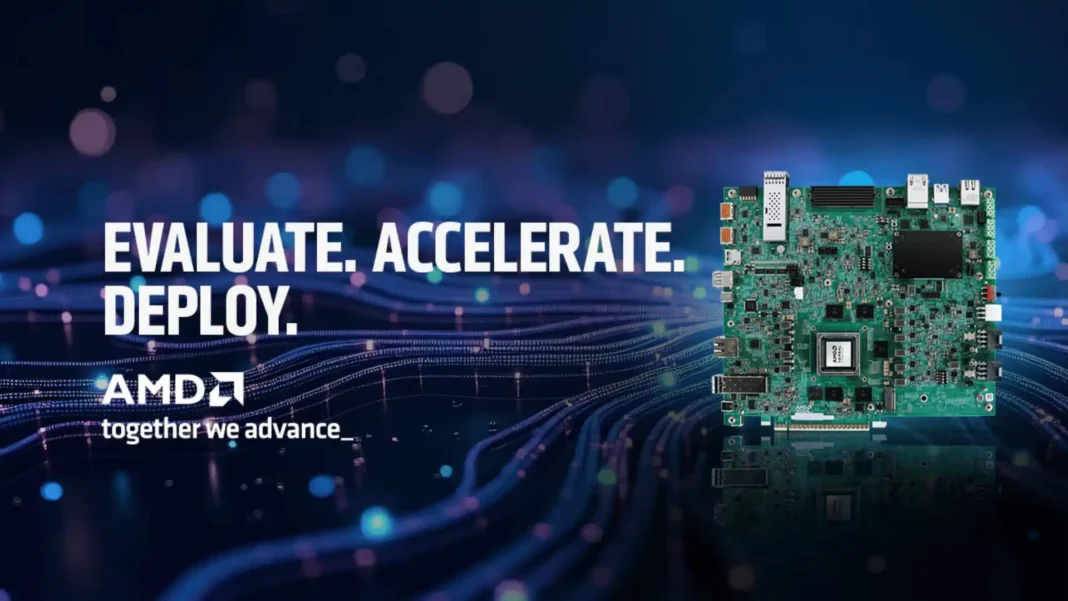
Embedded AI development has long been stuck in a slow loop of hardware bring-up, driver debugging, and toolchain setup before a single inference runs. AMD’s VEK385 Evaluation Kit breaks that cycle. Built around the Versal AI Edge Series Gen 2 2VE3858 adaptive SoC, this platform compresses weeks of integration work into a single session, targeting engineers building safety-critical, long-lifecycle AI systems for robotics, automotive, industrial, and vision markets.
What Makes the 2VE3858 Architecture Different
The VEK385’s core is not a conventional FPGA or a standalone AI accelerator. It is a heterogeneous adaptive SoC that handles preprocessing, AI inference, and post-processing on a single chip, eliminating the power, area, and complexity overhead of multi-chip solutions.
The 2VE3858 device combines eight Arm Cortex-A78AE application processor cores running at up to 2.2 GHz, ten Cortex-R52 real-time cores running at up to 1.05 GHz, programmable logic, DSP Engines, and AIE-ML v2 AI Engine tiles in one package. That integration matters: in multi-chip architectures, data moves between discrete devices for each processing stage, introducing latency and consuming board space.
AMD’s AIE-ML v2 compute tile uses the MX6 datatype instead of INT8, delivering up to 3X the TOPS per watt compared to first-generation Versal AI Edge devices. This efficiency gain is based on AMD internal projections using a 2-row by 8-column subarray at 1 GHz, 0.7V AIE operating voltage, and 60% vector utilization, with a note that final product performance may vary. For power-constrained edge deployments, this efficiency difference directly influences whether a design remains viable in production.
Scalar compute capacity also receives a major upgrade. Versal AI Edge Series Gen 2 delivers 10X higher scalar compute versus first-generation Versal AI Edge products, based on combined total DMIPs from the eight Cortex-A78AE and ten Cortex-R52 cores. This is a pre-silicon estimate, and final product DMIP performance may vary per AMD’s official documentation.
 Oracle Fusion Cloud EPM Earns Gartner Leader Status: What It Means for Enterprise Finance in 2026
VEK385 Connectivity: Built for Real Industrial Conditions
| Interface | Specification | Target Use Case |
|---|---|---|
| HDMI RX/TX + USB3/DP | 4K and 8K capable | Vision pipelines, surveillance |
| PCIe x8 edge connector | Gen5 x4 / Gen3-4 x8 | High-throughput data acceleration |
| QSFP28 + SFP28 | 25 to 100 Gb/s Ethernet | Telecom, industrial networking |
| CAN-FD + PL/PS Ethernet | Deterministic communication | Robotics, industrial control |
| FMC+ connector | I/O expansion | Custom interface expansion |
| LPDDR5X memory | High-bandwidth onboard memory | Concurrent inference and control |
This is not a stripped-down demo board. The breadth of interfaces means a single VEK385 unit can evaluate multiple product variants, from an industrial robot controller to a 4K smart camera, without hardware swaps.
Rapid Bring-Up: What “Minutes, Not Months” Actually Means
The System Controller and Board Evaluation Tool handles board setup and target configuration directly, so the board can be customized to the target use case without manual low-level bring-up steps that typically consume an engineer’s first days with a new platform.
Ready-to-run example designs, including HDMI and MRMAC reference designs, are available out of the box. Engineers do not start from a blank project. Flexible boot modes including JTAG, OSPI, and UFS support rapid testing of OS image configurations, PL bitstreams, and embedded application stacks in sequence.
Target Markets Where VEK385 Delivers Measurable Value
AMD positions this kit specifically for applications requiring high security, high reliability, long lifecycle, and safety-critical operation. The underlying silicon architecture, including the Cortex-A78AE application cores and Cortex-R52 real-time cores, maps directly to the functional safety requirements that automotive and industrial designs demand.
Key verticals AMD identifies for Versal AI Edge Series Gen 2 and the VEK385 platform:
- Autonomous driving and ADAS systems running sensor fusion at the edge
- Sensor-fusion smart cameras for industrial and surveillance workloads
- Medical imaging systems requiring deterministic AI processing
- Aerospace and defense platforms with long-lifecycle silicon requirements
- Robotics and industrial control leveraging CAN-FD and deterministic I/O
- Broadcast and professional AV systems handling multi-channel 8K workflows
VEK385 vs. VEK280: The Generation Difference
The VEK280, AMD’s previous Versal AI Edge evaluation kit, used the XCVE2802 adaptive SoC with first-generation AIE-ML compute tiles operating on INT8 data types and Cortex-A72 application cores. The VEK385 advances to the 2VE3858, which brings AIE-ML v2 tiles using the MX6 datatype, Cortex-A78AE cores replacing the A72 generation, ten Cortex-R52 real-time cores, and 10X higher scalar compute capacity.
AMD also recommends the VEK385 for Versal Prime Series Gen 2 evaluations, making it a dual-purpose platform. Engineers evaluating both adaptive SoC families need only one board, reducing hardware procurement cost and accelerating comparative benchmarking.
Considerations Before Ordering
The VEK385 is an evaluation platform, not a production-qualified board. AMD explicitly states it is not intended for volume production and does not require complete reliability and production qualification. Engineering teams should not use VEK385 hardware in production contexts where board-level qualification documentation is mandatory.
The 3X TOPS per watt and 10X scalar compute figures are AMD internal projections and pre-silicon estimates respectively, both carrying the qualification that final product performance may vary. Engineers should treat these as directional indicators during evaluation, not as guaranteed production silicon specifications.

Frequently Asked Questions (FAQs)
What adaptive SoC does the AMD VEK385 use?
The VEK385 uses the AMD Versal AI Edge Series Gen 2 2VE3858 adaptive SoC. This device integrates Arm Cortex-A78AE application cores, Cortex-R52 real-time cores, programmable logic, DSP Engines, and AIE-ML v2 AI Engine tiles on a single chip for end-to-end embedded AI acceleration.
How does the AIE-ML v2 in Versal Gen 2 differ from the first generation?
AIE-ML v2 uses the MX6 datatype instead of INT8, delivering up to 3X the TOPS per watt compared to first-generation Versal AI Edge devices. AMD specifies this is based on internal projections at defined operating conditions, and that final product performance may vary.
What is the scalar compute improvement in Versal AI Edge Series Gen 2?
Scalar compute capacity in Versal AI Edge Series Gen 2 is 10X higher than first-generation Versal AI Edge products. This is based on pre-silicon DMIP estimates using eight Cortex-A78AE cores at 2.2 GHz and ten Cortex-R52 cores at 1.05 GHz, with final performance subject to variation.
Can the VEK385 be used for Versal Prime Series Gen 2 evaluations?
Yes. AMD explicitly recommends the VEK385 for both Versal AI Edge Series Gen 2 and Versal Prime Series Gen 2 evaluations. Engineers working across both product families can use a single kit for comparative benchmarking and reduce hardware procurement overhead.
What boot modes does the VEK385 support?
The VEK385 supports JTAG, OSPI, and UFS boot modes. This flexibility allows engineers to test multiple OS image configurations, PL bitstreams, and embedded application stacks rapidly without hardware modifications between test runs.
What vision interfaces does the VEK385 include?
The board includes HDMI RX/TX and USB3/DisplayPort interfaces supporting 4K and 8K vision pipelines. This makes it suitable for evaluating smart camera systems, AI vision workloads, and computer vision applications requiring high-resolution input alongside real-time embedded AI inference.
Is the VEK385 suitable for safety-critical production designs?
The VEK385 is an evaluation platform only and is not intended for volume production. AMD states it does not require complete reliability and production qualification. The underlying 2VE3858 silicon supports safety-critical architecture requirements, but production designs need separate device-level qualification processes.
What connectivity does the VEK385 offer for industrial and networking applications?
The board includes QSFP28 and SFP28 connectors for 25 to 100 Gb/s Ethernet, CAN-FD with PL/PS Ethernet for deterministic industrial control and robotics, and an FMC+ connector for I/O expansion. This range of interfaces supports evaluation across industrial, telecom, and robotics use cases.

