

Quick Brief
- AT&T and Cisco commercially launched a 5G SA-native IoT platform on February 19, 2026
- The platform integrates Cisco IoT Control Center and Converged Core with AT&T’s nationwide 5G SA core
- Network slicing, edge compute, and automated device lifecycle management are now available through one enterprise interface
- Enterprise IoT connections stood at 13 billion in 2025 and are projected to reach 24 billion by 2030
AT&T and Cisco converted 5G Standalone’s enterprise potential into a live commercial platform this month, announced February 19, 2026. The integration pairs AT&T’s nationwide 5G SA core with Cisco’s Mobility Services Platform, delivering network slicing, edge compute, and automated device lifecycle management through a single operational interface. With enterprise IoT connections on a trajectory from 13 billion in 2025 to 24 billion by 2030, the infrastructure decisions organizations make now will determine how they scale across that growth curve.
What the AT&T-Cisco 5G Standalone IoT Platform Does
The platform commercially activates a 5G Standalone-native architecture that tightly integrates AT&T’s nationwide 5G SA core with Cisco’s Mobility Services Platform portfolio, specifically IoT Control Center and Converged Core. This is not a software layer on top of existing infrastructure. It is a native integration that gives enterprise applications direct access to programmable 5G SA capabilities from the core outward, covering lifecycle management, diagnostics, and automation all in one place.
Cisco’s Converged Core and globally distributed data centers extend the platform’s reach beyond US borders. Subject to regulatory constraints, enterprises operating across multiple geographies can use local data breakouts to reduce latency in regions where their operations are based. For multinational deployments, that distinction between centralized cloud routing and a locally resolved data path matters in both performance and data compliance terms.
 The World’s First Commercial 5G Core SaaS Is Live Citymesh, Nokia, and AWS Just Redefined Telecom
Network Slicing: The Capability That Changes Enterprise Planning
Network slicing divides a single physical 5G network into multiple virtual networks, each with dedicated bandwidth, latency parameters, and security policy enforcement. Unlike non-standalone 5G setups that rely on a 4G core, 5G SA’s cloud-native architecture with dynamic resource allocation and software-defined networking is specifically designed to enable true network slicing. The AT&T-Cisco platform removes the prior architectural constraint, making these capabilities commercially available to enterprises on AT&T’s network.
A GlobalData 2024 study commissioned by Ericsson, covering large enterprises, CSPs, and managed service providers across the US and Canada, found that 54% of enterprise respondents cite increased productivity and efficiency as the primary anticipated benefit of network slicing. The same research shows enterprises prioritize scalability (71%), security (62%), throughput (60%), and reliability (58%) when evaluating network slicing features for their specific use cases. That priority hierarchy directly maps to the workload types AT&T and Cisco target: connected vehicles, smart cities, and digital healthcare each demand distinct, non-negotiable performance thresholds.
Additionally, 59% of North American CSPs foresee significant opportunity in 5G network slicing, though most anticipate the major market window opening within 3 to 4 years of widespread 5G SA deployment. AT&T and Cisco’s February 2026 launch positions them ahead of that adoption curve rather than reactive to it.
How a Network Slice Works in Practice
Consider a smart city deployment managing traffic signal sensors, emergency vehicle routing, and environmental air quality monitors simultaneously. Emergency routing demands sub-10ms latency while air quality logging tolerates seconds of delay. With network slicing on the AT&T-Cisco 5G SA platform, city operations teams can provision separate virtual network lanes per application, enforce performance guarantees, and manage every device through Cisco IoT Control Center without deploying parallel physical infrastructure.
A city that previously required separate dedicated connections for public safety, utilities, and environmental systems can now consolidate onto a single 5G SA contract with software-defined separation between workloads. That consolidation reduces both capital expenditure and operational overhead.
Three Sectors Targeted by This Platform First
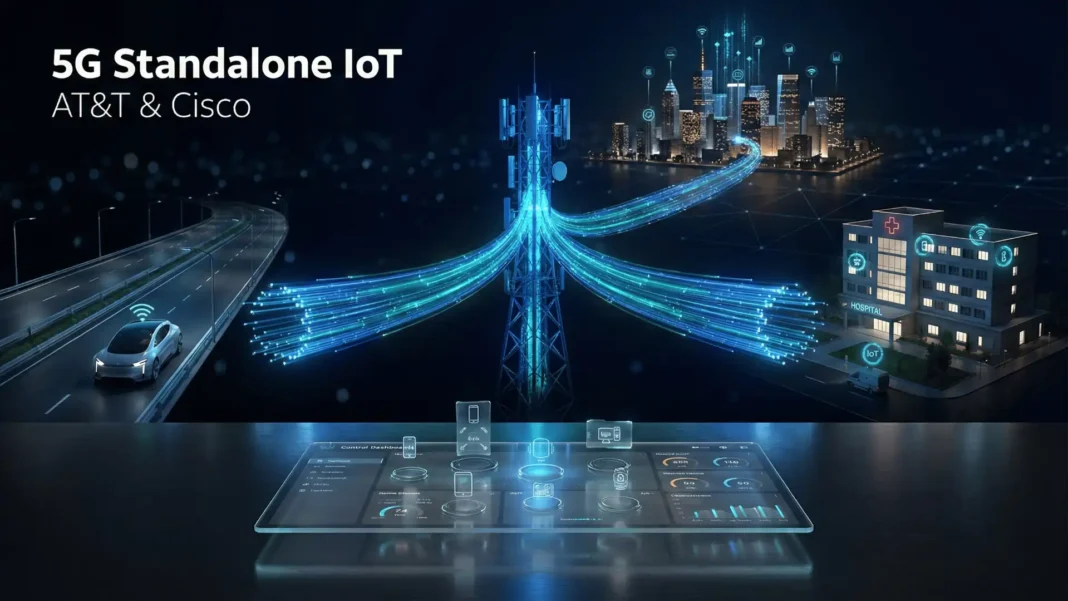
AT&T and Cisco identify connected vehicles, smart cities, and digital healthcare as the initial priority verticals for the platform. Each sector has specific performance requirements that 5G non-standalone architectures struggled to deliver reliably at scale.
Connected vehicles. Vehicle-to-infrastructure communication requires consistent low latency and high reliability for collision avoidance systems and autonomous navigation support. 5G SA’s edge compute support moves processing closer to the endpoint, reducing round-trip data times compared to centralized cloud routing.
Smart cities. Municipalities are integrating transportation, public safety, energy management, and environmental systems onto shared infrastructure. Network slicing allows each function to operate on the same physical network without competing for bandwidth or violating the performance requirements of adjacent workloads.
Digital healthcare. Remote diagnostics, telemedicine, and connected surgical systems require guaranteed uptime and strict data security. The 5G SA platform’s enhanced security posture, paired with Cisco’s policy enforcement capabilities, addresses compliance demands in both US and Indian healthcare IoT regulatory environments.
Cisco IoT Control Center: Unified Management on 5G SA
Cisco’s IoT Control Center has managed enterprise SIM-based IoT connectivity across carrier networks for years, but its native integration into AT&T’s 5G SA core tightens the operational path between device events and network response. For enterprises managing large-scale deployments, this matters because manual intervention points decrease as the platform handles provisioning, diagnostics, usage monitoring, and rule-based responses from a single interface.
The Converged Core handles session management and policy enforcement at the network layer, not the application layer. An enterprise can define a policy once, such as prioritizing a critical industrial sensor over background fleet telemetry, and have it enforced consistently across all devices on the AT&T SA network without reconfiguring each device individually.
AT&T unveiled IoT Network Intelligence at CES 2026 in January, designed to give businesses enhanced visibility into connected device behavior. The Cisco 5G SA platform provides the underlying network layer that IoT Network Intelligence and planned future AI workloads will build on, making this launch part of a deliberate infrastructure sequencing strategy.
How AT&T-Cisco Stacks Up Against Competing Enterprise IoT Platforms
| Capability | AT&T + Cisco (2026) | T-Mobile Enterprise IoT | Verizon Enterprise IoT |
|---|---|---|---|
| 5G SA Core | Nationwide, commercially active | Nationwide, commercially active | Phased rollout in progress |
| Network Slicing | Natively enabled via 5G SA integration | T-Priority dedicated slices available | In testing; limited commercial availability |
| IoT Management Platform | Cisco IoT Control Center + Converged Core | T-Mobile IoT Solutions via API suite | Verizon ThingSpace platform |
| Global Data Breakout | Cisco distributed DCs, subject to regulations | Limited global integration | US-centric core architecture |
| AI IoT Roadmap | Stated as next development phase | Partial automation features available | No unified AI IoT roadmap publicly announced |
The competitive gap on network slicing is the most operationally significant difference. True slicing requires a fully deployed 5G SA core, and carriers still completing that transition cannot offer enterprises the same programmable virtual network separation that the AT&T-Cisco platform now delivers commercially.
The AI-Driven IoT Foundation Being Built Now
AT&T and Cisco describe the February 2026 launch as a foundation, not a finished system. The stated goal is AI-driven IoT in which connectivity, compute, and control adapt dynamically in real time to application and business demands. The platform architecture is designed to integrate AI workloads in future iterations as both companies develop those capabilities, though no specific release timeline for AI automation features has been publicly announced.
The global connected IoT device count grew 14% to reach 21.1 billion in 2024, according to IoT Analytics. With enterprise connections projected to double from 13 billion to 24 billion by 2030, the network infrastructure decisions organizations make in 2026 will directly shape how efficiently they can onboard, manage, and optimize that device scale. Building on 5G SA-native infrastructure today means AI optimization layers will deploy onto an already-capable network foundation rather than requiring an architecture rebuild when those tools arrive.
Limitations Worth Noting Before Deployment
The platform’s global breakout capabilities are explicitly subject to regulatory constraints per the official AT&T-Cisco announcement. Enterprises in jurisdictions with strict data residency requirements should verify regional availability and compliance compatibility before designing deployments around local breakout functionality. The AI-driven IoT roadmap remains a published future objective rather than a commercially active feature, so enterprises evaluating the platform today are purchasing foundational 5G SA infrastructure with AI enhancements on a forward delivery schedule.
 Sam Altman Dropped Out of Stanford at 19, Raised $30M, and Built the Startup That Led to OpenAI
Frequently Asked Questions (FAQs)
What is the AT&T and Cisco 5G Standalone IoT platform?
Announced February 19, 2026, this platform integrates AT&T’s nationwide 5G SA core with Cisco’s Mobility Services Platform, including IoT Control Center and Converged Core. Enterprises gain lifecycle management, network slicing, edge compute support, and automated device diagnostics through a single interface built for demanding IoT operations.
How is 5G Standalone different from 5G Non-Standalone for IoT?
5G Standalone runs on an independent cloud-native core with dynamic resource allocation and software-defined networking. 5G Non-Standalone relies on a 4G LTE core. Only 5G SA enables true network slicing and advanced edge compute. These capabilities are essential for IoT workloads like autonomous vehicles, industrial automation, and real-time healthcare monitoring.
What is network slicing and why does it matter for enterprise IoT?
Network slicing partitions a single physical 5G network into multiple virtual networks, each with dedicated bandwidth, latency parameters, and security policies. Enterprises can enforce per-application performance standards programmatically without building separate physical networks. GlobalData 2024 research found 71% of enterprises prioritize scalability and 62% prioritize security when selecting slicing features.
What does Cisco IoT Control Center do on AT&T’s 5G SA network?
Cisco IoT Control Center manages SIM-based IoT device connectivity across the full lifecycle, covering provisioning, diagnostics, usage monitoring, and automated policy enforcement. On AT&T’s 5G SA core, it gains native access to programmable network capabilities, allowing enterprises to set performance policies for each device class from a single operational dashboard.
Which industries benefit most from this 5G SA IoT platform?
AT&T and Cisco identify connected vehicles, smart cities, and digital healthcare as primary verticals. Connected vehicles require consistent low latency for safety systems. Smart cities need sliced infrastructure to run multi-function deployments without workload interference. Healthcare IoT requires guaranteed uptime and data security compliance across both US and international regulatory environments.
How many enterprise IoT connections exist today and where is growth heading?
Enterprise IoT connections reached 13 billion in 2025. They are projected to reach 24 billion by 2030. Globally, connected IoT devices across all categories grew 14% to 21.1 billion in 2024. That scale of device growth reinforces the business case for platform-level lifecycle management rather than device-by-device administration.
Is the AT&T-Cisco IoT platform available for global enterprise deployments?
The platform uses Cisco’s Converged Core and globally distributed data centers to support local data breakouts in multiple regions, allowing enterprises to optimize performance in locations where their operations are based. Regional availability is explicitly subject to regulatory constraints. Enterprises with strict data residency requirements should confirm local compliance before designing multinational deployments.
What is the AI-driven IoT roadmap for this platform?
AT&T and Cisco describe the current launch as the infrastructure foundation for AI-driven IoT, where network, compute, and control dynamically adapt to real-time application demands. No specific release timeline for AI automation features has been publicly announced. The platform architecture is built to integrate future AI workloads as those capabilities are developed and released.

