

Key Takeaways
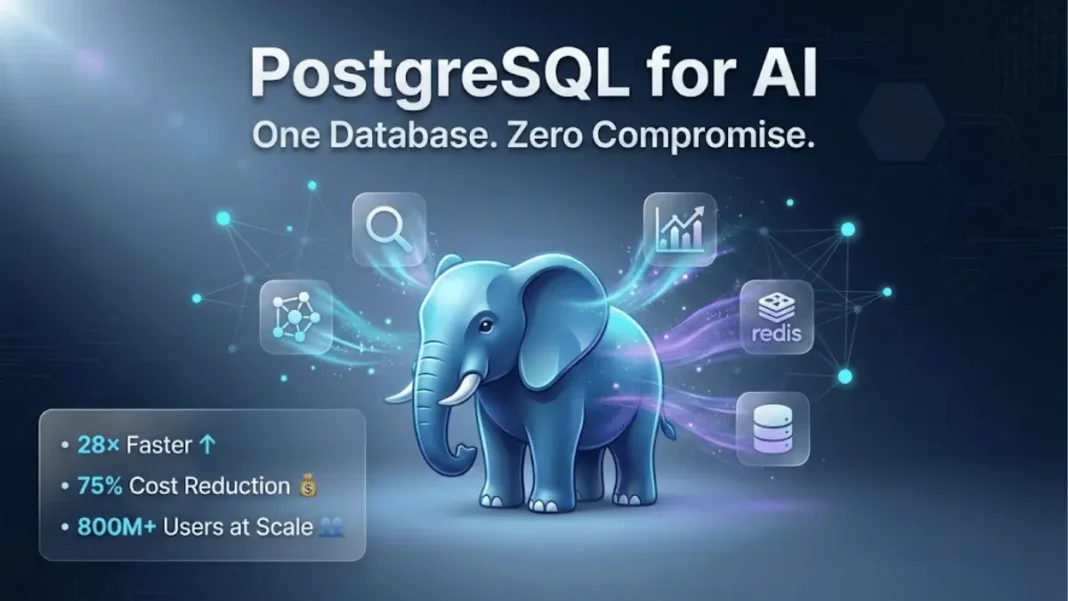
- PostgreSQL with DiskANN indexing delivers 28x lower latency than Pinecone at 75% reduced infrastructure cost
- OpenAI powers 800 million ChatGPT users with PostgreSQL across nearly 50 read replicas
- Extensions like pgvectorscale and pg_bm25 eliminate need for separate vector and search databases
- Production implementations demonstrate PostgreSQL scales to billions of embedding vectors
Developers are consolidating AI application infrastructure around PostgreSQL and the technical evidence validates this shift. Extensions now deliver the functionality of specialized vector databases, full-text search engines, and time-series stores through standard SQL interfaces, eliminating the operational complexity of managing multiple data systems.
This transformation accelerated in 2026 as production deployments demonstrated that properly configured PostgreSQL matches or exceeds the performance of purpose-built AI databases while reducing infrastructure costs by 60-75%. The architecture simplifies development workflows, improves data consistency, and scales to the largest AI workloads in production today.
Why PostgreSQL Became the AI Developer Default
PostgreSQL’s extensibility architecture allows third-party developers to add specialized functionality without modifying the core database. This capability enabled the rapid development of AI-focused extensions that replicate features previously exclusive to commercial vector databases.
The pgvector extension introduced high-dimensional vector storage and similarity search in 2021. By 2024, pgvectorscale extended this foundation with DiskANN indexing a Microsoft Research algorithm that dramatically improved performance for billion-scale vector workloads.
TigerData’s 2026 analysis demonstrates how this extension ecosystem matured to production-grade reliability. Organizations now deploy PostgreSQL for semantic search, recommendation engines, and retrieval-augmented generation without compromising performance.

OpenAI’s PostgreSQL Architecture at ChatGPT Scale
OpenAI disclosed in January 2026 that PostgreSQL powers the backend for 800 million ChatGPT users. The architecture processes millions of queries per second across nearly 50 read replicas while maintaining near-zero replication lag.
The implementation required extensive optimization work. OpenAI’s infrastructure team implemented connection pooling with up to 10,000 concurrent connections per replica, upgraded to the latest PostgreSQL versions for I/O improvements, and leveraged read-only replicas to distribute query load geographically.
This disclosure validates PostgreSQL’s capacity to support the most demanding AI production workloads when architected with proper replication strategy, caching, and workload distribution. The scale OpenAI achieved challenges the assumption that AI applications require specialized databases to handle high-volume vector operations.
7 PostgreSQL Extensions Replacing Specialized Databases
1. pgvectorscale with DiskANN Indexing
Timescale developed pgvectorscale to address performance limitations in the original pgvector extension. The key innovation implements Microsoft Research’s DiskANN algorithm, which compresses vector indexes into graph structures stored on disk rather than memory.
TigerData’s benchmarks measured 28x lower p95 latency and 16x higher query throughput compared to Pinecone at 99% recall rates. The test used 50 million 1536-dimensional vectors representative of OpenAI’s text-embedding-3-large model output.
Infrastructure cost analysis shows 75% reduction when replacing Pinecone with PostgreSQL using pgvectorscale. The savings stem from eliminating separate database subscriptions, data transfer fees between services, and the operational overhead of maintaining multiple database systems.
DiskANN trades exact precision for approximate nearest neighbor search. Applications requiring 100% recall such as regulatory compliance systems should validate whether 99% recall meets requirements before relying on approximate indexing.
2. pg_bm25 for Full-Text Search
The pg_bm25 extension implements Okapi BM25 ranking within PostgreSQL, matching the core functionality that made Elasticsearch the default choice for full-text search. Developers execute keyword searches with relevance scoring using SQL queries rather than maintaining separate search infrastructure.
This extension eliminates the synchronization complexity inherent in dual-database architectures. Changes to source data immediately reflect in search results through PostgreSQL’s transaction guarantees a property external search indexes cannot provide without additional engineering.
ParadeDB maintains pg_bm25 as open-source software with performance optimizations specifically for PostgreSQL’s query planner. The extension integrates with pgvector to enable hybrid search combining keyword matching and semantic similarity.
3. pg_vectorize for Automated Embedding Generation
The pg_vectorize extension automates embedding creation as data changes, eliminating the need for external AI pipelines. Developers configure which text columns should generate embeddings, specify the embedding model, and the extension handles synchronization automatically.
This architecture reduces latency between data updates and AI feature availability. Traditional approaches require extract-transform-load jobs that introduce delays ranging from minutes to hours depending on batch scheduling.
The extension supports multiple embedding providers including OpenAI, Hugging Face, and self-hosted models. Organizations with data residency requirements can route embedding generation through private endpoints while maintaining the convenience of automated synchronization.
4. TimescaleDB for Time-Series AI Data
TimescaleDB extends PostgreSQL with optimizations for time-series workloads common in AI monitoring and observability systems. The extension implements automatic data partitioning, compression, and retention policies that reduce storage requirements by 90%+ for historical metric data.
AI application monitoring generates high-volume time-series data: model inference latencies, embedding generation times, token usage, and error rates. TimescaleDB stores this data efficiently while supporting complex analytical queries that join time-series metrics with operational tables.
The extension maintains full SQL compatibility, allowing developers to query time-series data using standard joins and aggregations rather than learning specialized query languages.
5. PostGIS for Geospatial AI Applications
PostGIS adds geospatial data types and functions to PostgreSQL, supporting location-based AI features without separate GIS databases. The extension handles coordinate transformations, distance calculations, and spatial indexing through SQL commands.
Location-aware AI applications such as delivery route optimization, ride-sharing matching, and real estate recommendations combine geospatial queries with vector similarity search. PostgreSQL with PostGIS and pgvector enables these hybrid queries within single transactions.
The extension has matured over 20 years of development with enterprise-grade reliability. Organizations in logistics, urban planning, and location intelligence rely on PostGIS for production systems processing billions of spatial queries daily.
6. pg_graphql for API Generation
The pg_graphql extension generates GraphQL APIs directly from PostgreSQL schemas, accelerating AI application development. Frontend developers query the database using GraphQL without writing backend API code, while PostgreSQL’s row-level security enforces authorization policies.
This approach reduces the code required to build AI-powered applications. Schema changes automatically reflect in the API without manual controller updates, maintaining consistency between database structure and application interfaces.
Supabase popularized this pattern in their PostgreSQL-based backend platform, demonstrating that generated APIs meet production requirements for most applications.
7. pg_cron for Scheduled AI Workflows
The pg_cron extension enables scheduling of SQL jobs directly within PostgreSQL, replacing external workflow orchestration tools for common AI maintenance tasks. Developers schedule embedding refreshes, model retraining triggers, and data cleanup operations using familiar cron syntax.
This architecture simplifies deployment by reducing dependencies on external schedulers like Airflow or Kubernetes CronJobs for database-centric workflows. The extension executes jobs with the same permissions model as interactive queries, eliminating the security complexity of external tools accessing the database.
PostgreSQL vs Specialized Vector Databases
Performance Comparison: PostgreSQL pgvectorscale vs Pinecone
| Metric | PostgreSQL (DiskANN) | Pinecone |
|---|---|---|
| P95 Latency | 28x lower | Baseline |
| Query Throughput | 16x higher | Baseline |
| Recall Rate | 99% | ~99% |
| Infrastructure Cost | 75% reduction | $0.096/hour pods |
| Memory Requirements | Disk-based | Memory-intensive |
TigerData tested 50 million vectors with 1536 dimensions on equivalent infrastructure: AWS i4i.2xlarge for PostgreSQL versus Pinecone’s standard performance pods. The benchmark measured latency, throughput, and cost over 30-day production simulation.
PostgreSQL achieved superior performance through DiskANN’s graph-based indexing algorithm. The approach stores compressed graph structures on disk, enabling billion-scale vector searches without proportional memory costs.
Pinecone maintains advantages in scenarios requiring single-digit millisecond latencies at extreme scale or where development teams lack database administration expertise. The managed service abstracts infrastructure complexity at the cost of flexibility and economics.
When to Choose PostgreSQL for AI Applications
PostgreSQL fits AI workloads that benefit from transactional consistency, complex joins between operational and AI data, or cost-sensitive architectures. The database excels when applications combine multiple data types: structured records, embeddings, full-text search, and time-series metrics.
Ideal Use Cases:
- Semantic search over structured product catalogs with inventory joins
- Recommendation engines combining user preferences with real-time availability
- RAG systems requiring transactional consistency between source documents and embeddings
- Multi-tenant SaaS applications with row-level security requirements
- Cost-optimized AI features for startups and small teams
When Specialized Databases Make Sense:
- Ultra-low latency requirements (<5ms) at billion-vector scale
- Teams without PostgreSQL expertise preferring managed AI databases
- Applications with extreme vector-only workloads lacking relational data
- Organizations committed to specific vendor ecosystems (AWS, Azure, GCP)
The consolidation trend favors PostgreSQL for most AI applications built in 2026, but technical requirements and team capabilities should drive architecture decisions rather than industry momentum.
Real-World Migration: From Multi-Database to PostgreSQL
TigerData documented a representative migration from a five-database architecture to consolidated PostgreSQL. The original system used PostgreSQL for operational data, Pinecone for vectors, Elasticsearch for search, Redis for caching, and TimescaleDB for metrics.
The consolidated architecture replaced Pinecone with pgvectorscale, Elasticsearch with pg_bm25, and TimescaleDB with the TimescaleDB extension. Redis caching remained for session management but eliminated the need for database query caching through PostgreSQL performance tuning.
Migration Results:
- Infrastructure costs decreased 68% (from $8,400 to $2,700 monthly)
- Query latency improved 35% through elimination of inter-service network calls
- Development velocity increased through unified SQL interface
- Operational complexity reduced from five systems to two (PostgreSQL + Redis)
The migration required eight weeks including testing and cutover planning. Database schema changes were minimal since the core operational data remained in PostgreSQL.
Implementation Guide: PostgreSQL AI Setup
Step 1: Install Core Extensions
CREATE EXTENSION vector;
CREATE EXTENSION vectorscale;
CREATE EXTENSION pg_bm25;
These three extensions provide vector similarity search, DiskANN indexing, and full-text search capabilities.
Step 2: Create Embedding Table with DiskANN Index
CREATE TABLE documents (
  id BIGSERIAL PRIMARY KEY,
  content TEXT,
  metadata JSONB,
  embedding VECTOR(1536)
);

CREATE INDEX ON documents
USING diskann (embedding vector_cosine_ops);
The diskann index type activates pgvectorscale’s optimized indexing. Cosine distance works well for normalized embeddings from OpenAI and similar providers.
Step 3: Configure Full-Text Search
ALTER TABLE documents
ADD COLUMN search_vector tsvector
GENERATED ALWAYS AS (to_tsvector('english', content)) STORED;

CREATE INDEX ON documents USING GIN(search_vector);
This setup enables hybrid search combining keyword matching and semantic similarity.
Step 4: Optimize Configuration
PostgreSQL requires tuning for high-dimensional vector workloads. Key parameters include shared_buffers (25% of RAM), effective_cache_size (75% of RAM), and max_parallel_workers (CPU core count).
OpenAI’s infrastructure team documented additional optimizations: connection pooling to prevent connection exhaustion, query statement timeouts to prevent runaway queries, and read-only replicas for geographical distribution.
Cloud-Managed vs Self-Hosted PostgreSQL
Managed PostgreSQL Services:
- AWS RDS/Aurora: Tight integration with Lambda, Redshift, SageMaker
- Azure Database for PostgreSQL: Microsoft ecosystem integration
- Google Cloud SQL: GCP service interoperability
- Supabase: Open-source platform with instant APIs and authentication
Managed services handle backups, high availability, and security updates at the cost of reduced configuration flexibility and vendor lock-in.
Self-Hosted PostgreSQL:
Organizations self-host for maximum control, cost optimization beyond certain scales, or specific compliance requirements. The approach shifts operational burden to internal teams but enables custom configurations unsupported by managed services.
TigerData provides managed PostgreSQL optimized for AI workloads with pgvectorscale pre-installed. This middle ground offers specialized configuration with reduced operational overhead compared to fully self-managed deployments.
PostgreSQL Limitations for AI Applications
Memory Constraints:
PostgreSQL processes queries in memory, limiting the size of result sets and intermediate calculations. Queries returning millions of embedding vectors can exhaust available memory, requiring pagination or result streaming patterns.
Connection Overhead:
Each PostgreSQL connection consumes significant memory (5-10MB). Applications with thousands of concurrent users require connection pooling to prevent resource exhaustion. This adds architectural complexity compared to databases designed for connection-heavy workloads.
Write Scalability:
PostgreSQL scales reads through replication but write operations ultimately bottleneck at the primary server. Applications with extreme write volumes may require sharding or alternative architectures.
OpenAI addressed this limitation through careful read/write separation and caching strategies. The architecture routes read-heavy queries to replicas while batching write operations to reduce load on the primary database.
Extension Maturity:
AI-focused extensions like pgvectorscale launched recently compared to PostgreSQL’s 30-year history. While production-ready, these extensions lack the battle-tested reliability of core PostgreSQL features. Organizations should conduct thorough testing before production deployment.
Frequently Asked Questions (FAQs)
What is the infrastructure cost difference between PostgreSQL and Pinecone?
TigerData’s analysis shows 75% cost reduction when replacing Pinecone with PostgreSQL using pgvectorscale extensions. The benchmark compared AWS i4i.2xlarge instances running PostgreSQL against Pinecone’s standard performance pods for 50 million 1536-dimensional vectors. The savings stem from eliminating separate vector database subscriptions, inter-service data transfer fees, and maintenance overhead from managing multiple database systems.
Can PostgreSQL handle production AI applications at scale?
OpenAI powers 800 million ChatGPT users with PostgreSQL, processing millions of queries per second across nearly 50 read replicas while maintaining near-zero replication lag. This production deployment validates that PostgreSQL scales to the largest AI workloads when architected with proper replication strategy, connection pooling, and query optimization. Organizations should implement read-only replicas, connection pooling, and query statement timeouts as OpenAI documented in their infrastructure disclosure.
How does DiskANN improve PostgreSQL vector search performance?
DiskANN implements graph-based indexing that stores compressed vector representations on disk rather than memory. This approach enables billion-scale vector searches without proportional memory costs while achieving 28x lower p95 latency than standard HNSW indexing used in Pinecone. The algorithm trades exact precision for approximate nearest neighbor search at 99% recall, making it suitable for most AI applications where perfect recall is not mandatory.
Which PostgreSQL extensions are essential for AI applications?
The core extensions are pgvector for vector storage, pgvectorscale for DiskANN indexing, and pg_bm25 for full-text search. These three extensions provide the foundation for semantic search, recommendation engines, and RAG applications. Additional extensions like pg_vectorize automate embedding generation, TimescaleDB optimizes time-series metrics, and PostGIS enables location-based AI features. Organizations should evaluate their specific requirements rather than installing all available extensions.
Should startups use PostgreSQL or specialized vector databases?
PostgreSQL offers 60-80% cost reduction and architectural simplicity advantages for startups with limited budgets and small teams. The unified database eliminates operational overhead from managing multiple systems while maintaining sufficient performance for early-stage applications. Specialized vector databases make sense when startups have specific ultra-low latency requirements, lack PostgreSQL expertise, or secure venture funding where managed service costs are not constraints. Most startups will benefit from PostgreSQL’s economics and simplicity in 2026.

