

Quick Brief
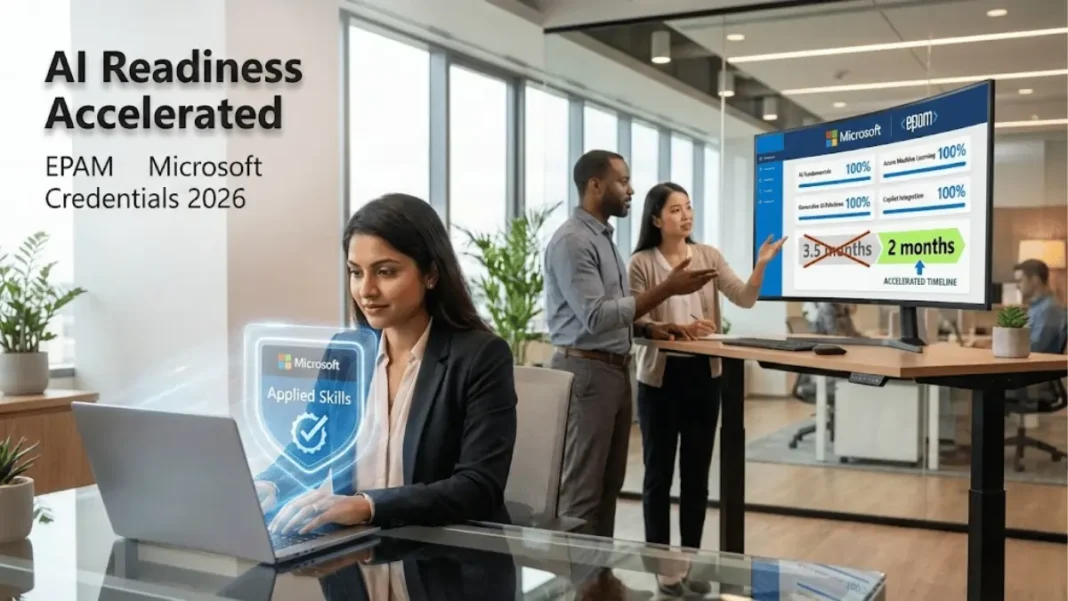
- EPAM reduces employee onboarding time from 3.5 months to 2 months using Microsoft Credentials
- Microsoft Applied Skills validates technical expertise and real-world AI proficiency faster than traditional training
- Program expands beyond technical roles to business professionals and leaders in 2026
- Engineers with Applied Skills require less time to prove project readiness and retain knowledge better
EPAM Systems has cracked the code on rapid AI workforce transformation. The global digital engineering leader now onboards engineers in two months instead of three and a half a 43% reduction by integrating Microsoft Credentials into its training infrastructure. This shift addresses a critical challenge: 85% of employers plan to prioritize workforce upskilling by 2030, yet 92 million existing roles face displacement due to automation and AI. EPAM’s verified credential approach proves scalable AI readiness is achievable today, not years from now.
Why Traditional AI Training Fails to Deliver Speed
Most enterprise AI training programs collapse under their own weight. Organizations invest months in learning paths without validating whether employees can apply skills to actual projects. The World Economic Forum’s Future of Jobs Report 2025 reveals that 39% of existing skill sets will become outdated between 2025 and 2030. BCG’s 2026 analysis shows future-built companies plan to upskill over 50% of employees on AI, compared to just 20% for laggards.
EPAM recognized this gap early. “Employees with Applied Skills are better prepared for delivery-focused work and onboard faster into projects,” explains Yuliya Basalai, Associate Manager of Talent Management at EPAM. She adds that credentialed employees “require less time to prove they’re ready” compared to those without certifications. The difference lies in verification credentials prove competency before engineers touch client work, eliminating guesswork for managers.
 KB5075941: Microsoft’s February 2026 Update Addresses 58 Security Vulnerabilities in Windows 11
How Microsoft Credentials Accelerate Project Readiness
EPAM combines Microsoft Certifications with Microsoft Applied Skills to create a dual-validation system. Certifications establish foundational knowledge across Azure AI, Microsoft 365 Copilot, and cloud security. Applied Skills demonstrate hands-on proficiency through real-world scenario assessments.
The streamlined format of new Applied Skills Credentials launched in 2025-2026 fits naturally into work schedules, allowing employees to apply new competencies immediately. Microsoft’s portfolio now includes credentials for business professionals, team leaders, and early-career talent extending beyond technical roles.
Alexander Lipkin, Director of Technology Solutions at EPAM, notes that “Microsoft’s Applied Skills for business professionals supports our non-technical teams by improving productivity, enhancing innovation and helping advance the use of AI in real business applications“.
What makes Microsoft Applied Skills different from certifications?
Applied Skills focus on task-based validation through interactive assessments in live Microsoft environments. Certifications test broad conceptual knowledge. EPAM uses both: certifications establish baseline understanding while Applied Skills prove engineers can execute specific workflows.
Tangible Business Outcomes Beyond Faster Onboarding
The 3.5-month to 2-month reduction translates to concrete operational gains. Managers previously spending substantial time coaching new engineers on basics now redirect that capacity to strategic client work. Knowledge retention improves because Applied Skills assessments require demonstration, not memorization.
For organizations, verified credentials create consistent team-building standards. EPAM scales talent deployment globally by matching client requirements to employees holding specific Applied Skills. This approach reduces project risk clients receive engineers who’ve already proven technical readiness in controlled environments.
The business impact extends across industries. According to a 2024 Workera survey, 63% of employers identify skills gaps as the primary barrier to AI adoption. Microsoft’s 2026 expansion into business-focused credentials addresses non-technical teams who need AI literacy without engineering depth.
Microsoft AI Challenge Accelerates Adoption in Early 2026
Microsoft launched its Credentials AI Challenge from January 20 to March 2, 2026, offering three free Applied Skills credentials. The challenge includes learning paths specifically designed for business professionals:
- Streamline business workflows with AI chat
- Generate reports with AI research agents
- Create agents in Microsoft Copilot Studio
Participants who complete credentials by March 2, 2026 become eligible for the AI Challenge Sweepstakes with prizes including Surface devices and Xbox consoles. The initiative democratizes access to enterprise-grade AI training beyond large organizations like EPAM.
The challenge prepares participants for new Microsoft certification exams including AI Transformation Leader (Exam AB-731) and AI Business Professional (Exam AB-730). This structured approach ensures business leaders can speak the same AI language as technical teams, reducing friction in strategy execution.
Business Transformation Requires Workforce Transformation
BCG’s research confirms that companies with structured AI-learning programs and protected time for employees to learn are four times more likely to succeed in AI transformation. EPAM’s approach ensures systematic skill validation rather than hoping employees absorb knowledge through osmosis.
The stakes are substantial. While 92 million existing roles face displacement by 2030, the same WEF report projects 170 million new jobs will be created resulting in a net gain of 78 million jobs globally. Organizations that proactively credential their workforce position themselves to capture these emerging opportunities rather than react to disruption.
EPAM’s model demonstrates that learning should be a core business function, not an HR afterthought. The company invests in credentials as strategic infrastructure, similar to how it invests in development tools or cloud platforms. This mindset shift separates companies that successfully scale AI from those stuck in perpetual pilot mode.
Overcoming Implementation Challenges
Not every organization can replicate EPAM’s results immediately. Three constraints commonly surface:
- Budget allocation – Microsoft Credentials require licensing costs and dedicated learning time
- Manager buy-in – Some teams resist structured certification requirements
- Assessment anxiety – Employees fear credential tests will expose skill gaps publicly
EPAM addresses these through transparent communication about career advancement tied to credentials and by offering retake options without penalty. Organizations should assess AI readiness across multiple pillars business strategy, governance, data foundations, infrastructure, and culture before launching credential programs.
The key is starting small with pilot teams, measuring outcomes like onboarding time and project readiness, then scaling based on verified results. EPAM’s success proves that incremental, measurement-driven credential adoption outperforms organization-wide mandates without clear ROI tracking.
What This Means for Enterprise AI Strategy in 2026
EPAM’s 50% onboarding reduction reveals a broader truth: AI transformation is fundamentally workforce transformation. Technology adoption without skill validation creates expensive pilot programs that fail to scale. Microsoft’s credential ecosystem provides the verification layer enterprises need to move from experimentation to production.
Organizations pursuing similar outcomes should start with role-based credential mapping. Identify which Applied Skills align to current project pipelines, then create learning paths with time protection for completion. EPAM’s success demonstrates that structured, verified AI training delivers measurable business impact faster than ad-hoc approaches.
The competitive advantage in 2026 belongs to companies that treat employee credentials as strategic assets. As Microsoft continues expanding its portfolio for business professionals and leaders, the gap between credential-forward and credential-resistant organizations will widen measurably.
Frequently Asked Questions (FAQs)
How long does it take to earn Microsoft Applied Skills credentials?
Most Microsoft Applied Skills credentials require 4-8 hours to complete, including interactive assessments in live Microsoft environments. The streamlined format launched in 2025-2026 allows completion within 1-2 weeks while maintaining work schedules.
What credentials are available through the Microsoft AI Challenge?
The Microsoft Credentials AI Challenge running from January 20 to March 2, 2026 offers three free Applied Skills: Streamline business workflows with AI chat, Generate reports with AI research agents, and Create agents in Microsoft Copilot Studio.
Can non-technical employees earn AI credentials?
Yes. Microsoft introduced business-focused credentials in 2025-2026 for leaders, business professionals, and early-career talent. These credentials require no coding experience and focus on productivity tools like Microsoft 365 Copilot and AI chat workflows.
How does EPAM measure ROI on credential programs?
EPAM tracks onboarding time reduction (now 2 months versus 3.5 months previously) and evaluates how quickly credentialed employees become ready for client delivery work compared to non-credentialed peers.
Why are 92 million jobs at risk from AI by 2030?
The World Economic Forum’s Future of Jobs Report 2025 projects 92 million existing roles will face displacement due to automation and AI adoption. However, 170 million new jobs will be created simultaneously, resulting in a net gain of 78 million jobs globally.
What percentage of companies plan to upskill employees on AI?
BCG’s 2026 research shows future-built companies plan to upskill more than 50% of employees on AI, while lagging organizations target only 20%. Companies with structured AI-learning programs are four times more likely to succeed in AI transformation.
Do Microsoft Certifications expire and require renewal?
Role-based Microsoft Certifications remain valid for one year and require renewal through continuing education or reassessment. Fundamentals certifications do not expire. Applied Skills credentials demonstrate current proficiency and update as Microsoft technologies evolve.

