

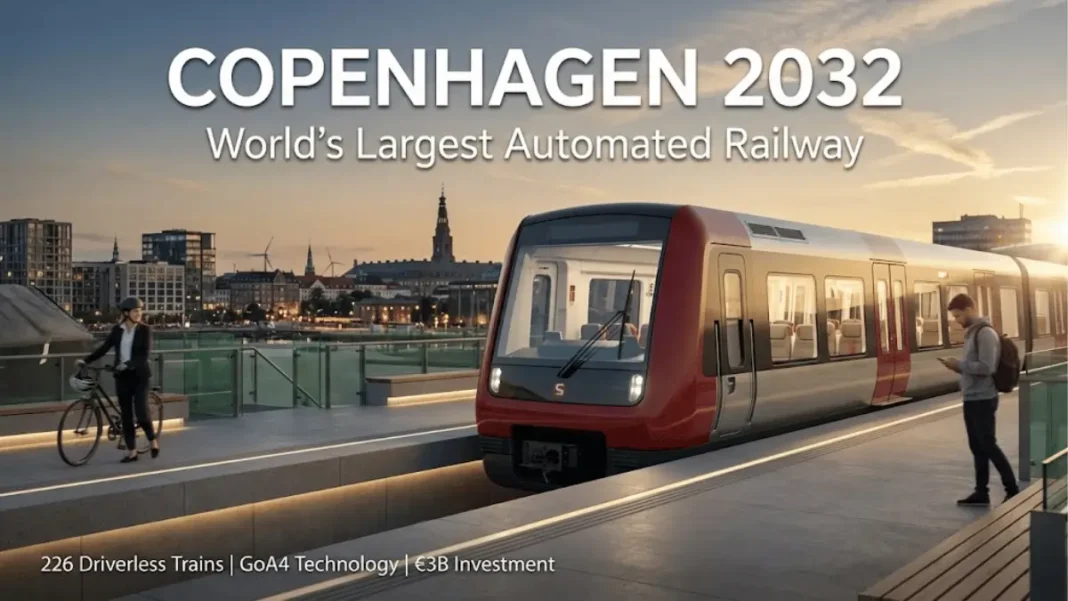
Quick Brief
- DSB signs €3 billion contract for 226 fully automated trainsets with Siemens-Stadler consortium
- World’s largest open railway system operating at GoA4 automation launches 2032
- Service frequency increases 35% with trains running every 90 seconds in peak hours
- 30-year maintenance agreement includes Railigent X digital monitoring and Air-free Brake System
Denmark has committed €3 billion to transform Copenhagen’s 90-year-old S-Bane network into the world’s largest fully automated open railway system. The Danish State Railways (DSB) signed a framework contract with Siemens Mobility and Stadler on February 6, 2026, for 226 driverless four-car trainsets, with options for 100 additional units. This marks the largest infrastructure investment in S-Bane history and positions Copenhagen at the forefront of Grade of Automation 4 (GoA4) technology deployment.
What Makes This Railway Project Unprecedented
The Copenhagen S-Bane automation surpasses existing GoA4 systems like Sydney Metro and Paris Line 14 in scale and complexity. Unlike closed metro systems, Copenhagen’s 170-kilometer network operates as an open railway with multiple interconnecting lines serving 111 million annual passengers. Siemens Mobility leads the consortium, providing electrical equipment, propulsion systems, braking technology, and vehicle control systems, while Stadler handles carbody construction, interior fittings, and final assembly.
The contract value reaches approximately three billion euros, making it one of Europe’s largest single rail procurement deals in 2026. DSB CEO Flemming Jensen stated this investment future-proofs the capital’s public transport backbone as demand continues growing beyond 2025’s 111 million passenger journeys.

GoA4 Automation: Technical Foundation
GoA4 represents the highest automation grade, transferring all operational responsibility from human drivers to integrated train control systems. Siemens Mobility deploys its Trainguard MT Communications-Based Train Control (CBTC) solution across the entire 170-kilometer network. The migration occurs in five phases beginning 2030, with full driverless operations targeted by 2033.
How does GoA4 differ from driver-assisted systems?
GoA4 systems operate completely unattended without onboard personnel for train operation. The Trainguard MT platform manages train positioning, speed control, door operations, and emergency protocols autonomously. Siemens announced the Copenhagen signaling upgrade contracts in 2024, covering trainborne and wayside technology for all 226 new trainsets.
Capacity and Frequency Transformation
The automated system enables unprecedented service density in Copenhagen’s city center. During peak hours, trains will run with maximum 7.5-minute intervals on each line and as little as 90 seconds between consecutive trains in central Copenhagen. This represents up to 35 percent more departures on several routes compared to 2026 operations.
DSB projects the enhanced frequency will accommodate approximately 10 million additional journeys annually. The capacity increase addresses projected ridership growth following 2025’s baseline of 111 million S-Bane passengers. First automated services launched on the Copenhagen-Hellerup section in 2032, with network-wide deployment completing by 2040.
Train Design and Passenger Experience
Each 56-meter trainset accommodates 120 fixed seats, 36 folding seats, and approximately 300 standing passengers. Stadler’s design maintains DSB’s iconic visual identity while incorporating modern features like panoramic front windows and barrier-free access. Ground-level entrances with sliding steps provide step-free boarding for wheelchairs, bicycles, and prams.
Interior innovations include:
- 2+2 seating configurations with workspace tables for commuters
- Integrated wheelchair spaces in flexible multi-purpose areas
- Air conditioning throughout all carriages
- Wide aisles and spacious entrance zones for rush-hour passenger flow
- Modern digital passenger information displays
Ansgar Brockmeyer, Stadler’s Deputy Group CEO, emphasized the vehicles continue Copenhagen’s S-train design tradition while delivering comfort that rivals long-distance rail services.
Air-Free Brake System: Sustainability Breakthrough
Siemens Mobility’s Air-free Brake System replaces conventional pneumatic braking components, reducing weight and cutting CO₂ footprint by over 50 percent. The system eliminates complex air compressors and associated energy consumption while maintaining precision braking performance. Combined with state-of-the-art propulsion technology, the innovation delivers substantial operational savings across the fleet’s projected 30-year lifespan.
What environmental impact does the Air-free Brake System deliver?
The Air-free Brake System achieves a 50% reduction in CO₂ footprint through weight reduction and elimination of pneumatic system energy consumption. Siemens reports the technology sets new standards for operational performance in urban rail applications. Copenhagen’s fleet will be among the first large-scale deployments of this braking innovation.
30-Year Maintenance Agreement with Railigent X
Siemens Mobility signed a Technical Support & Spares Supply Agreement Plus (TSSSA+) guaranteeing fleet availability for minimum 30 years, with options for two five-year extensions. The consortium maintains overall responsibility while DSB employees execute daily maintenance work.
Digital monitoring centers on Railigent X, Siemens’ predictive maintenance platform that analyzes real-time train data to optimize maintenance scheduling. The system integrates CORMAP optimization tools and FRACAS/RAM reliability reporting to maximize fleet availability. Michael Peter, Siemens Mobility CEO, stated the agreement delivers intelligent mobility solutions beyond basic rolling stock supply.
Implementation Timeline and Phased Rollout
| Phase | Year | Milestone |
|---|---|---|
| Signaling upgrade begins | 2030 | First automated operations on test section |
| Initial service | 2032 | First trainsets enter Copenhagen-Hellerup route |
| Network automation complete | 2033 | Full GoA4 operations across 170km network |
| Fleet delivery complete | 2040 | All 226 trainsets operational |
Siemens Mobility builds on existing Copenhagen infrastructure work, having previously increased S-Bane capacity and reliability through earlier modernization projects with Banedanmark and DSB.
Strategic Importance for Stakeholders
The contract strengthens Stadler’s Northern European presence and demonstrates the manufacturer’s capability in large-scale automated railway systems. For Siemens Mobility, the project showcases end-to-end solutions combining rolling stock, signaling, and long-term digital maintenance services.
DSB positions the S-Bane as Copenhagen’s transport network backbone capable of absorbing projected population growth in Denmark’s capital region. The 90-year-old network’s transformation enables Denmark to maintain competitive public transport against private vehicle usage and support sustainability commitments.
Limitations and Considerations
The 2032 launch date represents a six-year implementation window that depends on successful signaling migration and staff training for remote monitoring operations. GoA4 systems require comprehensive safety protocols since no onboard personnel can respond to emergencies, necessitating remote control capabilities and modified emergency response procedures.
The €3 billion investment excludes ongoing operational costs beyond the 30-year maintenance agreement, and DSB must fund infrastructure modifications for full automation compatibility. Passenger acceptance of driverless operations remains untested in Denmark’s cultural context, though similar systems in Sydney and Paris demonstrate public adaptability.

Frequently Asked Questions (FAQs)
When will Copenhagen’s automated trains begin service?
The first fully automated trains will enter service in 2032 on the Copenhagen-Hellerup section. DSB will continuously deliver all 226 trainsets through 2040, with complete network automation targeted by 2033.
How many passengers can each automated train carry?
Each 56-meter trainset accommodates 456 total passengers: 120 fixed seats, 36 folding seats, and approximately 300 standing spaces. This capacity supports Copenhagen’s busy S-Bane service during peak hours.
What is GoA4 automation technology?
GoA4 (Grade of Automation 4) represents fully driverless train operation without onboard personnel. The train control system manages all operations including speed, positioning, doors, and emergencies through Siemens’ Trainguard MT CBTC platform.
Who manufactures the Copenhagen automated trains?
Siemens Mobility and Stadler formed a consortium to deliver the trains. Siemens provides electrical systems, propulsion, braking, and vehicle control, while Stadler supplies carbodies, interiors, and handles final assembly.
How much does the Copenhagen S-Bane automation project cost?
The framework contract with Siemens-Stadler consortium totals approximately €3 billion for 226 trainsets, with options for 100 additional units. This includes a 30-year maintenance agreement with Railigent X digital monitoring.
Will automated trains increase Copenhagen S-Bane capacity?
Yes. Automation enables up to 35% more departures on several routes, with trains running every 90 seconds in central Copenhagen during peak hours. DSB projects capacity for 10 million additional annual journeys.
What makes Copenhagen’s automated railway the world’s largest?
Copenhagen’s 170-kilometer S-Bane network will become the world’s largest open railway system operating at GoA4 automation, surpassing closed metro systems like Sydney Metro and Paris Line 14 in scale and complexity.

