

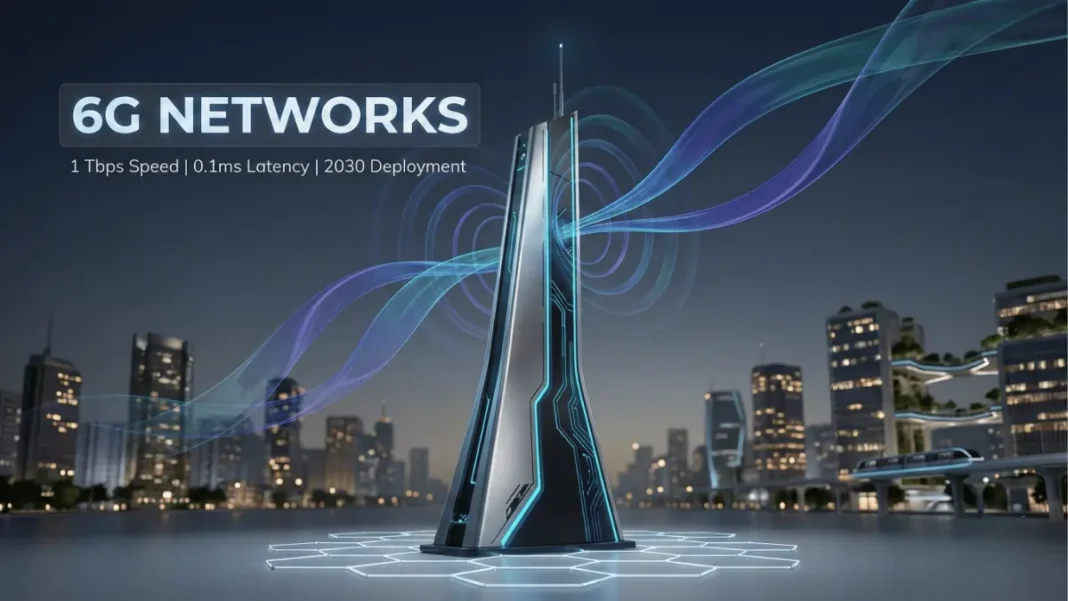
Key Takeaways
- 6G achieves peak data rates of 1 terabit per second 50 times faster than 5G’s 20 Gbps
- Operating with 0.1 millisecond latency and connection density of 10 million devices per square kilometer
- Commercial rollout targeted for 2030 with 3GPP specifications finalized in Release 21 by 2028
- India’s Bharat 6G Vision targets 2030 deployment with indigenous technology development
The telecommunications industry stands at the threshold of its most transformative leap yet. 6G networks represent not merely an incremental upgrade but a fundamental reimagining of wireless connectivity integrating artificial intelligence at the network core, operating in previously untapped terahertz frequencies, and enabling applications that blur the boundary between physical and digital realities. While 5G deployment continues globally, researchers and standardization bodies have already charted the roadmap for sixth-generation wireless technology.
What Defines 6G Technology
6G refers to the sixth generation of cellular networks, succeeding 5G with capabilities designed for the 2030s digital landscape. Unlike previous generations that focused primarily on speed improvements, 6G introduces a paradigm shift toward cognitive, self-aware networks that combine communication with sensing, computing, and intelligence.
The 3GPP established its official 6G development timeline with technical performance requirements to be finalized by 2026. Complete specifications will appear in Release 21 by the end of 2028, with the first batch of commercial systems expected to deploy in 2030. This timeline aligns with global coordination efforts to ensure interoperability across manufacturers and regions.
What makes 6G networks revolutionary for connectivity?
6G networks achieve peak data rates of 1 terabit per second approximately 50 times faster than 5G’s peak 20 Gbps performance. This extraordinary bandwidth enables simultaneous transmission across multiple gigahertz channels while maintaining latency of just 0.1 milliseconds for ultra-responsive applications like autonomous vehicle coordination and remote surgery.

Technical Specifications That Matter
Speed and Data Throughput
6G targets peak speeds of 1 Tbps (1000 Gbps) under optimal conditions, representing nearly 50 times the improvement over current 5G networks. This performance leap enables data-intensive applications like holographic telepresence and massive digital twin simulations.
Laboratory demonstrations have already achieved wireless transmission speeds of 938 Gbps using terahertz spectrum technology, proving the viability of near-terabit performance in real-world implementations. These breakthroughs validate the technical foundation for 6G’s ambitious speed targets.
Frequency Spectrum Architecture
6G operates across three distinct spectrum layers designed for specific use cases:
Upper-Mid Bands (6-8 GHz / FR3): The 3GPP decided in December 2024 that a channel bandwidth of 200 MHz should be considered for 6G, with a carrier frequency of 7 GHz as the pragmatic assumption for this bandwidth. This FR3 frequency range (7.125-24.25 GHz) provides enhanced coverage for macro deployments.
Sub-Terahertz (90-300 GHz): Serves as capacity layer with candidate windows including W-band (92-114 GHz), D-band (130-175 GHz), and higher bands around 220-260 GHz.
Terahertz Range (300 GHz-10 THz): Delivers unprecedented data rates for short-range, high-capacity scenarios in dense urban environments and specialized indoor applications.
Latency and Reliability
6G achieves air latency of 0.1 milliseconds (100 microseconds) 10 times faster than 5G’s one-millisecond target. This microsecond-level responsiveness enables precision-critical applications including:
- Autonomous robotics requiring real-time sensor fusion
- Telesurgery with haptic feedback synchronization
- Industrial automation with deterministic networking
- High-frequency financial trading systems
Enhanced Ultra-Reliable Low-Latency Communication (URLLC) services introduced in 5G receive substantial improvements through 6G’s higher speeds, greater network penetration, and more stable performance characteristics.
6G vs 5G: Understanding Core Differences
| Specification | 5G Networks | 6G Networks |
|---|---|---|
| Peak Speed | 20 Gbps | 1 Tbps (50x faster) |
| Latency | 1-5 milliseconds | 0.1 millisecond |
| Frequency Range | Up to 100 GHz | 7 GHz to 10 THz |
| Device Density | 1 million devices/km² | 10 million devices/km² |
| Network Architecture | Enhanced mobile broadband | AI-native, self-optimizing |
| Commercial Availability | 2019 (deployed) | 2030 (planned) |
5G primarily uses sub-6 GHz and millimeter-wave frequencies up to 100 GHz, requiring line-of-sight for optimal performance. 6G’s expansion into sub-terahertz and terahertz ranges dramatically increases available bandwidth while introducing new challenges for signal propagation and hardware design.
The integration of artificial intelligence represents 6G’s most significant architectural departure from 5G. While 5G networks utilize AI for optimization, 6G embeds machine learning at the core network layer, enabling autonomous bandwidth allocation, predictive maintenance, and context-aware service delivery without human intervention.
Revolutionary Use Cases and Applications
Autonomous Mobility and Smart Infrastructure
6G enables mass deployment of autonomous vehicles, drones, and robotics through ubiquitous coverage and deterministic reliability. Fleets communicate directly with each other and infrastructure in real-time without centralized control, using advanced sensor fusion powered by AI orchestration.
The technology supports smart transport systems with real-time position tracking, environmental awareness, and coordination across road and airspace users. This includes aerial vehicle management, intelligent traffic flow optimization, and predictive collision avoidance systems operating with microsecond precision.
Extended Reality and Ambient Intelligence
6G delivers true spatial computing where ambient intelligence infuses every physical environment. XR headsets, smart glasses, and wearable interfaces seamlessly blend data, objects, and experiences across retail, healthcare, education, and entertainment sectors.
The networks support mixed reality with immersive shared experiences, enabling real-time holographic telepresence and wide-area mass-market augmented reality applications. Context-aware data slicing and location-based services operate through energy-efficient edge devices that adapt to user movement and environmental conditions.
Industrial Automation and Digital Twins
Manufacturing facilities, supply chains, and energy grids adopt real-time digital twin technology powered by 6G sensors and AI analytics. These systems optimize processes, detect anomalies, and forecast disruptions with massive machine-type communications supporting billions of connected endpoints.
Private 6G networks enable critical infrastructure to operate securely and autonomously with ultra-precise positioning accuracy measured in centimeters rather than meters. Industrial robotics coordinate complex assembly operations through low-latency communication that synchronizes movements across distributed workstations.
Environmental Sensing and Global Connectivity
6G networks incorporate advanced sensing capabilities for monitoring climate patterns, pollution levels, and natural disasters at planetary scale. Integration with non-terrestrial networks including low-Earth orbit satellites ensures connectivity in remote regions and maritime environments.
The technology delivers global internet access leveraging macro cells, long-range base station towers, and satellite constellations with optimized spectrum sharing. This universal coverage model addresses the digital divide while supporting environmental stewardship through real-time planetary monitoring systems.
Key Features Enabling 6G Performance
AI-Native Network Architecture
6G marks the first generation built with artificial intelligence integrated at the foundational level rather than added as an optimization layer. Networks automatically adjust bandwidth allocation, predict potential outages, and personalize user experiences in real-time through distributed machine learning models.
Edge intelligence moves processing from centralized cloud infrastructure to distributed nodes, enabling autonomous orchestration and adaptive services tailored to user context. AI processors embedded in network hardware and end devices facilitate real-time distributed decision-making without backhaul latency.
Energy Efficiency and Sustainability
6G developers prioritize energy-efficient operation across expanded frequency ranges through intelligent power management and green radio technologies. The networks reduce energy consumption per bit transmitted, making large-scale connectivity economically viable and environmentally sustainable.
Virtualization of physical layer (PHY) and medium access control (MAC) functions reduces specialized hardware requirements, lowering deployment costs for dense urban networks. Features like spectrum sharing and micro sleep modes optimize power usage when traffic demand fluctuates.
Massive Device Connectivity
6G supports up to 10 million connected devices per square kilometer, a tenfold increase over 5G’s 1 million device capacity. This density enables Internet of Things deployments in smart cities, industrial zones, and agricultural monitoring systems where sensor networks collect continuous environmental data.
The progression shows dramatic improvement across generations: 4G supported 0.1 million devices per km², 5G expanded to 1 million, and 6G will handle 10 million devices per km². This exponential growth accommodates the proliferation of connected sensors, wearables, and smart infrastructure.
Quantum-Safe Security
With quantum computers on the horizon threatening current encryption methods, 6G platforms feature quantum-safe encryption and multi-layered security protocols. Network providers partner with cybersecurity firms to ensure privacy and data integrity for billions of devices connecting people, machines, and environments.
End-to-end security features protect critical infrastructure, financial transactions, and sensitive communications against both classical and quantum-based attacks. Authentication mechanisms verify device identity and user credentials through distributed ledger technologies and biometric validation.
Global Development and Deployment Timeline
International Standardization Roadmap
The 3GPP coordinates global 6G standardization with a clear timeline established for development milestones. Technical performance requirements reach finalization by 2026, followed by complete specifications in Release 21 by the end of 2028.
The first batch of 6G commercial systems is expected to be deployed in 2030, with initial commercial products available in the market by that year. This timeline allows manufacturers sufficient development cycles for compatible devices and infrastructure equipment.
India’s 6G Vision and Strategy
India launched the Bharat 6G Vision Document in March 2023 to position the nation as a global leader in sixth-generation technology. The vision emphasizes affordability, sustainability, and ubiquitous connectivity while integrating cutting-edge innovations including AI, terahertz spectrum, and satellite-based networks.
India is preparing for the rollout of 6G technology by 2030, aiming to establish the country as a global leader in telecommunications innovation. The government has established the Bharat 6G Alliance to coordinate research, development, and standardization efforts across academic institutions, industry partners, and government agencies.
India’s 6G development timeline progresses through distinct phases:
2023: Bharat 6G Vision released with strategic objectives
2023-2027: Research and development, testbed establishment, indigenous technology development
2028-2029: Large-scale trials, pilot programs, international collaboration partnerships
2030: Commercial rollout aligned with IMT-2030 international standards
The initiative builds on India’s successful 5G deployment in 2022, accelerating toward next-generation leadership in telecommunications technology.
Regional Development Initiatives
Multiple countries have initiated 6G research programs and experimental testbeds to validate technologies before standardization completes. These early development efforts focus on proving technical concepts, testing hardware prototypes, and evaluating use case feasibility.
Research institutions and technology companies worldwide collaborate on 6G development through consortiums and standards bodies to ensure global interoperability. This coordination prevents fragmentation and accelerates the path to commercial deployment.
Technical Challenges and Limitations
Spectrum Availability and Regulation
Higher frequency bands like terahertz remain largely allocated for non-commercial purposes including defense and scientific research. Making sufficient bandwidth available for 6G requires regulatory coordination across international bodies and potential spectrum reallocation from existing users.
Terahertz propagation characteristics limit effective range, requiring dense infrastructure deployment in urban areas. Indoor penetration suffers compared to lower frequencies, necessitating hybrid network architectures that combine multiple spectrum bands.
Hardware and Infrastructure Requirements
Operating at terahertz frequencies demands entirely new radio hardware, antennas, and signal processing components. Manufacturing challenges include heat dissipation, power efficiency, and miniaturization for consumer devices.
Network densification requires significantly more base stations than 5G deployments, increasing capital expenditure and operational complexity. Fiber backhaul must support terabit-per-second aggregation from multiple cell sites.
Cost and Economic Viability
Infrastructure investment for 6G networks will substantially exceed 5G deployment costs due to higher site density and specialized equipment requirements. Operators face challenges justifying return on investment given 5G networks remain underutilized in many markets.
Consumer willingness to pay premium pricing for 6G services remains uncertain, particularly in price-sensitive markets like India where affordability drives adoption. Business models must demonstrate clear value propositions beyond raw speed improvements.
Preparing for 6G Adoption
For Businesses and Enterprises
Organizations should assess which use cases genuinely require 6G capabilities versus those adequately served by existing 5G infrastructure. Early adoption makes sense for industries like autonomous logistics, industrial automation, and immersive entertainment where latency and bandwidth directly impact competitive advantage.
Private 6G networks offer enterprises dedicated spectrum, enhanced security, and customized performance for mission-critical applications. Planning should begin 2-3 years before commercial availability to align technology roadmaps with business objectives.
For Consumers and End Users
6G services will emerge gradually starting around 2030, with initial deployments targeting specific use cases before expanding to mass-market offerings. Most consumers can continue using 5G devices through the late 2020s without experiencing significant limitations for typical smartphone tasks.
Applications worth monitoring include cloud gaming, volumetric video, extended reality experiences, and AI-powered personal assistants that leverage edge computing. Device compatibility will emerge gradually as chipset manufacturers release 6G-capable modems around 2028-2029.

Frequently Asked Questions (FAQs)
What is 6G technology and when will it launch?
6G is the sixth generation of cellular networks, succeeding 5G with peak data rates of 1 terabit per second and 0.1 millisecond latency. Commercial deployment is expected in 2030, with 3GPP finalizing specifications in Release 21 by the end of 2028.
How much faster is 6G compared to 5G networks?
6G delivers peak speeds of 1 Tbps approximately 50 times faster than 5G’s 20 Gbps performance. Laboratory tests have already demonstrated 938 Gbps transmission speeds using terahertz spectrum technology.
Which frequency spectrum will 6G networks use?
6G operates across three layers: upper-mid bands (7 GHz with 200 MHz channel bandwidth), sub-terahertz (90-300 GHz) for capacity, and terahertz range (300 GHz-10 THz) for ultra-high-speed connections. The 3GPP established 7 GHz as the baseline carrier frequency in December 2024.
What are the main use cases for 6G technology?
Key applications include autonomous vehicles and robotics with microsecond coordination, holographic telepresence, massive digital twins for industrial automation, ambient intelligence for extended reality, environmental sensing at planetary scale, and AI-powered edge computing for real-time decision-making.
How many devices can 6G support per area?
6G supports connection density of 10 million devices per square kilometer a tenfold increase over 5G’s 1 million device capacity. This represents a 100x improvement from 4G’s 0.1 million devices per km².
What is India’s 6G deployment timeline?
India’s Bharat 6G Vision targets commercial rollout by 2030 aligned with IMT-2030 standards. The roadmap includes R&D and testbed establishment through 2027, large-scale trials in 2028-2029, followed by nationwide deployment in 2030.
How does 6G integrate artificial intelligence?
Unlike 5G which adds AI for optimization, 6G embeds machine learning at the core network layer. This AI-native architecture enables self-optimizing bandwidth allocation, predictive maintenance, autonomous orchestration, and context-aware personalized services without human intervention.
What latency improvements does 6G offer?
6G achieves air latency of 0.1 milliseconds (100 microseconds) 10 times faster than 5G’s 1-5 millisecond performance. This microsecond-level responsiveness enables precision applications like telesurgery, autonomous robotics, and high-frequency trading systems.
Last Updated: February 3, 2026

