

Key Takeaways
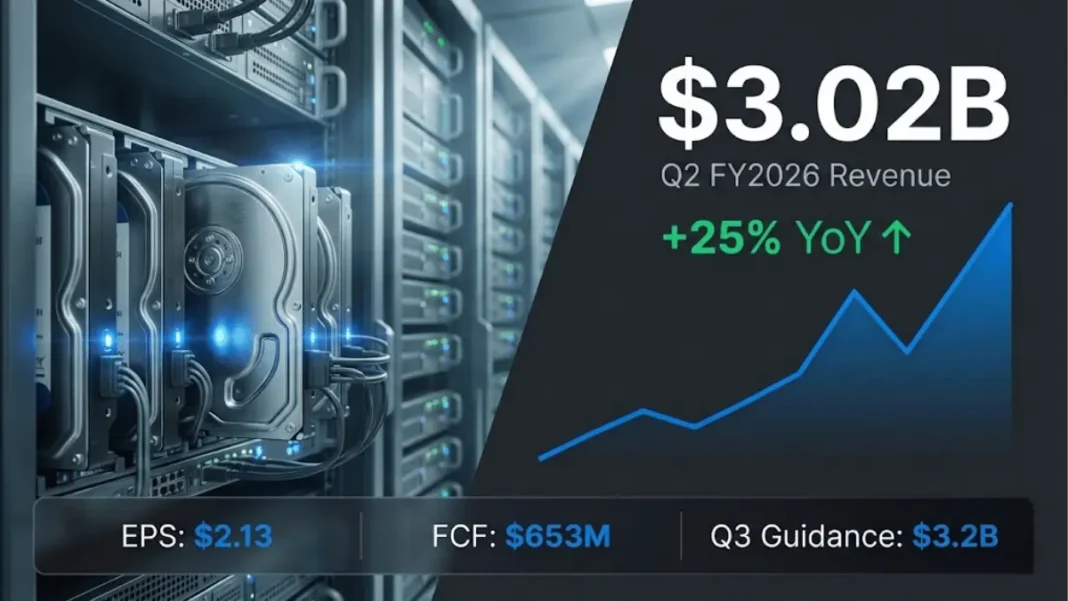
- Western Digital delivered $3.02 billion revenue in Q2 FY2026, marking 25% year-over-year growth
- Non-GAAP earnings per share hit $2.13, beating analyst estimates of $1.93 by 10.4%
- Free cash flow generation reached $653 million with over 100% returned to shareholders
- Q3 FY2026 revenue guidance projects $3.2 billion, representing 40% annual growth acceleration
Western Digital Corporation dismantled Wall Street expectations with fiscal second quarter 2026 results that signal the storage giant has captured the AI infrastructure wave. The San Jose-based company posted $3.02 billion in revenue for the quarter ended January 2, 2026 a 25% jump from the prior year and 2.7% above consensus forecasts of $2.94 billion. The performance validates Western Digital’s strategic pivot to high-capacity hard disk drives (HDDs) following the February 2025 separation of its flash memory division into SanDisk Corporation.
Revenue Growth Accelerates Across Core Metrics
Western Digital’s fiscal Q2 2026 demonstrated sequential and year-over-year momentum across key financial indicators. Revenue climbed 7% quarter-over-quarter from $2.82 billion in Q1 FY2026, while the 25% annual increase reflects sustained demand from hyperscale data center operators deploying AI workloads.
Non-GAAP gross margin expanded to 46.1%, up 220 basis points sequentially and 770 basis points year-over-year. Operating margin reached 33.8%, representing a 340 basis point quarter-over-quarter improvement. This margin expansion stems from disciplined execution in manufacturing high-capacity enterprise HDDs at scale, where Western Digital maintains pricing power amid supply constraints.
Diluted earnings per share on a non-GAAP basis hit $2.13, surpassing the $1.93 analyst consensus by 10.4%. This represented 78% annual growth and 20% sequential improvement. On a GAAP basis, diluted EPS reached $4.73 a 272% year-over-year surge driven by operational improvements and one-time gains from the SanDisk separation.
What drove Western Digital’s Q2 2026 revenue growth?
Western Digital’s Q2 2026 revenue growth resulted from AI data center expansion requiring high-capacity HDD storage solutions. Hyperscaler demand for enterprise drives and improved gross margins from manufacturing efficiency drove the 25% annual increase to $3.02 billion.

Data Center Demand Drives Cash Flow Generation
Cash flow from operations totaled $745 million in Q2 FY2026, with free cash flow reaching $653 million. Western Digital returned over 100% of free cash flow to shareholders through share repurchases and dividend payments during the quarter.
The company’s Board of Directors declared a quarterly cash dividend of $0.125 per share, payable March 18, 2026 to stockholders of record as of March 5, 2026. This marks continued commitment to shareholder returns despite ongoing capital requirements for capacity expansion to meet AI storage demand.
CEO Irving Tan emphasized the disciplined capital allocation strategy: “During the quarter, free cash flow generation continued to be strong, and we returned over 100% of our free cash flow to shareholders“. The approach balances growth investments with immediate value return as Western Digital capitalizes on its position as a critical infrastructure provider in the AI-driven data economy.
Q3 FY2026 Guidance Signals Accelerating Growth
Western Digital issued Q3 fiscal 2026 guidance projecting revenue of $3.2 billion at the midpoint, representing approximately 40% year-over-year growth. This acceleration from Q2’s 25% growth rate indicates strengthening data center demand patterns extending through the March 2026 quarter.
CFO Kris Sennesael outlined the Q3 outlook: “We expect revenues of $3.2 billion, non-GAAP gross margin of 47.5%, with non-GAAP EPS of $2.30“. The 47.5% gross margin guidance at midpoint represents further sequential expansion from Q2’s 46.1%.
Non-GAAP earnings per share guidance of $2.30 (plus or minus $0.15) implies 8% sequential growth and positions Western Digital for continued outperformance. Operating expenses are projected at $380-390 million with an approximate 16% tax rate.
Why is Western Digital’s Q3 guidance significantly higher than Q2 results?
Western Digital’s Q3 FY2026 guidance projects 40% annual revenue growth versus Q2’s 25% due to accelerating hyperscale data center buildouts requiring high-capacity enterprise HDDs. Adoption of the company’s latest drive platforms and sustained AI infrastructure investments drive the forecast increase.
AI Infrastructure Positions HDDs as Dominant Storage Solution
Western Digital’s performance validates hard disk drives as the primary storage medium for AI data centers despite solid-state drive alternatives. Market research indicates 80% of data center storage remains on HDD technology due to total cost of ownership advantages.
SSDs command a 5x to 10x cost premium per terabyte compared to HDDs while delivering comparable power efficiency for most data center workloads. This economic reality drives hyperscalers toward high-capacity HDD deployments for AI training data, model checkpoints, and inference dataset storage.
The AI-powered storage market is projected to grow from $28.71 billion in 2024 to $255.24 billion by 2034 at a 24.42% compound annual growth rate. Western Digital’s strategic focus on enterprise and nearline HDDs positions the company to capture significant share of this expansion.
India’s data center capacity alone is expected to reach 2 gigawatts in 2026 and exceed 8 gigawatts by 2030, requiring over $30 billion in capital expenditure. Owais Mohammed, Western Digital’s sales director for India, Middle East, and Africa, noted: “India is already looking at doubling its data center capacity in the next five years. That means doubling storage“.
Strategic Separation Sharpens HDD Focus
The February 21, 2025 separation of Western Digital’s flash business into SanDisk Corporation fundamentally altered the company’s strategic profile. Western Digital now operates as a pure-play HDD manufacturer focused on enterprise, nearline, and hyperscale storage markets.
This structural change enables concentrated investment in high-capacity drive development and manufacturing capacity expansion. The timing proved advantageous as AI infrastructure buildouts accelerated through 2025 and into 2026, creating supply constraints for enterprise storage that Western Digital fills with premium pricing.
Post-separation financial results reflect only continuing HDD operations, with SanDisk’s historical performance now reported as discontinued operations. This presentation clarity allows investors to evaluate Western Digital’s data center storage business without flash memory volatility complicating the narrative.
Competitive Landscape and Market Position
Western Digital competes primarily with Seagate Technology in the enterprise HDD market, with both benefiting from industry consolidation that reduced supplier options for hyperscale customers. Western Digital’s addition to the NASDAQ-100 index on December 22, 2025 reflected recognition of its strategic importance to AI infrastructure.
The company’s stock surged 6.7% on January 6, 2026 as investors repositioned ahead of Q2 earnings following the NASDAQ-100 inclusion. The tight supply environment for enterprise storage solutions provides pricing power that Western Digital leveraged in Q2 to expand gross margins while growing volume.
Exabyte shipments reached 215 EB in Q2 FY2026, up 22% year-over-year, indicating Western Digital captured both price and volume gains. This combination of unit growth and margin expansion demonstrates the company’s strengthened competitive position in the AI storage era.
Margin Expansion Demonstrates Operational Leverage
Western Digital’s margin progression through fiscal 2026 illustrates operational leverage as the company scales production of high-capacity drives. Non-GAAP operating margin reached 33.8% in Q2 FY2026, up from 30.4% in Q1 FY2026 and 24.5% in the prior-year quarter.
Gross margin expansion of 770 basis points year-over-year to 46.1% stems from several factors. Product mix shifted toward higher-capacity enterprise drives with superior economics. Manufacturing efficiency improved through yield optimization and cost reduction initiatives. Pricing remained favorable amid industry supply constraints.
The Q3 FY2026 guidance for 47-48% gross margin suggests continued trajectory improvement. Western Digital’s ability to expand margins while growing revenue 25-40% annually demonstrates the quality of demand and company’s market position.
What is Western Digital’s gross margin target for 2026?
Western Digital achieved 46.1% non-GAAP gross margin in Q2 FY2026 and guided Q3 FY2026 to 47-48%. The company’s margin expansion reflects pricing power in enterprise HDDs and manufacturing efficiency gains as AI data center demand accelerates.
Risk Factors and Market Considerations
Western Digital’s forward-looking statements acknowledge several risk factors that could impact future performance. Global or regional economic conditions, including potential tariffs or trade restrictions, pose macroeconomic headwinds.
The company depends on a limited number of qualified suppliers for components critical to HDD manufacturing. Any supply chain disruption could constrain production capacity amid robust demand. Cybersecurity risks and potential data system security incidents present operational vulnerabilities.
Customer concentration remains a consideration as hyperscale operators represent significant revenue portions. Changes in relationships with key customers or shifts in their storage strategies could affect demand patterns.
Competitive dynamics could shift if alternative storage technologies achieve cost parity with HDDs or if new entrants emerge in the enterprise storage market. Western Digital’s technology development cadence and capacity to scale production determine its ability to maintain market leadership.
Future Outlook and Strategic Direction
Western Digital positions itself as the infrastructure backbone for the AI-driven data economy through 2026 and beyond. Management expects continued strong demand from data center customers deploying AI workloads that require massive storage capacity at economical price points.
The company’s vision statement emphasizes its commitment to “unleashing the power and value of data” through scalable, sustainable storage technology. Western Digital invests in manufacturing capacity expansion to support projected data center growth, particularly in high-growth markets like India.
Greenhouse gas emissions reduction and sustainability goals factor into Western Digital’s strategic planning as data center operators increasingly prioritize environmental metrics. Energy-efficient HDD designs that reduce power consumption per terabyte stored align with customer requirements and regulatory trends.
Frequently Asked Questions (FAQs)
What was Western Digital’s Q2 2026 revenue?
Western Digital reported $3.02 billion in revenue for fiscal Q2 2026, representing 25% year-over-year growth and 7% sequential increase. The results exceeded analyst consensus estimates of $2.94 billion by 2.7%.
How much did Western Digital earn per share in Q2 2026?
Western Digital delivered non-GAAP diluted earnings per share of $2.13 in Q2 FY2026, beating analyst estimates of $1.93 by 10.4%. GAAP diluted EPS reached $4.73, up 272% year-over-year.
What is driving Western Digital’s revenue growth?
AI data center expansion drives Western Digital’s revenue growth as hyperscale operators deploy high-capacity HDDs for storing AI training datasets and inference workloads. Enterprise storage demand and favorable pricing contribute to growth acceleration.
What is Western Digital’s Q3 2026 revenue guidance?
Western Digital guided Q3 fiscal 2026 revenue to $3.2 billion at midpoint, representing approximately 40% year-over-year growth. The company expects non-GAAP EPS of $2.30 and gross margin of 47.5%.
Why did Western Digital separate from SanDisk?
Western Digital separated its flash memory business into SanDisk Corporation on February 21, 2025 to create focused pure-play companies. Western Digital concentrates on HDD enterprise storage while SanDisk pursues flash and SSD markets independently.
Does Western Digital pay a dividend?
Yes, Western Digital declared a quarterly cash dividend of $0.125 per share, payable March 18, 2026. The company returned over 100% of Q2 FY2026 free cash flow through dividends and share repurchases.
Are HDDs still relevant for data centers in 2026?
Hard disk drives remain dominant in data centers with 80% of storage capacity deployed on HDD technology in 2026. HDDs offer 5-10x lower cost per terabyte versus SSDs, making them economical for AI workloads requiring massive capacity.
What is Western Digital’s stock ticker symbol?
Western Digital Corporation trades on NASDAQ under ticker symbol WDC. The company was added to the NASDAQ-100 index on December 22, 2025, recognizing its AI infrastructure significance.
Last Updated: February 2, 2026

