

Quick Brief
- DeviceHub launched 3 February 2026 in Barcelona as a secure, cloud-based AV management platform.
- The platform is in public beta and initially supports Sennheiser TeamConnect Bar Solutions.
- Built on Microsoft Azure, DeviceHub follows industry-recognised IT security standards for authentication and encryption.
- Sainte-Justine Hospital in Quebec reports daily portal use and faster onboarding with single configuration per new device.
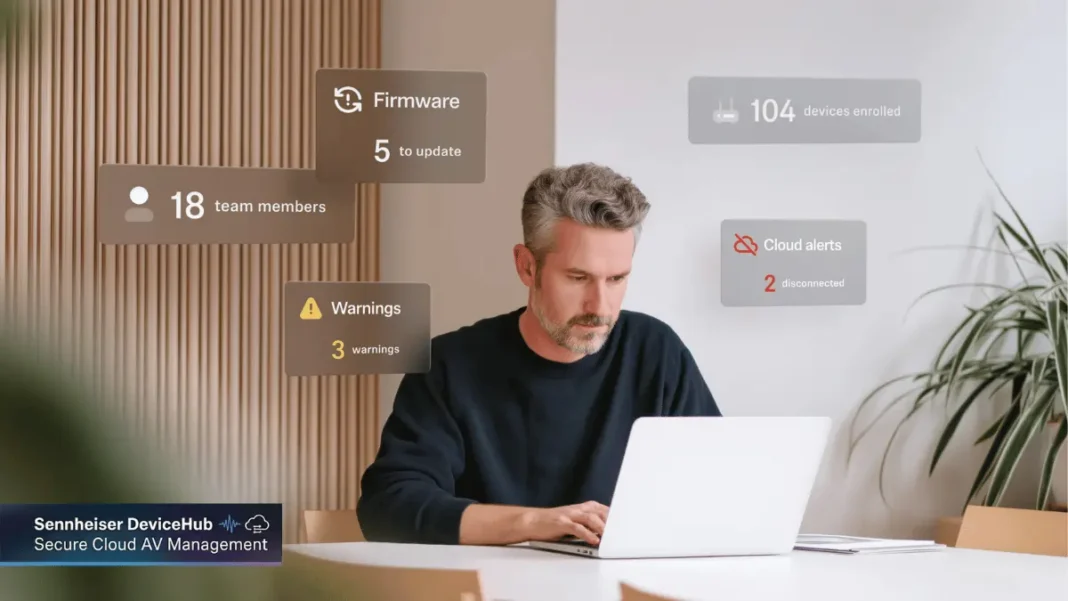
Sennheiser has launched DeviceHub, a secure, cloud-based platform that centralises visibility and control of networked Sennheiser devices from anywhere in the world. Announced on 3 February 2026 in Barcelona, DeviceHub entered public beta after extensive internal testing and a private beta phase. At launch, it supports TeamConnect Bar Solutions and is designed to grow across additional Sennheiser devices through 2026.
What DeviceHub Is Designed to Solve
DeviceHub addresses the complexity of managing networked Sennheiser devices across multiple rooms and sites by providing one cloud-based platform accessible through any browser. Real-time monitoring, diagnostics, and alerts give clear insight into device status and performance so teams can act before issues disrupt meetings, classes, or collaboration spaces.
For IT personnel, DeviceHub organises devices by room, building, campus, or region in a structure that mirrors real-world environments. This hierarchy helps teams see every space from a single platform, navigate between locations easily, view devices in context, and understand system health at a glance from a handful of rooms to global estates.

Security Architecture on Microsoft Azure
DeviceHub is built on Microsoft Azure and incorporates security and trust from the outset. According to Sennheiser, the platform follows industry‑recognised IT security standards across authentication, authorisation, encryption, and data handling. Ongoing evaluation and compliance oversight are intended to ensure DeviceHub meets the privacy and security expectations of enterprise and education environments.
What security foundations does Sennheiser DeviceHub use?
DeviceHub runs on Microsoft Azure and follows industry‑recognised IT security standards for authentication, authorisation, encryption, and data handling. Continuous evaluation and compliance oversight are designed to meet the security expectations of enterprise and education users.
Role-based access is integrated into DeviceHub so organisations can assign permissions in line with user responsibilities. This supports secure access to device management while maintaining control over who can view or change configurations across the estate.
Supported Devices and 2026 Roadmap
At launch, DeviceHub supports Sennheiser TeamConnect Bar Solutions, with public beta focused on these conferencing bars. Official FAQ information states that TeamConnect Bar S and M will be supported in 2026, with further hardware compatibility following throughout the year.
Secondary coverage confirms that more Sennheiser hardware will be added, including devices previously managed through Cockpit, the company’s local management utility. Sennheiser describes this launch as part of a broader DeviceHub roadmap, with compatibility expanding across additional devices in 2026.
Local Web UI for Single-Device Setup
Alongside the cloud platform, DeviceHub is complemented by a streamlined Local Web UI that supports efficient single-device setup through a browser. This interface allows IT teams to configure individual devices directly in the browser, reducing software dependencies during installation.
How does Local Web UI support DeviceHub deployments?
The Local Web UI lets IT teams configure single Sennheiser devices directly through a browser, even during installation. This reduces the need for additional software tools and speeds up initial setup, especially for TeamConnect Bar units integrated into larger estates.
Documentation for TeamConnect Bar notes that the Local Web UI can be accessed by connecting the device to the network and reaching it via its IP address or hostname, enabling browser‑based configuration within local environments.
Real-World Feedback from Sainte-Justine Hospital
Early customers have already provided feedback on DeviceHub. Guillaume Amaurin, AV Specialist at Sainte-Justine Hospital in Quebec, reports that DeviceHub has significantly simplified management of their infrastructure. He states that a single configuration is enough to onboard a new device, making onboarding fast and frictionless, and that the portal is easy to access and used daily by the entire team to configure bars and monitor usage.
Alain Lamontagne, IT Specialist at the same hospital, contrasts DeviceHub with the previous method based on Cockpit, which was limited to a single computer and required bars to be re‑added whenever the machine changed. He describes DeviceHub as representing a major gain in both time and flexibility and expresses interest in adding more devices synchronised with the portal.
How does DeviceHub differ from Sennheiser’s previous Cockpit tool?
Sainte‑Justine Hospital notes that Cockpit was limited to a single computer and required bars to be re‑added if the machine changed. DeviceHub instead provides a browser-based portal used daily by the team, delivering significant gains in time, flexibility, and infrastructure management simplicity.
Monitoring, Alerts, and Remote Management
As described in the launch materials, DeviceHub provides real-time monitoring, diagnostics, and alerts to give clear visibility into device status and performance. This helps teams act before issues affect meetings, classes, or collaborative sessions, whether they are on site or working remotely.
Coverage of the platform highlights that DeviceHub supports remote configuration and status checks without needing on-site access, which can be particularly valuable in distributed environments such as universities or multinational businesses. A single “pane of glass” view is emphasised as a key benefit for monitoring different devices and alert states across a network.
Designed to Scale from Rooms to Global Estates
Sennheiser states that DeviceHub is built to grow with an organisation’s needs, from a small number of rooms to global estates. Devices can be grouped by room, building, campus, or region, mirroring real-world structures and providing a clear overview from one platform.
| Scope | Verified DeviceHub Capability | Source-backed Benefit |
|---|---|---|
| Individual room | Local Web UI single-device browser setup | Reduces software needs during installation. |
| Building or campus | Devices organised by room and building | Easier navigation and contextual view of system health. |
| Multiple sites / estates | Hierarchy up to campus or region | Clear oversight from small deployments to global estates. |
This structure supports organisations that manage AV infrastructure across multiple locations but want a consolidated view of status and configuration.
Availability and Commercial Status
The official launch materials confirm that DeviceHub is now publicly available in beta. The platform was first announced at InfoComm US in June 2025 and subsequently introduced at ISE 2026.
Is Sennheiser DeviceHub available today, and what does it cost?
DeviceHub is publicly available in beta as of 3 February 2026, with access provided via Sennheiser’s DeviceHub product information and registration channels. Official communications do not yet provide public pricing or licensing details for the platform.
Organisations can visit the DeviceHub product page to learn more about the beta and supported devices.
Limitations and Current Scope
At this stage, DeviceHub’s supported hardware is limited to TeamConnect Bar Solutions and specifically TeamConnect Bar S/M, according to the FAQ. Sennheiser indicates that further hardware compatibility will follow throughout 2026, including devices previously managed through Cockpit.
Because the service is in public beta, Sennheiser notes that the platform will continue to evolve with new capabilities that strengthen monitoring, configuration, and collaboration across its ecosystem. Organisations adopting DeviceHub should therefore expect ongoing feature development during 2026.

Frequently Asked Questions (FAQs)
Which devices does Sennheiser DeviceHub support at launch?
At launch in 2026, DeviceHub supports Sennheiser TeamConnect Bar Solutions, including TeamConnect Bar S and M. Further hardware compatibility will follow throughout 2026, expanding coverage to additional Sennheiser devices.
How does DeviceHub help IT teams manage AV systems?
DeviceHub centralises networked Sennheiser devices in a single cloud-based platform accessible through any browser. It offers real-time monitoring, diagnostics, and alerts, helping IT teams act before issues affect meetings, classes, or collaboration spaces.
What security foundations does DeviceHub use?
DeviceHub is built on Microsoft Azure and follows industry‑recognised IT security standards across authentication, authorisation, encryption, and data handling. Ongoing evaluation and compliance are aimed at meeting enterprise and education security expectations.
What is the role of Local Web UI in DeviceHub deployments?
The Local Web UI provides a streamlined way to configure single devices via a browser, reducing software dependencies during installation. This feature supports quick setup of devices such as TeamConnect Bars in local network environments.
How have early customers responded to DeviceHub?
Sainte-Justine Hospital in Quebec reports that DeviceHub has significantly simplified management of its infrastructure. A single configuration is enough to onboard new devices, and the portal is used daily by the team to configure bars and monitor usage.
What advantages does DeviceHub offer over Cockpit?
According to Sainte‑Justine Hospital, the previous Cockpit-based method was limited to a single computer and required bars to be re‑added when the machine changed. DeviceHub delivers major gains in time and flexibility through a browser-based portal that is not tied to one computer.
Where can organisations learn more or join the beta?
Sennheiser directs interested organisations to the DeviceHub product page for more information about the platform, supported devices, and participation in the public beta.

