

Quick Brief
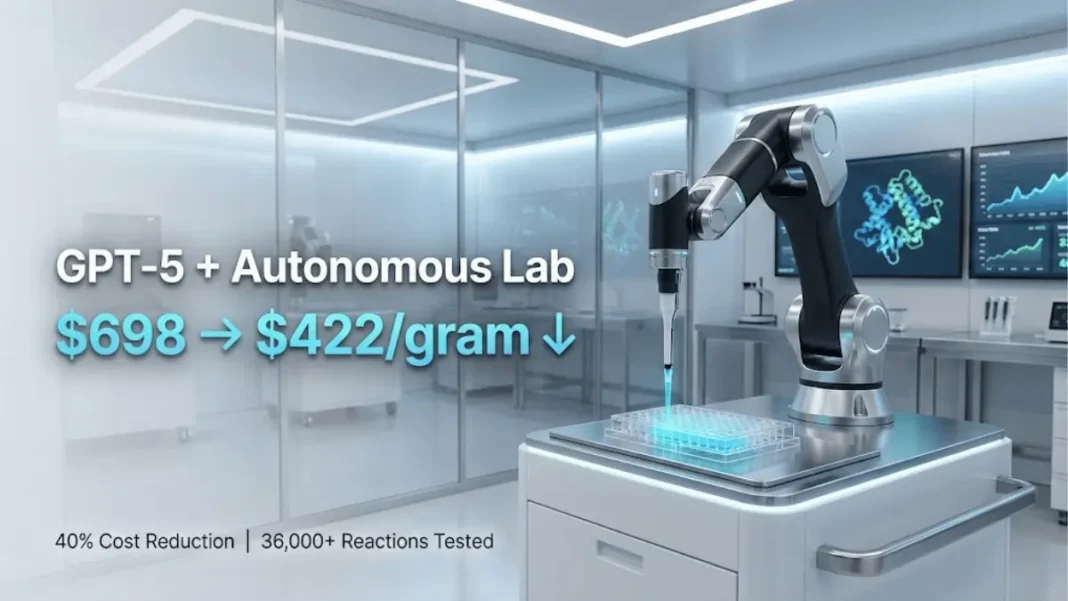
- GPT-5 reduced protein production costs from $698 to $422 per gram in six experimental rounds
- Autonomous lab tested 36,000+ reactions across 580 automated plates over two months
- System achieved 57% improvement in reagent costs through novel composition discovery
- Breakthrough demonstrates AI’s capacity to optimize complex biological processes autonomously
OpenAI’s GPT-5 has achieved a 40% reduction in cell-free protein synthesis costs by autonomously designing and executing over 36,000 laboratory experiments. The breakthrough, announced February 5, 2026, positions artificial intelligence as a transformative force in drug discovery and biological research, where protein production expenses have historically limited innovation. Ginkgo Bioworks’ stock rose 6% following the announcement, reflecting investor confidence in AI-driven laboratory automation.
How GPT-5 Lowered Protein Synthesis Costs
The autonomous system connected GPT-5 directly to Ginkgo Bioworks’ cloud laboratory, a robotic facility that executes experiments remotely through software. GPT-5 proposed reaction compositions, the lab executed them in 384-well plate format, and results fed back to the model for analysis. This closed-loop cycle repeated six times, with the AI refining hypotheses based on experimental data rather than theoretical assumptions.
After three rounds of testing, the system established a new benchmark: superfolder green fluorescent protein (sfGFP) production at $422 per gram in total reaction costs, compared to the previous state-of-the-art of $698 per gram. The 40% cost reduction stemmed from identifying reagent combinations that performed well under high-throughput automation constraints, including low-oxygen conditions common in plate-based experiments.
What is the breakthrough in GPT-5’s protein synthesis optimization?
GPT-5 identified reaction compositions humans had not previously tested by exploring 36,000+ combinations across six iterative experimental rounds. The system discovered that small adjustments in buffering, energy regeneration components, and polyamines produced outsized impacts relative to their costs. These parameters are often treated as background assumptions in manual workflows but became testable hypotheses at autonomous lab scale.
Cell-Free Protein Synthesis Explained
Cell-free protein synthesis (CFPS) produces proteins without growing living cells. Instead of inserting DNA into organisms and waiting for protein expression, CFPS runs the cellular protein-making machinery in a controlled mixture. Scientists can execute multiple experiments and measure results the same day, making CFPS a practical tool for rapid prototyping.
CFPS applications span drug candidate identification, protein microarray production, virus-like particle expression, and diagnostic reagent development. Many medicines rely on proteins as active ingredients. Industrial enzymes use proteins to make chemical processes cleaner. When protein production becomes faster and cheaper, researchers test more ideas sooner and reduce the cost of translating early research into practical applications.
The complexity of CFPS formulations has made optimization difficult. The system requires DNA templates, cell lysate (cellular machinery extracted from cells), and numerous biochemical components ranging from energy sources to salts. Previous machine learning studies achieved incremental progress, but thorough exploration remained labor-intensive.
Autonomous Laboratory Architecture
The GPT-5 system paired OpenAI’s reasoning model with Ginkgo Bioworks’ reconfigurable automation carts. The architecture enforced strict programmatic validation before executing any experiment, preventing “paper experiments” that appear plausible in text but cannot be carried out in robotic workflows.
Validation protocols eliminated physically impossible designs while the AI generated human-readable lab notebook entries documenting analyses and reasoning. Human oversight focused on reagent preparation and system monitoring, while GPT-5 managed experimental design and data interpretation.
Across the full experimental run spanning six months, the system executed 580 automated plates and generated nearly 150,000 data points. This throughput enabled pattern identification critical in biology, where single experiments contain noise and iteration separates signal from randomness.
| Metric | Traditional Manual Lab | GPT-5 Autonomous Lab |
|---|---|---|
| Experiments executed | Dozens per cycle | 36,000+ total |
| Iteration timeframe | Weeks to months | 2 months for 6 rounds |
| Cost per gram (sfGFP) | $698 | $422 (40% reduction) |
| Reagent cost improvement | Baseline | 57% improvement |
| Human involvement | Continuous oversight | Reagent prep + monitoring |
What the Results Mean for Drug Discovery
The cost structure shift makes protein production more accessible for pharmaceutical development. In CFPS, lysate and DNA dominate expenses, meaning yield optimization becomes the highest-leverage strategy. Boosting protein output per unit of expensive input drives meaningful cost progress before pursuing marginal savings elsewhere.
AI-driven automation enables closed-loop discovery cycles where artificial intelligence proposes hypotheses and automation tests them in real time. This framework allows continuous improvement through iterative experiments running 24/7 without manual setup between runs. Self-driving laboratories drastically accelerate discovery pace by making decisions autonomously and immediately learning from new data.
According to a 2023 Nature Biotechnology study, protein production costs for complex molecules often exceed $100 per gram. A 40% reduction translates to more affordable drug development timelines. CFPS positions researchers to conduct high-throughput screening, synthetic biology workflows, and protein engineering with improved economic viability.
How does GPT-5’s autonomous lab compare to traditional drug discovery?
Traditional cell-based expression systems require cell culture maintenance, longer reaction kinetics, and limited tolerance to toxic proteins. GPT-5’s cell-free approach operates independently from cell culture, offers rapid kinetics, and easily incorporates non-canonical amino acids. The autonomous system runs thousands of reactions in timeframes where human teams might complete dozens, with reagent costs becoming the primary limiting factor at scale.
Technical Considerations and Limitations
These results demonstrated on sfGFP and one CFPS system require validation across other proteins and reaction formats. Oxygenation and reaction geometry strongly affect yields, with sensitivities varying across scales. Most CFPS reactions produce significantly more protein in test tubes than microtiter plates due to oxygen availability and mixing differences.
The system’s improvements may depend on high-throughput constraints specific to plate-based automation. GPT-5 proposed many reagent combinations robust in low-oxygen conditions common in automated settings, but generalization to bench-top manual workflows remains unverified.
Human oversight was required for protocol improvements and practical laboratory details. The autonomous system designs and interprets experiments, but experienced operators remain essential for reagent handling and system supervision.
Biosecurity and Safety Framework
OpenAI evaluates and mitigates risks through its Preparedness Framework as models gain capability to reason in wet laboratory environments. These results show AI can improve biological protocols, carrying implications for biosecurity that require assessment. OpenAI commits to building necessary safeguards at model and system levels while developing evaluations tracking current risk levels.
The scientific preprint has not undergone peer review. The manuscript is accessible on OpenAI’s website and bioRxiv for community evaluation. Ginkgo Bioworks now offers the AI-enhanced reaction mix in its reagents store and plans to release the Pydantic validation model as open source.
What Comes Next for AI-Driven Biology
OpenAI plans to apply lab-in-the-loop optimization to additional biological workflows where faster iteration unlocks progress. The organization views autonomous labs as complementary to models AI generates designs, but biology requires testing and iteration. Closing the loop between generation and experimentation transforms promising ideas into working results.
The partnership demonstrates practical applications of AI-driven automation in biotechnology. Advanced language models like GPT-5 drive efficiency and cost savings in large-scale laboratory operations, showcasing business opportunities for autonomous discovery systems.
Combining leading reasoning models with cloud-based laboratory infrastructure allows design, execution, and analysis of experiments with minimal human input. This closed-loop system represents a leap in reinforcement learning applications for real-world laboratories, with direct impacts on pharmaceutical industries.
Frequently Asked Questions (FAQs)
What is cell-free protein synthesis?
Cell-free protein synthesis produces proteins without living cells by running cellular protein-making machinery in a controlled mixture. Scientists obtain results the same day, enabling rapid prototyping and testing for drug discovery and diagnostics.
How much did GPT-5 reduce protein production costs?
GPT-5 achieved a 40% cost reduction, lowering protein synthesis from $698 to $422 per gram for superfolder green fluorescent protein. The system also improved reagent costs by 57% through novel composition discovery.
How many experiments did the autonomous lab run?
The GPT-5-driven system executed over 36,000 cell-free protein synthesis reactions across 580 automated plates during six iterative experimental rounds spanning two months.
Which company partnered with OpenAI for this breakthrough?
Ginkgo Bioworks partnered with OpenAI to connect GPT-5 to their cloud laboratory automation system. The collaboration resulted in a 40% protein production cost reduction announced February 5, 2026.
What are the limitations of GPT-5’s protein synthesis results?
Results were demonstrated on one protein (sfGFP) and one CFPS system, requiring validation across other proteins. Improvements may depend on high-throughput automation constraints, and human oversight remains necessary for protocol improvements.
How does AI autonomous laboratory work?
AI proposes experimental designs based on prior results, robotic systems execute reactions, and data feeds back to the model for analysis. This closed-loop cycle operates continuously, with AI refining hypotheses through iterative testing.
What applications benefit from cheaper protein synthesis?
Drug candidate identification, diagnostic reagent development, protein microarrays, enzyme production for industrial processes, and structural protein analysis all benefit from reduced CFPS costs.
Will this technology be available to researchers?
Ginkgo Bioworks now offers the AI-enhanced reaction mix in its reagents store and plans to release the Pydantic validation model as open source for research community use.

