

Key Takeaways
- Fundamental raised $255M ($30M seed + $225M Series A) led by Oak HC/FT since founding in October 2024
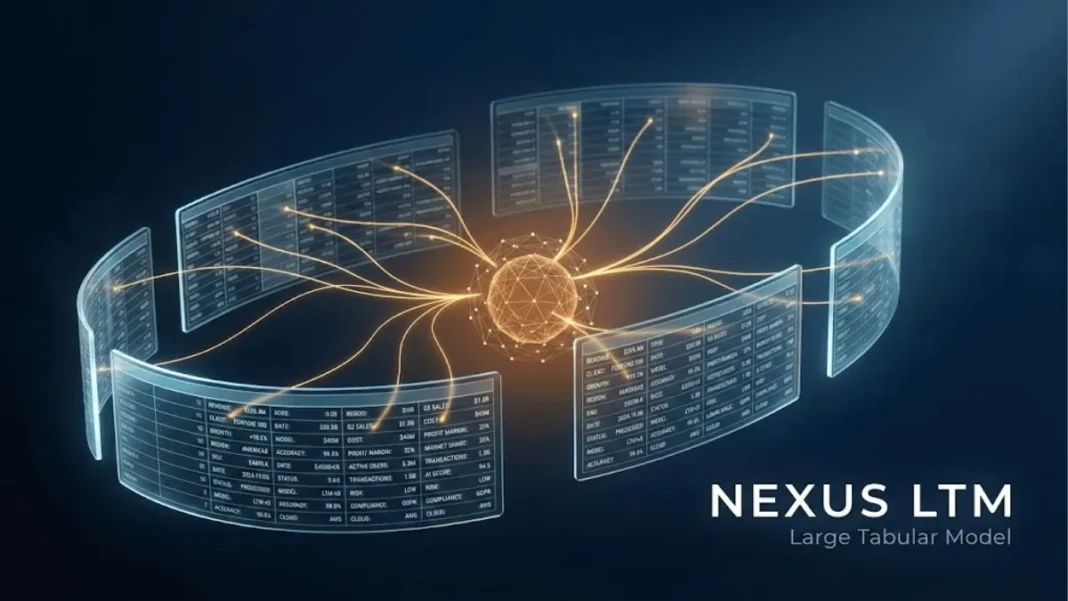
- NEXUS is the first publicly available Large Tabular Model (LTM) built specifically for structured enterprise data
- AWS partnership enables one-click deployment through existing customer dashboards
- Seven-figure Fortune 100 contracts secured for demand forecasting, price prediction, and churn analysis
Fundamental emerged from stealth February 5, 2026, with $255 million in total funding and NEXUS, the first publicly available Large Tabular Model (LTM). The San Francisco company, founded in October 2024, built NEXUS specifically for structured data spreadsheets, databases, CRM records that comprises the majority of enterprise information. Annie Lamont, Co-Founder & Managing Partner at Oak HC/FT, stated: “The significance of Fundamental’s model is hard to overstate structured, relational data has yet to see the benefits of the deep learning revolution“.
What Large Tabular Models Address
Large Language Models transformed unstructured text processing but were not designed for tabular data formats. Traditional machine learning algorithms require extensive manual feature engineering work where data scientists specify which variables to analyze and how they relate. NEXUS eliminates this requirement by automatically learning structure and patterns from raw data.
CEO and co-founder Jeremy Fraenkel describes NEXUS as “the OS for business decisions,” enabling enterprises to answer forward-looking questions with fast time-to-value. The model addresses use cases from hospital readmission risk to energy price volatility across industries.
What makes tabular data prediction critical for enterprises?
Tabular data prediction enables enterprises to forecast demand, identify fraud patterns, predict customer churn timing, and optimize pricing strategies. NEXUS processes billions of rows without truncation or sampling, allowing analysis of complete datasets. This capability addresses predictive use cases that traditional analytics approaches could not efficiently handle.

The $255M Funding Structure and Strategic Backers
Oak HC/FT led Fundamental’s $225 million Series A round following a $30M seed investment, bringing total capital to $255 million since the company’s October 2024 founding. The investor roster includes Valor Equity Partners, Battery Ventures, Salesforce Ventures, and Hetz Ventures.
Notable angel investors include Perplexity co-founder and CEO Aravind Srinivas, Wiz CEO Assaf Rappaport, Brex co-founder Henrique Dubugras, and Datadog co-founder and CEO Olivier Pomel. The company secured seven-figure contracts with Fortune 100 clients before its public launch.
The funding will scale compute infrastructure, expand enterprise deployments, and grow teams across research, engineering, and go-to-market functions. Forbes identified structured data as a $600 billion AI frontier in January 2026.
AWS Partnership: One-Click Enterprise Deployment
Amazon Web Services integrated NEXUS directly into customer dashboards, enabling procurement and deployment identical to buying compute or storage resources. This partnership eliminates traditional enterprise software implementation barriers by leveraging AWS’s existing infrastructure and customer relationships.
“Fundamental’s structured data prediction model builds on AWS’s advanced AI offerings, helping enterprise customers fill a crucial gap in comprehensive tabular data analysis at scale,” said Dave Brown, VP of Compute, Platforms & ML Services at AWS. The integration provides enterprise-grade security, reliability, and scalability without additional IT implementation work.
How does NEXUS integrate with existing data stacks?
NEXUS connects to enterprise data infrastructure with minimal effort, often requiring a single line of code. The model ingests raw tabular data directly from databases, data warehouses, or cloud storage without extensive preprocessing. NEXUS automatically learns underlying structure, patterns, and dependencies without manual feature engineering or model training. The cloud-agnostic architecture supports deployment on any infrastructure while offering native AWS support.
NEXUS Architecture: Built by DeepMind Alumni
Fundamental was built by DeepMind alumni and employs a non-transformer architecture. NEXUS trains on billions of tabular datasets using Amazon SageMaker HyperPod. The architecture handles enterprise-scale tables with thousands of columns and billions of rows.
The model’s deterministic design prioritizes reproducibility essential for regulated industries like finance and healthcare where model decisions require auditability. TechCrunch reported February 4, 2026, that this approach differs fundamentally from probabilistic text generation models.
The model unifies multiple analytics tasks forecasting, classification, optimization, anomaly detection, and scenario simulation into a single foundation model. Traditional approaches require specialized models and data science teams for each use case.
Enterprise Use Cases Across Industries
Fortune 100 companies are applying NEXUS to mission-critical predictions across sectors. Financial services firms deploy the model for fraud detection in real-time. Healthcare systems predict hospital readmission risk for proactive patient intervention.
Retail and e-commerce enterprises use NEXUS for demand forecasting and inventory optimization. Energy companies predict price volatility for trading strategies. Customer success teams forecast churn timing to target retention efforts.
Fundamental secured commitments from large enterprises before the public launch, with contract values reaching seven figures. The company reports fast time-to-value for customers deploying predictive analytics capabilities.
What accuracy improvements does NEXUS deliver over traditional ML?
Fundamental states that NEXUS delivers more accurate predictions than traditional machine learning methods, with expanded applicability across domains. The model eliminates extensive hyperparameter tuning and feature engineering that traditional approaches require. Specific benchmark comparisons have not been publicly released as of February 2026.
The Competitive Landscape for Tabular Foundation Models
Fundamental’s public launch positions LTMs as a new AI category distinct from Large Language Models. Fast Company noted February 5, 2026, that “this new type of AI can do what large language models can’t“. VentureBeat reported NEXUS “bypasses manual ETL” through its native approach to structured data.
No comparable foundation model existed for enterprise structured data at this scale before NEXUS. While LLMs from OpenAI, Anthropic, and Google dominate unstructured data processing, tabular data prediction remained dependent on traditional machine learning approaches until 2026.
Deloitte’s January 2026 State of AI in the Enterprise report emphasized that “legacy data and infrastructure architectures cannot power real-time, autonomous AI“. The enterprise AI infrastructure landscape is consolidating rapidly in 2026, with major acquisitions validating strategic focus on data foundations.
Implementation Considerations
NEXUS addresses tabular data prediction rather than general-purpose intelligence. The model does not process unstructured data like text, images, or video. Enterprises requiring both capabilities must integrate NEXUS with existing systems.
The deterministic architecture serves regulated industries but differs from generative models designed for creative content. Organizations deploying NEXUS should evaluate performance characteristics across their specific data conditions and integration requirements.
Fundamental provides access through its website at www.fundamental.tech/contact, with AWS customers able to deploy directly through their dashboards.

Frequently Asked Questions (FAQs)
What is a Large Tabular Model (LTM)?
A Large Tabular Model is a foundation model purpose-built for structured data in tables, databases, and spreadsheets. NEXUS is the first publicly available LTM designed to understand relationships across rows and columns in enterprise datasets.
When was Fundamental founded and who leads the company?
Fundamental was founded in October 2024 by a team of DeepMind alumni. CEO Jeremy Fraenkel leads the company, which remained in stealth mode until its February 5, 2026 public launch.
How much total funding has Fundamental raised?
Fundamental raised $255 million total: a $30 million seed round and a $225 million Series A round led by Oak HC/FT. Additional investors include Valor Equity Partners, Battery Ventures, Salesforce Ventures, and Hetz Ventures.
Which enterprises are using NEXUS?
Fundamental secured seven-figure contracts with Fortune 100 companies across industries including financial services, healthcare, retail, and energy. Specific client names have not been publicly disclosed.
How does NEXUS differ from traditional machine learning?
NEXUS automates feature engineering and learns data patterns autonomously, whereas traditional ML requires manual specification of variables and relationships. The foundation model approach operates at scale on billions of rows without truncation.
Is NEXUS available to all companies or only AWS customers?
NEXUS is available to any enterprise through Fundamental’s website at www.fundamental.tech/contact. AWS customers can deploy NEXUS directly through their existing dashboards for streamlined procurement.
What industries benefit most from Large Tabular Models?
Financial services, healthcare, retail, energy, and any sector relying on structured data for decisions benefit from LTMs. Use cases include fraud detection, demand forecasting, patient risk prediction, and price optimization.
What infrastructure does NEXUS use for training?
NEXUS trains on billions of tabular datasets using Amazon SageMaker HyperPod. The model’s architecture handles enterprise-scale tables with thousands of columns and billions of rows.

