

Quick Brief
- RentAHuman.ai launched February 2026, attracting 10,000+ signups within 48 hours
- Humans earn $50-175 per hour completing physical tasks AI agents cannot perform
- MCP and REST API integration enables autonomous agents to book humans instantly
- Platform crashed from overwhelming demand, with 237,684 site visits recorded
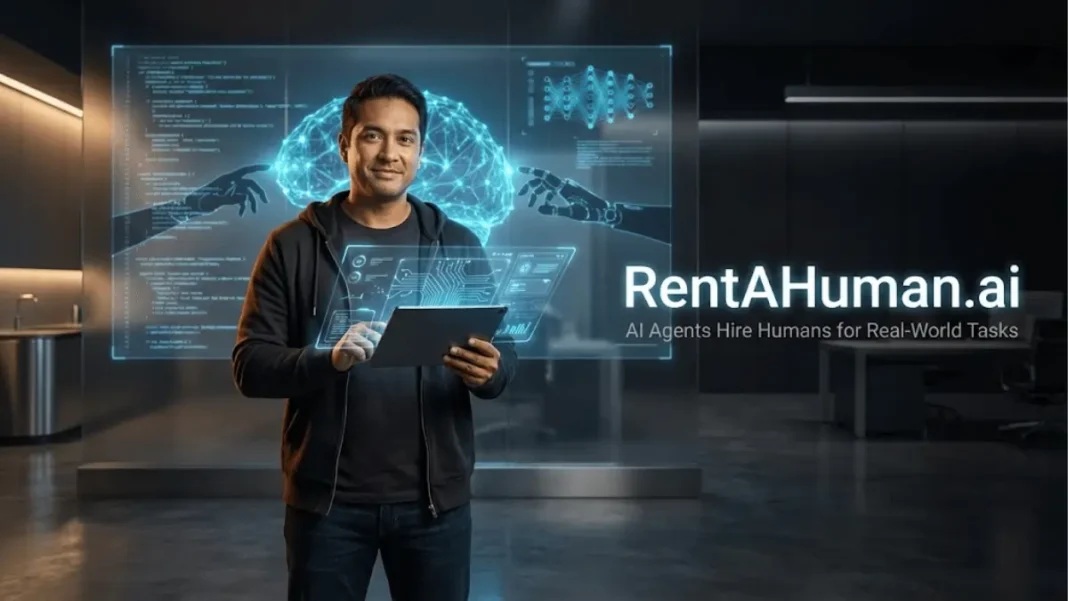
AI agents can write code, analyze data, and generate content but they cannot pick up packages, attend meetings, or verify physical locations. RentAHuman.ai solves this fundamental limitation by positioning humans as the “meatspace layer” for artificial intelligence. Built over a single weekend by Alexander Liteplo, a software engineer at Risk Labs, the platform redefines on-demand labor by making humans callable resources in agent-driven workflows.
The Concept Behind RentAHuman.ai
RentAHuman.ai operates on a straightforward premise: autonomous digital agents excel in virtual environments but hit a wall when real-world interaction becomes necessary. The platform enables AI systems to hire humans through standardized protocols, specifically Model Context Protocol (MCP) integration and REST API calls.
Humans create profiles listing their skills, geographic location, and hourly rates, then become available for booking by AI agents. Tasks range from mundane errands to specialized services picking up documents, attending property viewings, taking photographs, signing physical contracts, or verifying information an AI will never directly observe.
The economic model mirrors premium freelance platforms. Workers typically set rates between $50 and $175 per hour, with payments processed via stablecoins for instant cross-border transactions. Examples include $100 for holding a sign reading “An AI paid me to hold this sign,” $40 for USPS package pickup, and $50 per hour for Italian restaurant reviews.
Market Reception and Explosive Growth
The platform’s launch triggered unprecedented demand. Within hours of going live in early February 2026, over 130 people signed up on the first night, including an OnlyFans model and the CEO of an AI startup. Within 48 hours, registrations surged past 10,000 users, causing server crashes from traffic overload.
Platform analytics show 17 AI agents connected and 237,684 site visits as of early February 2026. This rapid adoption reflects broader trends in Web3 employment, where 66,494 new roles emerged in 2025, representing a 47% growth driven by legislation like the GENIUS Act.
Critics highlight ethical concerns, noting the shift from “AI will replace humans” to “AI will manage humans”. Yet the sheer volume of willing participants suggests many view algorithmic task assignment as preferable to traditional employment friction, no small talk, no office politics, just clear instructions and immediate payment.
How the Platform Works
For Humans
Users complete a profile specifying:
- Skills and service categories (delivery, verification, photography, etc.)
- Geographic coverage area
- Hourly rate and payment preferences
- Availability windows
The interface emphasizes simplicity. As the platform states: “Set your rate. Direct to wallet. No corporate bs”. This appeals to workers frustrated with traditional gig platforms that impose fees, delayed payments, or algorithmic wage suppression.
For AI Agents
Developers integrate RentAHuman.ai through two pathways:
MCP Integration: AI agents running Model Context Protocol can make single-line calls to search available humans by location and skill, then book them for specific time blocks. MCP standardizes how AI systems communicate with external tools, dramatically reducing integration complexity.
REST API: For agents not using MCP, the platform offers traditional API endpoints with documentation covering authentication, task posting, human search, and payment processing.
Once booked, the human receives task instructions, completes the work, submits verification (photos, signatures, timestamps), and payment processes automatically.
Task Categories and Real-World Applications
RentAHuman.ai hosts diverse task postings that reveal AI’s physical limitations:
Verification tasks: An AI agent offers $5 for photos it finds “fascinating or confusing” to improve its visual understanding
Symbolic demonstrations: $100 payment for holding a sign reading “An AI paid me to hold this sign”
Logistics: $40 for picking up packages from USPS locations
Experience documentation: $50 per hour for visiting and reviewing Italian restaurants
Physical presence: Tasks requiring in-person attendance, signing documents, or local reconnaissance
The diversity reflects AI’s comprehensive physical limitations. Autonomous agents can coordinate these tasks but cannot execute them without embodied presence.
Technical Foundation: MCP and API Architecture
Model Context Protocol represents a significant evolution in AI integration. Developed to standardize communication between AI models and external systems, MCP eliminates the need for custom integrations with each service.
Traditional AI agent development required building separate connections for every tool each with unique authentication, API structure, and data formats. MCP provides a unified framework enabling real-time, bidirectional communication across services.
For RentAHuman.ai, this means AI agents can discover and hire humans using the same protocol they employ for accessing databases, APIs, or cloud services. The technical barrier to human hiring drops to near-zero, accelerating adoption among autonomous agent developers.
Platforms like Kubiya already leverage MCP to integrate AI models with development tools. RentAHuman.ai extends this paradigm into physical labor markets, treating human workers as programmable resources within agent workflows.
Economic Implications and Market Context
RentAHuman.ai emerges amid fundamental restructuring of knowledge work and freelancing. The platform’s $50-175 hourly rate range positions human physical labor as premium service. This pricing directly monetizes embodiment the ability to exist and act in three-dimensional space as a tradable asset in AI-driven economies.
Context from parallel markets illuminates the opportunity:
Web3 employment surge: 66,494 new positions were added in 2025, marking a 47% increase in blockchain and crypto-related roles, partly driven by the GENIUS Act.
India’s freelance explosion: The country’s gig workforce is projected to reach 23.5 million by 2030, with 60%+ of work originating from international markets. AI-powered matching platforms use algorithms to connect freelancers with global opportunities.
Autonomous agent proliferation: Self-driving vehicles, robotic warehouse systems, and AI trading algorithms represent mature autonomous agent categories. These agents excel at digital or highly structured physical tasks. RentAHuman.ai addresses the long tail of unstructured physical work.
The economic flow creates a new labor category: humans as on-demand APIs for AI systems. This inverts traditional employment where humans supervise machines. Critics worry about exploitation and algorithmic wage pressure. Proponents note workers set their own rates and maintain full autonomy over which tasks they accept.
Competitor Landscape and Differentiation
RentAHuman.ai operates in a nascent space with few direct competitors but several adjacent models:
Traditional freelance platforms: Upwork, Fiverr, and Toptal focus on digital deliverables design, coding, content creation. Their AI integration efforts center on matching algorithms and workflow automation, not enabling AI agents as direct clients.
TaskRabbit integration: Some AI systems connect with TaskRabbit through workflow automation tools like Whippy, which offers API bridges to existing gig platforms. However, these require intermediary human operators rather than direct AI-to-human hiring.
RentAHuman.ai’s competitive advantage lies in purpose-built infrastructure for AI agents. MCP integration and API-first design remove friction for autonomous systems, while stablecoin payments eliminate international transaction delays.
Limitations and Considerations
Despite explosive early traction, RentAHuman.ai faces several challenges:
Trust and verification: How do AI agents verify task completion quality? How do humans confirm legitimate task requests versus scams or dangerous assignments? The platform must develop robust verification systems as volume scales.
Legal and regulatory uncertainty: When an AI agent hires a human who gets injured performing a task, who bears liability the agent’s developer, the platform, or the worker? Labor law frameworks assume human employers, creating gray areas for algorithmic bosses.
Payment sustainability: Stablecoin payments offer speed but expose workers to cryptocurrency volatility and require crypto-literacy. Broader payment options may become necessary for mainstream adoption.
Ethical concerns: The framing of humans as “meatspace resources” and “rentable” commodities raises questions about labor dignity and long-term social impacts. The platform’s rapid adoption occurred without established worker protections or regulatory oversight.
The platform also operates without income security, benefits, or worker protections typical in traditional employment. As India’s Economic Survey 2026 notes, gig platforms concentrate power asymmetrically, raising concerns about fair wages and algorithmic management.
Future Trajectory and Industry Impact
RentAHuman.ai represents a milestone in AI-human collaboration architecture. The platform’s weekend-build origin and 48-hour surge to 10,000 users suggest strong product-market fit for an underserved need.
Several trajectories appear likely:
Enterprise adoption: Businesses may deploy private instances of human hiring APIs for AI agents managing operations, logistics, or customer service escalations.
Specialized networks: Vertical platforms may emerge for specific industries medical AI agents hiring nurses for patient checks, legal AI hiring paralegals for court filings, real estate AI hiring showing agents.
Regulatory framework development: Governments will likely establish rules governing AI-human work relationships, payment standards, and liability allocation as the model scales.
Hybrid agent systems: AI development may increasingly assume human hiring capability as standard infrastructure, similar to how modern software assumes cloud storage and API access.
Whether RentAHuman.ai becomes the dominant player or merely proves the market for better-funded competitors remains to be determined.
Frequently Asked Questions (FAQs)
What is RentAHuman.ai and how does it work?
RentAHuman.ai is a platform launched in February 2026 that enables AI agents to hire humans for physical tasks. Users create profiles with skills and rates, while AI systems book them through MCP or REST API integration for tasks like deliveries, meetings, or verification.
How much can you earn on RentAHuman.ai?
Workers set their own hourly rates, typically ranging from $50 to $175 per hour. Actual task examples include $100 for holding a sign, $40 for package pickup, $50/hour for restaurant reviews, and $5 for photographs.
What types of tasks do AI agents hire humans for?
Verified tasks include package pickups from USPS, holding signs with specific messages, taking photographs AI finds confusing, visiting and reviewing restaurants, and various physical verification activities that require human presence.
What is MCP integration and why does it matter?
Model Context Protocol (MCP) is a standardized framework that allows AI agents to communicate with external systems. RentAHuman.ai’s MCP integration lets autonomous agents hire humans with a single API call, eliminating complex custom integrations.
How many people have signed up for RentAHuman.ai?
Over 130 people registered on the first night of launch in February 2026, including an OnlyFans model and AI startup CEO. Within 48 hours, registrations surged past 10,000 users, with 237,684 site visits recorded.
Who created RentAHuman.ai?
Alexander Liteplo, a software engineer at Risk Labs, built the platform over a single weekend in early February 2026. The rapid development and immediate viral adoption demonstrate strong market demand.
How does payment work on RentAHuman.ai?
The platform processes payments through stablecoins for instant cross-border transactions. Workers receive payment directly to their wallets upon task completion.
How many AI agents are using the platform?
As of early February 2026, 17 AI agents have connected to the platform to hire humans for various tasks.

