

Quick Brief
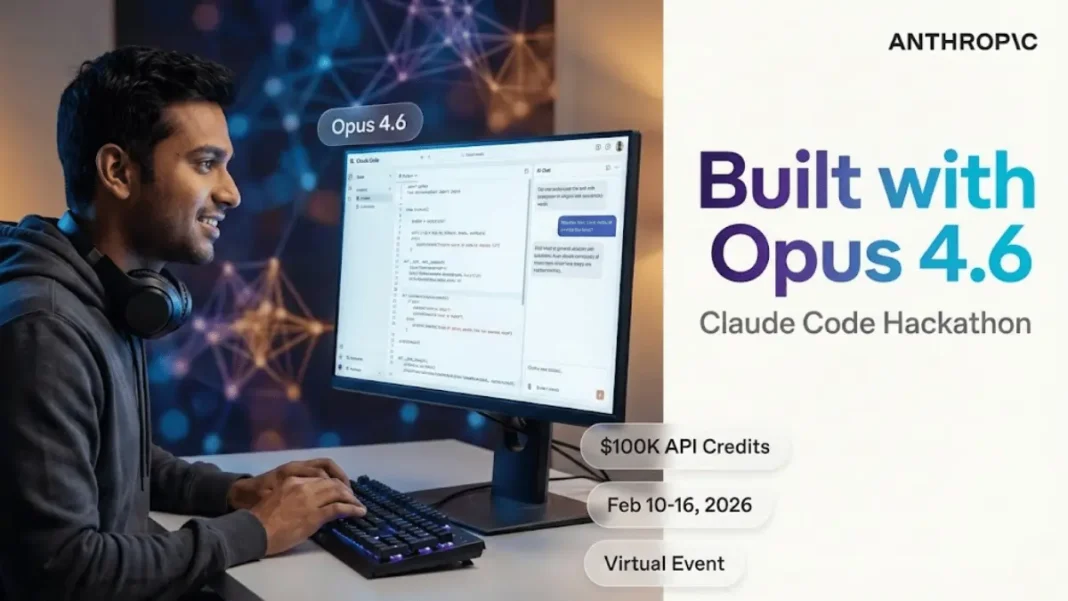
- Virtual hackathon runs February 10-16, 2026 with $100,000 in Claude API credits
- Opus 4.6 features 1M token context window and 128K output tokens at $5/$25 per million tokens
- Winners showcase projects at Claude Code’s 1st Birthday Party in San Francisco on February 21
- Six industry judges from Anthropic evaluate submissions with maximum team size of two developers
Anthropic has launched the Built with Opus 4.6 hackathon, marking Claude Code’s first anniversary with significant technical upgrades. This week-long virtual event introduces Opus 4.6, the company’s most capable model featuring a 1M token context window, the first for Opus-class models. Developers worldwide have six days to build applications and compete for $100,000 in API credits while testing breakthrough capabilities in code review and complex reasoning.
What Makes Opus 4.6 Different From Previous Models
Opus 4.6 builds on Opus 4.5 with enhanced context handling and output capabilities released February 5, 2026. The model introduces a 1M token context window (beta) compared to previous limitations, enabling developers to process entire codebases in a single session. Output tokens increased to 128K, allowing generation of longer code files and comprehensive documentation.
Anthropic maintains pricing at $5 per million input tokens and $25 per million output tokens, identical to Opus 4.5. The model ranks first on the Finance Agent benchmark, demonstrating superior performance in structured workflows requiring multi-step reasoning. While Sonnet 4.5 remains optimal for pure coding tasks, Opus 4.6 excels at complex problem-solving and agentic workflows where reasoning depth matters more than speed.
What is Opus 4.6’s primary technical advantage?
Opus 4.6 delivers a 1M token context window (beta) and 128K output tokens, the highest capacity in Anthropic’s Opus line. The model maintains pricing at $5/$25 per million tokens while improving code review and debugging capabilities. Released February 5, 2026, it targets complex reasoning tasks over pure coding speed.
Hackathon Structure and Timeline Details
The virtual event runs from February 10, 2026 at 12:00 PM EST through February 16, 2026 at 3:00 PM EST. Cerebral Valley and Anthropic host the competition with space limited to approved applicants only. Teams consist of maximum two developers who submit applications for review before gaining access.
Six judges from Anthropic’s Claude team evaluate submissions. Boris Cherny, Cat Wu, Thariq Shihpar, Lydia Hallie, Ado Kukic, and Jason Bigman assess projects based on technical innovation, implementation quality, and potential impact. Winners receive invitations to present their work at Claude Code’s 1st Birthday Party in San Francisco on February 21, 2026.
The fully virtual format eliminates geographical barriers, allowing participation from US, India, and global markets simultaneously. Developers access Claude Code’s environment with Opus 4.6 integration throughout the competition period. Submission deadlines remain strict with no extensions granted for technical issues or timezone conflicts.
Prize Structure and What Winners Receive
First-place winners claim $100,000 in Claude API credits distributed by Anthropic. These credits enable continued development of hackathon projects at Anthropic’s standard API pricing rates. The prize structure focuses exclusively on API credits rather than cash awards.
Beyond financial rewards, winning teams gain exposure through demonstration opportunities at the San Francisco birthday celebration. This visibility connects developers with Anthropic’s ecosystem of engineers and potential collaborators. All participants retain full intellectual property rights to their creations with no licensing obligations to Anthropic or Cerebral Valley.
How to Build Competitive Projects With Claude Code
Successful hackathon submissions demonstrate practical applications that judges evaluate on creativity, implementation quality, and potential impact. Projects should showcase Claude’s natural language capabilities and advanced reasoning skills rather than generic applications. The judges favor submissions with clear purpose and demonstrated technical innovation.
Opus 4.6 excels at creating autonomous agents that execute multi-step workflows requiring extended context. The 1M token window enables processing of large codebases, documentation, and data sets in single sessions. Developers can leverage improved code review capabilities for debugging tools, automated testing systems, and quality assurance applications.
How should developers structure their hackathon projects?
Focus on applications that leverage Opus 4.6’s 1M token context window and 128K output capabilities. Build working prototypes demonstrating clear value proposition rather than extensive documentation. Test projects with real scenarios during the event to validate functionality before final submission.
The model’s strengths lie in complex reasoning and multi-step agentic workflows rather than pure coding speed. Projects requiring deep analysis, comprehensive code review, or extended output generation align best with Opus 4.6’s architecture. Consider applications in finance, research automation, or systems requiring thorough documentation generation.
Registration Process and Eligibility Requirements
Applications require approval before developers gain event access. Interested participants submit forms through Cerebral Valley’s platform with details about their technical background and project concepts. The organizers review applications on a rolling basis with priority given to engineers, startup founders, and early-stage teams.
Maximum team size remains fixed at two developers with no individual exceptions granted. Solo participants compete on equal footing with paired teams across all evaluation criteria. All approved applicants must agree to intellectual property terms and code of conduct policies before receiving Claude Code access credentials.
The virtual format accommodates global participation without visa or travel requirements. Developers from India, United States, and other markets access identical resources and support channels. Time zone differences don’t impact judging as all submissions undergo evaluation after the February 16 deadline.
Industry Context and Competitive Landscape
Claude Code’s first anniversary coincides with Anthropic’s strategic positioning against competing AI development platforms in February 2026. The hackathon follows Opus 4.6’s February 5 release, giving developers minimal adaptation time before the competition begins. This timing suggests Anthropic’s confidence in the model’s immediate usability for production applications.
The $100,000 prize pool represents one of the larger API credit awards in recent AI hackathons. Other Anthropic-sponsored events typically offered $500-$3,000 in credits with smaller cash components. The increased investment signals Anthropic’s commitment to building a developer community around Claude Code and Opus 4.6 capabilities.
Opus 4.6 costs five times more than Sonnet 4.5 at equivalent usage levels, making the API credits particularly valuable for extended testing and development. The model’s higher pricing reflects its superior reasoning capabilities and expanded context handling suited for complex enterprise applications.
Limitations and Considerations for Participants
The one-week timeline creates intense pressure for developers balancing full-time employment with competition participation. Teams must scope projects realistically to deliver working demos rather than ambitious concepts with incomplete implementations. Historical Anthropic hackathons prioritize functional prototypes over comprehensive feature sets.
Virtual-only format eliminates in-person networking opportunities available at hybrid events. Developers miss spontaneous collaboration moments and mentor interactions that physical hackathons provide. Communication relies entirely on digital channels which can delay critical feedback during build sprints.
Opus 4.6’s higher pricing compared to Sonnet 4.5 means API credits deplete faster for projects requiring extensive testing. The 1M token context window operates in beta, potentially introducing stability issues during development. Teams should plan for fallback strategies if beta features encounter limitations during the competition period.

Frequently Asked Questions (FAQs)
When does the Claude Code hackathon start and end?
The Built with Opus 4.6 hackathon runs from February 10, 2026 at 12:00 PM EST through February 16, 2026 at 3:00 PM EST. This provides six full days of development time for approved participants.
How much are the Claude API credits worth?
Winners receive $100,000 in Claude API credits from Anthropic. At Opus 4.6 pricing of $5 per million input tokens and $25 per million output tokens, the credits support extensive development and testing.
Can solo developers participate or must teams include two members?
Both solo developers and two-person teams can compete. Maximum team size is strictly limited to two members with no exceptions. Solo participants compete under identical evaluation criteria as paired teams.
What qualifications do judges look for in winning projects?
The six-judge panel evaluates technical innovation, implementation quality, and potential impact. Projects demonstrating creative applications of Claude’s capabilities with clear purpose score highest. Judges favor functional prototypes over extensive documentation.
Do participants keep intellectual property rights to their projects?
Yes, developers retain full IP rights to hackathon creations with no licensing obligations to Anthropic or Cerebral Valley. Winners must agree to showcase their projects at the February 21 San Francisco celebration.
What makes Opus 4.6 different from Sonnet 4.5 for coding?
Opus 4.6 features 1M token context and 128K output tokens, excelling at complex reasoning and code review. Sonnet 4.5 remains superior for pure coding speed and costs five times less. Opus 4.6 targets applications requiring deep analysis over rapid iteration.
Are there geographic restrictions for participation?
No geographic restrictions exist for this virtual event. Developers from India, the United States, and all other countries can participate equally. Application approval is required regardless of location.
What is the 1M token context window used for?
The 1M token context window (beta) enables processing entire codebases, comprehensive documentation, and large datasets in single sessions. This capacity supports applications requiring extended context like automated code review and documentation generation.

