

Key Takeaways
- Mercedes-Benz S-Class 2026 features NVIDIA DRIVE AV L4-ready autonomous platform
- Partnership with Uber delivers premium robotaxi services through global mobility network
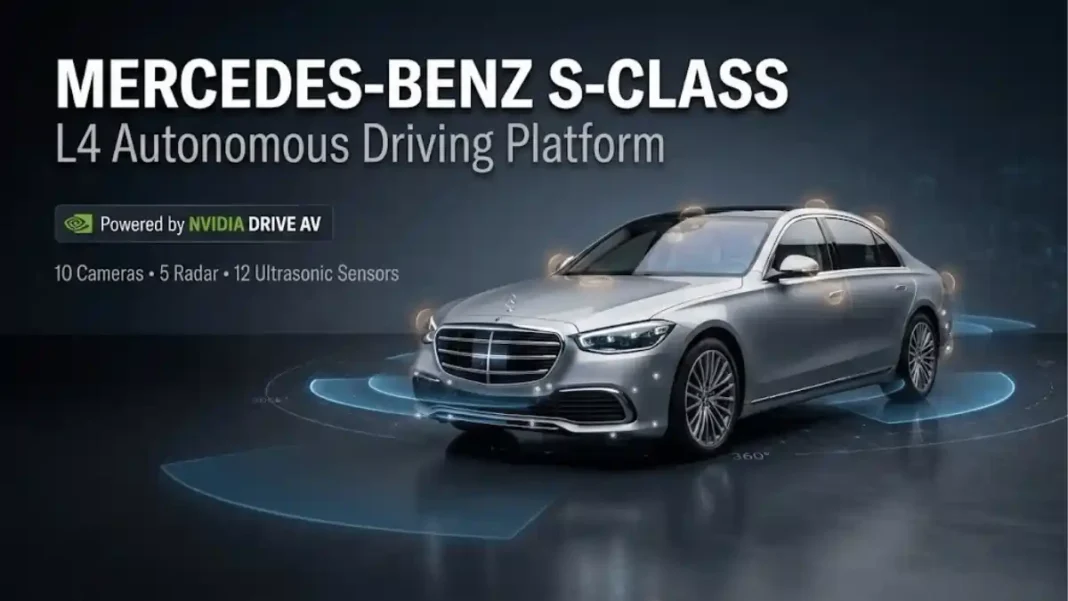
- DRIVE Hyperion architecture uses 10 cameras, 5 radar sensors, 12 ultrasonic sensors
- First on-road testing begins 2026 with planned markets across Americas, Europe, Asia, Middle East
Mercedes-Benz shattered conventional luxury boundaries on January 29, 2026, unveiling an S-Class built for the autonomous era. The German automaker’s collaboration with NVIDIA transforms 140 years of automotive safety engineering into AI-powered Level 4 autonomy, where vehicles operate without human intervention in defined operating zones. This partnership positions Mercedes to capture a share of the robotaxi market, projected to grow at approximately 60% CAGR through 2026.
What Makes the S-Class L4-Ready Architecture Different
The 2026 S-Class integrates NVIDIA DRIVE AV full-stack software with MB.OS, creating a safety-first autonomous system that goes beyond traditional automation. Unlike Level 2 or Level 3 systems that require driver readiness, Level 4 vehicles handle all driving tasks within specific geographic boundaries without human backup.
NVIDIA DRIVE AV processes sensor data through end-to-end AI and parallel classical driving stacks, analyzing complex environments rather than reacting to predetermined patterns. The system evaluates multiple decision paths simultaneously, selecting the safest outcome in real time when confronted with edge cases like aggressive cut-ins, debris, or unpredictable pedestrian behavior.

What distinguishes Level 4 from Level 3 autonomous driving?
Level 4 autonomous driving enables vehicles to handle all driving tasks within specific operating zones without requiring human intervention or attention. The driver can work, sleep, or remain absent from the vehicle entirely. Level 3 systems still require drivers to take control when prompted by the vehicle.
NVIDIA DRIVE Hyperion: Defense-in-Depth Hardware Architecture
The S-Class robotaxi platform runs on NVIDIA DRIVE Hyperion, a reference architecture integrating sensor diversity and hardware redundancy. This eliminates single points of failure through three core principles.
Redundant compute maintains operation if one processing element fails. The system continues autonomous driving even when individual hardware components experience faults or degradation.
Multimodal sensor diversity spans 10 cameras, 5 radar sensors, and 12 ultrasonic sensors to support robust perception across varying weather and lighting conditions. Each sensor type compensates for others’ limitations, ensuring continuous environmental awareness.
Software stack diversity pairs AI-driven decision-making with a parallel classical safety stack. The NVIDIA Halos safety system monitors both stacks continuously, keeping the vehicle within safe operational boundaries even when one stack encounters unexpected behavior.
| Component | Specification | Purpose |
|---|---|---|
| Cameras | 10 units | Visual perception, object recognition |
| Radar sensors | 5 units | Distance measurement, weather resilience |
| Ultrasonic sensors | 12 units | Close-range obstacle detection |
| Compute platform | NVIDIA DRIVE Hyperion | Redundant AI processing |
| Safety system | NVIDIA Halos | Multi-layer validation architecture |
Mercedes-Uber Partnership Brings Autonomous Rides to Global Markets
Mercedes-Benz and NVIDIA partnered with Uber Technologies to deploy S-Class robotaxis across Uber’s global mobility network. This collaboration makes premium autonomous experiences accessible through a platform already used by millions of riders worldwide.
The first S-Class robotaxi prototypes begin on-road testing in 2026, with deployments planned for the Americas, Europe, Asia, and the Middle East. “Together, Mercedes-Benz, Nvidia and Uber will build a global platform that makes autonomous driving available to everyone,” stated NVIDIA CEO Jensen Huang during the January 29, 2026 unveiling event.
Separately, Mercedes-Benz has established partnerships with Momenta and Lumo for autonomous shuttle services in Abu Dhabi, which utilizes different autonomous driving technology platforms.
How does NVIDIA Alpamayo enhance S-Class autonomous capabilities?
NVIDIA Alpamayo provides open AI models enabling vehicles to perceive, reason, and act with human-like judgment. The platform allows the S-Class to explain decision logic step-by-step, improving transparency and safety validation. Alpamayo integrates with DRIVE AV to handle long-tail driving scenarios not previously encountered.
Training and Validation: From Cloud to Road
NVIDIA DRIVE AV undergoes large-scale training on NVIDIA DGX systems before deployment. The AI models learn from massive datasets representing diverse driving scenarios, weather conditions, and geographic variations.
High-fidelity simulation validates the system using NVIDIA Omniverse NuRec libraries and NVIDIA Cosmos world foundation models. These tools reconstruct real-world data into interactive simulations, allowing engineers to test edge cases and rare scenarios without physical road testing.
The production-grade approach combines large-scale training, simulation validation, rigorous safety standards, and integration with Mercedes-Benz’s specific sensor configurations. This methodology enables both Level 2 point-to-point systems and Level 4-ready platforms to share core AI foundations while meeting different safety requirements.
Safety Leadership Extends Into the AI Era
Mercedes-Benz’s 140-year safety legacy transitions from passive crash protection to active accident prevention. The S-Class L4 architecture demonstrates this shift toward intelligent, predictive safety systems that identify and avoid hazards before collisions occur.
Independent testing supports this direction the Mercedes-Benz CLA received Euro NCAP’s Best Performer of 2025 designation, recognizing advanced driver assistance systems. The S-Class builds on this foundation with enhanced sensor arrays and more powerful compute platforms.
The L4-ready system combines end-to-end AI with parallel classical driving stacks, delivering predictable and reliable operation through diverse, multi-layered design. This approach reflects automotive safety entering a new era where AI systems actively predict and prevent accidents rather than solely protecting occupants during crashes.
Market Implications for Autonomous Mobility
The Mercedes-NVIDIA-Uber collaboration signals legacy automakers’ path toward autonomous services beyond vehicle sales. Mercedes positions the S-Class as a premium robotaxi platform, targeting customers seeking chauffeur-style experiences without human drivers.
The robotaxi market shows strong regional growth patterns, with projections indicating approximately 60% compound annual growth rate. Urbanization trends and regulatory frameworks enabling autonomous testing drive adoption across major global markets.
Mercedes CTO Jörg Burzer stated: “The next step on our roadmap is to enable a robotaxi service based on the new S-Class. These collaborations mark our entry into the robotaxi market with the S-Class and MB.OS as the perfect platform”.
Technology Integration and Future Readiness
The S-Class hardware readiness for Level 4 autonomy precedes regulatory approval in most markets. While the sensor suite and compute platform support full autonomy, activation depends on regional legislation and infrastructure development.
This hardware-first approach allows Mercedes to deploy software updates enabling autonomous features as regulations evolve. The MB.OS operating system provides over-the-air update capabilities, ensuring vehicles gain new capabilities throughout their lifecycle.
NVIDIA’s broader AI ecosystem, including Alpamayo open models and simulation tools, enables continuous improvement of autonomous driving algorithms. Partners and developers can refine the technology for specific use cases, accelerating industry-wide innovation while maintaining safety standards.
Limitations and Considerations
Level 4 autonomy operates within defined geographic zones called operational design domains. The S-Class robotaxi requires detailed mapping and infrastructure support for each deployment city, limiting initial availability to select markets.
Weather conditions and infrastructure quality affect autonomous system performance. Heavy rain, snow, or poorly maintained road markings can challenge sensor perception, requiring fallback protocols or restricted operation.
Regulatory frameworks vary significantly across regions, with some markets years away from approving Level 4 commercial operation. Hardware readiness does not guarantee immediate autonomous service availability.
Cost considerations may limit initial robotaxi deployment to premium markets and high-density urban areas where ride volumes justify infrastructure investment.
Frequently Asked Questions (FAQs)
When will Mercedes-Benz S-Class robotaxis be available for rides?
First S-Class robotaxi prototypes begin on-road testing in 2026, with commercial deployment timing dependent on regulatory approvals in each market. Uber network integration will enable riders to access autonomous S-Class vehicles through the existing Uber app once services launch.
What is the NVIDIA DRIVE AV platform used in the S-Class?
NVIDIA DRIVE AV is a full-stack autonomous driving software platform enabling Level 2 to Level 4 autonomy. It combines perception, prediction, planning, and control systems with NVIDIA Halos safety architecture, trained on DGX Cloud systems and validated through high-fidelity simulation.
How does the S-Class ensure safety in autonomous mode?
The S-Class uses NVIDIA DRIVE Hyperion architecture with redundant compute, multimodal sensors (10 cameras, 5 radar, 12 ultrasonic), and dual software stacks AI-driven plus classical safety. NVIDIA Halos safety system monitors all systems continuously to maintain safe operation boundaries.
Which markets will get Mercedes S-Class robotaxis first?
Mercedes-Benz plans deployments across Americas, Europe, Asia, and Middle East regions. Specific cities will be announced as testing progresses through 2026 and regulatory approvals are obtained.
What makes Level 4 different from Tesla’s Full Self-Driving?
Level 4 vehicles operate fully autonomously without requiring human attention or intervention within defined areas. Current production Tesla vehicles operate at Level 2, requiring continuous driver supervision and readiness to take control. Level 4 removes the driver from the responsibility chain entirely in supported zones.
How does NVIDIA Halos improve autonomous vehicle safety?
NVIDIA Halos applies safety-first architecture principles throughout the AI pipeline, from training to deployment. The system validates both AI and classical driving stacks continuously, provides explainable decision-making for transparency, and maintains redundant safety layers to eliminate single points of failure.

