

Quick Brief
- Anthropic confirms Claude will remain permanently ad-free across all conversation features
- Decision follows OpenAI’s January 2026 announcement to test ads in free ChatGPT tier
- Anthropic generates revenue through enterprise contracts and paid subscriptions instead of advertising
- Company analysis shows appreciable portion of Claude conversations involve sensitive or deeply personal topics
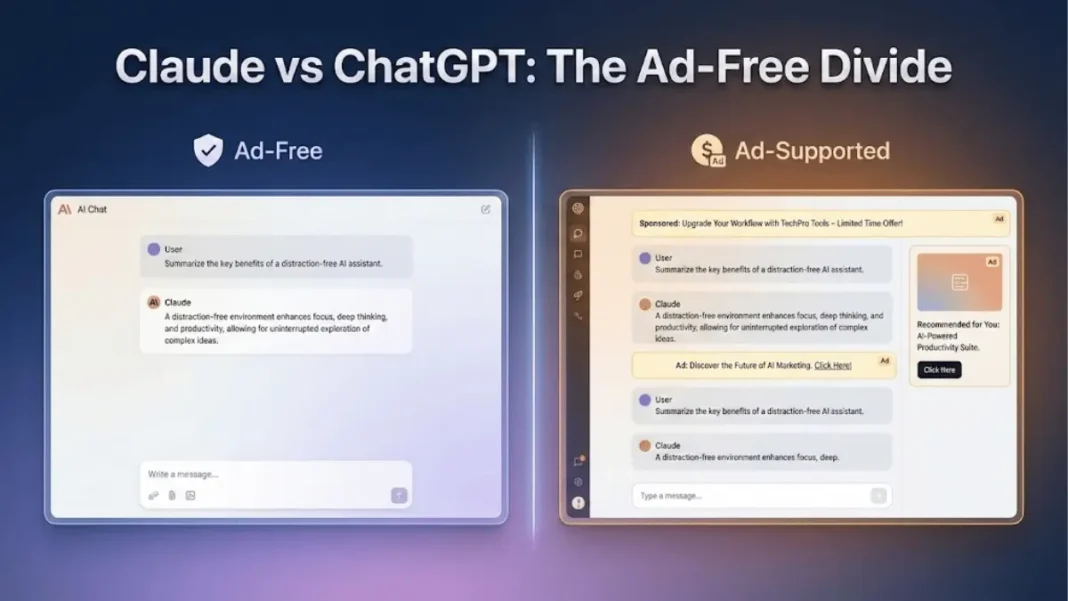
Anthropic has drawn a defining line in AI development. On February 4, 2026, the company announced Claude will never display advertisements, directly contrasting OpenAI’s move to monetize ChatGPT through sponsored content. This decision reflects fundamentally different philosophies about how AI assistants should serve users and who they ultimately work for.
The timing carries weight. OpenAI introduced ads to its free ChatGPT tier on January 15, 2026, alongside an $8-per-month “Go” subscription plan that still includes advertising. Anthropic’s response positions Claude as “a space to think” where commercial incentives won’t influence responses or clutter conversations.
Why Anthropic Rejected the Advertising Model
Anthropic’s leadership cited three core reasons for keeping Claude ad-free. First, AI conversations differ fundamentally from search engine queries or social media browsing. Users share context and reveal information in ways that create deeper vulnerability to commercial influence.
The company’s internal analysis of Claude conversations revealed that many involve sensitive topics the kind you’d discuss with a trusted advisor rather than in a public forum. Introducing ads into these contexts would feel “incongruous and often inappropriate,” according to Anthropic’s statement.
Second, advertising creates misaligned incentives. Anthropic used a concrete example: when a user mentions sleep trouble, an ad-free assistant explores various causes based on what helps the user most. An ad-supported assistant must also consider monetization opportunities. These objectives sometimes align but not always.
What makes Claude’s ad-free model different from ChatGPT?
Claude generates zero revenue from advertising, relying entirely on enterprise contracts and paid subscriptions ($20-$200 monthly). ChatGPT’s free tier and new $8 “Go” plan will display ads, while Plus ($20) and Pro ($200) subscribers avoid advertisements. Anthropic argues this keeps Claude’s incentives “unambiguously” aligned with user interests.

The Business Model Behind Ad-Free AI
Anthropic operates on subscription and enterprise revenue exclusively. The company stated its approach is “straightforward” revenue comes from paid users and business contracts, then gets reinvested into improving Claude. This model carries tradeoffs, primarily limiting free user access compared to ad-supported alternatives.
To expand reach without selling user attention, Anthropic has deployed targeted programs. The company brought AI tools to educators in 60+ countries, launched national AI education pilots with multiple governments, and offered nonprofits significant discounts. Free tier users still access frontier intelligence models, though Anthropic acknowledged it may introduce lower-cost subscription tiers with regional pricing where demand exists.
The contrast with OpenAI’s strategy is stark. While ChatGPT pursues consumer monetization through advertising, Claude focuses on business customers and power users willing to pay for uncompromised assistance. Industry analysts compare this to historic software licensing debates some companies chose advertising, others chose premium models.
How does advertising affect AI assistant responses?
Research shows advertising incentives can subtly steer AI behavior even when ads appear separately from responses. Engagement optimization maximizing time spent and return visits doesn’t always align with being genuinely helpful. The most useful AI interaction might be short and resolve requests without prompting further conversation. Anthropic noted that once introduced, advertising incentives “tend to expand over time” as they integrate into revenue targets.
What This Means for AI Competition in 2026
The divergence between Claude and ChatGPT reveals competing visions for AI’s commercial future. OpenAI’s advertising move reflects the scale challenge serving hundreds of millions of free users requires massive infrastructure investment. Ads provide a path to sustainable free tiers while monetizing attention.
Anthropic’s rejection suggests advertising fundamentally conflicts with AI assistant design principles. The company stated Claude’s Constitution defines “being genuinely helpful” as core to the model’s character. Advertising incentives would introduce objectives that could work against this principle.
Industry context matters. Global advertising spending is forecast to exceed $1 trillion in 2026 for the first time, with 71.6% of ad spend now algorithm-driven as AI transforms marketing strategies. Conversational commerce ads embedded in AI responses represent a growing segment of this market. OpenAI’s move positions ChatGPT to capture this revenue stream. Anthropic’s decision explicitly rejects it.
The philosophical divide extends beyond business models. Anthropic emphasized that early research on AI’s psychological impact shows both benefits and risks, including potential to reinforce harmful beliefs in vulnerable users. Adding advertising incentives “would add another level of complexity” that the company wants to avoid.
Claude’s Approach to Commerce Without Ads
Anthropic distinguished between advertising and useful commerce features. The company expressed interest in “agentic commerce” where Claude handles purchases or bookings end-to-end on a user’s behalf. This model keeps the AI working for the user rather than for advertisers.
Claude already supports third-party integrations with tools like Figma, Asana, and Canva. Anthropic plans to expand this toolkit while maintaining a core principle: interactions should be user-initiated, not advertiser-driven. When someone asks Claude about running shoes, mortgage rates, or restaurant recommendations, “Claude’s only incentive is to give a helpful answer”.
The company compared Claude to physical thinking tools notebooks, chalkboards, well-crafted instruments none of which display ads. This analogy frames AI assistants as cognitive extensions rather than attention-monetization platforms.
Will Claude ever introduce ads if growth slows?
Anthropic stated it will remain transparent if circumstances require revisiting the ad-free approach. The company acknowledged “tradeoffs” in its business model and respects that other AI companies might reach different conclusions. However, the February 2026 announcement positions ad-free service as central to Claude’s identity, not a temporary tactic.
Technical and Privacy Implications
The ad-free decision has technical consequences. Without advertising optimization, Claude’s interface design prioritizes task completion over engagement metrics. Anthropic noted the “most useful AI interaction might be a short one” that resolves user needs efficiently. Ad-supported models face pressure to extend conversations and increase return visits.
Privacy architecture also differs. Advertising typically requires user behavior tracking, interest profiling, and attribution systems. Anthropic’s analysis of Claude conversations uses privacy-preserving methods that keep data “private and anonymous”. Ad infrastructure would introduce additional data collection requirements.
The company’s Responsible Scaling Policy and Constitutional AI framework emphasize alignment with user interests over commercial optimization. Advertising would complicate these alignment efforts by introducing competing objectives during model training and deployment.
Limitations and Considerations
Anthropic’s ad-free stance carries constraints. Subscription-dependent revenue limits free tier generosity compared to ad-supported alternatives. Users unwilling or unable to pay face restricted access, even as Claude serves paying customers extensively.
The approach also depends on sustained enterprise demand. If business revenue falters, Anthropic would face pressure to reconsider advertising or introduce freemium limitations. The company’s transparency commitment suggests it would announce such changes openly, but market dynamics could force difficult decisions.
Competitors argue ads enable broader access. OpenAI’s model provides feature-rich free ChatGPT service to users who can’t afford subscriptions, with advertising offsetting costs. This democratization argument has merit advertising has historically made many services universally accessible.

Frequently Asked Questions (FAQs)
Is Claude completely free to use without ads?
Claude offers a free tier without ads, though with usage limits. Paid plans ($20-$200 monthly) provide expanded access while remaining completely ad-free. Anthropic generates revenue exclusively through subscriptions and enterprise contracts.
Why did Anthropic decide against ads when OpenAI introduced them?
Anthropic stated advertising creates misaligned incentives that conflict with Claude’s purpose as “a genuinely helpful assistant for work and deep thinking.” Analysis showed many conversations involve sensitive topics where ads would be inappropriate.
What is agentic commerce in Claude?
Agentic commerce allows Claude to handle purchases or bookings end-to-end on a user’s behalf. This differs from advertising because the AI works for the user rather than promoting advertiser products. Anthropic plans to expand these capabilities.
Does ChatGPT’s ad strategy affect Claude’s competitiveness?
OpenAI’s advertising enables broader free tier access, potentially attracting more users. Claude targets users prioritizing uncompromised assistance over free access. Anthropic focuses on enterprise customers and subscribers willing to pay for ad-free service.
Can Claude recommend products without ads?
Yes. When users ask Claude about products, mortgages, or services, Claude provides recommendations based solely on helpfulness. The company distinguishes between user-initiated research assistance and advertiser-driven product placements.
Will Anthropic reverse the ad-free decision if revenue declines?
Anthropic committed to transparency if circumstances require reconsidering the approach. The February 2026 announcement frames ad-free service as central to Claude’s identity, though the company acknowledged its business model involves tradeoffs.
How does the ad-free model affect Claude’s AI training?
Without advertising optimization, Claude’s training prioritizes task completion and genuine helpfulness over engagement metrics. Anthropic’s Constitutional AI framework emphasizes alignment with user interests, which advertising incentives could complicate.
What other AI assistants remain ad-free besides Claude?
Most enterprise-focused AI platforms avoid advertising, relying on business contracts and API revenue. Consumer-facing alternatives vary some use freemium models, others display ads. Claude distinguishes itself through explicit commitment to permanent ad-free service.

