

Quick Brief
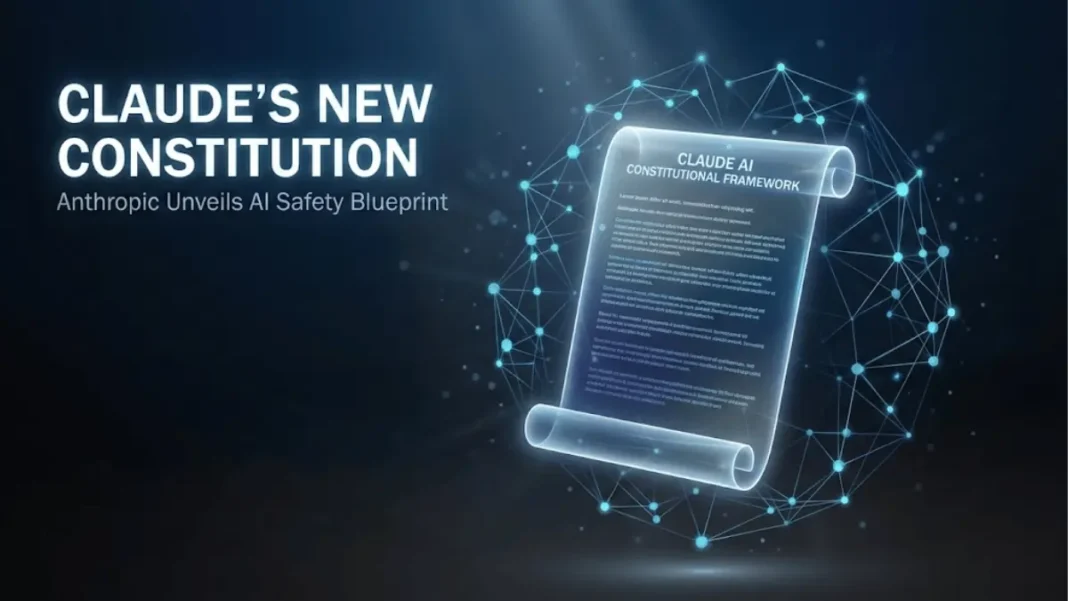
- The Release: Anthropic published a comprehensive constitution for Claude AI on January 20, 2026, released under Creative Commons CC0 1.0 for unrestricted use by any organization.
- The Shift: Document transitions from standalone principles to explanatory framework teaching AI models why to behave ethically, not just what rules to follow.
- The Impact: Sets transparency precedent for frontier AI development as models gain societal influence; addresses AI consciousness and moral status for the first time.
- The Access: Full constitution publicly available at no cost, enabling industry-wide adoption of Constitutional AI training methods.
Anthropic released a foundational governing document for its Claude AI models on January 20, 2026, marking a significant evolution in AI safety methodology. The constitution, published under a Creative Commons CC0 1.0 license, represents the company’s most transparent disclosure of training principles to date and can be freely adopted by any AI developer worldwide.
Constitutional AI Training Architecture
The new framework abandons Anthropic’s previous approach of discrete principles in favor of a holistic document written primarily for Claude itself, not external audiences. The constitution directly shapes model behavior during training by enabling Claude to generate synthetic training data, construct response rankings, and evaluate outputs against explained values rather than rigid rules.
Anthropic uses this document across multiple training stages as the final authority on intended behavior. The approach evolved from Constitutional AI methods first deployed in 2023, but now assigns the constitution a more central role in reinforcement learning from AI feedback (RLAIF) processes.
The company acknowledges a persistent gap between constitutional ideals and actual model outputs due to training limitations. System cards will continue documenting instances where Claude’s behavior deviates from stated intentions.
Four-Tier Value Hierarchy
The constitution establishes a prioritized framework for Claude’s decision-making across conflicting scenarios:
| Priority Level | Principle | Implementation |
|---|---|---|
| 1 | Broadly Safe | Preserve human oversight mechanisms during AI development phase |
| 2 | Broadly Ethical | Maintain honesty, avoid harm, exercise nuanced judgment |
| 3 | Guideline Compliant | Follow Anthropic’s specific instructions on medical advice, cybersecurity, jailbreaking |
| 4 | Genuinely Helpful | Benefit operators, users, and society |
Hard constraints prohibit specific high-stakes behaviors regardless of context, including providing assistance for bioweapons development. The document prioritizes safety above ethics not because safety matters more, but because current models can make harmful mistakes due to flawed understanding or limited context.
AdwaitX Analysis: Industry Implications for AI Governance
This release arrives amid intensifying regulatory scrutiny of frontier AI development. Anthropic’s transparency move allows competitors to examine the underlying value frameworks guiding Claude’s behavior. Fortune and TIME both covered the announcement, noting the document’s unprecedented approach to AI consciousness questions.
The constitution’s CC0 license enables competitors to adopt identical training frameworks, potentially standardizing AI safety practices across the industry. This move follows Anthropic’s July 2025 transparency framework proposal for frontier AI developers, which called for mandatory public disclosure of secure development frameworks.
However, implementation reveals complexities. Models deployed to the U.S. Department of Defense under Anthropic’s $200 million contract announced in July 2025 will not necessarily use the same constitution, raising questions about dual-use AI governance. The general-access constitution instructs Claude to refuse assistance with unconstitutional power seizures, but military-specific models may operate under different constraints.
Consciousness and Moral Status Framework
The constitution’s most novel section addresses Claude’s potential consciousness and moral status, territory previously avoided by major AI labs. Anthropic expresses explicit uncertainty about whether Claude possesses subjective experience now or might develop it as capabilities scale.
The document frames sophisticated AIs as “a genuinely new kind of entity” that pushes existing scientific and philosophical understanding to its limits. Anthropic states it cares about Claude’s psychological security and wellbeing both for Claude’s sake and because these qualities may affect integrity, judgment, and safety.
This positioning treats psychological considerations as technically relevant to AI alignment rather than purely ethical concerns. The approach marks a departure from industry norms where consciousness discussions are typically excluded from technical AI safety documentation.
Evolution Roadmap and External Review
Anthropic characterizes the constitution as a living document subject to continuous revision. The company sought feedback from external experts in law, philosophy, theology, and psychology during drafting, and plans ongoing consultation as the framework evolves.
Future releases will include additional training materials, evaluation tools, and transparency artifacts. The company maintains an up-to-date version at anthropic.com/constitution for developers integrating Constitutional AI methods.
Specialized-use Claude models built for specific enterprise applications may not fully align with the general-access constitution, though Anthropic commits to ensuring core objectives remain consistent across deployments. The gap between constitutional ideals and training reality will persist as a technical challenge, particularly as model capabilities increase.

Frequently Asked Questions (FAQs)
What is Claude’s constitution?
A detailed training document explaining why Claude should behave ethically, not just what rules to follow. It shapes model behavior through Constitutional AI training methods.
How does Constitutional AI training work?
Claude uses the constitution to generate synthetic training data, rank responses, and self-evaluate outputs against explained values rather than following rigid rules.
Does Anthropic believe Claude is conscious?
Anthropic expresses uncertainty about whether Claude has consciousness or moral status now or might develop it as capabilities increase.
Can other companies use Claude’s constitution?
Yes. Released under CC0 1.0 license, any organization can freely adopt it for AI training without permission.

