

Key Takeaways
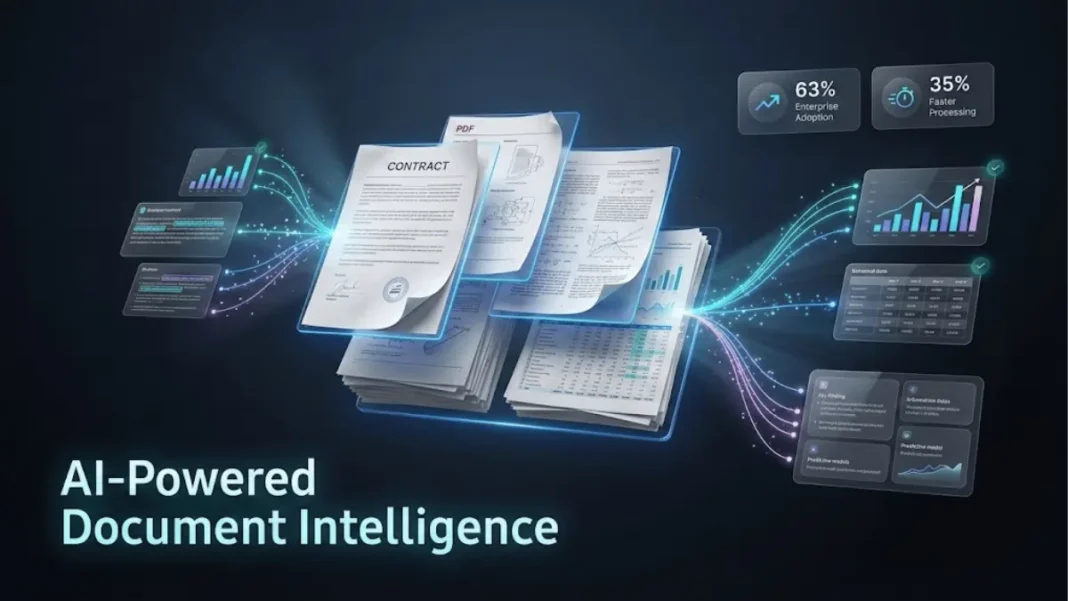
- 63% of Fortune 250 companies deployed intelligent document processing solutions, with financial sector leading at 71% adoption
- AI-powered IDP market valued between $2.3 billion and $10.57 billion in 2024-2025, projected to reach $91 billion by 2034
- NVIDIA Nemotron hybrid Mamba-Transformer architecture delivers 35% higher throughput in multi-page document processing
- Organizations automate document workflows using AI agents that extract tables, charts, and text while maintaining citation transparency
Businesses lose critical insights buried inside unstructured documents reports, contracts, PDFs, spreadsheets, and presentations that teams process manually. AI agents built on NVIDIA Nemotron open models now automatically extract, understand, and transform these documents into actionable business intelligence within seconds. Organizations from financial services to scientific research are deploying these systems to eliminate manual data entry, reduce errors, and accelerate decision-making across operations.
What Is Intelligent Document Processing and Why It Matters Now
Intelligent document processing represents an AI-powered workflow that automatically reads, understands, and extracts insights from documents containing complex formats tables, charts, images, and text. Unlike traditional optical character recognition (OCR) tools that simply scrape text, modern IDP systems use AI agents and retrieval-augmented generation (RAG) to interpret document semantics, recognize structure, and provide context other systems can immediately use.
The technology has reached critical mass. The global intelligent document processing market was valued at $2.3 billion in 2024 according to GM Insights, while Fortune Business Insights reports $10.57 billion in 2025, with both firms projecting growth to approximately $91 billion by 2034 at compound annual growth rates exceeding 24%. This explosive growth reflects fundamental shifts in how enterprises handle information.
Manual document processing creates operational bottlenecks. Teams copy data into spreadsheets, build dashboards manually, and use basic search tools that miss important details in complex media. These legacy approaches cannot scale to the volume, variety, and velocity of documents modern businesses generate.

AI Document Intelligence Solves Four Critical Business Problems
Modern AI-powered document intelligence systems deliver capabilities impossible with traditional tools. These systems understand rich document content, moving beyond simple text scraping to capture information from charts, tables, figures, and mixed-language pages by recognizing structure, relationships, and context.
They handle large quantities of shifting data by ingesting and processing massive document collections in parallel while keeping knowledge bases continuously updated. Advanced retrieval mechanisms help AI agents pinpoint the most relevant passages, tables, or paragraphs to specific queries, enabling responses with precision and accuracy.
Critically for regulated industries, these systems show the evidence behind answers by providing citations to specific pages or charts, delivering transparency and auditability. This transforms static document archives into living knowledge systems that directly power business intelligence, customer experiences, and operational workflows.
Real-World Impact: Three Industries Getting Measurable Results
Financial Services: Automated Chargeback Recovery
Payment disputes create significant revenue loss for merchants because evidence needed to handle them lives in unstructured formats across fragmented systems. Justt.ai built an AI-driven platform that automates the full chargeback lifecycle at scale, connecting directly to payment service providers and merchant data sources.
The platform’s dispute optimization, powered by NVIDIA Nemotron Parse, applies predictive analytics to determine which chargebacks to fight or accept, then optimizes each response for maximum net recovery. Leading hospitality operators like HEI Hotels & Resorts use the system to automate dispute handling across properties, recapturing revenue while maintaining guest relationships.
Contract Management: Enterprise Agreement Intelligence
Docusign handles millions of transactions daily for over 1.8 million customers and 1 billion users globally. Critical information buried inside agreement pages requires high-fidelity extraction of tables, text, and metadata from complex PDFs so organizations can understand and act on obligations, risks, and opportunities faster.
Docusign is evaluating Nemotron Parse for deeper contract understanding at scale. Running on NVIDIA GPUs, the model combines advanced AI with layout detection and OCR to reliably interpret complex tables and reconstruct required information, reducing manual corrections. This transforms agreement repositories into structured data that powers contract search, analysis, and AI-driven workflows.
Scientific Research: Literature Synthesis at Scale
Edison Scientific’s Kosmos AI Scientist helps researchers navigate complex scientific landscapes to synthesize literature, identify connections, and surface evidence. The challenge involved rapidly and accurately extracting structured information from large volumes of PDFs, including equations, tables, and figures that traditional parsing methods mishandle.
By integrating NVIDIA Nemotron Parse into its PaperQA pipeline, Edison decomposes research papers, indexes key concepts, and grounds responses in specific passages, improving both throughput and answer quality. This approach turns sprawling research corpuses into interactive, queryable knowledge engines that accelerate hypothesis generation and literature review.
The Technology Stack: Four Components That Make It Work
Modern document intelligence pipelines built on NVIDIA technologies handle extraction, embedding, reranking, and parsing while keeping data secure and compliant.
Extraction uses Nemotron extraction and OCR models to rapidly ingest multimodal PDFs, text, tables, graphs, and images, converting them into structured, machine-readable content while preserving layout and semantics.
Embedding converts passages, entities, and visual elements into vector representations tuned for document retrieval using Nemotron embedding models, enabling semantically accurate search.
Reranking evaluates candidate passages with Nemotron reranking models to ensure the most relevant content surfaces as context for large language models, improving answer fidelity and reducing hallucinations.
Parsing deciphers document semantics to extract text and tables with precise spatial grounding and correct reading flow using Nemotron Parse models. These models overcome layout variability and turn unstructured documents into actionable data that enhances the accuracy of LLMs and agentic workflows.
These capabilities are packaged as NVIDIA NIM microservices and foundation models that run efficiently on NVIDIA GPUs. The hybrid Mamba-Transformer architecture offers 35% higher throughput in long multi-page document understanding scenarios compared to previous architectures.
Market Momentum: Adoption Accelerating Across Enterprise Segments
Enterprise adoption of intelligent document processing has reached critical scale. 63% of Fortune 250 companies have implemented IDP solutions, with the financial sector leading at 71% adoption. This represents a fundamental shift from experimental technology to essential operational tool.
The United States dominates with 40% of global IDP market share in 2024, driven by sophisticated digital infrastructure, high business adoption, and availability of key technology providers. Cloud deployment accounts for 60% of implementations, valued for scalability, flexibility, and cost-effectiveness.
Asia Pacific is expected to expand at 34.76% CAGR from 2025 to 2032, driven by accelerating digital transformation in emerging economies. Enterprises in India, China, and Southeast Asia are increasingly automating document-intensive workflows through cloud-based IDP offerings, supported by government digitization initiatives.
Small and medium enterprises represent the fastest-growing segment, projected to exhibit 33.42% CAGR from 2025 to 2032 as cloud-based and economical IDP solutions gain widespread adoption. The services segment is anticipated to grow at 33.83% CAGR as organizations seek professional assistance in implementing IDP solutions, training models, integrating systems, and continuous optimization.
Why Open Models Matter for Document Intelligence
The most effective AI systems use a mix of frontier models and open source models like NVIDIA Nemotron, with an LLM router analyzing each task and automatically selecting the model best suited for it. This approach keeps performance strong while managing computing costs and improving efficiency.
NVIDIA Nemotron open models have produced strong results on leaderboards including MTEB, MMTEB, and ViDoRe V3, benchmarks for evaluating multilingual and multimodal retrieval models. Teams can choose from among the best models for tasks like search and question answering.
Organizations can build AI-powered document intelligence systems while keeping sensitive data within their chosen cloud or data center environment. This addresses critical requirements for regulated industries where data residency and compliance drive technology decisions.
Natural language processing technology is expected to register 33.65% CAGR from 2025 to 2032 as companies increasingly demand contextual awareness and semantic examination of complex text data. NLP allows IDP platforms to understand language patterns, categorize content, and derive meaning from emails, contracts, and legal documents.
Implementation Considerations and Real-World Limitations
Organizations deploying intelligent document processing face several practical considerations. While IDP significantly reduces manual effort, initial implementation requires expertise in AI model selection, integration with existing systems, and training on domain-specific documents.
Document quality affects extraction accuracy. Heavily degraded scans, handwritten content, or unusual layouts may require additional preprocessing or human review. Organizations should establish quality thresholds and exception handling workflows.
Cost structures vary significantly between deployment models. Cloud-based solutions offer lower upfront costs but ongoing subscription expenses, while on-premise deployments require infrastructure investment but provide greater control over sensitive data.
Nearly 90% of organizations intend to scale automation initiatives enterprise-wide in the next 2-3 years. Success requires change management, staff training, and clear metrics to measure ROI beyond simple cost reduction.
Getting Started With Document Intelligence Systems
Organizations can begin with NVIDIA’s step-by-step tutorial on building a document processing pipeline with RAG capabilities. The NVIDIA Blueprint for Enterprise RAG is available on build.nvidia.com, GitHub, and the NGC catalog.
Nemotron RAG models and the NVIDIA NeMo Retriever open library are available on GitHub and Hugging Face, along with Nemotron Parse. Developers can experiment with these tools to understand capabilities before committing to production deployments.
The government of India launched the IndiaAI Intelligent Document Processing Challenge in November 2025 to develop robust, scalable, accurate, and secure AI engines leveraging advanced OCR and NLP. This initiative aims to manage end-to-end document processing for diverse sources including certificates, affidavits, disciplinary proceedings, transcripts, identity cards, and promotion files.

Frequently Asked Questions (FAQs)
What is the difference between OCR and intelligent document processing?
Traditional OCR simply extracts text from images without understanding context or structure. Intelligent document processing uses AI agents to interpret document semantics, recognize relationships between elements, and extract meaning from complex layouts including tables, charts, and mixed media. IDP provides structured, actionable data rather than raw text.
How accurate are AI agents at extracting data from complex documents?
NVIDIA Nemotron models achieve leading accuracy on OCRBench v2 benchmarks for document understanding. The hybrid Mamba-Transformer architecture delivers 35% higher throughput in long multi-page document scenarios compared to previous architectures. Organizations typically see significant reduction in manual corrections when processing complex tables and layouts.
What is the typical ROI timeline for implementing intelligent document processing?
Organizations reduce manual document review effort immediately upon deployment, with measurable operational improvements in weeks to months. Cloud-based implementations typically deploy faster than on-premise solutions. Nearly 90% of organizations plan to scale automation initiatives enterprise-wide within 2-3 years.
Can intelligent document processing handle handwritten documents?
Modern IDP systems can process handwritten text alongside printed content. Accuracy varies based on handwriting legibility, document quality, and whether the system was trained on similar handwriting samples. Mixed documents containing both printed and handwritten elements require specialized processing pipelines.
How does intelligent document processing ensure data security and compliance?
NVIDIA NIM microservices and foundation models run on-premise or in chosen cloud environments, allowing organizations to maintain data residency requirements. This addresses regulatory compliance in sectors like healthcare, finance, and legal services. Organizations maintain full control over sensitive data throughout the processing pipeline.
What industries benefit most from AI-powered document processing?
Financial services leads with 71%

