

Quick Brief
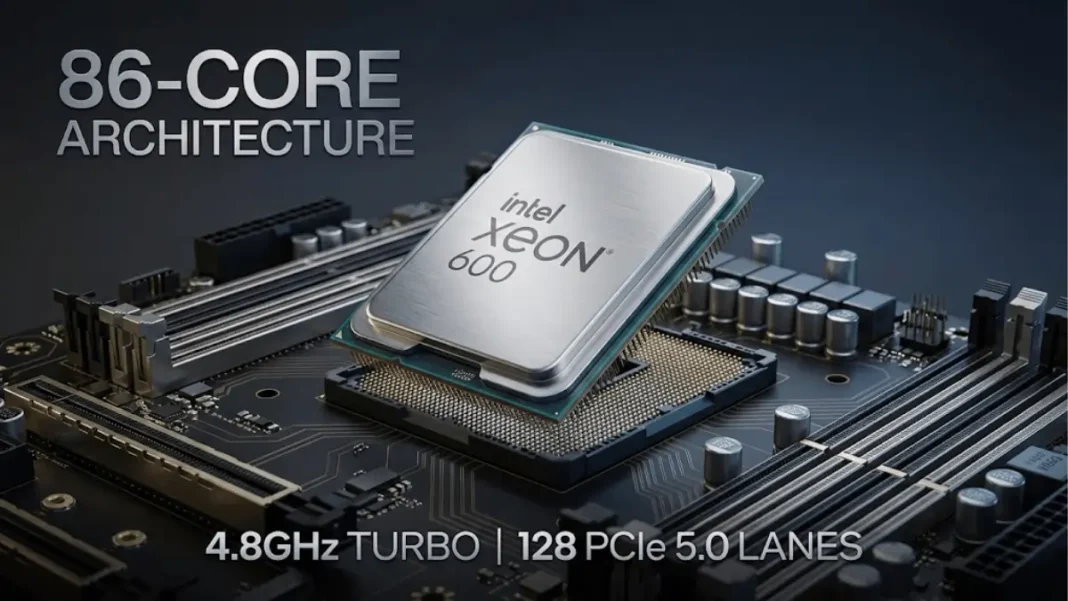
- Intel Xeon 600 scales to 86 P-cores with 4.8GHz turbo on Intel 3 process technology
- Multi-thread performance jumps 61% compared to 64-core W3595X at same power envelope
- DDR5 MRDIMM memory support reaches 8,000 MT/s, doubling prior generation bandwidth
- Five boxed SKUs launch late March 2026 from 18-core 654 to 64-core 696X models
Intel fundamentally rewrote workstation processor expectations on February 2, 2026. The Xeon 600 family isn’t an incremental update, it’s a complete platform overhaul targeting data scientists, simulation engineers, and content creators who need compute density without cloud dependency. Where the previous W-3500 series topped out at 60 cores, Intel now delivers 86 cores with architectural improvements that extend beyond raw threading.
Core Architecture: Redwood Cove+ Meets Intel 3
Intel Xeon 600 processors utilize Redwood Cove+ microarchitecture manufactured on Intel 3 process technology. This combination enables higher core densities while maintaining single-thread responsiveness. The flagship Xeon 698X packs 86 performance cores into a workstation form factor, each running up to 4.8GHz in turbo mode.
The architectural shift from Sapphire Rapids to Granite Rapids brings measurable gains. Single-thread performance improves 9% in Cinebench 2026 testing, addressing the criticism that prior Xeon workstation chips sacrificed clock speeds for core count. Multi-thread workloads see the 61% performance increase Intel emphasizes against the 64-core W3595X baseline.
What makes Intel Xeon 600’s architecture different from previous generations?
Intel Xeon 600 uses Redwood Cove+ cores on Intel 3 process technology, increasing core counts to 86 while maintaining 4.8GHz turbo frequencies. The redesigned architecture adds FP16 datatype support in Intel AMX accelerators, delivering 17% faster AI workload performance versus W-3500 series.
Memory Subsystem: 8-Channel DDR5 at 8,000 MT/s
Memory bandwidth becomes the limiting factor in workstation workflows once core counts exceed 32. Intel addresses this with octa-channel DDR5 support across X-series SKUs. Standard RDIMM configurations reach 6,400 MT/s a 33% increase from the previous 4,800 MT/s ceiling.
The breakthrough arrives with DDR5 MRDIMM (Multiplexed Rank DIMM) support, pushing speeds to 8,000 MT/s. This matters for memory-bound operations like fluid dynamics simulations and large dataset manipulations. Maximum capacity hits 4TB per system. Error-correcting code (ECC) memory remains standard, maintaining data integrity during multi-day rendering jobs.
Platform Connectivity: 128 PCIe 5.0 Lanes
Modern workstation builds demand connectivity for multiple GPUs, NVMe arrays, and high-speed network adapters. Intel Xeon 600 provides 128 lanes of PCIe 5.0 bandwidth directly from the CPU. This eliminates the lane-sharing compromises forced by consumer platforms.
A typical configuration might allocate 64 lanes to dual professional GPUs, 32 lanes to eight NVMe Gen5 drives, and 16 lanes to CXL 2.0 memory expansion modules. The remaining bandwidth handles network cards and capture devices without bottlenecking. CXL 2.0 support enables memory pooling across multiple systems relevant for render farms and AI training clusters.
The W890 chipset complements CPU connectivity with integrated Wi-Fi 6E and discrete Wi-Fi 7 support. For environments requiring deterministic network performance, multiple 10GbE ports can be added without stealing GPU lanes.
AI Acceleration: FP16 Support in Intel AMX
Intel Advanced Matrix Extensions (AMX) appear in Xeon 600 cores with a critical update: FP16 datatype support. Previous generations handled BF16 and INT8 operations, but FP16 is the native format for many AI frameworks including PyTorch and TensorFlow.
SPECworkstation 4.0 AI benchmarks show 17% performance gains versus the W9-3595X when running machine learning inference tasks. Intel attributes this to AMX executing FP16 matrix multiplications without type conversion overhead. The company released Open Image Denoise 2.4 specifically optimized for Xeon 600’s FP16 capabilities.
Topaz Labs Video Upscaler, a tool content creators use for AI-based resolution enhancement runs 29% faster on the Xeon 698X compared to prior generation processors. This translates to hours saved when upscaling feature-length footage from 1080p to 4K.
For organizations comparing on-device AI versus cloud inference: Xeon 600 eliminates data egress costs and latency while maintaining full control over proprietary datasets.
How does Intel Xeon 600 perform in AI workloads?
Intel Xeon 600 delivers 17% faster AI performance through FP16 datatype support in AMX accelerators. Real-world testing shows 29% speed improvements in Topaz Labs Video Upscaler and accelerated performance in PyTorch inference tasks compared to W-3500 series.
Performance Claims: 61% Multi-Thread Gain
Intel’s headline claim compares the 86-core Xeon 698X against the 64-core W3595X in Cinebench 2026. The 61% multi-thread improvement aligns with the 34% core count increase (86 vs 64), with architectural enhancements contributing additional performance through improved power efficiency and cache optimization.
Blender Junkshop rendering completes 74% faster on the Xeon 698X versus the W9-3595X, a scenario where thread scaling matters more than per-core frequency. Financial services workloads in SPEC Workstation 4.0 show the same 61% advantage, while life sciences applications also demonstrate double-digit improvements.
Not all workloads scale equally. SPEC’s productivity category showed minimal performance differences between high-core-count configurations, indicating office applications don’t leverage the additional cores effectively. Professionals should match core counts to their specific applications a 48-core Xeon 678X may deliver better value than the 86-core flagship for workloads that saturate at 32 threads.
Overclocking Records: ASUS Partnership Delivers
Intel partnered with ASUS’s overclocking team to push Xeon 600 beyond stock specifications. Using an ASUS Pro WS W890E-SAGE SE motherboard and extreme cooling, the Xeon 698X set 10 world records on HWBot as of February 2, 2026.
Notable achievements include Geekbench 4 and 5 Multi-Core records, Y-Cruncher benchmarks from 25 million to 28 billion digits, and 3DMark CPU Profile Max Cores. An additional 10 global first-place submissions span Cinebench R15 through R23, demonstrating sustained performance across workloads.
X-series SKUs include unlocked multipliers with advanced tuning options: per-core voltage control, AVX2/AVX512 ratio offsets, and per-CDIE (chiplet die) ring/mesh frequency adjustments. New features include undervolt protection baselines and per-core performance limit reporting useful for identifying thermal or power bottlenecks during tuning.
Professionals should note that overclocking voids warranties and reduces system stability for production environments. Stock configurations with proper cooling deliver reliable performance without the risks of extreme tuning.
What overclocking features does Intel Xeon 600 offer?
Intel Xeon 600 X-series SKUs include unlocked multipliers with per-core voltage control, AVX offset tuning, and mesh frequency adjustments. The Xeon 698X set 10 HWBot world records including Geekbench Multi-Core and Cinebench benchmarks when paired with ASUS Pro WS W890E-SAGE SE motherboard.
SKU Lineup: 18 to 86 Cores
Intel will release five boxed Xeon 600 processors for individual purchase starting late March 2026:
- Xeon 654 (18 cores): Entry workstation tier for CAD and design workflows
- Xeon 658X (24 cores): Mid-range option balancing core count and frequency
- Xeon 676X (32 cores): Sweet spot for simulation and rendering tasks
- Xeon 678X (48 cores): High-thread applications like video encoding
- Xeon 696X (64 cores): Maximum performance in boxed processor format
The Xeon 698X (86 cores) appears in OEM systems from Dell, HP, and Lenovo but won’t sell as a boxed processor. This strategy limits the flagship to validated system configurations while giving enthusiasts access to 64-core performance.
Non-X SKUs lack overclocking support and reduce PCIe lanes to 64, targeting users who prioritize stability over tunability. All SKUs maintain ECC memory support and Intel vPro enterprise management features.
Use Cases: Who Needs 86 Cores
Data scientists training large language models locally benefit from high core counts combined with AMX acceleration. The ability to process datasets without cloud uploads addresses data sovereignty requirements in healthcare and finance sectors.
Engineering teams running computational fluid dynamics (CFD) or finite element analysis (FEA) see performance scaling that benefits from both the increased core count and the octa-channel DDR5 configuration at 8,000 MT/s. This extends threading efficiency compared to consumer platforms with limited memory bandwidth.
Media and entertainment workflows span the range. The 74% Blender rendering improvement demonstrates how 3D visualization and ray tracing scale effectively to 86 cores. The Topaz Labs improvements show real-world AI integration in content creation pipelines.
Organizations replacing 3-5 year old dual-socket Xeon E5 systems gain single-socket simplicity with equivalent or better performance. Power consumption optimization improves while maintaining or exceeding prior multi-socket threading capabilities.
Competitive Landscape: Platform Differentiation
Memory capacity distinguishes Intel’s approach: Xeon 600 supports up to 4TB maximum configuration. Applications that load entire datasets into RAM molecular dynamics, genomic analysis, large-scale simulations favor this configuration. PCIe lane counts reach 128 for flagship SKUs.
The boxed SKU strategy provides five retail purchase options, contrasting with OEM-focused approaches from competitors. Professionals with existing Intel workflows and ISV certifications may favor Xeon 600 for compatibility and ecosystem support.
Neither workstation-class platforms include consumer features like integrated graphics or NPUs these are purpose-built processors expecting discrete GPUs and PCIe accelerators.
Enterprise Features: vPro and Security
Intel vPro technologies integrate throughout Xeon 600 processors. Multi-key total memory encryption (TME-MK) isolates virtual machines at the hardware level critical for multi-tenant environments.
Intel One-Click Recovery enables IT teams to restore compromised systems to known-good states remotely, reducing downtime from security incidents. Firmware version control through Intel Transparent Supply Chain prevents unauthorized BIOS modifications.
Out-of-band management via Wi-Fi extends remote administration beyond traditional wired connections. Technicians can troubleshoot and repair systems without physical access, useful for distributed teams or secure facilities.
These features position Xeon 600 for regulated industries requiring compliance documentation and audit trails. Consumer-grade platforms lack the hardware-enforced security boundaries necessary for HIPAA, SOX, or defense contracting requirements.
Availability and Ecosystem
System builders including BOXX, Puget Systems, and Velocity Micro will offer configured workstations starting late March 2026. OEMs like Dell Precision, HP Z-series, and Lenovo ThinkStation P-series integrate Xeon 600 into their spring 2026 refreshes.
Intel has not disclosed official pricing for Xeon 600 processors at launch. Availability begins with the five boxed SKUs (654, 658X, 676X, 678X, 696X) through retail channels and system integrators. The flagship Xeon 698X remains exclusive to complete OEM systems.
Organizations planning deployments should engage system integrators early to understand configuration options and lead times for specific SKU selections.
When will Intel Xeon 600 processors be available for purchase?
Intel Xeon 600 processors launch late March 2026 through OEM partners and system integrators. Five boxed SKUs (654, 658X, 676X, 678X, 696X) will be available for individual purchase, while the flagship 698X remains OEM-exclusive in pre-built workstations.
Platform Requirements and Considerations
Power consumption scales with core count. The Xeon 698X requires robust cooling solutions and high-efficiency power supplies to handle thermal and electrical demands. Workstation chassis must accommodate appropriate cooling systems for sustained performance.
Software licensing often charges per-core. Organizations running commercial engineering, simulation, or rendering software should verify licensing costs before deploying high-core-count systems the performance gain must justify the license multiplier.
PCIe 5.0 ecosystem maturity continues to develop. While the platform provides 128 Gen5 lanes, the future-proofing benefit depends on hardware refresh cycles and peripheral adoption timelines.
The W890 platform requires new motherboards with LGA 4710 socket, representing a complete architectural update incompatible with prior W790 or W680 boards from earlier generations.
Frequently Asked Questions (FAQs)
What is the core count on Intel Xeon 600 processors?
Intel Xeon 600 processors range from 18 to 86 performance cores across the product stack. The flagship Xeon 698X features 86 P-cores with 4.8GHz turbo frequency, while entry-level Xeon 654 offers 18 cores for mainstream workstation tasks.
How much faster is Xeon 600 compared to previous generation?
Xeon 600 delivers 61% higher multi-thread performance and 9% better single-thread performance versus the 64-core W3595X. The Xeon 698X completes Blender renders 74% faster in real-world testing scenarios.
What memory configurations does Intel Xeon 600 support?
Intel Xeon 600 supports up to eight channels of DDR5 RDIMM at 6,400 MT/s or DDR5 MRDIMM at 8,000 MT/s. Maximum capacity reaches 4TB per system with ECC support for data integrity in professional applications.
Does Intel Xeon 600 include AI acceleration features?
Yes, Intel Xeon 600 incorporates AMX accelerators with FP16 datatype support, delivering 17% faster AI and machine learning performance. Applications like Topaz Labs Video Upscaler show 29% speed improvements over previous generation processors.
Which Intel Xeon 600 SKUs can be overclocked?
X-series SKUs (658X, 676X, 678X, 696X) include unlocked multipliers for overclocking. Features include per-core voltage control, AVX offset tuning, and mesh frequency adjustments. Non-X models maintain locked specifications for stability.
What PCIe connectivity does Xeon 600 provide?
Intel Xeon 600 processors deliver 128 lanes of PCIe 5.0 bandwidth directly from the CPU. This supports multi-GPU configurations, NVMe storage arrays, and high-speed network adapters without lane-sharing compromises found in consumer platforms.
Is Intel Xeon 600 compatible with existing W790 motherboards?
No, Intel Xeon 600 requires new W890 chipset motherboards with LGA 4710 socket. The platform represents a complete architectural update incompatible with prior W790 or W680 boards from earlier generations.
What industries benefit most from Intel Xeon 600 processors?
Data science/AI development, engineering simulation/visualization, and media entertainment content creation gain significant benefits from Xeon 600’s high core counts. Financial services and life sciences workloads show measurable performance improvements in SPEC benchmarks.

