

Quick Brief
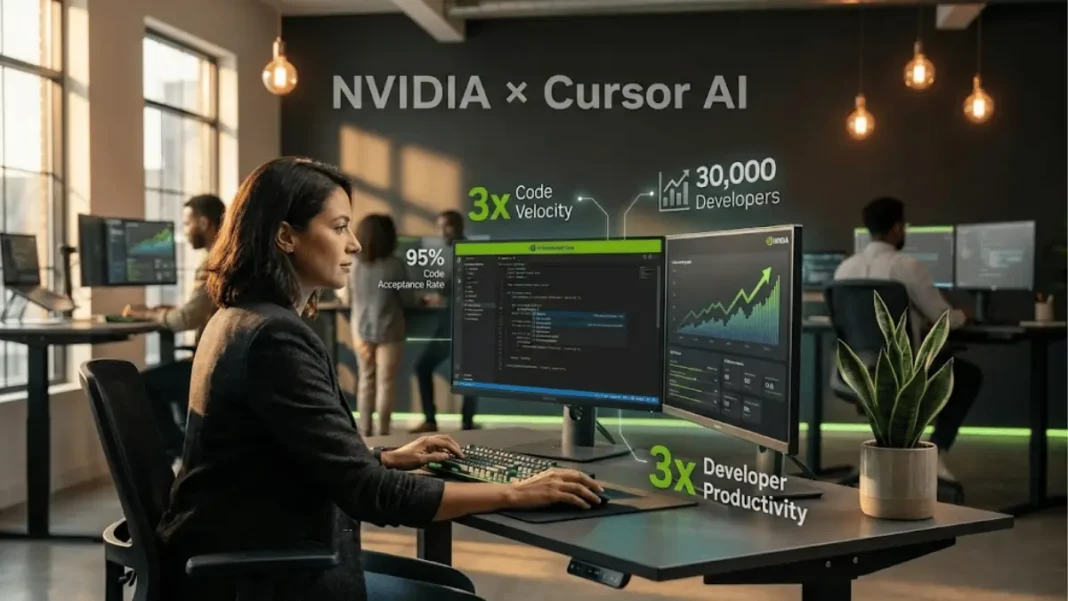
- 30,000 NVIDIA developers using Cursor AI daily achieved 3x increase in committed code volume
- Cursor automated entire software development lifecycle code generation, reviews, testing, and debugging
- Junior developers onboard faster while seniors bridge skill gaps across unfamiliar languages
- Bug rates remained flat despite tripled velocity, proving quality maintained at scale
NVIDIA dropped a productivity bombshell that redefines what AI coding assistants can achieve at enterprise scale. The world’s most valuable tech company deployed Cursor AI across its entire 30,000-developer workforce and measured results that sound impossible until you examine the methodology. This isn’t incremental improvement; it’s a structural shift in how software gets built.
What NVIDIA Actually Measured
NVIDIA tracked three metrics that matter: adoption, velocity, and quality. Over 30,000 engineers now use Cursor daily not as an optional tool but as core infrastructure. Developers using Cursor commit three times more code than their pre-AI baseline. Most revealing: bug rates stayed flat despite the tripled output, and code style consistency improved.
Wei Luo, VP of Engineering at NVIDIA, stated the impact directly: “Before Cursor, NVIDIA had other AI coding tools, both internally built and other external vendors. But after adopting Cursor is when we really started seeing significant increases in development velocity“.
Why Cursor Outperformed Previous Tools at NVIDIA
NVIDIA tested multiple AI coding assistants before Cursor both internal builds and external vendors. The difference came down to how Cursor handles massive, interconnected codebases. NVIDIA’s 30-year codebase history created systems where changes in one repository cascade through dozens of dependencies.
Fabian Theuring, Senior Software Architect at NVIDIA, explained: “Each of NVIDIA’s product lines has a complex codebase that is evolving quickly. It’s very hard for developers to stay on top of these changes and understand the entirety of the codebase. This is where Cursor really shines“.
What makes Cursor faster on large codebases:
- Semantic reasoning that maps entire repository structures and dependencies
- Context retrieval that pulls only relevant code sections, not entire files
- Agent intelligence that understands downstream effects of changes
From Code Generation to Full SDLC Automation
NVIDIA didn’t stop at using Cursor for writing code. The engineering leadership mandate was clear: embed AI in every phase of the software development lifecycle. As developers shipped faster, bottlenecks shifted to code review, testing, and debugging.
Cursor now handles:
- Code reviews: Automated analysis of pull requests with context-aware suggestions
- Test generation: Creating test cases based on code changes and edge case identification
- Bug resolution: Finding and fixing rare, persistent bugs that evade manual review
- Git workflow automation: Branch creation, commits, CI debugging, and issue tracking
Theuring’s team built custom rules in Cursor to automate the complete git flow. Luo’s team automated bug fixes from ticket context through implementation and test validation. The shift from individual productivity tool to program-level automation unlocked enterprise-scale impact.
How does Cursor automate debugging at NVIDIA?
Cursor excels at identifying and resolving rare, persistent bugs through agent-based workflows. The system pulls context from tickets and documentation using MCP servers, implements fixes, and runs validation tests automatically. This approach solves bugs that previously required senior engineer intervention.
Junior Developers Onboard Faster, Seniors Cross Skill Boundaries
NVIDIA measured acceleration in two developer segments. New hires now contribute to production codebases in dramatically shorter timeframes compared to pre-Cursor onboarding. The AI assistant answers questions about unfamiliar code and provides context without consuming senior engineer time.
Senior developers experienced a different benefit: skill gap bridging. Experienced backend engineers now tackle frontend tasks with confidence they lacked before. “Cursor allows developers to bridge their skill gaps and ramp in new areas faster,” Luo explained.
What This Means for Enterprise AI Adoption in 2026
NVIDIA’s results set a benchmark for AI coding assistant ROI. A 2025 Pragmatic Engineer survey showed 85% of developers use at least one AI tool in their workflow. NVIDIA’s deployment proves the difference between individual adoption and enterprise-wide transformation.
The customization layer separates experimental tools from production infrastructure. NVIDIA built custom rules, automated workflows, and integrated Cursor with existing systems like ticket tracking and CI/CD pipelines. This investment transformed Cursor from a productivity enhancer to a platform that eliminates entire categories of manual work.
| Metric | Pre-Cursor | With Cursor | Change |
|---|---|---|---|
| Active users | Limited adoption | 30,000 daily | Full deployment |
| Code commits per developer | Baseline | 3x baseline | +200% |
| Bug rate | Baseline | Flat | Maintained quality |
| Onboarding time | Standard | Compressed | Faster productivity |
Cursor vs GitHub Copilot: What NVIDIA Chose
The AI coding assistant market in 2026 features multiple players, with GitHub Copilot and Cursor as leading options. NVIDIA’s selection of Cursor over alternatives came down to performance on large, complex codebases. Cursor’s semantic reasoning and context retrieval outperformed on NVIDIA’s specific use case massive repositories with intricate dependencies.
GitHub Copilot focuses on inline code completion and suggestions. Cursor offers agent-based automation that handles multi-file edits, terminal commands, and workflow orchestration. For individual developers, both tools deliver value. For enterprises with legacy codebases and custom workflows, architectural differences matter.
Implementation Timeline and Rollout Strategy
NVIDIA set an engineering mandate in 2025 to leverage Cursor across the full SDLC. The February 2026 announcement represents deployment at scale 30,000 developers using the tool daily. This timeline suggests a phased rollout: pilot teams, measurement of results, custom rule development, and finally organization-wide adoption.
The VP of Engineering’s mission statement “embed AI in every step of the SDLC” indicates ongoing expansion beyond current capabilities. NVIDIA treats Cursor as infrastructure, not a point solution.
Limitations and Considerations
NVIDIA’s results reflect a specific environment: massive codebases, 30-year technical debt, highly skilled engineering teams, and investment in customization. Smaller teams or simpler codebases may not achieve 3x improvements. The customization effort building rules, automating workflows, integrating with existing tools requires dedicated resources.
AI coding assistants in 2026 still require human oversight. NVIDIA’s maintained bug rates prove quality control processes remain essential. The tool amplifies developer capability; it doesn’t replace developer judgment.
Frequently Asked Questions (FAQs)
How many NVIDIA developers use Cursor AI daily?
Over 30,000 NVIDIA developers use Cursor daily as of February 2026, making it one of the largest enterprise AI coding assistant deployments. The company implemented organization-wide adoption after measuring significant velocity improvements.
What is the exact productivity increase NVIDIA achieved with Cursor?
Developers using Cursor at NVIDIA commit three times more code than before adoption, representing a 200% increase in committed code volume. Bug rates stayed flat despite the tripled output, indicating quality maintained at scale.
Does Cursor AI work for large codebases like NVIDIA’s?
Cursor handles large, complex codebases through semantic reasoning that maps repository structures and retrieves only relevant context. NVIDIA’s 30-year codebase with interconnected dependencies presented an ideal test case for Cursor’s architectural approach.
How does Cursor automate code reviews and testing?
NVIDIA extended Cursor beyond code generation to automate code reviews, test case generation, and QA processes. Custom rules enable workflow automation from branch creation through CI debugging and issue tracking.
Can junior developers learn faster with Cursor AI?
NVIDIA reports compressed onboarding times for new hires using Cursor to understand unfamiliar codebases. The AI assistant provides context and answers questions without requiring senior engineer time.
What makes Cursor different from GitHub Copilot?
Cursor offers agent-based automation with multi-file editing and terminal command execution, while GitHub Copilot focuses on inline code completion. NVIDIA selected Cursor for its performance on massive repositories with complex dependencies.
Did code quality decrease with 3x faster development at NVIDIA?
Bug rates remained flat despite tripled coding velocity at NVIDIA, and code style consistency actually improved. The company measures both velocity and quality metrics to validate AI assistant impact.
How long did NVIDIA’s Cursor AI implementation take?
NVIDIA announced full deployment in February 2026 after setting an engineering mandate in 2025, suggesting approximately 12-15 months from decision to organization-wide adoption. The timeline included pilot testing, measurement, and custom rule development.

