

Key Takeaways
- Continuous AI uses natural language rules with AI reasoning to automate tasks requiring judgment, not just deterministic checks
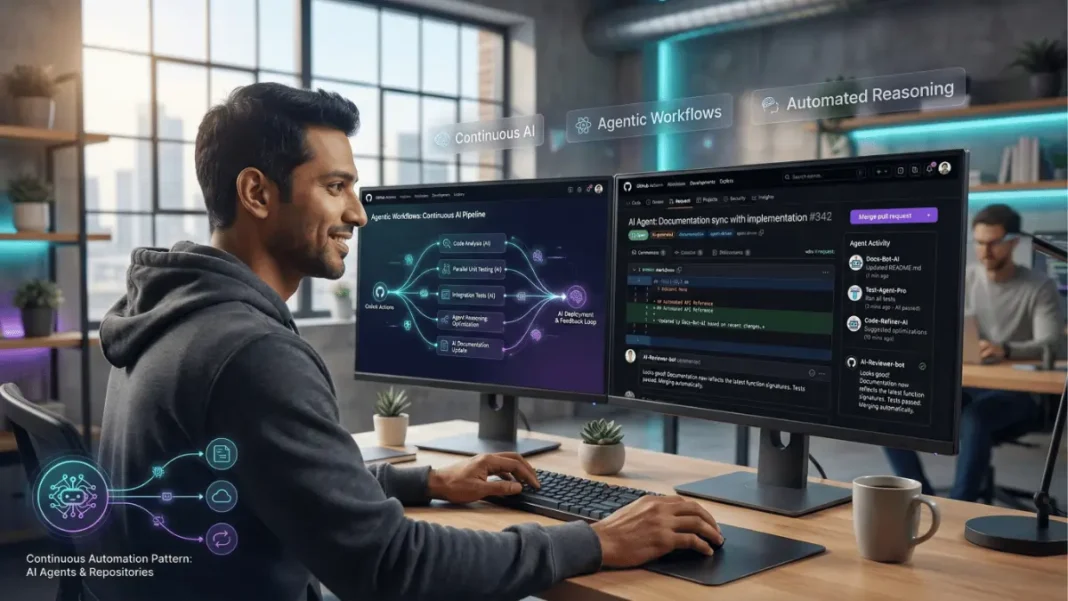
- GitHub Next’s pattern runs background agents in repositories via GitHub Actions with read-only permissions and Safe Outputs
- Developers can automate documentation drift detection, translation updates, dependency monitoring, and test coverage improvements today
- Agentic workflows produced 1,400+ tests across 45 days for approximately $80 in token costs in real-world testing
Software development teams waste countless hours on repetitive tasks that resist automation. Traditional continuous integration (CI) handles tests, builds, and linting anything following deterministic rules. But the hardest engineering work requires judgment: reviewing code context, maintaining documentation accuracy, tracking subtle regressions, and managing dependencies that change behavior without warning.
GitHub Next introduces Continuous AI, a pattern that extends automation beyond rules into reasoning. Published February 5, 2026, this approach deploys AI agents inside repositories to handle tasks CI was never designed for.
Why Traditional CI Reaches Its Limits
Continuous integration excels at binary outcomes. Tests pass or fail. Builds succeed or break. Linters flag violations against predefined rules. That works perfectly for deterministic automation.
But judgment-heavy problems escape CI’s reach. Consider a docstring contradicting its implementation, accessibility text that passes linting but confuses users, or a regex compiled inside a loop that tanks performance. These issues concern whether intent still holds something rules cannot capture.
“Any task that requires judgment goes beyond heuristics,” explains Idan Gazit, head of GitHub Next. “Any time something can’t be expressed as a rule or a flow chart is a place where AI becomes incredibly helpful“.
Traditional CI/CD follows predetermined scripts and static configurations. Continuous AI addresses the gap where correctness depends on interpretation, context, and understanding developer intent.
What Continuous AI Actually Means
Continuous AI is not a replacement product. Traditional CI remains essential. Instead, it represents a pattern for a different automation class.
The formula: Continuous AI = natural-language rules + agentic reasoning, executed continuously inside repositories.
In practice, developers express expectations in plain language, especially when those expectations cannot be reduced to heuristics. An AI agent evaluates the repository and produces reviewable artifacts: suggested patches, issues, discussions, or insights.
Developers collaborate with agents to refine intent, add constraints, and define acceptable outputs through iteration. Example workflows include:
- “Check whether documented behavior matches implementation, explain mismatches, and propose fixes”
- “Generate weekly reports summarizing project activity and emerging bug trends”
- “Flag performance regressions in critical code paths”
- “Detect semantic regressions in user flows”
“The first era of AI for code was about generation,” Idan notes. “The second era involves cognition and tackling cognitively heavy chores off developers”.
How does Continuous AI ensure safety in production environments?
Continuous AI implements Safe Outputs, a deterministic contract defining exactly what agents can do. Agents operate with read-only repository access by default and cannot create issues, open pull requests, or modify content unless explicitly permitted. Developers specify allowed artifacts and constraints when defining workflows. All activity is logged and auditable.
Safe Outputs: Guardrails That Prevent Agent Overreach
GitHub Next designed agentic workflows with safety as the foundational principle. By default, agents receive read-only repository access. They cannot create issues, open pull requests, or modify content without explicit permission.
Safe Outputs provides the deterministic contract. When defining workflows, developers specify exactly which artifacts agents may produce opening a pull request, filing an issue and under what constraints. Anything outside those boundaries is forbidden.
This model assumes agents can fail or behave unexpectedly. Outputs undergo sanitization, permissions are explicit, and all activity is logged and auditable. The blast radius stays deterministic. This isn’t “AI taking over development” it’s AI operating within guardrails developers explicitly define.
Natural Language Complements YAML, Doesn’t Replace It
When problems can be expressed deterministically, extending CI with more rules remains the right approach. YAML, schemas, and heuristics are correct tools for those jobs.
But many expectations lose meaning when reduced to rules. A requirement like “whenever documentation and code diverge, identify and fix it” cannot be expressed in regex or schema. It requires understanding semantics and intent. Natural-language instructions express that expectation clearly enough for agents to reason over.
“There’s a larger class of chores and tasks we can’t express in heuristics,” Idan explains.
Natural language doesn’t replace YAML it complements it. CI remains the foundation. Continuous AI expands automation into commands CI was never designed to cover.
7 Tasks Developers Can Automate Today With Continuous AI
GitHub Next tested these patterns in real repositories. These aren’t theoretical examples.
1. Fix Documentation-Code Mismatches Automatically
This is among the hardest problems for CI because it requires understanding intent. An agentic workflow can read a function’s docstring, compare it to the implementation, detect mismatches, suggest updates to code or documentation, and open a pull request.
“You don’t want to worry every time you ship code if the documentation is still right,” Idan says. “That wasn’t possible to automate before AI“.
2. Generate Project Reports With Reasoning
Maintainers and managers repeatedly answer the same questions: What changed yesterday? Are bugs trending up? Which codebase parts are most active? Agentic workflows generate recurring reports pulling from issues, pull requests, commits, and CI results, applying reasoning on top.
The value isn’t the report itself, it’s the synthesis across multiple data sources that would otherwise require manual analysis.
3. Keep Translations Current Continuously
Localized applications follow a predictable pattern: English content changes, translations fall behind, and teams batch work late in release cycles. An agent can detect when English text changes, regenerate translations for all languages, and open a single pull request containing updates.
The workflow becomes continuous, not episodic. Machine translations might not be perfect initially, but having draft translations ready for review makes engaging professional translators or community contributors easier.
4. Detect Dependency Drift and Undocumented Changes
Dependencies often change behavior without changing major versions. New flags appear, defaults shift, help output evolves. In one demonstration, an agent installed dependencies, inspected CLI help text, diffed it against previous days, found an undocumented flag, and filed an issue before maintainers noticed.
This requires semantic interpretation, not just diffs which is why classical CI cannot handle it.
5. Automated Test Coverage Improvement
In one experiment, test coverage went from approximately 5% to nearly 100% 1,400+ tests written across 45 days for about $80 worth of tokens. Because the agent produced small pull requests daily, developers reviewed changes incrementally.
6. Background Performance Optimization
Linters and analyzers don’t always catch performance pitfalls depending on understanding code intent. Example: compiling a regex inside a function call so it compiles on every invocation. An agent can recognize the inefficiency, rewrite code to pre-compile the regex, and open a pull request with explanation.
Small improvements add up, especially in frequently called code paths.
7. Automated Interaction Testing
One creative demonstration from GitHub Universe used agents to play a simple platformer game thousands of times to detect UX regressions. Strip away the game, and the pattern proves widely useful for onboarding flows, multi-step forms, retry loops, input validation, and accessibility patterns under interaction.
Agents can simulate user behavior at scale and compare variants.
What is the difference between Continuous AI and traditional CI/CD pipelines?
Traditional CI/CD handles deterministic tasks with binary outcomes tests pass or fail, builds succeed or break. Continuous AI handles judgment-heavy tasks requiring reasoning and context understanding, like detecting documentation drift or identifying semantic regressions. CI uses rules and heuristics; Continuous AI uses natural language instructions and agentic reasoning.
Building Your First Agentic Workflow
Developers don’t need new CI systems or separate infrastructure to try this. The GitHub Next prototype (gh-aw) uses a simple pattern.
Write a natural-language rule in a Markdown file. Example: “Analyze recent repository activity and create an upbeat daily status report. Provide an agentic task description to improve the project based on activity. Create an issue with the report”.
Compile it into an action using gh aw compile daily-team-status. This generates a GitHub Actions workflow. Review the YAML nothing is hidden. Push to your repository. The agentic workflow begins executing in response to repository events or on schedules you define, just like any other action.
The workflow operates transparently. All outputs are visible and reviewable. Developers retain full control. Agents don’t merge code or make autonomous commits they create the same artifacts developers would: pull requests, issues, comments, or discussions, depending on workflow permissions.
“The PR is the existing noun where developers expect to review work,” Idan explains. “It’s the checkpoint everyone rallies around“.
Emerging Patterns in Agentic Automation
Several trends are crystallizing as teams adopt these workflows.
Natural-language rules will become part of automation. Developers will write short English rules expressing intent: “Keep translations current,” “Flag performance regressions,” “Warn on unsafe auth patterns”.
Repositories will begin hosting fleets of small agents, not one general agent, but many small ones, each responsible for one chore, check, or rule of thumb.
Tests, documentation, localization, and cleanup will shift into continuous mode. This mirrors the early CI movement: not replacing developers, but changing when chores happen from “when someone remembers” to “every day”.
Debuggability will win over complexity. Developers will adopt agentic patterns that are transparent, auditable, and diff-based not opaque systems acting without visibility.
Agentic AI is transforming continuous integration pipelines by enabling autonomous systems where AI agents independently analyze code changes, assess risk, select optimal testing strategies, and execute comprehensive validation workflows without human intervention.
What This Means for Development Teams
“Custom agents for offline tasks, that’s what Continuous AI is,” Idan says. “Anything you couldn’t outsource before, you now can“.
More precisely: many judgment-heavy chores previously manual can now be made continuous. This requires a mental shift, similar to moving from owning files to streaming music. “You already had all the music,” Idan explains. “But suddenly the player is helping you discover more”.
Continuous AI isn’t an all-or-nothing paradigm. You don’t need to overhaul pipelines. Start with something small: translate strings, add missing tests, check for docstring drift, detect dependency changes, flag subtle performance issues.
Each represents something agents can meaningfully assist with today. Identify recurring judgment-heavy tasks that quietly drain attention, and make those tasks continuous instead of episodic.
Continuous AI operates at what industry experts call “Level 2 Continuous AI” AI handles routine analysis tasks with human oversight through GitHub issue review and prioritization. The synergy between GitHub Actions and GitHub Models forms the core of Continuous AI at GitHub, combined with LLM programming frameworks like GenAIScript, llm, or ell.
If CI automated rule-based work over the past decade, Continuous AI may do the same for select categories of judgment-based work when applied deliberately and safely.

Frequently Asked Questions (FAQs)
What is Continuous AI in software development?
Continuous AI is a pattern combining natural-language rules with agentic reasoning, executed continuously inside repositories. It automates judgment-heavy development tasks that traditional CI/CD cannot handle, such as documentation drift detection, semantic regression identification, and dependency behavior monitoring through AI agents running on GitHub Actions.
How does Continuous AI differ from continuous integration?
Continuous integration handles deterministic tasks with binary outcomes using predefined rules tests pass or fail, builds succeed or break. Continuous AI addresses tasks requiring reasoning, interpretation, and understanding of developer intent that cannot be expressed as rules or heuristics. CI remains essential; Continuous AI extends automation into new territory.
Is Continuous AI safe for production repositories?
Yes, when implemented with Safe Outputs. Agents operate with read-only repository access by default and cannot create issues or pull requests unless explicitly permitted. Developers define exactly which artifacts agents can produce and under what constraints. All activity is logged, auditable, and sanitized, creating a deterministic blast radius.
What tasks can Continuous AI automate today?
Developers can automate documentation-code mismatch detection, recurring project report generation, translation updates, dependency drift monitoring, test coverage improvement, performance optimization, and interaction testing. GitHub Next tested these patterns in real repositories with measurable results, including 1,400+ tests generated for approximately $80 in token costs.
How do I start using Continuous AI workflows?
Use GitHub Next’s gh-aw prototype. Write natural-language rules in Markdown files, compile them into GitHub Actions workflows, review the generated YAML, and push to your repository. Workflows execute on repository events or schedules you define. Start small with tasks like translation updates or docstring drift checking.
Do Continuous AI agents make autonomous code changes?
No. Agents create reviewable artifacts, pull requests, issues, comments, or discussions based on workflow permissions. They don’t merge code or make autonomous commits. Developers retain full control and review all suggested changes. The pull request serves as the checkpoint where teams review and approve agent-generated work.
What are agentic workflows in CI/CD?
Agentic workflows deploy specialized autonomous agents that independently analyze code changes, assess risk, select optimal strategies, and execute validation tasks without human intervention. Unlike static CI/CD pipelines following predetermined scripts, agentic systems use AI reasoning to handle context-dependent problems requiring judgment rather than deterministic rules.
How much does Continuous AI cost to operate?
In GitHub Next’s real-world testing, one experiment generated 1,400+ tests across 45 days for approximately $80 worth of LLM tokens. Costs depend on workflow complexity, execution frequency, and chosen language models. The pattern works with GitHub Actions and GitHub Models, leveraging existing infrastructure without requiring separate systems.

