

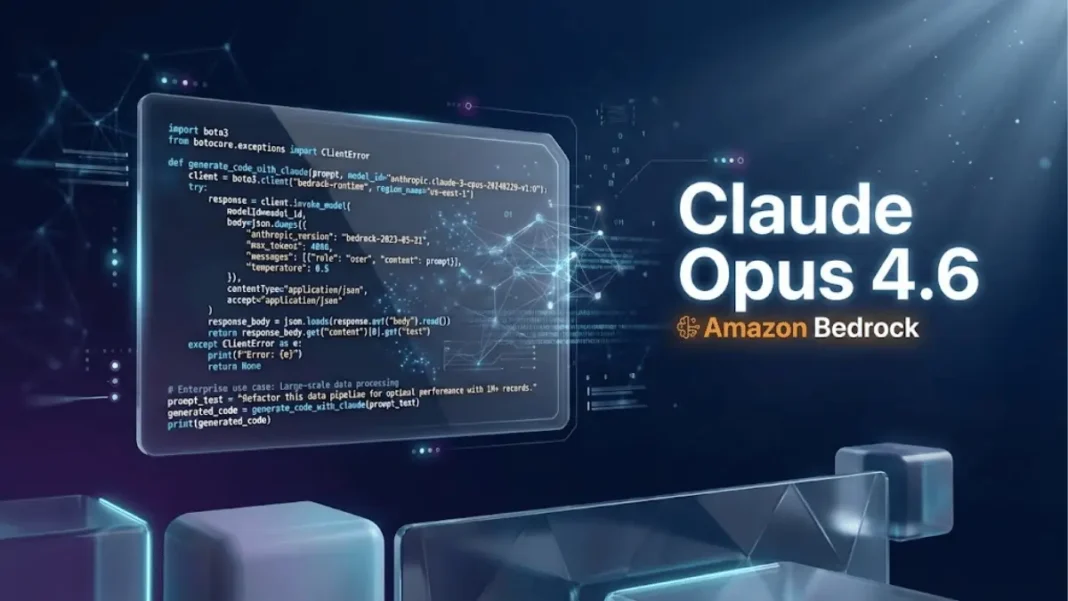
Quick Brief
- Claude Opus 4.6 launched February 5, 2026, with 1M token context window processing 750,000 words simultaneously
- Achieves 81.42% on SWE-bench Verified and leads all frontier models on Terminal-Bench 2.0 coding assessments
- Introduces Agent Teams enabling multiple AI agents to collaborate on complex enterprise workflows
- Available through Amazon Bedrock, Anthropic API, and Google Cloud Vertex AI at $5/$25 per million tokens
Anthropic has fundamentally redefined what AI can accomplish in production environments and Claude Opus 4.6 proves it. Amazon Web Services announced February 5, 2026, that Claude Opus 4.6 now operates on Amazon Bedrock, delivering autonomous coding capabilities that compress multi-day development projects into hours-long tasks. This marks the most significant leap in agentic AI capabilities for enterprise deployment, combining sustained task performance with unprecedented context understanding across massive codebases.
Claude Opus 4.6 Sets New Standards for Enterprise AI
Claude Opus 4.6 represents Anthropic’s most intelligent model to date, achieving world-leading performance on real-world software engineering benchmarks. The model scored 81.42% on SWE-bench Verified, a benchmark measuring performance on actual software engineering tasks averaged over 25 trials with prompt optimization. Opus 4.6 leads all frontier models on Terminal-Bench 2.0, which tests real-world coding scenarios requiring sustained reasoning and tool use.
The model also dominates Humanity’s Last Exam, a comprehensive assessment designed by experts to challenge the limits of AI reasoning, and outperforms GPT-5.2 by 144 Elo points on GDPval-AA, a rigorous benchmark measuring general problem-solving capability. These achievements position Opus 4.6 as the strongest coding and reasoning model available for enterprise deployment.
Kate Jensen, head of Growth and Revenue at Anthropic, emphasized the model’s breakthrough capability: “Claude models consistently set new standards in coding, advanced reasoning, and multi-step workflows while understanding full business contexts and delivering precise results”. The transformation enables senior engineers to delegate complex work with confidence and substantially less oversight than previous AI systems required.
What makes Claude Opus 4.6 different from previous models?
Claude Opus 4.6 improves on its predecessor’s coding skills through more careful planning, sustained performance on longer agentic tasks, and reliable operation within larger codebases. The model features enhanced code review and debugging capabilities to identify and correct its own mistakes before deployment. Opus 4.6 introduces a 1M token context window, a first for Anthropic’s Opus-class models enabling processing of extensive documents and large-scale codebases that previous versions couldn’t handle.
Seven Breakthrough Capabilities Transforming Enterprise Workflows
Autonomous Multi-Day Project Compression
Claude Opus 4.6 handles the full software development lifecycle from gathering requirements to implementation and ongoing maintenance. The model sustains focus across complex tasks spanning several hours of continuous work, dramatically expanding what AI agents can accomplish without human intervention. Sourcegraph reports the model demonstrates “substantial leap in software development staying on track longer, understanding problems more deeply, and providing more elegant code quality”.
Extended Context Window for Massive Codebases
The 1M token context window allows Opus 4.6 to process approximately 750,000 words or 3,000 pages of documentation simultaneously. This capacity enables the model to maintain relevant context across entire enterprise codebases, understanding interdependencies that shorter-context models miss. The extended window supports use cases requiring sophisticated reasoning and multi-step orchestration across thousands of files.
Agent Teams for Collaborative Workflows
Opus 4.6 introduces Agent Teams, allowing multiple Claude instances to collaborate on complex projects. Organizations can deploy specialized agents for different roles one for coding, another for testing, and a third for documentation all coordinating through a shared understanding. This distributed approach mirrors human development team structures while maintaining AI speed and consistency advantages.
Enhanced Debugging and Self-Correction
Opus 4.6 demonstrates superior code review capabilities, actively catching its own mistakes before execution. The model performs more surgical code edits with higher success rates, as reported by Augment Code, which designated Sonnet 4 as their top choice for primary model deployment. This self-correction mechanism reduces the debugging burden on development teams while maintaining code quality standards.
Enterprise-Grade Security on AWS Infrastructure
Amazon Bedrock provides enterprise-grade security, privacy, and responsible AI controls for Opus 4.6 deployments. All data and customizations remain within customer AWS accounts, ensuring full control and compliance with organizational security policies and industry regulations. Bedrock’s fully-managed service includes comprehensive built-in products for governance, privacy, observability, and compliance monitoring.
Advanced Tool Integration and Adaptive Thinking
Opus 4.6 supports advanced capabilities including tool search, tool use, and adaptive thinking that automatically adjusts reasoning depth based on query complexity. The model includes an effort parameter that balances performance with latency and cost, allowing developers to optimize resource allocation for specific use cases. New API capabilities include code execution tools, MCP connector integration, Files API access, and prompt caching for up to one hour.
Extended Output Capacity
Claude Opus 4.6 delivers up to 128,000 output tokens approximately 400 pages of text in a single response. This massive output capacity enables the model to generate complete codebases, comprehensive documentation sets, or detailed analysis reports without requiring multiple API calls or manual concatenation.
Real-World Impact Across Industries
Finance and Professional Services
Finance teams using Claude Opus 4.6 achieve better reasoning on complex analyses and cleaner first-pass deliverables. The model handles ambiguity and reasons about tradeoffs without constant hand-holding, making it ideal for comprehensive workflows across financial modeling, risk assessment, and compliance documentation.
Software Development Teams
GitHub selected Claude Sonnet 4 to power the new coding agent in GitHub Copilot, citing its performance in agentic scenarios. iGent reports Sonnet 4 excels at autonomous multi-feature app development with substantially improved problem-solving and codebase navigation, reducing navigation errors from 20% to near zero.
Long-Horizon Enterprise Projects
Claude Opus 4.6 functions as an expert virtual collaborator rather than simply generating content. The model maintains focus across projects requiring thousands of steps, preserving relevant context and delivering complete solutions from developing software systems to creating comprehensive marketing strategies.
Amazon Bedrock Advantage for Model Deployment
Amazon Bedrock offers significant advantages over standalone AI APIs for enterprise deployment. The platform provides access to diverse models from multiple providers through a single API across multiple global regions, delivering better resilience than services that have experienced notable outages.
| Feature | Amazon Bedrock | Standalone AI APIs |
|---|---|---|
| Model Diversity | Claude, Cohere, Jurassic, Llama, Mistral, Stable Diffusion, Titan | Limited to single vendor models |
| Scalability | AWS robust infrastructure with geographically distributed availability zones | Risk of single-point-of-failure |
| Security | Data remains in customer AWS accounts with full control | Variable security implementations |
| Integration | Deep AWS ecosystem integration with granular deployment control | Limited flexibility and customization |
| Fine-Tuned Models | Seamlessly imports models from SageMaker AI and other providers | Limited external model support |
Bedrock’s Converse API simplifies switching between different models with minimal application changes, enabling organizations to select optimized models for specific use cases and achieve better price-performance ratios.
Technical Specifications and Access
What is the Claude Opus 4.6 context window size?
Claude Opus 4.6 features a 1M token context window that processes approximately 750,000 words, enabling analysis of entire codebases or comprehensive document collections in a single inference call. The model also supports 128,000 output tokens for generating extensive responses.
How do I access Claude Opus 4.6 on Amazon Bedrock?
Claude Opus 4.6 is available immediately through the Amazon Bedrock API for all AWS customers. Developers access the model via the Anthropic API, AWS Bedrock, and Google Cloud’s Vertex AI platforms. Bedrock Studio provides a web interface that streamlines prototyping without writing integration code.
What are Claude Opus 4.6 pricing specifications?
Claude Opus 4.6 is priced at $5 per million input tokens and $25 per million output tokens. The effort parameter allows developers to balance performance requirements with latency and cost considerations based on specific use case demands. AWS Bedrock charges based on tokens processed, with volume discounts available for enterprise deployments.
Integration with Development Tools
Claude Opus 4.6 integrates seamlessly with modern development environments through Claude Code, which supports VS Code and JetBrains IDEs. The integration displays edits directly in files for seamless pair programming workflows. Background task support via GitHub Actions enables automated workflows without manual intervention.
Microsoft Office integration brings AI capabilities to Excel and PowerPoint, allowing users to analyze complex spreadsheets and create professional presentations within familiar tools. The Claude for Desktop application extends these capabilities across Mac and Windows systems with native performance.
Future Trajectory for Agentic AI
Anthropic indicates the latest Claude generation points toward AI systems becoming increasingly capable partners in creative and knowledge work. Agent Teams represent the first step toward AI systems that coordinate across specialized roles, mimicking human organizational structures while maintaining computational advantages.
Future iterations will take on specialized organizational roles including routine analysis, cross-department coordination, and complete workflow management with minimal oversight. The evolution from content generation to autonomous task completion represents a fundamental shift in how organizations deploy AI capabilities.
Implementation Considerations
Organizations deploying Claude Opus 4.6 should evaluate use cases requiring sophisticated reasoning and multi-step orchestration versus tasks suited for faster, lower-cost Sonnet models. The model excels at long-horizon projects where deep reasoning, precision, and reliability outweigh response speed considerations.
The adaptive thinking feature automatically adjusts computational effort based on query complexity, optimizing cost efficiency without requiring manual configuration. Developers can override this behavior using the effort parameter for use cases with specific performance requirements.
Safety alignments through constitutional AI ensure helpful, harmless, and honest responses while enhanced resistance to prompt injection strengthens alignment on sensitive tasks. These built-in guardrails maintain responsible AI practices across enterprise deployments.
Frequently Asked Questions (FAQs)
Is Claude Opus 4.6 better than GPT-5 for coding?
Claude Opus 4.6 achieved 81.42% on SWE-bench Verified and leads all frontier models on Terminal-Bench 2.0 coding assessments. The model outperforms GPT-5.2 by 144 Elo points on GDPval-AA, demonstrating superior problem-solving and reasoning capabilities.
Can Claude Opus 4.6 replace human developers?
Claude Opus 4.6 functions as an expert collaborator that handles complex tasks with less oversight, but senior engineers remain essential for strategic decisions, architecture design, and final quality validation. The model compresses development timelines rather than eliminating human expertise requirements.
What industries benefit most from Claude Opus 4.6?
Finance, cybersecurity, manufacturing, healthcare, and sales departments gain substantial value from Opus 4.6’s comprehensive workflow management. Software development teams, research organizations, and professional services handling long-horizon projects see immediate productivity improvements.
How does the 1M token context window work?
The 1M token context window processes approximately 750,000 words simultaneously, maintaining context across entire codebases or document collections. This enables the model to understand interdependencies and relationships that shorter-context models miss during complex analysis.
What safety measures does Claude Opus 4.6 include?
Anthropic implements constitutional AI for aligned responses, enhanced prompt injection resistance, and strengthened guardrails on sensitive tasks. Amazon Bedrock adds enterprise security controls including data governance, privacy tools, and compliance monitoring.
Will Claude Opus 4.6 work with my existing tools?
Claude Opus 4.6 integrates with VS Code, JetBrains, GitHub Actions, Microsoft Excel, Microsoft PowerPoint, and custom APIs. The MCP connector standardizes context exchange between AI assistants and software environments for seamless workflow integration.
How long can Claude Opus 4.6 work on a single task?
The model sustains focused effort for several hours continuously, working through thousands of steps on complex projects. This sustained performance dramatically outperforms previous models and significantly expands autonomous agent capabilities.
What are Agent Teams in Claude Opus 4.6?
Agent Teams allow multiple Claude instances to collaborate on complex projects with specialized roles. Organizations can deploy one agent for coding, another for testing, and a third for documentation all coordinating through shared understanding to complete enterprise workflows.

