

Key Takeaways
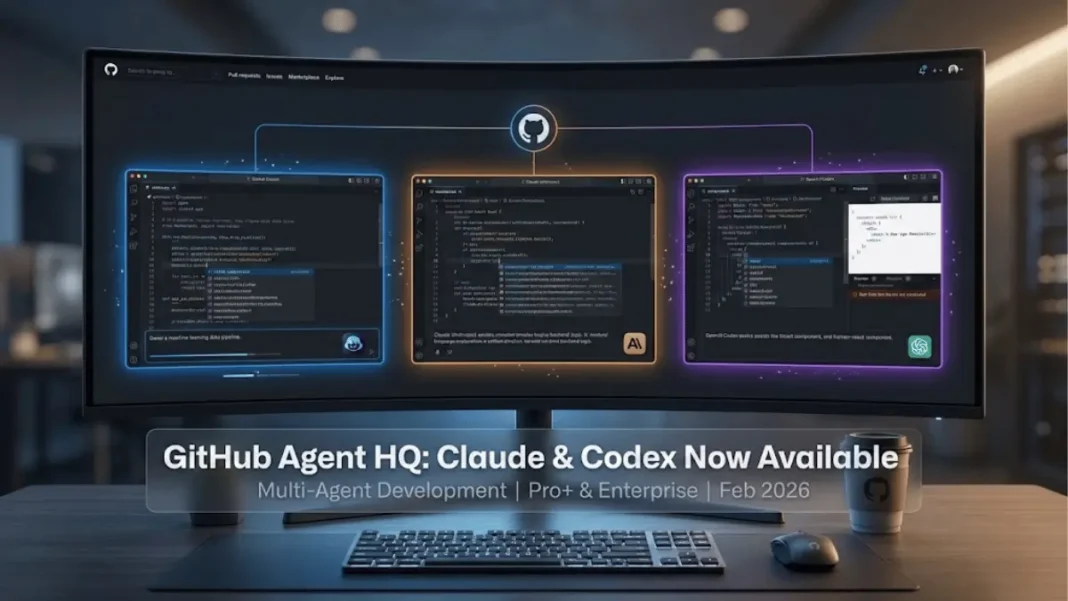
- Claude by Anthropic and OpenAI Codex launched in public preview February 4, 2026 on GitHub Agent HQ
- Available across GitHub.com, GitHub Mobile, and VS Code for Copilot Pro+ ($39/month) and Enterprise subscribers
- Developers can run multiple AI agents simultaneously on same tasks to compare implementation approaches
- Each agent session consumes one premium request from monthly allocation (1,500 for Pro+, 300 for Business)
GitHub Eliminates Context Switching for Developers
GitHub removed a persistent friction point in software development on February 4, 2026. Copilot Pro+ and Enterprise users gained access to Claude by Anthropic and OpenAI Codex through Agent HQ directly inside GitHub.com, GitHub Mobile, and Visual Studio Code. This integration centralizes coding agents where code already lives, collaboration happens, and decisions receive review before shipping.
Context switching between tools, documents, and prompt threads disrupts developer flow. Agent HQ addresses this by attaching AI agent sessions to repositories, issues, and pull requests rather than isolating them in external interfaces. Mario Rodriguez, GitHub’s Chief Product Officer, announced the expansion as part of GitHub’s multi-agent platform strategy.

How GitHub Agent HQ Multi-Agent Access Works
Platform Availability and Requirements
Copilot Pro+ subscribers ($39 monthly or $390 yearly) and Enterprise users activate Claude and Codex through repository settings. Both agents require explicit enablement before first use. GitHub imposes no additional fees beyond the subscription tier, but each agent session depletes one premium request from monthly quotas.
What is a premium request?
Premium requests measure consumption of advanced AI features like Chat, CLI, and autonomous agent sessions. Pro+ includes 1,500 monthly; Business tier provides 300 per user; Enterprise allocates 1,000 per user. Once exhausted, Pro+ users pay $0.04 per additional request.
VS Code users need version 1.109 or later to access the Agent Sessions view. GitHub Mobile support launched simultaneously, enabling mobile code review workflows with AI assistance.
Starting Agent Sessions
Developers initiate sessions three ways across GitHub’s ecosystem:
- Agents Tab: Open any repository’s Agents tab, enter a request, select Copilot/Claude/Codex via the interface icon, and submit
- Issue Assignment: Assign GitHub issues directly to @Copilot, @Claude, or @Codex; agents submit draft pull requests for review
- Pull Request Mentions: Tag agents in PR comments (@Copilot, @Claude, @Codex) to request specific changes or analysis
Sessions run asynchronously by default. Developers follow progress in real time or review completed work later through detailed execution logs explaining agent decisions and actions.
VS Code Integration Details
Visual Studio Code users access three session types through the Agent Sessions panel:
- Local sessions (Copilot, Claude, or Codex): Fast, interactive assistance within the editor environment
- Cloud sessions: Autonomous tasks delegated to GitHub’s infrastructure select any available agent
- Background sessions: Asynchronous local work (Copilot exclusive currently)
This architecture lets developers explore ideas locally, then escalate complex work to GitHub’s cloud agents without losing conversation context or file history.
Comparing Agent Approaches to Identical Problems
Agent HQ’s differentiator surfaces when assigning multiple agents to one task. Developers assign the same issue to Copilot, Claude, and Codex simultaneously, receiving three distinct implementation strategies.
Architectural Behavior Differences
Claude and Codex demonstrate contrasting execution philosophies shaped by their underlying models:
Claude Code (Anthropic) prioritizes maintainability. Before generating code, Claude asks clarifying questions, explains reasoning mid-task, and interrupts work to verify alignment with requirements. Katelyn Lesse, Anthropic’s Head of Platform, emphasized Claude’s reasoning power integrated where developers need it in repositories, commits, and pull request reviews.
OpenAI Codex optimizes for speed. Alexander Embiricos from OpenAI noted Codex powered the first GitHub Copilot iteration and now returns to GitHub directly. Codex starts tasks immediately with minimal clarification, works rapidly in cloud-isolated sandboxes, and produces functional code fast though often requiring more review cycles than Claude.
GitHub Copilot balances both approaches. Already familiar to 180 million developers using GitHub, Copilot leverages Microsoft’s Azure infrastructure and GitHub’s repository context to deliver rapid suggestions tuned to project conventions.
Strategic Review Workflows Enabled by Multi-Agent Architecture
GitHub designed Agent HQ outputs to integrate with existing code review processes. Agent-generated pull requests, comments, and code changes receive the same scrutiny as human contributions.
Specialized Review Patterns
Organizations deploy agents for targeted review types before human evaluation:
Architectural guardrails: Assign one agent to evaluate modularity, coupling, and potential side effects in proposed changes. This surfaces design issues before implementation hardens.
Edge case analysis: Deploy a second agent to hunt async pitfalls, race conditions, and scale assumptions that cause production failures. Agents systematically explore failure modes humans overlook under time pressure.
Minimal change validation: Use a third agent to propose the smallest backward-compatible implementation, reducing refactor blast radius. This agent acts as a constraint enforcer.
This pattern shifts senior developers from syntax review to strategic evaluation assessing tradeoffs agents surfaced rather than catching basic errors.
Enterprise Controls and Visibility
Agent HQ provides organization-wide governance unavailable in standalone AI coding tools.
Security and Policy Management
Enterprise administrators control agent access through centralized policies:
- Agent permissions: Define which agents (Copilot, Claude, Codex, custom) operate in specific repositories or across organizations
- Model restrictions: Limit teams to approved AI models for compliance with data residency or industry regulations
- Audit logging: Every agent action generates audit trails showing who invoked which agent, what code changed, and when
GitHub’s ZDNET coverage highlighted this differentiates Agent HQ from competitors enterprises gain AI acceleration without sacrificing compliance infrastructure.
Code Quality Integration
GitHub Code Quality (public preview) extends Copilot’s security scanning to maintainability and reliability analysis. Before agents submit pull requests, Code Quality evaluates long-term code health impact. This automated first-pass review addresses obvious issues before human developers see the PR, reducing review latency.
The Copilot metrics dashboard tracks agent usage patterns, acceptance rates, and productivity impact across teams. Organizations quantify ROI and identify which agents perform best for specific task types.
Agent HQ Limitations and Considerations
GitHub and partner companies acknowledge agent fallibility. Mario Rodriguez referenced Simon Willison’s February 3, 2025 essay emphasizing AI outputs require review rather than blind acceptance.
Current Constraints
- Premium request caps: Pro+ users exhausting 1,500 monthly requests face per-request charges; Business tier’s 300 requests may insufficient for heavy agent users
- Claude and Codex preview status: Both agents remain in public preview with potential reliability fluctuations and feature incompleteness
- VS Code version dependency: Agent Sessions require VS Code 1.109+; older versions incompatible
- GitHub Copilot CLI pending: Announced support for Copilot CLI remains unavailable at launch
Privacy and Data Handling
Claude Code and Codex transmit code to external APIs for processing. Anthropic and OpenAI maintain separate data handling policies organizations must evaluate against security requirements. GitHub states agent interactions follow existing Copilot privacy terms Enterprise tier data never trains models.
Roadmap: Additional Agents Joining Platform
GitHub confirmed partnerships with Google, Cognition (Devin), and xAI to expand Agent HQ’s ecosystem. Claude and Codex access will extend beyond Pro+ and Enterprise to lower subscription tiers in coming months.
Alexander Embiricos stated OpenAI views GitHub integration as extending Codex to millions more developers where they already work repositories and VS Code. Anthropic’s Katelyn Lesse emphasized Claude’s repository-native positioning enables teams to iterate faster with confidence.
Microsoft announced Agent Framework integration on January 27, 2026, allowing developers to build custom agents leveraging GitHub Copilot SDK alongside Azure OpenAI and other providers. This enables hybrid workflows combining GitHub-native agents with organization-specific AI systems.
Comparison: Agent HQ vs Standalone AI Coding Tools
| Feature | GitHub Agent HQ | Cursor AI | Windsurf | Amazon Q Developer |
|---|---|---|---|---|
| Multi-agent support | Yes (Copilot, Claude, Codex, custom) | Single agent | Single agent | Single agent |
| GitHub integration | Native | Plugin-based | Plugin-based | Separate platform |
| Enterprise audit logs | Yes | Limited | Yes | Yes (AWS-focused) |
| Context preservation | Repository-attached | Editor session | Editor session | AWS service context |
| Starting price | $10/month (Pro) | $20/month | $15/month | $19/month |
| Premium requests (base) | 300/month | Unlimited completions | Varies | 50 agentic/month |
GitHub’s advantage lies in native repository integration and multi-agent comparison capabilities. Standalone tools like Cursor and Windsurf offer faster iteration within IDEs but lack GitHub’s collaboration layer and agent diversity.
Getting Started: Activation Steps
For Copilot Pro+ Users
- Navigate to GitHub Copilot settings at github.com/settings/copilot
- Scroll to “Third-party coding agents” section
- Enable Claude and/or Codex toggles
- Open any repository where you have write access
- Click the “Agents” tab in repository navigation
- Select your agent and submit your first request
For Enterprise Administrators
- Access organization settings: github.com/organizations/[org-name]/settings/copilot
- Configure agent policies under “Agent access management”
- Define repository-level permissions for Claude and Codex
- Enable Code Quality and audit logging for agent activity
- Communicate changes to development teams with usage guidelines
Frequently Asked Questions (FAQs)
How much does GitHub Agent HQ cost?
Agent HQ access requires GitHub Copilot Pro+ ($39/month or $390/year), Business ($19/user/month), or Enterprise ($39/user/month) subscriptions. No additional fees apply, but each agent session consumes one premium request from your monthly allocation.
Can I use Claude and Codex without Copilot Pro+?
Not currently. Claude and Codex access launches exclusively for Pro+ and Enterprise tiers in February 2026. GitHub confirmed expansion to lower tiers in future months without specifying dates.
Do agents run locally or in the cloud?
Sessions can run either way depending on configuration. VS Code local sessions execute on your machine; cloud sessions run in GitHub’s sandboxed infrastructure. All sessions transmit code context to provider APIs (Anthropic, OpenAI, GitHub) for processing.
Which agent approach best fits different use cases?
Claude prioritizes maintainability with detailed explanations and clarifying questions before coding. Codex optimizes for rapid code generation with minimal clarification. GitHub Copilot balances both approaches using repository context and project conventions. Organizations can assign identical tasks to multiple agents simultaneously to compare implementation strategies.
Can I assign multiple agents to one issue simultaneously?
Yes. Assign issues to @Copilot, @Claude, and @Codex concurrently to compare implementation approaches. Each generates separate draft pull requests for review.
Does agent-generated code count toward GitHub contributions?
Agent commits appear in repository history attributed to the agent account (@Copilot, @Claude, @Codex). The developer who assigned the task remains the PR author and receives credit for review and merge decisions.
What happens if I exceed premium request limits?
Pro+ users exceeding 1,500 monthly requests pay $0.04 per additional request. Business and Enterprise tiers must contact GitHub sales for quota increases no automatic overage charges.
Are agent conversations private within organizations?
Yes, with caveats. Enterprise tier data never trains AI models. However, code context transmits to third-party APIs (Anthropic for Claude, OpenAI for Codex). Review each provider’s privacy policy and configure enterprise data residency settings accordingly.

