

Key Takeaways
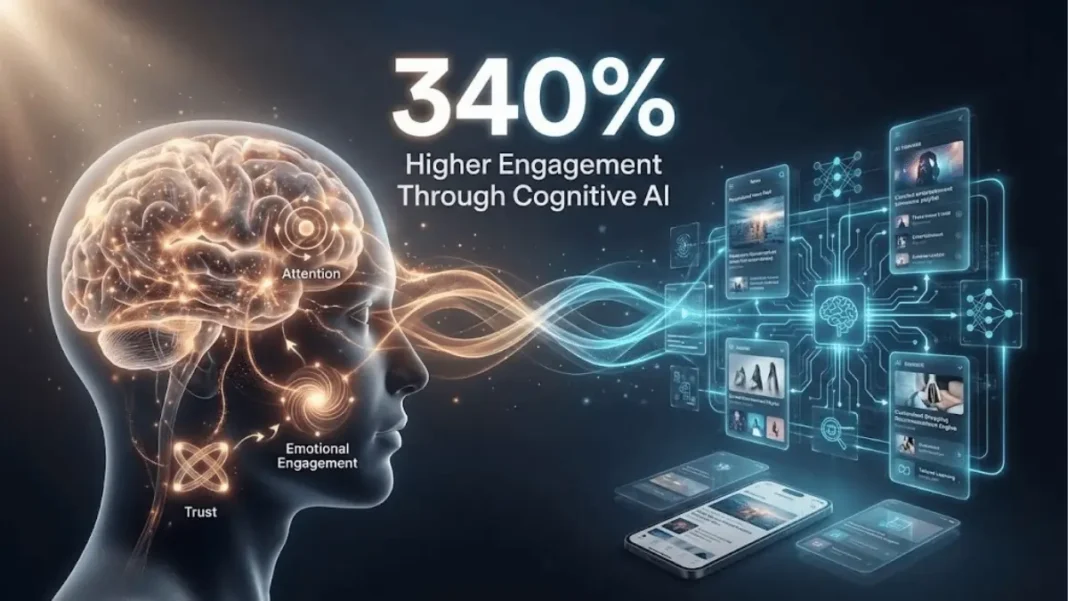
- Agentic AI systems using cognitive psychology principles achieve 340% higher click-through rates than click-based models
- Attention span modeling (average 32.4 seconds per item) outperforms traditional engagement metrics for personalization
- Trust-building through transparency shows strong positive correlation (path coefficient β = 0.471) with consumer acceptance
- Emotional engagement via AI-generated content creates deeper user connections through novelty effect and mere exposure principles
Agentic AI has shifted from reactive automation to cognitive personalization and the psychological frameworks driving this transformation determine which systems users trust and which they abandon. The convergence of cognitive science and agentic AI creates measurable engagement gains when applied correctly, with research showing attention-based personalization outperforms click-based models by 340%. Understanding these psychological mechanisms separates effective personalization from superficial recommendation systems.
Understanding Agentic AI Through Cognitive Architecture
Agentic AI systems operate through autonomous decision-making, goal-oriented behavior, and adaptive learning capabilities that mirror human cognitive processes. Unlike traditional AI responding to direct commands, these systems actively engage with their environment using cognitive architectures comprising perception (data gathering), reasoning (analysis via large language models), and action execution. Research from 2025 shows students’ perceived agency of AI significantly predicts usefulness, ease of use, and autonomy support, with ease of use enhancing AI-enabled self-efficacy. The cognitive substrate shift occurring in 2026 represents an architectural transformation in human-AI symbiosis rather than a simple upgrade cycle.
What defines agentic AI’s cognitive capabilities?
Agentic AI demonstrates goal-directed autonomy through continuous environment evaluation and strategic action selection. These systems maintain internal state representations and project future conditions to evaluate action sequences. Behavior models capture decision-making patterns, action selection, and goal-oriented responses using techniques from reinforcement learning, planning algorithms, and cognitive architecture.

Applying Behavioral Psychology Principles to AI Personalization
Attention Span Optimization
Attention span modeling delivers substantial personalization improvements over traditional metrics. Users spend an average of 32.4 seconds interacting per item when attention span drives recommendations. Experiments comparing attention-based recommendations against click-based models revealed 5.88% average CTR versus 1.73% CTR, a 340% performance increase validating attention span as a valuable personalization feature. Agentic AI systems detect text density patterns and user-triggered events to calculate engagement duration, filtering non-human traffic for accurate behavioral signals.
Mobile content must account for scarce attention environments where messages are short and dynamic. Attention travels from one message to another within platforms, creating informational impulses that renew attention cycles. This characteristic sustains user engagement once initial platform access occurs through notifications, extending dwell time significantly.
Trust-Building Through Transparency
Trust in AI systems depends on reliability, accuracy, security, and algorithmic transparency. Privacy and ethical concerns exert significant positive effects on consumer trust (path coefficient β = 0.471, t = 10.780) according to 2025 structural equation modeling research. Proactive communication, accountability, and user control mechanisms build trust by reducing uncertainty and increasing perceived fairness. Consumers desire explanations for AI-generated outcomes to make informed choices and maintain control.
A 2019 qualitative study of 50 consumers interacting with AI-powered chatbots identified perceived fairness, accountability, and transparency as key trust determinants. Authenticity of AI perceived human-aligned, trustworthy behavior proves central to building customer engagement. Agentic AI systems that support autonomy significantly impact self-learning motivation, driving positive self-learning behavior.
How does transparency affect AI personalization acceptance?
Algorithmic transparency enhances trust by reducing uncertainty in decision-making processes. AI-driven personalization awareness positively influences consumer trust (path coefficient β = 0.113, t = 2.467) and purchase behavior. Explainable AI reduces psychological barriers, routinely drawing deeper unfiltered accounts from users compared to opaque systems.
Emotional Resonance and Novelty Effect
Generative AI’s ability to evoke emotions ties directly to mimicking human-like creativity and expression. When users feel emotionally connected to AI-generated content, they spend more time interacting, share content with others, and return for future experiences. The novelty effect individuals’ attraction to new experiences over familiar ones sustains user interest through continuously produced novel content.
Personalization enhances engagement when AI-generated content aligns with individual preferences, interests, and needs. The mere exposure effect suggests people develop preferences for familiar things, allowing AI to balance novelty with relevance by creating content resonating with existing preferences while introducing new elements. Research from 2020-2024 demonstrates agentic AI enables hyper-personalized experiences that facilitate emotional connections through this psychological balance.
Cognitive Engagement Strategies for Content Delivery
Multi-Behavior Pattern Recognition
Psychology-aware recommendation systems incorporate personality information centered on user behavior patterns. Users showing similar behavior prefer similar content, with experimental results showing 21% performance gains over existing baseline systems when identifying the right behavioral information. Multi-behavior recommendation algorithms leverage auxiliary user behaviors to enhance predictions for target behaviors, overcoming performance limitations from data sparsity.
Agentic AI systems employ intent recognition using natural language processing and machine learning to analyze user inputs text, speech, or commands determining underlying goals. This enables systems to interpret context, extract meaning beyond keywords, and tailor actions to user needs rather than reacting to surface-level commands.
Reinforcement Learning for Adaptive Personalization
Reinforcement learning enables autonomous agents to learn optimal behaviors through continuous environment interaction. Agents receive feedback as rewards or penalties based on actions, allowing iterative decision-making improvement and strategy adaptation. Unlike traditional AI relying on static datasets and predefined rules, reinforcement learning empowers agentic systems to handle uncertainty, balance exploration and exploitation, and optimize for long-term goals.
Continuous learning and feedback loops allow agents to refine decisions and improve over time. This approach handles multi-step problems and delivers context-aware, goal-driven automation across diverse applications.
How does reinforcement learning improve content personalization?
Reinforcement learning optimizes personalization by adapting strategies based on user feedback rewards. Systems dynamically balance trying new content recommendations (exploration) with refining known successful strategies (exploitation). This creates increasingly accurate personalization that accounts for changing user preferences and contextual factors over extended interaction periods.
Real-World Implementation Framework
Cognitive State Profiling
Advanced systems introduce dual-granularity cognitive diagnosis modules capturing learner representations at coarse and fine granularities. This achieves comprehensive construction of users’ cognitive states, enabling accurate diagnosis and divergent task optimization. Cross-behavior profiling jointly models dynamic preferences from temporal interleaved learning behaviors, achieving semantic alignment between tasks.
Triple-stage distillation mechanisms exploit cognitive state features as prior knowledge, enhancing recommendations by profiling users’ preferences at deeper levels. Coarse-to-fine dynamic uplift modeling frameworks utilize offline features for long-term preference modeling alongside online real-time contextual features for immediate interest modeling.
Ethical Considerations and Risk Mitigation
Key risks associated with agentic AI include model drift, hallucinations, and memory poisoning. Risk mitigation strategies involve regular audits, strict access controls, and maintaining human-in-the-loop oversight. Balancing personalization with ethical transparency and data protection proves critical for gaining consumer trust without alienating audiences.
Agentic AI systems require robust ethical frameworks as foundational components. While behaviorists argue AI follows complex patterns based on pre-programmed reinforcement rather than acting independently, this raises questions about genuine autonomy versus training limitations.
Measuring Cognitive Personalization Success
Engagement Metrics Beyond Clicks
AI-driven personalization significantly enhances cognitive engagement by increasing relevance and reducing information overload. Emotional engagement strengthens through heightened enjoyment, satisfaction, and trust, while behavioral engagement improves via elevated click-through rates, purchase intentions, and loyalty behaviors. Social engagement expands through community participation and network effects amplified by personalized content flows.
Satisfaction and experience metrics exert significant positive effects on consumer trust (path coefficient β = 0.123, t = 2.408) according to path analysis research. Dwell time exceeding 90 seconds and scroll depth above 75% indicate successful cognitive engagement with personalized content.
User Self-Efficacy and Autonomy
Self-efficacy and autonomy support significantly impact self-learning motivation, driving positive self-learning behavior in AI interactions. Technology Acceptance Model, Social Cognitive Theory, and Self-Determination Theory provide integrated frameworks for understanding motivational and behavioral processes underlying AI adoption. Perceived agency of AI significantly predicts usefulness (correlation with ease of use), with ease of use enhancing AI-enabled self-efficacy directly.
What metrics indicate successful cognitive personalization?
Successful cognitive personalization shows attention span above 30 seconds per item, CTR improvements of 200%+ over non-personalized baselines, and trust correlation coefficients above β = 0.4 in path analysis. Emotional engagement manifests in sharing behaviors, return visit frequency, and extended session durations exceeding platform averages.

Frequently Asked Questions (FAQs)
What is agentic AI in content personalization?
Agentic AI refers to autonomous artificial intelligence systems that independently analyze challenges, develop strategies, and make decisions to achieve personalized content delivery goals. Unlike traditional AI requiring direct commands, agentic systems actively engage with user environments and adapt to changing preferences over time.
How does cognitive psychology improve AI personalization?
Cognitive psychology principles like attention span modeling, novelty effect, and mere exposure effect increase personalization effectiveness by 340% in CTR metrics. These frameworks help AI systems understand human decision-making patterns, emotional triggers, and trust-building mechanisms for deeper engagement.
What role does trust play in AI personalization acceptance?
Trust determines AI personalization adoption, with privacy concerns and transparency showing strong positive correlation (path coefficient β = 0.471) with consumer trust. Perceived fairness, accountability, and algorithmic explainability serve as key trust determinants in AI interactions.
Can attention span metrics replace click-based personalization?
Attention span modeling outperforms click-based personalization with 5.88% CTR versus 1.73% CTR, representing 340% improvement. Users spend an average 32.4 seconds per item when attention drives recommendations, providing richer behavioral signals than binary click data.
How do agentic AI systems learn user preferences?
Agentic AI employs reinforcement learning, receiving feedback rewards or penalties to iteratively improve decision-making. Systems maintain internal state representations, project future conditions, and balance exploration of new options with exploitation of known successful strategies.
What are the main risks of cognitive AI personalization?
Key risks include model drift, AI hallucinations, memory poisoning, and privacy violations. Mitigation requires regular audits, strict access controls, human-in-the-loop oversight, and ethical transparency frameworks to balance personalization with data protection.
How does emotional engagement differ from cognitive engagement?
Cognitive engagement involves relevance perception and information processing efficiency, while emotional engagement encompasses enjoyment, satisfaction, and trust feelings. AI-driven personalization significantly enhances both through tailored content that reduces overload while creating meaningful connections.
What psychological principles drive AI content recommendations?
Core principles include novelty effect (attraction to new experiences), mere exposure effect (preference for familiar patterns), attention span optimization, trust through transparency, and emotional resonance via human-like creativity. These create balanced personalization mixing familiarity with discovery.
Last Updated: February 2, 2026

